

What if the difference between a plan that barely covers the basics and one that truly supports your independence isn't your diagnosis, but the way your story is told on paper? Many Perth families feel a heavy sense of anxiety when an NDIS planning meeting approaches, often fearing that insufficient evidence will lead to funding cuts that impact their quality of life. It's a common concern, especially when you're trying to find local providers who truly understand the complexities of your daily routine. This guide explains how professional allied health assessments for NDIS act as a clinical voice for your needs, ensuring your reports accurately reflect your challenges to secure the funding and support required for independent living in Western Australia.
We understand that the system can feel overwhelming, but having the right evidence makes all the difference. This article provides a clear roadmap of the required assessments and explains how the 2026-27 pricing schedule reflects a shift towards more specific, unbundled professional reporting. You'll learn the vital distinction between clinical nursing and allied health services, helping you organise the right team for your needs. We'll give you the tools to approach your next planning meeting with confidence, knowing your professional reports represent your life with the clinical authority and human detail the NDIA requires.
Key Takeaways
- Understand how professional evaluations translate your daily functional capacity into the clinical evidence required for NDIS plan approvals and reassessments.
- Learn the vital distinction between a Functional Capacity Assessment and specialist nursing assessments to ensure you request the right evidence for complex clinical needs.
- Discover why nurse-led allied health assessments for NDIS provide a higher standard of clinical oversight for Perth participants who require detailed risk identification.
- Gain practical strategies for preparing for your appointment, including how to maintain a support diary that accurately captures your lived experience.
- Identify the benefits of choosing a local provider that combines professional clinical expertise with a deep understanding of the Western Australian support landscape.
What are Allied Health Assessments for NDIS and Why Do They Matter?
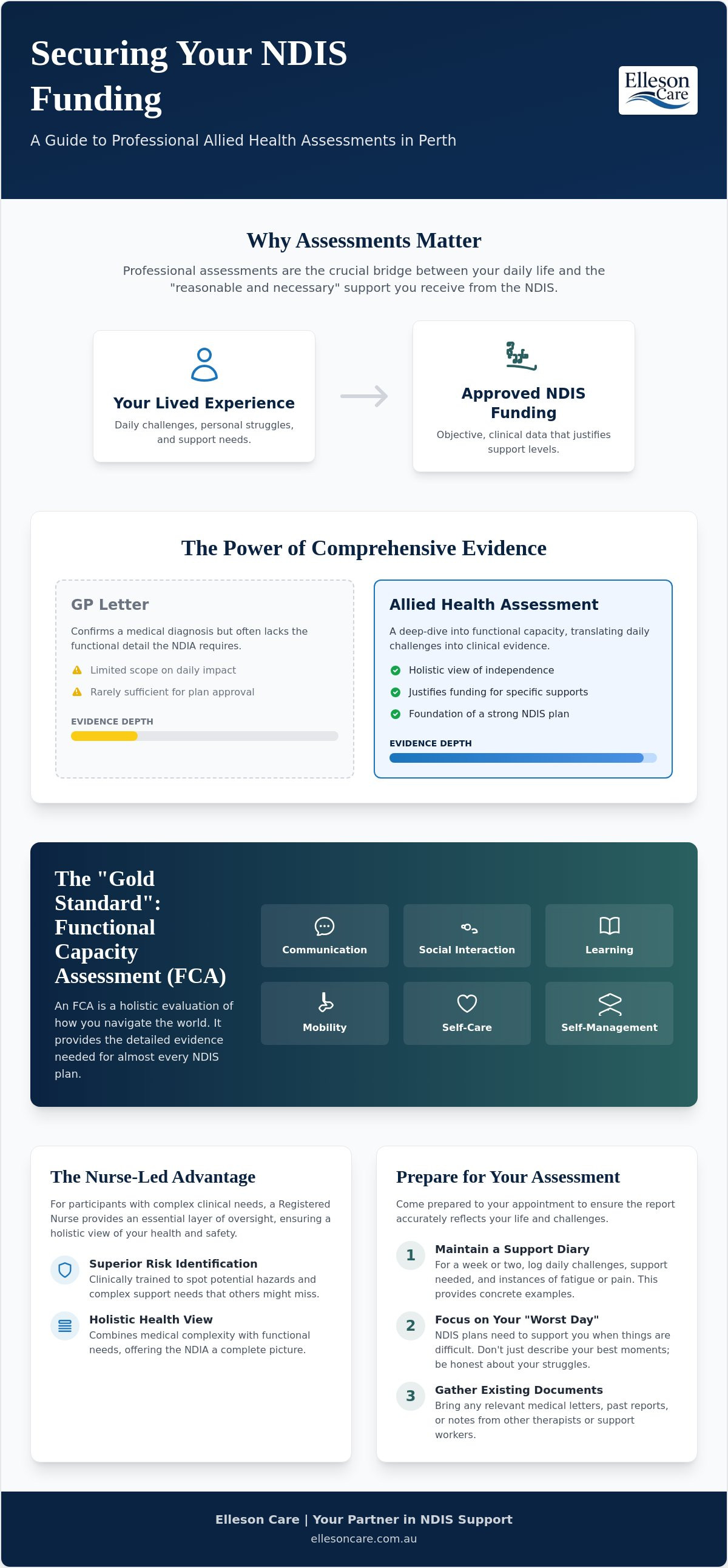
Professional allied health assessments for NDIS are essentially the bridge between your daily lived experience and the formal support you receive through your plan. At their core, these are comprehensive evaluations conducted by clinicians to determine your functional capacity. This means looking closely at how you manage everyday tasks like personal care, preparing meals, or moving safely within your Perth community. These assessments aren't merely administrative hurdles; they are the foundation of your support structure, ensuring that your funding aligns with your actual physical and clinical needs.
For many Western Australian families, these reports serve as the primary evidence during NDIS planning or reassessment meetings. Without a professional report, the NDIA may not have a clear or accurate picture of your daily challenges. High-quality allied health assessments for NDIS transform personal struggles into objective clinical data. This clarity often reveals hidden gaps in care that might be contributing to carer burnout, ensuring that the entire family unit receives the stability and assistance required for a sustainable lifestyle.
The Link Between Evidence and Funding
The NDIA operates under the strict principle of providing "reasonable and necessary" support. To meet this criteria, a simple letter from a GP is rarely sufficient. While your doctor understands your medical history, an allied health professional provides a deep dive into your functional reality. They document exactly how your disability impacts your independence. It is vital to capture your "worst day" during these evaluations. If a report only reflects your best moments, you risk receiving a plan that lacks the safety margins needed for when things become difficult. Comprehensive clinical evidence is your most effective tool for justifying the funding levels required to maintain your safety and dignity.
Who Performs These Assessments?
A range of qualified clinicians can conduct these evaluations, depending on your specific goals and challenges. You might find yourself asking, What are Allied Health Professionals? In the NDIS context, this group typically includes Occupational Therapists, Physiotherapists, and Speech Pathologists.
For participants with complex clinical requirements, the involvement of a Registered Nurse is often essential. Choosing a provider with deep experience in complex care ensures that every risk factor is identified. We find that a nurse-led approach to care provides a unique advantage. This model ensures that medical complexities and functional needs are assessed together, offering a holistic view of your health that standard assessments might overlook. This professional oversight is particularly valuable for Perth families navigating high-intensity support needs.
Core Types of NDIS Assessments for Complex Needs
Families in Western Australia often find themselves at a crossroads when determining which reports will best support their loved one's future. While various allied health assessments for NDIS exist, choosing the right combination is essential for capturing the full scope of a participant's life. These evaluations are not just boxes to tick; they are professional narratives that advocate for your safety and independence. Selecting the correct assessment type ensures that the evidence provided to the NDIA is both relevant and robust.
Functional Capacity Assessments (FCA)
The Functional Capacity Assessment is widely considered the "gold standard" for NDIS evidence. Unlike a standard medical check-up that might focus on a single symptom, an FCA is a holistic deep-dive into how you navigate the world. It examines six key areas: communication, social interaction, learning, mobility, self-care, and self-management. A high-quality report provides the foundation for almost every plan because it translates clinical observations into a clear picture of needed support hours. This level of detail ensures that the NDIA understands the intensity of support required to maintain a participant's quality of life. When these reports align with the official NDIS guide to assessment reports, they carry significant weight in planning meetings.
Specialised Clinical and Nursing Assessments
For those with complex medical needs, a standard functional assessment may not capture the full risk profile. This is where specialist nursing assessments become vital. If a participant requires ventilator support, complex wound management, or enteral feeding, a Registered Nurse must conduct the evaluation. These clinical reports are the primary evidence used to justify "High Intensity Daily Personal Activities" funding. By linking these specific clinical needs to nursing services in Perth, families can ensure that their clinical care is both safe and professionally supervised. These assessments bridge the gap between disability support and clinical health requirements.
Home Modifications and Assistive Technology
Independence often relies on the physical environment. Home modification assessments evaluate your living space to recommend structural changes, such as ramps or accessible bathrooms, that reduce risk. Similarly, Assistive Technology (AT) assessments justify the need for specialised equipment like powered wheelchairs or communication devices. Each of these allied health assessments for NDIS plays a specific role in building a life of dignity. These reports provide the technical justification needed for high-cost items that can significantly change a person's daily experience. If you feel uncertain about which path to take, speaking with a professional support team can help clarify your requirements.
Bridging the Gap: Why Nurse-Led Assessments are Vital in Perth
A common misconception persists that the NDIS solely funds non-medical supports like social participation or domestic assistance. This often leaves Perth families feeling stranded when their loved one requires high-level clinical oversight. Professional allied health assessments for NDIS are designed to bridge this exact gap. By integrating clinical nursing expertise into the assessment process, we ensure that medical risks are formally recognised as essential components of a participant's functional capacity. Clinical needs are, in every practical sense, functional needs that dictate how a person lives their life.
Choosing a WA-owned provider brings a distinct advantage to this process. We understand the specific nuances of the Perth healthcare landscape, from the discharge protocols of local hospitals to the availability of community-based specialists. This local knowledge allows for a more seamless integration of services, particularly when a plan needs to include palliative care or complex wound management. While palliative care is often associated with hospital settings, the NDIS can provide the necessary functional supports to ensure a participant remains comfortable and supported at home. These aren't just medical issues; they are daily realities that dictate how much support a person needs to remain safe.
Choosing a nurse-led approach for your allied health assessments for NDIS provides a critical safety net. Standard evaluations often focus on physical mobility or speech, but they can overlook the subtle clinical indicators of health decline. A nurse-led assessment identifies these risks early. Whether it's monitoring skin integrity for pressure sores or assessing respiratory stability, clinical nursing expertise provides a layer of protection that standard assessments might miss. This proactive approach ensures that your NDIS plan isn't just about getting through the day, but about preventing hospital readmissions and maintaining long-term wellness.
The Holistic Family Approach
Disability never exists in a vacuum. It affects the entire family unit, often placing immense pressure on primary carers who manage complex needs around the clock. Elleson Care prioritises dignity and person-centred goals in every clinical report, ensuring the participant’s voice remains central. Having a Registered Nurse oversee the assessment process provides families with genuine peace of mind. It ensures the home environment is clinically safe while respecting the personal sanctuary of the individual and their loved ones.
Navigating Complex Clinical Needs
For participants requiring specialised care, the clinical evidence must be precise. A professional assessment justifies the need for high-intensity support by documenting the specific risks involved, including:
- Ventilator and oxygen therapy management
- Complex catheter and bowel care
- Tracheostomy care and management
- Subcutaneous injections and medication oversight
This documentation is vital during the transition from hospital to home. We provide the technical evidence to ensure clinical safety is maintained, securing the funding required for a successful and sustainable return to the Perth community. By clearly outlining the level of skill required from support workers, we help create a care environment that is both safe and empowering.
Step-by-Step: Preparing for Your Allied Health Assessment
Preparing for professional allied health assessments for NDIS doesn't have to be a source of stress. Think of this process as a collaborative effort to ensure your voice is heard by the NDIA. You're the primary expert on your own life, and the clinician is there to translate your lived experiences into the specific clinical language the system requires. When you're well-prepared, the assessment becomes a powerful tool for advocacy rather than just another appointment in your calendar.
To start, gather your existing medical records, previous NDIS plans, and any recent reports from specialists or hospital discharge summaries. Having these documents ready provides a clear history for the clinician to build upon. We strongly suggest keeping a "support diary" for at least two weeks before your appointment. This simple habit helps you track the frequency and type of help you receive, including small tasks you might normally overlook because they've become part of your "normal" routine. This data is invaluable for showing the true level of support you need to stay safe and independent.
- Identify three primary goals you want to achieve in your next plan period, such as improving mobility or increasing community access.
- Choose a familiar environment, usually your own home, for the evaluation to ensure the assessor sees how you function in your real-world setting.
- Invite a trusted family member, friend, or professional advocate to be present for emotional support and to help recall details you might miss.
Documenting Your Daily Challenges
To track "invisible" support needs, simply record every instance where you require a verbal prompt, emotional encouragement, or supervision to complete a task safely. It's often hard to talk about what's difficult, but remember that you aren't complaining; you're providing vital clinical data. Focus on the possibilities that open up when you have the right assistance. Instead of only listing what you can't do, describe how specific support would allow you to engage more fully with your Perth community. If you need guidance on how to start this documentation, you can request a consultation with our clinical team to discuss your preparation.
What to Expect on the Day
A typical session for allied health assessments for NDIS lasts between two and four hours, though this varies based on the complexity of your clinical requirements. The assessor will ask detailed questions about your routine, from the moment you wake up until you go to sleep. They may also ask to see how you move around your home or use existing equipment to identify any safety risks. After the visit, the clinician will compile their findings into a comprehensive professional report. You can usually expect to receive the final document within fourteen days, giving you plenty of time to review the evidence before your NDIS planning meeting.
Choosing the Right Assessment Provider in Perth
Selecting a provider for your allied health assessments for NDIS is a decision that impacts your long-term stability and peace of mind. While many organisations offer reporting services, choosing a team with deep roots in Western Australia ensures that your assessment is informed by local clinical pathways and community resources. A WA-based operation understands the specific challenges Perth families face, from navigating metropolitan hospital transitions to accessing regional support networks. This local context adds a layer of practical relevance to your report that national providers might struggle to replicate.
A "nurse-led" model of care represents the highest tier of clinical oversight. When a Registered Nurse manages your evaluation, they bring a disciplined, evidence-based perspective that prioritises your personal dignity and safety. It's essential to verify that your chosen provider maintains full NDIS registration and employs clinicians with current Australian credentials. This ensures that every report meets the rigorous standards required by the NDIA while providing a seamless transition if you also require in-home aged care or other complex disability supports. By choosing a provider that understands both the NDIS and aged care systems, you ensure your support remains consistent as your circumstances evolve.
The Elleson Care Difference
With more than 22 years of registered nursing experience in Western Australia, our team brings a wealth of clinical expertise to every assessment we conduct. We believe in a holistic, family-centred approach that respects your autonomy and individual goals. We don't just see a diagnosis; we see a person who deserves to live with independence and comfort. Our team is also uniquely positioned to help families navigate the complexities of the Support at Home Program, ensuring that your care remains steady even as national funding structures change. This long-term perspective is vital for families who require a reliable partner in their care journey.
Next Steps for Your NDIS Plan
Securing professional allied health assessments for NDIS is the first step toward a plan that truly reflects your daily reality. Once your report is finalised, you can approach your NDIS planning meeting with the confidence that your clinical evidence is robust, accurate, and professionally prepared. Our Perth-based clinical team is ready to support you through this process with the kindness and technical expertise you deserve. We take the time to listen, ensuring that every challenge and goal is documented with precision.
Contact Elleson Care today to organise your professional NDIS assessment and take a meaningful step toward securing the funding and clinical support you need for a dignified, independent life.
Secure Your Future Independence with Confidence
Navigating the NDIS doesn't have to be a journey you take alone. By now, you've seen that professional reports aren't just paperwork; they're the clinical voice that ensures your daily needs are met with dignity and precision. Whether you require a comprehensive Functional Capacity Assessment or specialised nursing oversight, high-quality clinical evidence is the foundation of a sustainable and safe home life. Preparation is your most powerful tool, and choosing a provider who understands the Perth healthcare landscape ensures your advocacy is backed by local expertise.
Professional allied health assessments for NDIS provide the clarity and authority needed to justify the funding you deserve. At Elleson Care, we bring over 22 years of registered nursing experience to every evaluation we perform. As a West Australian owned and operated provider, we're deeply committed to a holistic, family-centred approach that prioritises your clinical safety and personal autonomy. We're here to help you translate your lived experience into a robust plan for the future.
Book a clinical NDIS assessment with Elleson Care's expert Perth team to ensure your next planning meeting is supported by professional expertise and genuine compassion. You have the strength to navigate this system, and we're ready to stand beside you every step of the way.
Frequently Asked Questions
How much do allied health assessments for NDIS cost in Perth?
Maximum price limits for therapy and nursing supports are set annually by the NDIA in their national pricing schedule. Most providers in Perth align their fees with these caps to ensure services remain accessible for participants. You should check your current NDIS plan to ensure you have sufficient funds in your 'Capacity Building' or 'Core' budgets to cover the hours required for a thorough evaluation and the subsequent professional report.
Can I use my NDIS funding to pay for a Functional Capacity Assessment?
You can typically use your NDIS funding to pay for a Functional Capacity Assessment, provided you have a budget for 'Improved Daily Living' under your Capacity Building supports. These allied health assessments for NDIS are considered essential evidence for the NDIA to understand your support needs. If you are unsure about your specific budget allocation, your Support Coordinator or Plan Manager can help clarify your available funds before you book.
How long does it take to get an allied health report for my NDIS review?
The timeline for receiving a final report generally ranges from two to four weeks following the initial face-to-face assessment. This period allows the clinician to synthesise their observations, review your medical history, and draft a detailed document that meets rigorous NDIS standards. It is advisable to book your assessment at least eight weeks before your plan review date to ensure all clinical evidence is submitted to the NDIA on time.
Do I need a new assessment for every NDIS plan reassessment?
You don't necessarily need a brand-new assessment for every reassessment, but it's highly recommended if your support needs or living situation have changed. The NDIA often requires current evidence, usually less than two years old, to justify ongoing or increased funding levels. A fresh report ensures that your plan remains a true reflection of your current functional capacity and any new clinical requirements that have emerged.
What is the difference between an OT assessment and a nursing assessment?
An Occupational Therapy assessment primarily focuses on your ability to perform daily tasks and interact safely with your physical environment. In contrast, a nursing assessment evaluates clinical health risks, such as medication management, wound care, or respiratory stability. For participants with complex medical needs, a nursing report provides the specialised clinical evidence required to justify high-intensity support that a standard OT report may not cover in sufficient detail.
Can Elleson Care help if my NDIS plan was rejected due to lack of evidence?
Elleson Care can assist if your plan was rejected by providing more robust, clinically detailed evidence to address the gaps identified by the NDIA. We review your previous feedback and conduct targeted allied health assessments for NDIS that focus on the specific clinical risks and functional limitations that were previously overlooked. Our goal is to ensure your new report provides the professional authority needed for a successful internal review or appeal.
Do you provide NDIS assessments for participants in regional Western Australia?
Our primary focus is on providing high-quality, nurse-led care to families within the Perth metropolitan area. We are a West Australian owned and operated organisation with a deep commitment to our local community. We recommend contacting our Perth team directly to discuss your specific location and support requirements, as we always aim to provide informed guidance to families navigating the WA healthcare system.
What happens if my functional capacity changes significantly between plans?
If your functional capacity changes significantly between plans, you should request a "Change of Circumstances" review with the NDIS. This process requires new clinical evidence to justify an immediate adjustment to your funding and supports. A professional assessment conducted during this time will document the specific changes in your health or mobility, ensuring that your plan is updated to maintain your safety and independence during this transition.


