

A standard support worker model is often insufficient when a loved one requires high-intensity clinical care to remain safe and comfortable at home. You likely feel the constant, quiet weight of coordinating multiple therapists and nurses while worrying if a medical emergency is just one undertrained staff member away. When it comes to finding NDIS providers for complex needs Perth families often find themselves caught between basic disability support and the high-level clinical expertise they actually require to manage risk effectively.
It's understandable to feel overwhelmed by the bureaucratic hurdles of NDIS funding or the stress of managing a revolving door of carers. You deserve the peace of mind that comes from a stable, nurse-led team that prioritises personal dignity alongside medical safety. This guide will help you identify and vet specialised Perth providers who possess the clinical authority to manage complex needs. We will outline how to navigate the latest 2026 NDIS registration standards and show you the path toward a more predictable, high-quality life for the person you care for.
Key Takeaways
- Identify the specific clinical requirements of high-intensity daily personal activities for conditions such as spinal cord or acquired brain injuries.
- Streamline the process of finding NDIS providers for complex needs Perth by prioritising organisations that offer nurse-led management and maintain rigorous registration standards.
- Recognise when a participant requires clinical nursing services rather than general support, ensuring tasks like ventilator or oxygen management are handled with professional expertise.
- Develop a robust vetting process using our interview guide to confirm a provider's clinical capabilities before committing to a care plan.
- Learn how a holistic, family-oriented approach to complex care can provide long-term stability and peace of mind for everyone involved.
What Defines "Complex Needs" in the Perth NDIS Landscape?
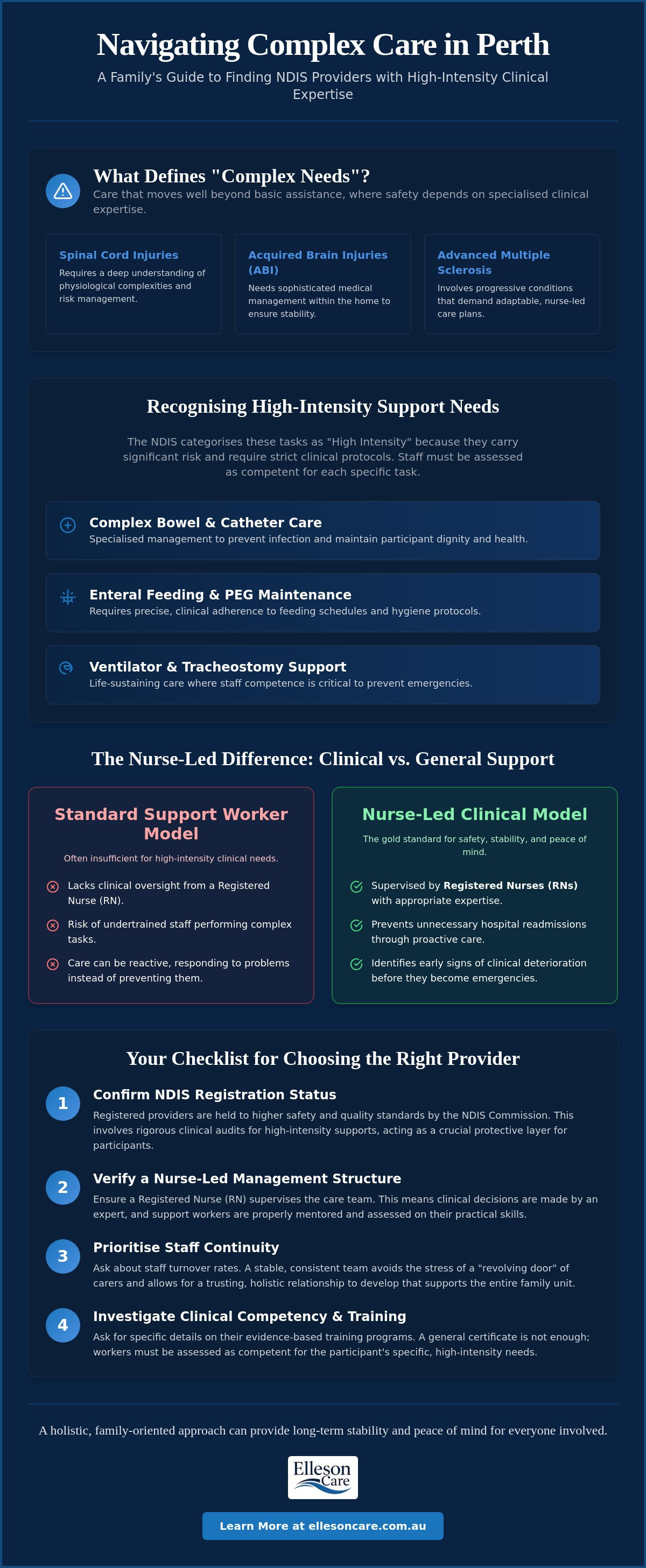
In Western Australia, "complex needs" describes a level of care that moves well beyond basic domestic assistance. It involves high-intensity daily personal activities where a participant's safety and well-being depend on specialised clinical expertise. For many families, the process of finding NDIS providers for complex needs Perth begins following a life-altering event or a diagnosis that requires sophisticated medical management within the home. This level of support is funded through the National Disability Insurance Scheme (NDIS), yet it requires a nuanced understanding of how disability funding intersects with clinical nursing requirements.
Common complex profiles across Perth often involve individuals living with spinal cord injuries, acquired brain injuries (ABI), or advanced Multiple Sclerosis (MS). These conditions require more than just a helping hand; they require a team that understands the physiological complexities involved. Local expertise is particularly important here. Navigating the interface between the WA Health system and NDIS funding requires a provider who knows the local landscape. Whether you're transitioning from a rehabilitation ward or managing a long-term condition, having a team that understands the specific protocols of the Perth healthcare environment is essential for a stable care arrangement.
High-Intensity Daily Personal Activities
The NDIS uses specific "High Intensity" descriptors to categorise supports that carry a significant level of risk. These tasks go beyond physical assistance and require strict adherence to clinical protocols. Common requirements for Perth participants include:
- Complex bowel care and catheter management.
- Enteral feeding and PEG maintenance.
- Tracheostomy management and ventilator support.
If staff lack the correct specialised training for these tasks, the risks to the participant's health are substantial. It's why clinical competence is a non-negotiable standard for any provider you consider. Every support worker must be competent in the specific tasks they perform to ensure individual safety and dignity.
The Role of Clinical Oversight
Clinical nursing oversight is the primary factor that prevents unnecessary hospital readmissions. When a participant transitions from an acute setting, such as Fiona Stanley Hospital or Royal Perth Hospital (RPH), back to their home, the care plan must be robust. A nurse-led model ensures that support workers aren't just following a list of chores. Instead, they're supervised by professionals who can identify early signs of clinical deterioration before they become emergencies. This proactive approach is a cornerstone of finding NDIS providers for complex needs Perth who can offer genuine, long-term stability and peace of mind.
Essential Criteria for Choosing a Complex Needs Provider
Selecting a partner for complex care is a decision that carries significant emotional and physical weight. When finding NDIS providers for complex needs Perth families should first look at registration status. Registered providers are held to a higher standard by the NDIS Quality and Safeguards Commission, which involves rigorous clinical audits for high-intensity supports. This registration acts as a protective layer, ensuring that the organisation meets strict safety and quality benchmarks that unregistered providers may not be required to follow.
A nurse-led management structure is equally vital for long-term stability. Having a Registered Nurse (RN) supervise your care team means that clinical decisions are made by someone with the appropriate expertise, rather than a general administrator. This ensures that every support worker is mentored and assessed on their practical skills, from complex wound management to catheter care. A provider should also prioritise staff continuity to avoid the stress of a "revolving door" of carers. A stable team allows for a holistic approach where the provider supports the entire family unit, recognising that your well-being is intrinsically linked to the quality of care your loved one receives.
To see how these standards are applied in a high-quality setting, you might check out Bloomfield Care for insights into their person-centred domiciliary care model.
Clinical Competency and Training
It's essential to verify that your chosen provider uses evidence-based practices for all clinical tasks. Ask for specific details on their training programmes. It isn't enough for a worker to have a general certificate; they must be assessed as competent for the specific requirements of the participant's plan. Inquire about their emergency response protocols as well. A high-quality provider will have a clear, documented process for managing medical incidents at home, ensuring that staff remain calm and effective under pressure.
Local Knowledge and Perth Presence
Local knowledge is a subtle but powerful factor when finding NDIS providers for complex needs Perth residents can rely on. Choosing a West Australian owned and operated provider offers distinct advantages. Local organisations understand Perth's geography, which leads to more reliable arrival times and better staff coordination across the metropolitan area. They also maintain stronger relationships with local Perth GPs and allied health specialists, creating a seamless network of support. If you are looking for a partner who understands the local healthcare landscape, Elleson Care provides the dedicated clinical oversight required for complex arrangements.
The Nurse-Led Difference: Clinical Nursing vs. General Support
Understanding the distinction between social support and clinical nursing is vital for families managing high-intensity care. While many agencies focus on social participation and domestic assistance, clinical nursing involves the management of complex medical conditions that require a higher level of professional oversight. The NDIS Complex Support Needs Pathway was specifically designed for participants whose situations are multifaceted, requiring a more integrated approach to healthcare. When finding NDIS providers for complex needs Perth families should look for a model that bridges the gap between daily living assistance and essential medical care.
Registered Nurses (RNs) play a pivotal role in this environment, particularly when managing life-sustaining equipment like ventilators or oxygen support. Unlike general support staff, an RN possesses the clinical training to troubleshoot equipment failures, monitor respiratory stability, and respond to physiological changes with precision. This expertise is also critical for complex wound management. Professional healthcare oversight ensures that dressings are applied correctly and that early signs of infection are identified immediately, which is essential for preventing secondary complications. For a deeper look at how these supports are structured, you can learn more about comprehensive nursing services in Perth and the benefits of personalised at-home care.
Managing Specialised Clinical Requirements
Ventilator support requires a level of vigilance that only RN-led training can provide. Support workers must be competent in suctioning, circuit changes, and emergency manual ventilation if required. Similarly, medication administration for complex regimens involves more than just handing over a tablet. It requires a strict adherence to safety protocols to prevent adverse drug interactions or administration errors. Proactive pressure injury management is another area where clinical knowledge is indispensable. By implementing evidence-based skin care routines, a nurse-led team can prevent painful injuries before they require reactive, invasive treatment.
Coordinating Care for Better Outcomes
How to Vet Perth Providers: A Family Interview Guide
The process of finding NDIS providers for complex needs Perth involves a structured approach to interviewing that moves beyond simple availability. Before your first meeting with a potential organisation, it's helpful to prepare a list of non-negotiable clinical skills based on your loved one’s specific requirements. This might include experience with particular ventilation models, specific PEG feeding protocols, or complex seizure management. Having these requirements clearly defined allows you to assess whether a provider has the actual capacity to manage high-intensity risks or if they are simply offering general support under a clinical label.
During the interview, observe the provider’s communication style closely. While clinical expertise is the foundation of safety, the way information is shared matters deeply. You are looking for a balance between professional authority and human empathy. A provider who speaks only in technical jargon without acknowledging the individual's lifestyle may struggle to provide truly person-centred care. Conversely, a provider who is overly casual might lack the disciplined approach necessary for medical safety. If you require a partner who balances these priorities, you can contact our Perth-based clinical team to discuss your specific care requirements.
Five Critical Questions for Complex Care Providers
To ensure a provider is equipped for high-intensity support, consider asking these three foundational questions during your initial consultation:
- Who supervises the support workers performing clinical tasks? A Registered Nurse should be directly responsible for assessing worker competency and overseeing the care plan.
- What is your process for staff training on specific medical equipment? Training should be evidence-based and specific to the exact models of equipment used in your home.
- How do you handle staff absences to ensure care continuity? For complex needs, a missed shift isn't just an inconvenience; it's a safety risk. The provider must have a robust contingency plan.
Assessing Cultural and Emotional Fit
The right provider should align with your family’s values and respect the autonomy of the participant. This involves finding a team that is responsive to feedback and willing to adjust the care plan as needs change. High-quality care is never static; it evolves alongside the individual. Ask for testimonials or references from other high-needs families in Western Australia to gauge how the provider handles long-term relationships and complex communication needs.
Reviewing the NDIS Service Agreement
When you reach the stage of reviewing a service agreement, ensure that clinical nursing hours are clearly defined. Under the NDIS Price Guide 2026, high-intensity supports have specific funding structures that must be accurately reflected in your budget to ensure sustainability. If the primary carer requires a break, you might also consider looking into respite care in Perth to ensure clinical standards are maintained even during short-term relief periods. Transparency in these documents is a hallmark of a reliable, ethical provider.
Elleson Care: Professional Clinical Support for Perth Families
Elleson Care stands as a dedicated partner for families navigating the complexities of high-intensity disability support. As a nurse-led organisation with over 22 years of experience in the Western Australian healthcare sector, we have seen first-hand the challenges families face when finding NDIS providers for complex needs Perth. Our mission is to provide more than just a service; we aim to deliver a stable, clinically governed environment where safety and personal dignity are never compromised. We bridge the gap between clinical nursing and community disability support, ensuring that even the most sophisticated medical requirements are managed within the familiar surroundings of home.
Our commitment extends beyond the participant to include a holistic family approach. We understand that the stress of coordinating complex care can take a toll on the entire household. By providing a reliable, nurse-led team, we offer families the peace of mind that clinical risks are being managed by professionals. Whether it involves ventilator support, complex wound management, or intricate medication regimens, our focus remains on improving the quality of life for everyone involved. We believe that professional healthcare should be both technically proficient and fundamentally kind.
Why Perth Families Trust Our Nurse-Led Team
The foundation of our service is the direct oversight provided by Registered Nurses for all high-intensity support plans. This clinical leadership ensures that every support worker is not only trained but remains competent in the specific tasks they perform. We are proudly West Australian owned and operated, which gives us a deep understanding of the local healthcare landscape and the unique needs of Perth families. Our team prioritises individual autonomy, ensuring that care is delivered in a way that respects the participant's lifestyle and personal choices while maintaining the highest standards of safety and evidence-based practice.
Taking the Next Step with Elleson Care
We specialise in assisting families with the transition from hospital settings to home-based care. Our team works collaboratively with discharge planners at Perth hospitals to ensure a seamless handover that covers all clinical and personal care requirements from the moment you arrive home. Our process for creating a personalised complex care team involves carefully matching staff to both the medical needs and the personality of the participant, fostering long-term stability. If you are ready to discuss your goals, we invite you to have a confidential conversation with our team. You can enquire about our complex NDIS support services to learn how we can provide the steady, professional presence your family deserves.
Securing Stability for Your Family’s Future
Establishing a safe and stable home environment for a loved one with high-intensity requirements is a journey that demands clinical precision and deep empathy. You now have the tools to distinguish between general disability support and the nurse-led oversight necessary for medical safety. By prioritising registered providers and asking the right questions about staff training and clinical supervision, you can significantly reduce the risks associated with complex care.
The process of finding NDIS providers for complex needs Perth doesn't have to be a source of constant stress. With a team that understands the intersection of the WA Health system and NDIS funding, you can move toward a life where medical risks are managed proactively. Elleson Care is a proudly West Australian owned and operated organisation, led by Registered Nurses with over 22 years of experience. We specialise in ventilator support and complex clinical care, ensuring that every participant is treated with the respect they deserve. To help these specialised services reach the families who need them, many Australian healthcare SMEs work with Marketing Angels to refine their brand and communication strategies.
If you're ready to build a more predictable and high-quality care arrangement, contact our Perth-based clinical team for a complex care consultation. We are here to support your family every step of the way.
Frequently Asked Questions
What qualifies as a high-intensity NDIS support in Perth?
High-intensity supports are defined by the level of risk involved and the requirement for specialised clinical knowledge to perform tasks safely. These include complex bowel care, enteral feeding, tracheostomy management, and catheter care. If a participant requires these supports, the NDIS provides specific funding for workers who have been trained and assessed as competent by a health professional to ensure daily activities don't compromise the individual's safety.
Can an NDIS provider also provide clinical nursing at home?
Yes, an NDIS provider can provide clinical nursing at home if they are registered for the 'Community Nursing Care' category and employ Registered Nurses. This allows for professional management of tasks like complex wound care and medication administration. For families finding NDIS providers for complex needs Perth, selecting a provider with this clinical capacity ensures that medical risks are overseen by qualified nurses rather than general staff.
How do I change NDIS providers if my complex needs aren’t being met?
You can change providers by following the notice period outlined in your current service agreement, which is often 14 or 28 days. It's essential to have a new provider ready to commence before you end your existing arrangement to avoid any gaps in clinical care. A professional handover between the two organisations should occur to ensure your specific medical protocols and care plans are transferred accurately.
Does the NDIS cover 24-hour nursing care for complex needs?
The NDIS typically funds nursing care that is directly related to a person's disability rather than acute medical conditions. While 24-hour support is common for complex needs, it usually consists of a team of high-intensity support workers with intermittent visits from Registered Nurses for clinical tasks. Continuous 24-hour nursing is rare and requires a detailed assessment to prove it's the most appropriate and value-for-money support for the participant.
What is the difference between a registered and unregistered NDIS provider for complex care?
Registered providers must undergo rigorous audits against the NDIS Practice Standards, including specific clinical modules for high-intensity supports. This provides a level of government oversight and safety that unregistered providers don't have. When finding NDIS providers for complex needs Perth, choosing a registered organisation ensures they've met strict benchmarks for clinical governance, which is vital when managing life-sustaining equipment or complex medical regimens.
This commitment to high-level safety and compliance is a standard found across many professional industries; for instance, AFN Industrial Services Ltd provides health, safety, and environmental compliance consultancy for commercial and industrial clients to ensure they meet stringent operational benchmarks.
How can I ensure my support workers are properly trained for ventilator use?
You should ask your provider for documented competency assessments for every staff member in your team. These assessments must be conducted by a Registered Nurse and should be specific to the exact ventilator model used in your home. Training shouldn't be a one-off event; it requires regular refreshers to ensure staff remain capable of responding to equipment alarms or changes in the participant’s respiratory status.
What should I do if my loved one is being discharged from a Perth hospital and needs complex care?
You should involve your NDIS provider in discharge planning meetings with hospital staff as early as possible. A specialised provider will liaise with social workers and clinical teams at facilities like Fiona Stanley Hospital or Royal Perth Hospital to ensure a safe transition. This coordination ensures all necessary equipment is delivered and that staff are fully trained on the participant's clinical needs before they arrive home.
Are there specific NDIS providers in Perth who specialise in palliative care?
While palliative care is primarily funded through the WA Health system, NDIS providers can support participants with life-limiting conditions by working alongside specialist palliative teams. This involves providing daily personal care and clinical nursing that focuses on comfort and dignity. The goal is to maintain the participant's quality of life and ensure their choices are respected while coordinating with the broader medical health network.


