

The 1 November 2025 transition wasn't just a change in paperwork; it was a fundamental shift toward ensuring that clinical care is the cornerstone of ageing at home. You might feel overwhelmed by the eight new funding classifications or worried that your essential services will be reduced under this new model. It's completely natural to feel a sense of uncertainty when the rules of support change so significantly for Western Australian families.
This guide will help you navigate the support at home program with absolute confidence, ensuring you understand exactly how your funding is structured and why your clinical needs are now more protected than ever. We'll examine the specific quarterly budget tiers, explain why personal care is now fully government-funded clinical support, and show you how to maintain your independence without a gap in nursing care. By the end of this article, you'll have a clear roadmap for your care and the peace of mind that your wellbeing remains in professional, expert hands.
Key Takeaways
- Understand how the support at home program has unified aged care services since November 2025 to provide a more streamlined and accessible experience for families.
- Discover the three distinct pillars of care; Clinical, Independence, and Everyday Living; and how they prioritise your personal health and dignity.
- Gain peace of mind with a clear explanation of the "No Worse Off" principle, which ensures your existing funding remains secure during the transition from previous models.
- Learn about the specialised short-term pathways for restorative care and end-of-life support that offer intensive, time-limited assistance when it is needed most.
- Identify the benefits of partnering with a local, nurse-led provider in Western Australia to ensure your care is managed with clinical precision and genuine empathy.
The Evolution of Aged Care: Understanding the Support at Home Program in 2026
The 1 November 2025 launch of the support at home program marked a new chapter for seniors across Western Australia. This unified model was designed to simplify a system that many families found confusing and difficult to navigate. By 2026, the rollout has matured into a stable framework that replaces the old Home Care Packages and Short-Term Restorative Care programmes. The primary objective is clear: to empower Perth seniors to maintain their independence within the familiar comfort of their own homes for as long as possible. It isn't just about providing services; it's about creating a sustainable environment where your autonomy is respected and your clinical safety is guaranteed.
Why the Australian Government Reformed In-Home Care
The transition followed years of advocacy and the findings of the Royal Commission into Aged Care Quality and Safety. These investigations revealed that the previous system often left individuals waiting too long for the support they deserved. The reform aims to create a more equitable landscape for aged care in Australia, prioritising transparency and clinical excellence. By moving to a single programme, the government has streamlined the assessment process. This efficiency means that when a family in WA identifies a need for help, the path to receiving that care is shorter and more direct. It removes the administrative hurdles that once stood between a senior and their essential nursing or allied health services.
Ensuring that these complex policy updates are clearly understood by the public is a significant undertaking. To see how professional media can effectively bridge the gap between government reform and public awareness, you can explore Case Studies from Digital Content Studios.
The 2026 Funding Update: Personal Care and Co-contributions
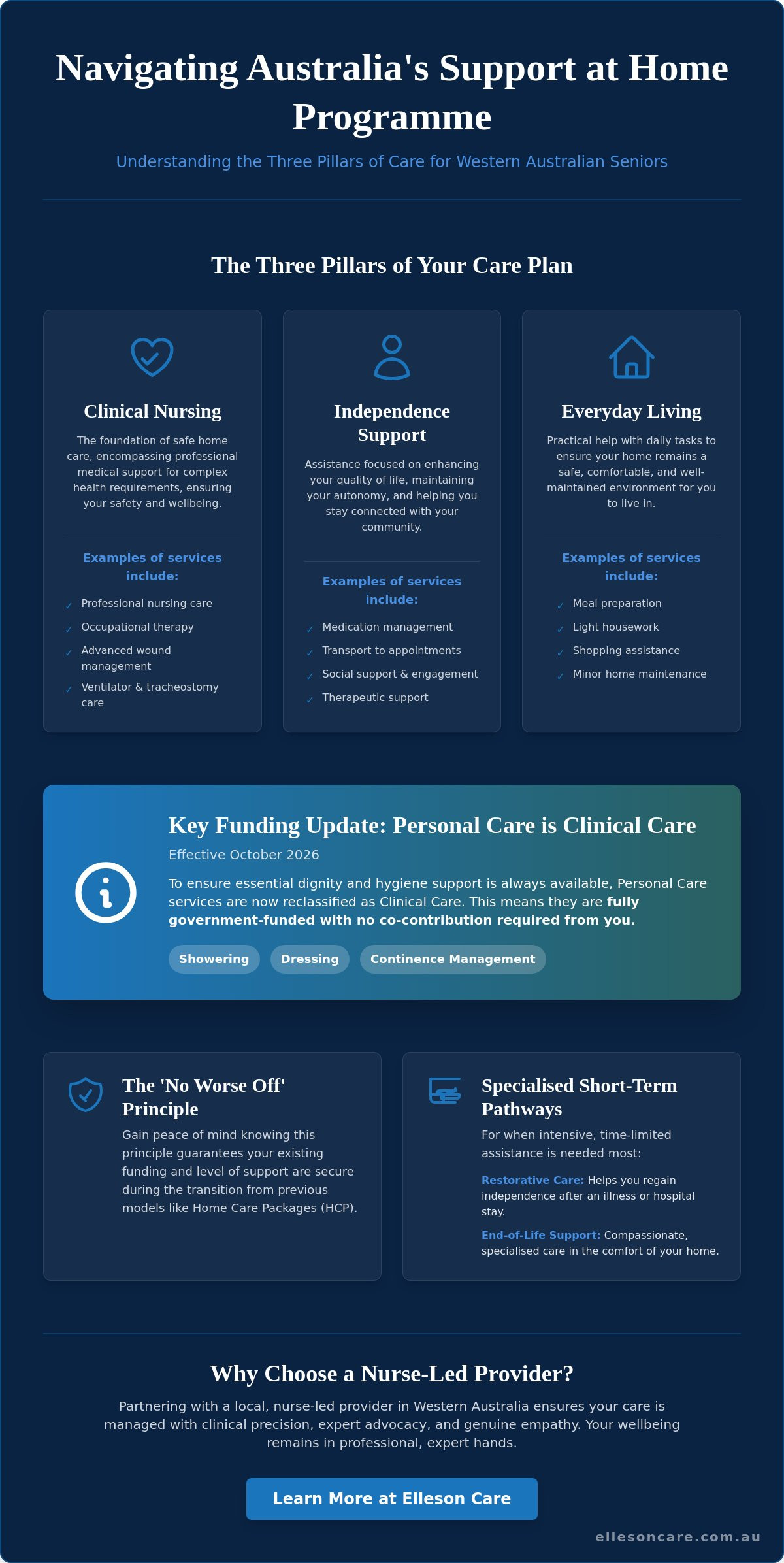
In October 2026, a significant policy update further refined how funding is allocated within the support at home program. Personal care services, including showering, dressing, and continence management, are now classified as clinical care. This reclassification is vital because these services are now fully funded by the government, meaning they don't require a co-contribution from the care recipient. For the average household in Perth, this provides immediate financial relief and ensures that essential hygiene and dignity-based supports are never compromised by budget constraints. It allows families to allocate their remaining budget toward "Independence" or "Everyday Living" services, such as meal preparation or transport, without worrying about the cost of fundamental clinical assistance. This shift reflects a deep commitment to the principle that high-quality, professional care should be accessible to everyone, regardless of their financial circumstances.
Decoding the Support at Home Categories: Clinical, Independence, and Everyday Living
The support at home program moves away from the "one size fits all" approach of previous funding models. Instead, it introduces a structured framework divided into three distinct service pillars. This design ensures your care plan is precisely tailored to your unique circumstances, acknowledging that your needs for clinical safety, social connection, and household maintenance are distinct yet interconnected. One of the most significant advantages of this model is the inherent flexibility it offers. You can work with your provider to adjust the focus of your supports as your health or lifestyle requirements evolve, ensuring the care you receive always matches your current situation.
Clinical Nursing: The Foundation of Safe Home Care
Clinical supports are the most specialised elements of the new programme. They encompass professional nursing care, occupational therapy, and advanced wound management. For individuals with complex health requirements, such as those requiring ventilator support or tracheostomy care, this pillar is a vital lifeline. Elleson Care specialises in these high-level clinical support services, ensuring that even the most intricate medical needs are met with professional precision. A nurse-led approach is particularly vital for Perth seniors transitioning back home after a hospital stay. It provides a level of advocacy and medical oversight that guarantees a safe recovery environment, preventing unnecessary readmissions and fostering genuine peace of mind for the whole family.
Independence Support and Everyday Living
The remaining two pillars focus on your quality of life and the practicalities of staying at home. Independence support includes assistance with medication management, transport to local Perth community centres, and essential respite care for family members. These services are designed to keep you active and safely engaged with your surroundings. Everyday living services cover domestic assistance like cleaning, laundry, and basic home maintenance. While clinical care is fully government-funded for all participants, it's helpful to remember that "Everyday Living" services usually require a small, means-tested co-contribution. This structure ensures that the highest level of professional expertise is always available to everyone while maintaining a sustainable system for general household help.
Navigating the Transition: From Home Care Packages (HCP) to the New Model
Transitioning from a familiar system like Home Care Packages (HCP) can naturally cause a degree of apprehension. Many Perth families have spent years building relationships with specific carers and nurses. The thought of a policy shift disrupting that continuity is a significant concern. The support at home program was designed with these fears in mind, ensuring that the move to the new framework is a methodical process rather than a sudden upheaval. It prioritises the stability of your current care arrangements while introducing a more precise way to manage your future needs.
Central to this transition is the "No Worse Off" principle. This government commitment ensures that if you were already receiving a Home Care Package before 1 November 2025, your funding and services are protected. You won't lose access to the essential care you rely on. If you are currently on the National Priority System waiting list, your place is preserved. You will be assigned a classification level that reflects your assessed needs when your funding becomes available. This roadmap ensures that families aren't left in a state of limbo; the transition is designed to be seamless, maintaining the high standards of care you have come to expect.
Grandfathered Participants and Funding Protection
If the budget allocated under the new support at home program classifications appears lower than your previous HCP budget, the "No Worse Off" principle ensures your funding is topped up to match your previous level. This protection remains in place as long as you stay with a Registered Provider who manages your transition. Your provider acts as your advocate, ensuring the administrative shift doesn't translate into a reduction in your actual hours of care or clinical oversight. They handle the complex communication with My Aged Care and Services Australia, allowing you to focus on your wellbeing. We understand that safety and consistency are your priorities. These protections are legally mandated to uphold your personal dignity and provide a sense of stability.
The 8 Classifications: Finding Your Level
The new system provides a more granular approach to care by expanding from four levels to eight. This allows for a much more precise alignment between your health requirements and your budget. Classification 1 begins with basic support, while Classification 8 provides the highest level of funding for those with the most complex clinical needs. This might include frequent nursing interventions or advanced allied health support. A fresh assessment through My Aged Care determines your specific level, ensuring that in-home aged care in Perth remains a viable and safe option for everyone. This nuanced scaling means that as your needs change, your support can be adjusted with greater accuracy than the old model allowed, preventing gaps in care as health conditions progress.
Short-Term Pathways: Restorative Care and End-of-Life Support
The support at home program recognises that health needs are rarely linear. There are times when a sudden illness, an injury, or a terminal diagnosis requires a level of intervention that exceeds a standard quarterly budget. To address these critical periods, the programme includes two specialised pathways designed as intensive, time-limited "boosts." These pathways provide additional funding on top of your ongoing care, ensuring that during life's most challenging transitions, the focus remains entirely on your recovery or comfort. Accessing these supports in Western Australia usually involves a rapid assessment, often triggered by a change in your medical status or a recommendation from your treating doctor.
The Restorative Care Pathway
This pathway is a proactive, short-term intervention focused on "re-ablement." If you've experienced a significant health event, such as a fall or a hospital stay, you may be eligible for up to 16 weeks of intensive support. This pathway provides up to A$12,000 to fund a combination of clinical nursing and allied health services, including physiotherapy and occupational therapy. The goal is to help you regain your strength and confidence, effectively preventing a premature move into residential care. By investing in your recovery early, the system helps you maintain your autonomy and stay in the home you love. It's a methodical approach to health that prioritises your long-term independence through professional, evidence-based care.
The End-of-Life Pathway: Dignity at Home
Choosing to spend your final weeks at home is a profound decision that requires an exceptional level of clinical precision and emotional sensitivity. The End-of-Life pathway provides rapid access to high-intensity nursing and palliative support, with funding of up to A$25,000 available for a 12 to 16-week period. This pathway prioritises symptom management, pain relief, and holistic family support. At Elleson Care, we believe that every individual deserves to face this stage of life with dignity and peace. Our team works as a protective advocate for Perth families, ensuring that clinical needs are met seamlessly so that you can focus on being together. We provide a steady, reliable presence that balances medical expertise with deep human warmth.
For these specialised pathways to be effective, a rapid response from a local provider is essential. Delays in service can impact recovery outcomes or compromise the comfort of a loved one. If you're currently navigating a change in health status and require immediate clinical support services, our experienced team can help you access these pathways and organise the necessary care without delay. We're committed to ensuring that no Western Australian family has to face these complex transitions without expert guidance and reliable support.
Choosing a Local Perth Provider: Why Nurse-Led Advocacy Matters
Selecting a partner for your journey within the support at home program is a decision that extends far beyond a simple service agreement. While large national franchises offer a familiar name, they often operate through centralised systems that can lack the nuanced understanding of the Western Australian healthcare environment. A local, WA-owned provider offers a distinct advantage; they're deeply integrated into the Perth community and understand the specific pathways of our local hospitals and specialist networks. This local expertise ensures that your care isn't just a set of tasks, but a person-centred experience that respects your history and your connection to your neighbourhood.
It's also beneficial to seek a provider with comprehensive expertise across both NDIS and Aged Care sectors. This dual capability reflects a sophisticated understanding of complex disability and age-related support, ensuring a higher standard of clinical oversight. When a provider is well-versed in diverse care requirements, they bring a broader perspective to your specific situation. This allows for more creative and effective solutions to help you stay independent, regardless of how your needs may shift over time.
The Elleson Care Difference: Professional Nursing Expertise
At the heart of our service is a leadership team with over 22 years of professional nursing experience. This clinical foundation is what sets nurse-led advocacy apart from standard care coordination. An experienced Registered Nurse doesn't just manage a schedule; they possess the clinical intuition to identify subtle changes in health or risks before they escalate into emergencies. This proactive vigilance is essential for maintaining safety at home. Our holistic family approach acknowledges that when one person requires support, the entire family is affected. We work to support caregivers and loved ones, providing the education and reassurance needed to foster a stable, nurturing environment for everyone involved.
Taking the Next Step in Your Support at Home Journey
If you're ready to explore how the support at home program can work for you, the first step is to confirm your eligibility through a My Aged Care assessment. Once your classification is determined, you have the right to nominate a provider that aligns with your specific clinical and personal goals. We encourage you to look for a partner who prioritises your dignity and possesses the technical proficiency to manage your needs as they evolve. If you'd like to discuss your circumstances with a team that values integrity and clinical excellence, we invite you to contact Elleson Care for a confidential conversation. Together, we can ensure your transition into this new era of aged care is handled with the professional care and human warmth you deserve.
Securing Your Future with Clinical Confidence
The shift to the unified support at home program represents a significant advancement in how we care for our seniors in Western Australia. By moving toward a model that prioritises clinical precision and transparent funding, families can now access specialised pathways for restorative and end-of-life care with greater ease. You've seen how the new eight-level classification system provides a more tailored budget and why the "No Worse Off" principle protects your existing services during this transition.
As a WA owned and operated provider led by nurses with over 22 years of experience, we're dedicated to helping you navigate these changes. We specialise in complex clinical care, ensuring that your health needs are met with the highest standards of professional integrity. We invite you to speak with a Perth Registered Nurse about your Support at Home transition to ensure your care plan remains robust and reliable. You don't have to manage these reforms alone; we're here to provide the steady, expert guidance your family deserves as you embrace this new chapter of independence.
Frequently Asked Questions
What is the Support at Home program exactly?
The support at home program is the unified system for Australian aged care that commenced on 1 November 2025. It replaced the previous Home Care Packages and Short-Term Restorative Care models to create a more efficient, three-tiered approach to support. This structure prioritises your clinical safety while offering clear funding for independence and everyday household tasks. It ensures that every senior receives a care plan that's precisely matched to their individual health requirements.
How do I apply for the Support at Home program in Perth?
You apply by contacting My Aged Care to register for an assessment. A member of the Aged Care Assessment Team (ACAT) will visit your home in Perth to discuss your health needs and lifestyle goals. Following this evaluation, you'll receive a letter confirming your assigned classification level. Once you have this approval, you can choose a Registered Provider to begin delivering your essential clinical and domestic supports.
Will I lose my current Home Care Package funding in 2026?
You won't lose your existing funding thanks to the "No Worse Off" principle. This policy was specifically designed to protect individuals who were already receiving a Home Care Package before the new system began. If your new classification budget is lower than your previous package, the government provides a top-up. This ensures your current services remain stable and your relationship with your carers isn't disrupted by the administrative transition.
What are the 8 classification levels in the new program?
The program features eight distinct funding levels that provide a more granular approach than the old four-tier system. These range from Classification 1, providing approximately A$11,000 per year for basic assistance, up to Classification 8, which offers approximately A$78,000 for complex clinical needs. This expanded range allows the My Aged Care assessment to more accurately align your budget with the specific intensity of nursing and allied health care you require.
Is personal care really free under the new rules?
Personal care is now fully government-funded as part of the clinical care pillar. Since October 2026, services such as showering, dressing, and continence support have been exempt from co-contributions for all participants. This change ensures that essential hygiene and dignity-based supports are accessible without financial strain. It allows you to preserve your means-tested budget for other services like transport, social support, or domestic assistance within the support at home program.
Can I choose my own nursing agency in Western Australia?
You have complete freedom to choose any Registered Provider that operates in Western Australia. Selecting a local, nurse-led agency is often the best way to ensure your clinical advocacy is prioritised. A Perth-based provider understands the local hospital networks and specialist services, which is vital for maintaining a safe and professional care environment. This choice empowers you to partner with experts who truly understand the WA healthcare landscape.
What happens if my care needs suddenly increase?
If your needs increase, you can access specialised short-term pathways for intensive support. The Restorative Care pathway offers up to A$12,000 for 16 weeks of "re-ablement" support after an illness or injury. For those facing terminal illness, the End-of-Life pathway provides up to A$25,000 for high-intensity palliative care. If your health changes permanently, your provider can also help you request a new assessment for a higher ongoing classification level.
How much will I have to pay in co-contributions?
Your co-contributions depend on the type of service and a means assessment conducted by Services Australia. Clinical care, including nursing and allied health, is always free of charge. You may be asked to contribute toward "Independence" and "Everyday Living" services, but these amounts are capped. There is also a lifetime contribution cap of approximately A$135,318, providing long-term financial certainty for you and your family.


