

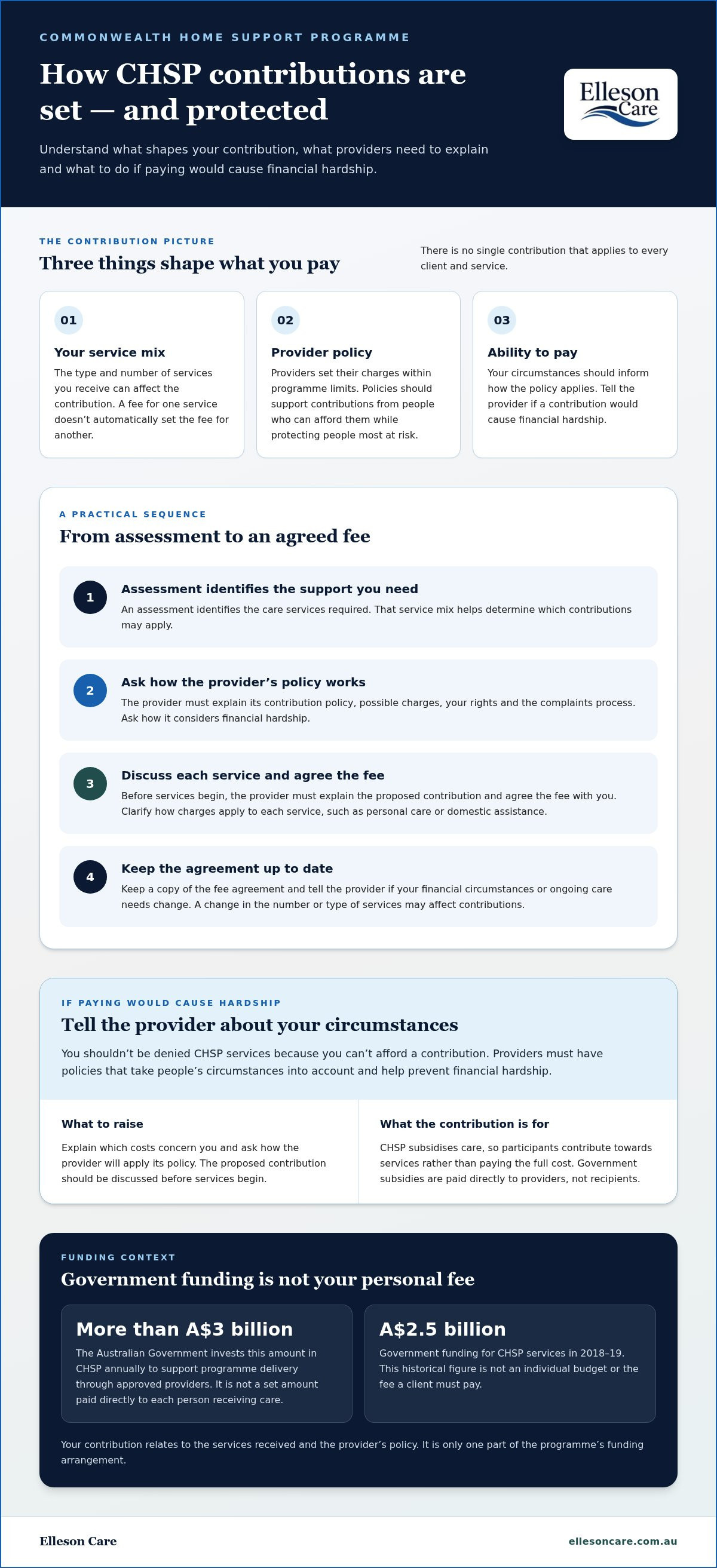
A CHSP contribution is intended to help cover care, not leave you paying its full cost. How much CHSP costs depends on the services you receive, the provider’s contribution policy and your ability to pay. If you’re experiencing financial hardship, you shouldn’t be denied CHSP services because you can’t afford a contribution.
It’s understandable to want a clear figure before deciding whether support is manageable. Contributions vary between services and providers, so understanding how fees are set and what protections apply can help you plan with greater confidence.
This guide explains how provider-set contributions work, how government funding fits in and what to expect from CHSP fees for different types of support. It also outlines what to do if contributing would cause financial hardship, so you can understand your options and protections before services begin.
Key Takeaways
- Your contribution depends on the services you receive, the provider’s policy and your ability to pay.
- Ask for a clear explanation of the contribution policy and the agreed charges before CHSP services begin.
- Government funding helps cover the cost of the programme, so recipients aren’t expected to pay the full cost of their care.
- If paying would cause financial hardship, the provider’s contribution policy should take your circumstances into account.
- CHSP charges are for the services described by the provider; there are no separate exit fees.
What if I can’t afford a contribution?
If a CHSP contribution would cause financial hardship, tell the provider about your circumstances. You shouldn’t be denied CHSP services because you can’t afford to contribute. The programme subsidises care, so participants contribute towards services rather than paying the full cost. Contributions vary according to ability to pay and the type and number of services received.
Eligibility also reflects who the programme supports. According to the Australian Government Department of Health, Disability and Ageing, CHSP provides support to Australians aged 65 and over, or Aboriginal and Torres Strait Islander peoples aged 50 and over. An assessment identifies the care services a person needs. That service mix helps determine which contributions may apply.
Contribution amounts differ by service. These figures describe typical contributions, not a fixed charge for every recipient. The provider’s policy, your circumstances and the amount of support all matter.
Ask the provider to explain its contribution policy and how it considers financial hardship. Providers must have policies that support contributions from people who can afford them while protecting the most vulnerable. They must also explain possible contributions, track them to help prevent hardship, and outline your rights and the complaints process.
Before services begin, the provider must explain the proposed contribution and agree the fee with you. Discuss how charges apply to each service, such as a regular personal care visit or domestic assistance. If the contribution is difficult to manage, explain which costs concern you. Your circumstances should inform how the policy applies.
CHSP contributions aren’t set through the same income and assets assessment process used for Support at Home contribution percentages. For Support at Home recipients without an Income and Assets Assessment, the default contributions are 80% of everyday living supports and 50% of independence supports. Private home care isn’t subsidised through CHSP, so its charges are set separately and aren’t directly comparable.
Receiving CHSP support doesn’t affect a person’s pension because the Australian Government pays subsidies directly to providers, not recipients. If ongoing care needs change, the number and type of services may change too, affecting contributions. Keep a copy of the fee agreement and note any changes to your financial circumstances so the provider can consider them under its policy.
Maximum fees and government rates
CHSP funding and client contributions are different parts of the programme’s cost. The Australian Government invests more than A$3 billion annually in the Commonwealth Home Support Programme. This funding supports delivery through approved providers. It isn’t a set amount paid directly to each person receiving care. A client’s contribution is only one part of the funding arrangement.
Historical funding figures need their period attached. The Australian Government provided A$2.5 billion for CHSP services in 2018-19. That figure describes government funding in that year, not an individual’s budget or current annual allocation. It also doesn’t indicate the fee a client must pay. Provider charges relate to services received and the contribution policy applied.
There is no single CHSP contribution amount that applies to every service and client. Providers set aged care fees up to the maximum allowed for their programme. The Australian Department of Health, Disability and Ageing sets rates and thresholds on behalf of the government. A provider’s fee therefore sits within the relevant programme rules and its own published pricing.
For clients, the practical distinction is between the government subsidy and the contribution charged for care services. The subsidy helps fund the programme’s delivery, while contributions help cover service costs. The amount charged can depend on the type and number of services, as well as the person’s ability to pay. A fee for one service doesn’t automatically determine the fee for another.
Support at Home has a different funding structure, so its annual funding levels shouldn’t be mistaken for CHSP fee limits. These figures describe annual funding levels, not the contribution every participant pays. Support at Home providers may charge a basic daily fee, an income-tested care fee, and amounts for additional care and services.
Use figures in the right context when comparing programmes. A government funding allocation isn’t a personal allowance, and a maximum permitted fee isn’t necessarily the amount charged. The service mix and applicable programme determine which figures matter. When comparing CHSP with Support at Home, separate annual funding from out-of-pocket contributions.
To understand a proposed CHSP charge, focus on the provider’s fee information and the services covered. The provider must explain its contribution policy and agree fees with the client before services begin. A clear agreement helps distinguish the service charge from government funding and makes ongoing costs easier to understand when the support plan includes multiple services.
Provider responsibility for setting fees
CHSP providers set their service fees within programme limits and must explain their charges. Knowing what a fee covers helps you understand the agreement before care begins.
Provider-set CHSP prices
Providers are responsible for setting aged care fees, up to the maximum allowed for their programme. The Australian Department of Health, Disability and Ageing sets rates and thresholds on behalf of the government. As a result, CHSP prices can differ between providers, even for similar home support services.
A provider must be transparent about its fees and publish pricing information to help people understand and compare costs. Compare like with like: consider the service, how it is charged and what the fee includes. A fee for domestic assistance, for example, may not be directly comparable with a charge for transport or personal care.
Provider agreements and fees
A CHSP service cannot start until you agree to the fee with the provider. Before you agree, the provider must explain its contribution policy and the charge for the services you’ll receive. The agreement gives you a reference point for understanding ongoing contributions and the services they relate to.
Read the fee information alongside the service details. Check that each charge corresponds to a service you’ve agreed to receive, such as a scheduled home support visit. If the services or your needs change, discuss how that affects the agreement and fees. CHSP services have no exit fees or charges beyond the service fees described by the provider.
Assessment, referral and setup costs
CHSP costs are the service charges described by the provider. There are no exit fees or other charges beyond those fees. Assessment, referral or setup should not appear as an additional CHSP fee outside the provider’s described service charges. Review the fee information and agreement to understand which charges apply.
For example, if you’re referred for domestic assistance, distinguish the referral from the service itself. The provider’s fee information should explain any contribution for the care service, and the service cannot begin until you agree to its fee. This gives you a clear opportunity to raise any charge that doesn’t match the services discussed.
When comparing CHSP providers, use their published pricing and contribution policies rather than comparing headline amounts alone. Consider the service type, charging method and support you plan to receive. A clear comparison can help you understand the cost of each proposed service before agreeing to ongoing care.
Average CHSP funding per person
The average Commonwealth Home Support Programme funding per person in Australia is roughly A$3,000. This is a programme funding average, not a personal allowance paid to each older Australian. The Australian Government pays subsidies directly to providers, rather than recipients. A client’s actual support and contribution depend on the services they receive and their circumstances.
That distinction matters when estimating the value of aged care services. The average doesn’t set an individual spending limit or promise a particular amount of care. CHSP support is shaped by assessed needs and the services available under the person’s approval. Someone approved for domestic assistance, for example, has a different support mix from someone receiving transport or personal care.
Assessment links a person’s needs with appropriate home support. A Regional Assessment Service assessment is required for CHSP, while Home Care Packages require an ACAT assessment. These are distinct pathways. The assessment helps identify the support required, but the roughly A$3,000 average should not be read as a personal budget or a fee schedule.
My Aged Care is the starting point for applying for aged care assistance. Completing its online application takes 15 to 20 minutes. The application provides information for the assessment process; it doesn’t convert the national funding average into an individual entitlement. A referral and assessment help establish which services may meet the person’s needs.
For older Australians planning care, focus on approved services rather than the average alone. Consider the type of help required, how often it is needed and whether needs are likely to change. These details help clarify the practical support arrangement. The average funding figure provides broad context, not a calculation of an individual’s contribution.
CHSP is suited to people who need one or two basic home care services, short-term respite or interim support while waiting for Support at Home. These examples show why a single average can’t describe everyone’s care. A recipient using one service has a different support arrangement from someone requiring several services or respite.
Use the A$3,000 average as context when discussing CHSP, not as a quote or forecast. Ask how the assessment relates to the recommended services and how contributions apply to those services. Keeping the funding average, approved support and client contribution separate makes the costs easier to understand. It also helps families discuss changing care needs without treating a programme-wide figure as an individual allocation.
CHSP price guide and co-payment policy
Typical CHSP contributions offer a guide, but they aren’t a national price list. Contributions vary by provider, service type, number of services and ability to pay. Providers usually charge for services on the days they’re received. The contribution policy explains how charges are set and helps eligible clients understand their share.
These are general CHSP contribution ranges, not a guaranteed quote for an individual service or a provider’s fixed fee.
The range matters because the same service can cost different amounts across providers. A cleaning visit and a delivered meal also use different charging units, so comparing their amounts directly can be misleading. Check whether the fee is hourly, per trip or per meal, then consider how often you’ll receive the service.
CHSP contributions aren’t determined through the same income and assets assessment process used to set Support at Home contribution percentages. Instead, a provider’s contribution policy considers ability to pay alongside the type and number of services. If a person can’t afford the proposed contribution, they should discuss financial hardship with the provider.
This differs from Support at Home, where Services Australia determines aged care contributions based on an Income and Assets Assessment. For recipients without that assessment, default contributions are 80% of everyday living supports and 50% of independence supports. Those percentages apply to Support at Home, not CHSP or a Home Care Package contribution under CHSP rules.
Before accepting ongoing services, discuss the contribution policy and proposed charges with the provider. The provider must explain possible contributions and agree fees with the client before services begin. Ask how each amount applies to the approved support, such as an hourly cleaning visit, a transport trip or each delivered meal.
If the total seems difficult to afford, explain which services and charges concern you. CHSP providers must track contributions to help prevent hardship, explain clients’ rights and outline the complaints process. Financial hardship doesn’t mean you can be denied CHSP services. A clear discussion can help explain how the policy applies to your circumstances.
For a practical discussion about care needs and support options, discuss aged care support with a care team. Keep the CHSP contribution guide separate from any individual service quote: the figures above describe typical programme contributions, not a provider’s specific price.
Elleson Care: Aged Care Services
Elleson Care provides Aged Care Services for people and families seeking support at home. If you’re considering CHSP or managing changing needs, understanding the programme’s contributions can help you plan questions about affordability and suitable support. Elleson Care also provides NDIS Support Services and Clinical Support, including nursing care tailored to individual needs.
CHSP funding and provider-set contributions apply specifically to the programme and its services. Elleson Care’s aged care support is separate, so don’t treat the CHSP contribution figures above as Elleson Care prices. Contact Elleson Care to discuss your care needs and the support that may suit your circumstances.
Take your next step with confidence
If you’re asking how much CHSP costs, understanding the contribution is only one part of planning care. Your next step can be a conversation about the support you need, what matters in your daily routine and how your needs may change. Taking this broader view can help you consider suitable care arrangements without assuming one programme or fee fits every situation.
Elleson Care offers Aged Care Services, NDIS Support Services and Clinical Support. If you’re exploring aged care support or need to discuss care needs alongside other supports, Elleson Care can be a point of contact for that conversation. The focus is on understanding your circumstances and considering support that respects your preferences.
Contact Elleson Care to discuss support. Taking the time to talk through your needs is a constructive step towards care that feels right for you.
Frequently Asked Questions
What is the Commonwealth Home Support Program?
The Commonwealth Home Support Programme helps eligible older people access practical assistance to live at home. It can support people who need help with everyday tasks or particular care needs, rather than a comprehensive package of ongoing support. According to the Australian Government Department of Health, Disability and Ageing, it supports Australians aged 65 and over, and Aboriginal and Torres Strait Islander peoples aged 50 and over.
How Much Does CHSP Cost?
There isn’t one fixed CHSP price for everyone. If you’re asking how much CHSP costs, the answer depends on which services you receive, how often you receive them, the provider’s contribution policy and your ability to pay. Treat typical fee ranges as a guide, not a personal quote. To plan, list the services you expect to use and note how each is charged.
How much will I pay?
Your personal contribution depends on the services in your support arrangement and the provider’s policy. To understand the likely total, look at each service separately, then consider how often it will occur. For example, an hourly service and a per-trip charge create different budgeting patterns. Your agreed fee information should identify the contribution for each service, rather than relying on a programme-wide average.
What does CHSP stand for in Australia?
CHSP stands for Commonwealth Home Support Programme, the Australian spelling of the programme’s full name. It is a Commonwealth-funded aged care programme for eligible people who need support to remain living at home. You may see “Program” in some materials, but “Programme” is the spelling used in Australian government programme names. CHSP refers to the same home support programme in either case.
What services does the Commonwealth Home Support Programme cover?
CHSP can cover practical supports such as domestic assistance, personal care, transport, delivered meals, social support, nursing and respite. The services a person can access depend on their assessed needs and approved support. One person may need help with household tasks, while another may benefit from transport or social connection. The programme aims to match support to needs, not provide every service to every recipient.
How much does CHSP cost per hour or service in Australia?
These amounts use different charging units, so compare hourly care with hourly care, and per-trip transport with transport. The provider’s fee information explains the contribution for the services you’ll receive.
Are CHSP prices set by the Australian government or by providers?
Providers set their CHSP service fees within the programme’s maximum, while government funding subsidises delivery. This means the contribution for a service can differ between providers. Before agreeing to care, compare the service description and charging method with the fee. A published price is useful only when you know whether it applies per hour, visit, trip or another unit.
How are CHSP fees calculated based on income or circumstances?
CHSP doesn’t use the same income and assets assessment process as Support at Home to set participant contribution percentages. A provider’s policy considers a person’s ability to pay, the type of service and the number of services needed. If contributions would cause hardship, explain your circumstances to the provider. Its policy should support contributions from people able to pay while protecting vulnerable clients.


