

The Commonwealth Home Support Programme (CHSP) provides entry-level support to help older people stay independent at home and in their community. A person aged 65 or older may be eligible, as may someone aged 50 or older who is homeless or at risk of homelessness.
It’s understandable to want a clear picture of costs before arranging care. CHSP clients are expected to contribute if they can afford to, and the amount depends on the service and provider. Support may include help at home, meals, transport, social support, nursing or allied health. An aged care assessment determines eligibility and identifies services suited to a person’s needs.
This article explains how CHSP contributions work, what support may be available, and how assessment and access work. It also explains why the time before support begins can depend on local provider availability, and how allied health and home support can help maintain wellbeing and independence.
Key Takeaways
- CHSP offers entry-level help to support older people to remain at home and connected with their community.
- Eligibility depends on age and circumstances, and an aged care assessment determines whether CHSP services are suitable.
- Support may include household help, meals, transport, social support, nursing and allied health. The services available depend on assessed needs.
- Contributions depend on the type of support and provider; people who can’t afford to contribute won’t be denied services.
- The time before support begins depends on local provider availability after assessment, so understanding the access process can help you plan.
CHSP purpose and entry-level support
The Commonwealth Home Support Programme (CHSP) is government-funded, entry-level support for older people who need help at home. It differs from Support at Home, which includes everyday living support and personal care. People with more complex needs may be approved for Support at Home instead. A Home Care Package is a separate programme name, not another name for CHSP.
The purpose of CHSP
CHSP helps older people maintain independence at home and stay connected with their communities. Support can address everyday tasks that have become difficult, such as preparing meals or getting to appointments. This assistance can help people keep up their daily routines in familiar surroundings. The programme also offers respite services for carers, recognising that care arrangements affect both the older person and those supporting them.
Entry-level support through CHSP
CHSP provides entry-level support for people who need some assistance, rather than a comprehensive package of care. In Australia, people can generally access one or two CHSP services a week. For example, someone might receive help with household tasks and transport. This model addresses specific needs without assuming everyone requires the same services. An assessment considers suitable support, and needs may change over time.
CHSP eligibility
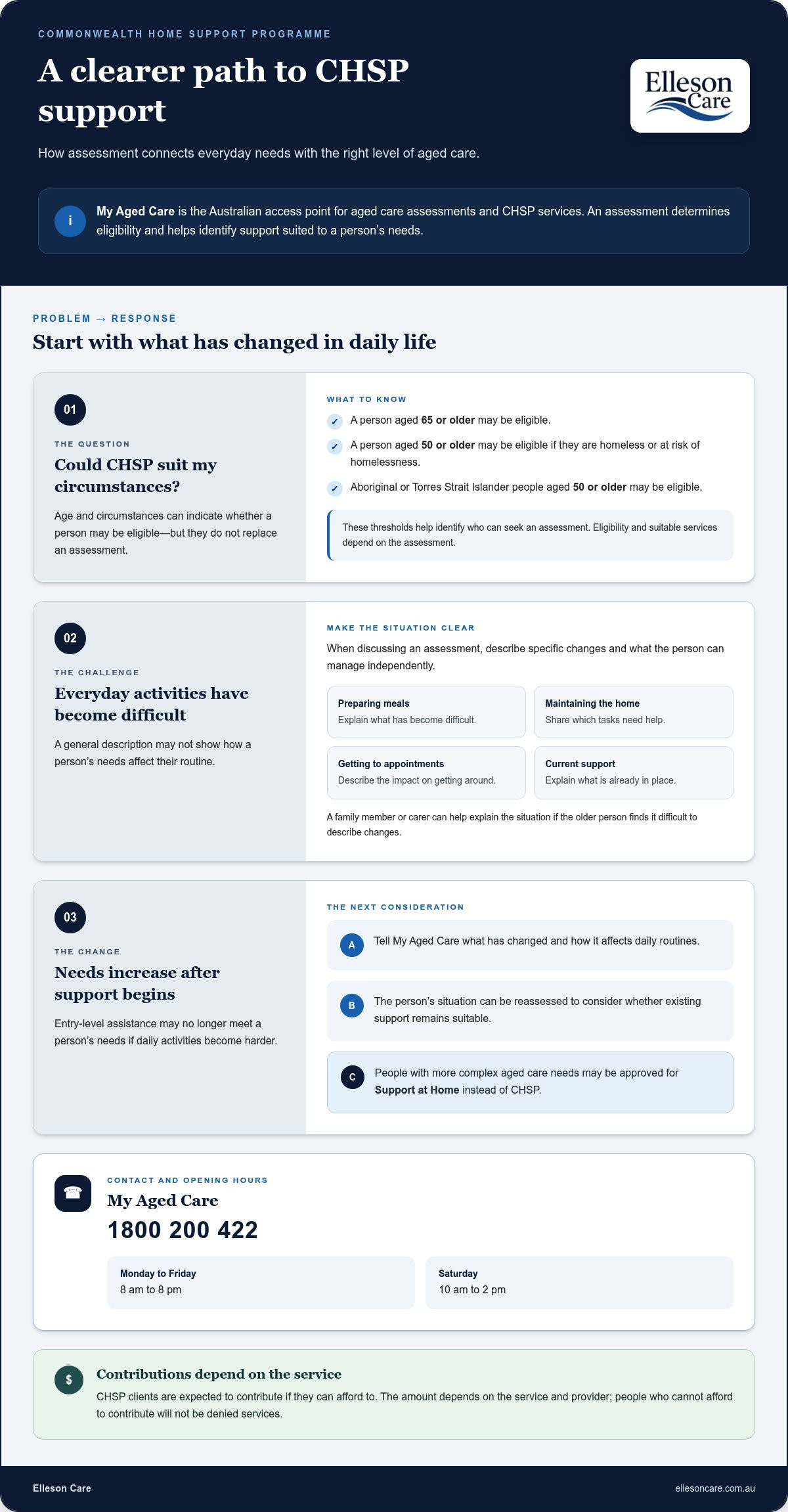
Eligibility depends on age, circumstances and an aged care assessment. In Australia, a person aged 65 years or older may be eligible for CHSP. A person aged at least 50 years may also be eligible if they are homeless or at risk of homelessness. Aboriginal or Torres Strait Islander people aged at least 50 years may be eligible as well. These thresholds help identify who can seek an assessment; they do not replace the assessment of support needs.
How CHSP differs from other support
CHSP is designed for entry-level assistance, while Support at Home includes everyday living support and personal care to help older people live independently at home for longer. People with more complex aged care needs may be approved for Support at Home instead of CHSP. This distinction matters when current assistance no longer meets daily needs. A Home Care Package is not interchangeable with CHSP, so use the programme name shown in a person’s aged care information.
For example, someone needing occasional help with meals or transport may seek a CHSP assessment. If their needs become more complex, the assessment process can consider whether Support at Home is more suitable. The programme is not a fixed set of services: assessment connects a person’s circumstances with an appropriate level of support. Knowing the difference between entry-level CHSP assistance and other aged care options can help families explain what help is needed.
My Aged Care access and assessments
My Aged Care is the Australian access point for aged care assessments and CHSP services. An assessment determines eligibility and helps identify support suited to a person’s needs.
If care needs increase while someone receives CHSP, their support can be reassessed. People with more complex aged care needs may be approved for Support at Home instead of CHSP.
Applying through My Aged Care
To start an application, contact My Aged Care to discuss aged care services and arrange an assessment. CHSP access depends on an assessment, not age or a particular service request alone.
People can call My Aged Care on 1800 200 422 from Monday to Friday, 8 am to 8 pm, or Saturday, 10 am to 2 pm. When calling, explain the everyday activities that have become difficult, such as preparing meals, maintaining the home or travelling to appointments. Clear examples help describe the practical impact of a person’s needs.
A family member or carer can help explain the situation, particularly if the older person finds it difficult to describe changes. Focus on what the person can manage independently, where they need help, and what support is already in place. This gives the assessment relevant context without assuming everyone needs the same services.
Assessment and access
An aged care assessment determines whether a person is eligible for CHSP services and which support may suit their circumstances. It matters because an assessment connects a person’s needs with an appropriate level of aged care, including consideration of more complex support.
Describe changes in everyday functioning with specific examples. For instance, explain whether meal preparation, personal care or getting to appointments has become difficult. In-home nursing and personal care are among the support services available through CHSP, but eligibility and suitable services depend on assessment.
If needs increase after support begins, share the change with My Aged Care so the person’s situation can be considered. Greater difficulty with personal care or several daily activities may mean existing entry-level assistance no longer meets their needs. People with more complex aged care needs may be approved for Support at Home instead.
An assessment considers the person’s circumstances, not just a checklist of requested services. Explain what has changed, how it affects daily routines, and whether current support addresses those difficulties. For example, someone who previously needed transport assistance may later need nursing or personal care. Explaining this change helps clarify the support needed and whether another programme may be suitable.
What services can I get through CHSP?
CHSP can fund different care services, depending on assessed needs and support available locally. The programme covers practical help at home, health-related support and assistance to stay connected with the community.
Commonwealth Home Support Programme services may include:
- Domestic assistance, home maintenance and repairs
- Meals, including meal delivery, and personal care
- Social support and transport
- Respite for carers
- Nursing care, allied health and other therapeutic services
These options address different everyday needs. Domestic assistance may help with household cleaning, while transport can support trips to appointments or community activities. Nursing and allied health services address health and therapy needs. An assessment helps identify suitable support, but not every service is provided to every person.
Australian CHSP clients are expected to contribute to care costs if they can afford to. Contributions depend on the service and provider, so costs for meals may differ from those for nursing or home maintenance. Simple services, such as house cleaning and meals, may cost a few dollars, while more complex services, including some home modifications, can cost much more. A person who can’t afford to contribute won’t be denied services.
Providers may set different contribution amounts and deliver the same type of service differently. CHSP clients can also use different providers for different services. This can matter when arranging a mix of transport, meals and allied health. Consider each service separately rather than assuming one provider or contribution covers every kind of assistance.
The CHSP manual describes the programme, funded service types and delivery requirements. It also covers eligibility, services in scope, wellness and reablement approaches, provider responsibilities and access to emergency CHSP services. These requirements define what programme funding can support. A request for a particular service must still match the person’s assessed needs and the service types within CHSP.
If a suitable CHSP service is not yet in place, some people arrange private support while waiting. Private care is separate from CHSP, and the provider sets its costs and delivery arrangements. Before committing, consider the task that needs attention, how often help is required and whether the arrangement fits the person’s budget. Track changing needs so they can be discussed during an aged care assessment or reassessment.
How long will it take to get some help at home?
There isn’t one set waiting time for CHSP support across Australia. After an aged care assessment, the wait depends on local provider availability, so timing can vary by service and location.
Age is one part of CHSP eligibility, but meeting an age threshold alone does not establish eligibility. An aged care assessment is also needed to determine whether CHSP services are appropriate. Reaching the relevant age does not automatically mean support can begin.
In Australia, a person aged 65 years or older may be eligible for CHSP. A person aged at least 50 years may also be eligible if they are homeless or at risk of homelessness. Aboriginal or Torres Strait Islander people aged at least 50 years may be eligible as well. These age thresholds indicate who may seek assessment; the assessment considers support needs.
For example, an older person who needs help with cleaning may meet an age threshold, but an assessment still determines whether CHSP is suitable. If eligible, the time before cleaning support starts depends on local provider availability after assessment. Another service may have a different wait because availability varies locally.
After assessment, the practical next step is to understand which service has been approved and whether local support can begin. Keep the assessment outcome and requested service clear when discussing arrangements. For example, distinguish a need for transport from household assistance, because local availability depends on the service required.
CHSP is partially subsidised through Australian Government funding grant agreements. This funding supports programme services, while clients are expected to contribute if they can afford to. A contribution does not determine how quickly a service starts: the wait depends on local provider availability after assessment.
While waiting, identify everyday tasks that cannot be postponed and note how they affect the person’s routine. For example, record whether cleaning, meal preparation or transport is the immediate concern. This keeps conversations about approved support focused and makes it easier to explain if needs change during the wait.
If circumstances change after assessment, describe the change through the aged care access process. A person whose needs become more complex may be approved for Support at Home instead of CHSP. The appropriate pathway depends on assessed needs, while the timing of CHSP services depends on local provider availability.
Age thresholds can help families understand whether an assessment may be relevant, but they do not provide a start date. For a person aged 65 years or older, or an eligible person aged at least 50 years, the assessment and local service availability are separate parts of the process. Planning around the specific support needed, such as cleaning or transport, gives families a clearer basis for managing the wait.
How do older Australians apply for CHSP services?
Older Australians start the CHSP access process through My Aged Care, where an aged care assessment determines eligibility. The assessment also considers which support services suit the person’s circumstances. An application does not automatically approve every requested service.
Calling My Aged Care is one way to start. The number is 1800 200 422, available Monday to Friday, 8 am to 8 pm, and Saturday, 10 am to 2 pm. For example, someone seeking help with meals can explain how meal preparation affects their everyday routine. A family member or carer can help describe the person’s needs during the conversation.
Before calling, think about tasks that have become difficult and what assistance may help. Specific examples make the discussion clearer. Someone might explain that cleaning is difficult, transport is needed to attend appointments, or personal care has become harder to manage. Describe existing support too, so the assessment can consider the person’s circumstances as a whole.
The process can be understood in three parts:
- Contact My Aged Care: Call 1800 200 422 during its stated opening hours to discuss aged care support.
- Describe the support needs: Give practical examples of daily tasks affected, such as preparing meals or travelling to appointments.
- Complete an aged care assessment: The assessment determines CHSP eligibility and considers appropriate services.
The assessment outcome links the person’s needs with a suitable level of Australian aged care. If CHSP is appropriate, it identifies relevant support services. People with more complex aged care needs may instead be approved for Support at Home. This distinction helps families understand why an assessment considers the type and complexity of support, not only the person’s preferred service.
After assessment, the time before help begins depends on local provider availability. Be clear about the requested support when discussing arrangements. A need for transport differs from a need for nursing care, and each service depends on local availability. If daily needs change while waiting, explain what has changed through the My Aged Care process.
Applying is also an opportunity to explain how care needs affect independence at home. One person may need help with a single task, while another may require a different combination of support. Clear examples explain these differences without assuming age alone determines the outcome. My Aged Care assesses the person’s situation and whether CHSP or another aged care programme is suitable.
Elleson Care: Aged Care Services
Elleson Care offers Aged Care Services for people whose care needs are changing. After learning about CHSP eligibility and assessment, you may also be considering support for ongoing wellbeing or health needs at home.
Elleson Care’s Clinical Support may be relevant when nursing care is part of a person’s needs. Its NDIS Support Services are for people seeking disability support. These services are separate from the My Aged Care assessment process, which determines access to government-funded aged care programmes such as CHSP.
If you’d like to discuss your care needs and the support Elleson Care provides, contact Elleson Care.
Plan support around the life you want to maintain
Understanding what the Commonwealth Home Support Programme (CHSP) can address is a starting point for considering broader care needs. Next, think about what could make everyday life safer, more manageable and more meaningful, including support that may sit beyond a single programme.
Before discussing care, note the routines that matter most and where assistance could help preserve independence. This might mean maintaining familiar activities, managing health needs at home or ensuring support reflects personal preferences. A clear picture of these priorities can help shape a considered conversation about care.
Elleson Care offers Aged Care Services, NDIS Support Services and Clinical Support in Perth. If you’re considering support alongside aged care arrangements, discuss your needs with the team and explore an approach that respects your circumstances.
Contact Elleson Care for support and take the next step towards care that fits your needs.
Frequently Asked Questions
How much will it cost me?
Your contribution depends on the service and provider. CHSP clients are expected to contribute if they can afford to. Simple services such as meals or house cleaning may cost a few dollars, while some home modifications cost much more. Providers may charge different amounts for similar support. If you can’t afford a contribution, you won’t be denied CHSP services. Consider each requested service separately when planning household expenses.
How do I access these services?
Start by contacting My Aged Care on 1800 200 422 to discuss an aged care assessment. The phone line is open Monday to Friday, 8 am to 8 pm, and Saturday, 10 am to 2 pm. Explain the daily tasks where assistance is needed, such as preparing meals or travelling to appointments. A family member or carer can help describe the situation during the call.
How does it work?
CHSP combines Australian Government funding with contributions from clients who can afford to pay towards their support. An aged care assessment determines eligibility and considers suitable services. Support is generally entry-level, with people commonly accessing one or two services a week. For instance, an assessed person might receive a regular service for a specific daily need. The services provided depend on assessed circumstances and local arrangements.
What is the Commonwealth Home Support Programme?
The Commonwealth Home Support Programme is Australian Government-funded entry-level assistance for older people who need help to live independently at home and in their communities. It also provides respite services for carers. Rather than being a single type of care, the programme funds different kinds of support, including practical household assistance and health-related services. An aged care assessment considers whether the programme suits a person’s circumstances and support needs.
What steps do I take to get CHSP?
Contact My Aged Care, describe the support needed and complete an aged care assessment. Before calling, note daily tasks that have become difficult, such as preparing meals, managing personal care or maintaining the home. These examples help explain how support could help. The assessment determines whether CHSP services are suitable. If needs are more complex, the person may be approved for Support at Home instead.
What is the Commonwealth Home Support Programme (CHSP) in Australia?
The Commonwealth Home Support Programme (CHSP) is Australia’s entry-level aged care programme for eligible older people needing some help at home. It supports independence in the home and community, and includes respite for carers. Services can address practical, social and health-related needs. Access requires an aged care assessment, which considers the person’s circumstances and whether CHSP is appropriate. Local provider availability affects how soon an approved service can start.
Who is eligible for CHSP support?
A person aged 65 years or older may be eligible for CHSP in Australia. People aged at least 50 years may also be eligible if they are homeless or at risk of homelessness. These age and circumstance thresholds are not approval by themselves: an aged care assessment determines eligibility for services.
What services does the CHSP provide?
CHSP services can include domestic assistance, home maintenance and repairs, meals, social support, transport, respite, personal care, nursing, allied health and other therapeutic services. The assessment considers which supports suit the person’s needs, so the programme doesn’t automatically provide every service to each participant. For example, one person may need help with meals, while another’s assessed needs may involve nursing care or transport to community activities.


