

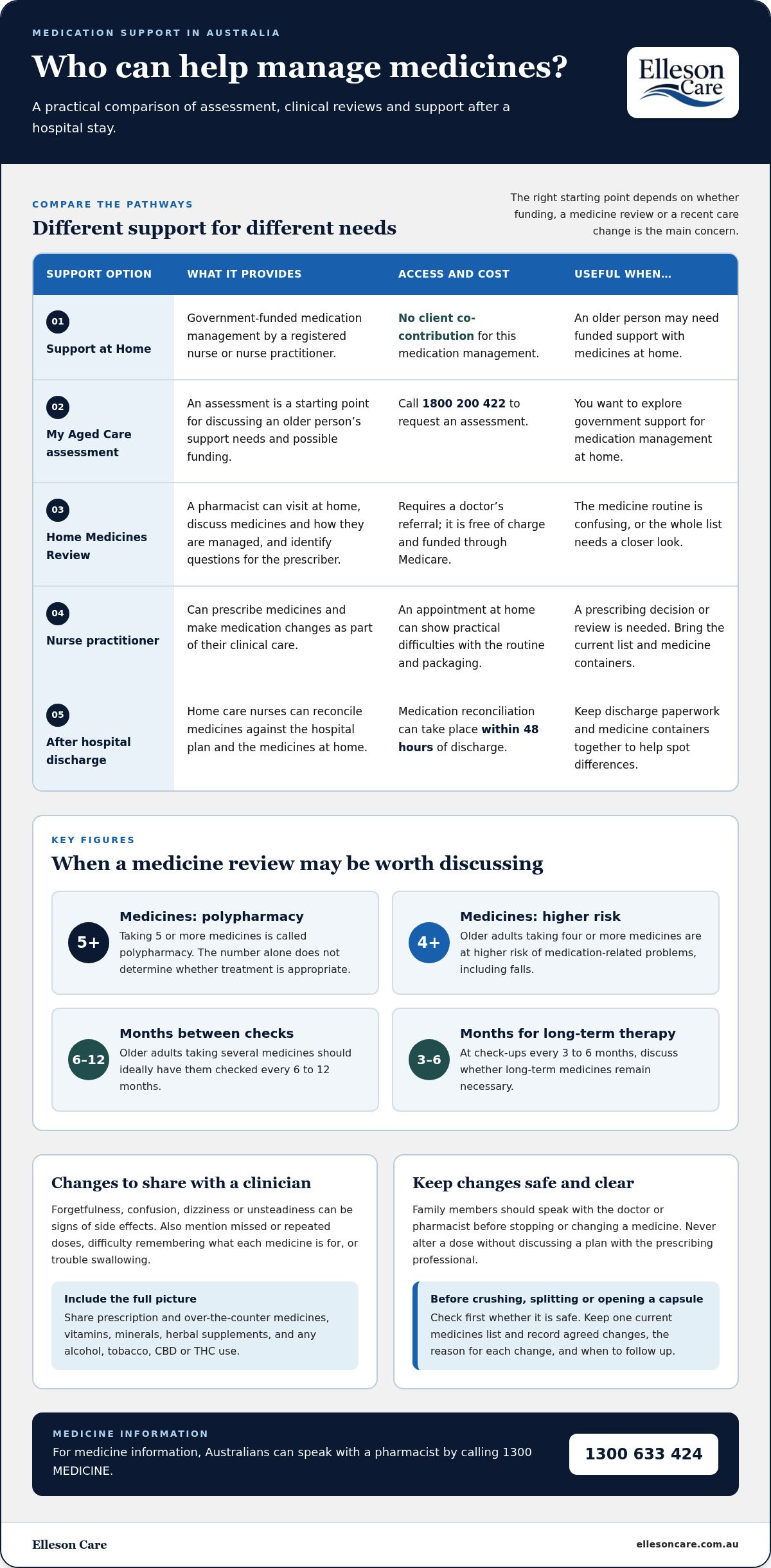
A nurse practitioner in Australia can prescribe independently and make medication decisions within their clinical scope; family members should speak with the doctor or pharmacist before stopping or changing a medicine. Managing medications for elderly parents can become more complex when several prescriptions, supplements and health conditions overlap. In Australia, taking 5 or more medicines is called polypharmacy, making a current, accurate record especially useful.
It’s understandable to want to help while respecting your parent’s independence and keeping their care safe. This guide explains who can change medicines at home, what support may be available in Australia, and how to organise an up-to-date medicines list and prescription records. It also covers the added complexity of managing medicines across home, community and aged care, so you can prepare for conversations with your parent’s healthcare team.
Key Takeaways
- Understand who can prescribe or change medicines, and why family members should speak with a doctor or pharmacist before making changes.
- Find out how to request an aged care assessment for possible funding through My Aged Care.
- Keep one current list of medicines, including each medicine’s purpose, dose and frequency, and update it after care changes.
- Save prescription records and share an accurate medicine history with the healthcare professionals involved in your parent’s care.
- Recognise when a complex medicine routine may need clinical support, particularly across home and aged care settings.
1. Is medication management covered by the government?
To help an older parent manage medicines safely in Australia, keep a current list and arrange a review if their routine becomes difficult. Don’t stop or change a medicine yourself. Discuss concerns with their doctor or pharmacist, especially after a hospital stay.
Government support can help with medication management at home. Under Support at Home, government-funded medication management by a registered nurse or nurse practitioner has no client co-contribution. Families can contact My Aged Care on 1800 200 422 to request an assessment for funding, according to the Australian Government Department of Health, Disability and Ageing. The assessment is a practical starting point for discussing the older person’s support needs.
Look for changes that could signal a medicine is causing problems or becoming harder to manage. Older adults taking four or more medicines are at higher risk of medication-related problems, including falls. Forgetfulness, confusion, dizziness and unsteadiness can be signs of side effects. A parent who misses or repeats doses, or can’t recall what each medicine is for, may need more support. Share these examples with their doctor or pharmacist instead of guessing at the cause.
Swallowing can also affect whether a medicine routine is safe. Watch for tablets left behind, coughing while swallowing, refusal, or a long time spent taking medicines. Don’t crush, split or open a capsule without first checking whether that is safe. If a question arises between appointments, call the prescribing doctor’s office; for medicine information, Australians can speak with a pharmacist by calling 1300 MEDICINE on 1300 633 424.
A hospital discharge is a key moment to reconcile medicines. Home care nurses can conduct medication reconciliation within 48 hours of discharge, helping identify changes between the hospital plan and medicines at home. Keep discharge paperwork and medicine containers together so the current list can be compared with the instructions. This can help make discrepancies visible before they become a missed or duplicated dose.
Another option is a Home Medicines Review, which requires a doctor’s referral and is free of charge. A pharmacist can visit your parent at home to discuss their medicines and how to manage them. When offering help, focus on a specific task, such as sorting a confusing list, rather than taking control of every dose. Ask what support would be useful and involve your parent in decisions wherever possible. This can ease family stress while respecting their independence.
2. Can a nurse practitioner change my parent's medications at home?
Yes. In Australia, nurse practitioners have independent prescribing authority, so they can prescribe medicines and make changes as part of their clinical care. A home appointment can give the practitioner a clearer picture of your parent’s routine, medicine packaging and practical difficulties. Bring the current list, prescription containers and details of recent changes to support a useful discussion.
A medication review looks beyond prescriptions. The practitioner or pharmacist can consider over-the-counter medicines, vitamins, minerals and herbal supplements alongside prescribed treatment. Mention alcohol, tobacco, and any CBD or THC use, as these details can affect treatment decisions. For example, a supplement may interact with a prescribed medicine, while confusion or dizziness may prompt a review of possible side effects.
In Australia, taking 5 medicines is called polypharmacy. The number alone does not determine whether treatment is appropriate, but it can be a useful prompt to review the whole regimen. Older adults taking several medicines should ideally have them checked every 6 to 12 months. For people on long-term therapy, discuss whether medicines remain necessary during check-ups every 3 to 6 months.
A Home Medicines Review (HMR) is a pharmacist-led option. It requires a doctor’s referral and is funded through Medicare. The pharmacist can visit your parent at home, discuss how each medicine is used and identify questions for the prescriber. Have the medicine list and packaging ready, including products bought without a prescription. The pharmacist’s findings can help the doctor and other providers consider a safer, clearer routine.
Medication therapy management also means reviewing whether each medicine still fits your parent’s health needs and quality-of-life priorities. They may want to reduce drowsiness, simplify dose times or focus on comfort. Share these goals with the prescriber. Deprescribing means reducing or stopping a medicine under clinical guidance when its risks outweigh its benefits. Never stop a medicine suddenly or alter its dose without discussing a plan with the prescribing professional.
Ask the doctor to review the complete list, not just the medicine linked to the latest concern. This can reveal medicines with overlapping effects, possible interactions or a prescription added to treat another medicine’s side effect. A prescribing cascade can develop when one medicine causes a problem, another is added, and further effects lead to still more treatment. Reviewing the sequence may clarify which symptoms and medicines need discussion.
After a review, record the agreed changes, the reason for each change and when to follow up. Ask who will update the medication list and how your parent should remember any new instructions. Clear records help your parent, family and providers follow the same plan.
3. Keeping a current medicines list
A single, current medicines list gives your parent and their healthcare team a shared reference. Write down each medicine’s name, purpose, dosage and frequency, including instructions such as “take with food”. Include prescription medicines, over-the-counter products, vitamins and complementary medicines. Products bought without a prescription can still matter when a doctor assesses effects, side effects or possible interactions. When managing medications for elderly parents, a clear list helps coordinate information across appointments and care settings.
Start by comparing the written list with every medicine container at home. Check each label against what your parent currently takes rather than assuming an old list is still accurate. For example, if a label says one tablet daily but your parent recalls a recent dose change, note the discrepancy and raise it with the prescriber. Don’t change the medicine based on the discrepancy.
For each entry, record the details a clinician needs to identify the medicine and understand its place in the routine:
- Name: copy it from the packet or container, including the strength if shown.
- Purpose: note the condition or symptom it treats, using the explanation provided by the healthcare professional.
- Dosage and frequency: record the amount and when it is taken, following the current instructions.
- Other products: include vitamins, herbal remedies and medicines bought over the counter.
Update the list after every doctor’s appointment, emergency department visit or hospital discharge. Record changes, remove medicines stopped under professional guidance, and note when the list was updated. A hospital discharge summary can help identify changes, but compare it with the medicines at home. If the instructions conflict, contact the treating team for clarification before making changes.
Bring the list to every healthcare appointment, including visits with specialists and pharmacists. Your parent’s primary care provider may not automatically receive medicine changes made by other providers. Reviewing the list together can help identify duplication, missing details or concerns about side effects. For a parent managing chronic conditions, an accurate record also helps each clinician see the wider medicine routine.
A separate medication log can record what was taken and when. Mark doses after they’re taken, rather than relying on memory later. If a dose is missed or your parent is unsure, record that clearly and follow the medicine’s instructions or seek professional guidance. The log should record what happened, not encourage doubling a later dose.
Keep the current list in one accessible place, such as a folder with appointment papers, and make sure your parent knows where it is. Replace outdated copies so family members don’t accidentally use an old version. A reliable record is a practical tool for managing medications for elderly parents, especially when several people help with appointments or daily care. Before an appointment, check that the list matches the medicine containers and log, then bring all three records for discussion.
4. Saving eScripts and paper prescription records
A carer can help organise prescriptions and communicate with your parent’s doctor or pharmacist. Your parent’s agreement and the pharmacy’s or practice’s privacy process matter when sharing personal medicine details. Agree on how your parent wants you to help, then follow the service’s process.
Keep eScripts and paper prescriptions in one organised place. For electronic prescriptions, save the token message where your parent can find it, and don’t delete it before dispensing. Store paper prescriptions with current medicine records, separate from expired scripts. Good prescription records are part of managing medications for elderly parents, particularly when more than one family member helps coordinate refills.
For each prescription, note the medicine name, strength, prescriber, pharmacy, date issued and any repeats shown. Check the remaining repeats and supply before the medicine runs low. For example, if your parent takes regular diabetes medicine, note when a new prescription is needed. Don’t assume an earlier script remains suitable after a treatment change.
Using one pharmacy for all prescriptions can help reduce the risk of interactions or similar medicines being supplied by different prescribers. Give the pharmacist current medicine details, including over-the-counter products, vitamins and supplements. If a new prescription appears to duplicate an existing medicine, ask the pharmacist or prescriber to clarify the instructions before changing the routine.
Contact the GP, prescribing clinician or pharmacist if a label conflicts with the written plan, the medicine looks different, or your parent reports unexpected effects. Keep the packaging and prescription details handy during the conversation. Don’t stop a medicine, change its dose or add a supplement without professional advice, as these changes can affect treatment.
A prescribing cascade can happen when a medicine causes a side effect, another medicine is added to treat it, and further effects lead to more medicines. If a new prescription follows a symptom, note the timeline and ask the doctor whether an existing medicine could be related. The doctor can review the regimen and consider whether a different treatment approach may reduce side effects.
If your parent forgets a dose or takes the wrong medicine, note what happened and contact their pharmacist or doctor for instructions. Don’t give an extra dose unless a healthcare professional directs you to. If you suspect an overdose, seek urgent medical advice. Trouble swallowing or breathing after taking a medicine requires immediate emergency department care, and no further dose should be taken.
Keep records ready for these conversations. Australians can call 1300 MEDICINE on 1300 633 424 to speak with a pharmacist about medicines. Note the advice and any next steps, then update the prescription records. Organising eScripts and paper copies is a straightforward part of managing medications for elderly parents, and helps family members work from the same information.
5. Medication complexity in the community and aged care
Medication routines can become difficult when an older person moves between home, community services and hospital care. Each setting may involve different clinicians, records and instructions. A medicine started in hospital may continue at home unless someone checks the discharge plan against the current list. Keep the discharge paperwork and medicine containers together for comparison.
Polypharmacy is common among older adults managing several health conditions. Taking 5 or more medicines is called polypharmacy, and some people with multiple chronic conditions manage eight to twelve different medications daily. More medicines can mean more opportunities for duplicated treatment, missed doses or interactions. The practical takeaway is to review the whole routine, not just the latest prescription.
Ageing can also change how the body handles medicines. The kidneys and liver metabolise medicines, and changes in their function can mean a previously suitable dose may no longer fit. Blood pressure and diabetes medicines may need close monitoring as health conditions change. At appointments, describe changes such as dizziness, confusion or unsteadiness, and ask whether medicines could be contributing.
Keep a clear handover whenever care changes. After a hospital discharge or clinical appointment, record which medicines were started, stopped or adjusted, and who gave the instructions. Share the updated record with your parent’s GP, pharmacist and relevant care workers. If records conflict, seek clarification rather than choosing one version yourself.
Community support can help with practical routines, while clinical decisions remain with authorised health professionals. A nurse can support medication management, and home care nurses can administer insulin and other injectable medicines. The Support at Home program was introduced in November 2025. For an older person receiving support at home, identify who monitors the routine and how changes are communicated to the prescriber.
Difficulties can also show up in day-to-day behaviour. Your parent may struggle to remember doses, resist assistance or have trouble swallowing tablets. Note the specific issue, when it happens and which medicines are involved. Bring those details to the next appointment so the healthcare team can consider practical barriers alongside treatment effects.
Medication-related problems cause an estimated 250,000 hospital admissions in Australia each year. That figure makes clear why accurate handovers and monitoring matter across community and aged care. For support with clinical care needs at home, explore clinical support for medication needs.
Elleson Care: Aged Care Services
Elleson Care provides Aged Care Services and Clinical Support for people with health and care needs at home in Perth. These services may be relevant when medicine routines are part of broader clinical needs, such as care after a hospital stay or support alongside ongoing health conditions. Medicines must still be prescribed or changed by an authorised health professional. A clear, current list helps family members and care teams stay informed.
If your family needs support beyond organising prescription records, consider how aged care or clinical support could fit your parent’s circumstances. Elleson Care also provides NDIS Support Services for participants. The right support depends on the person’s needs and care arrangements.
For a considered conversation about support, contact Elleson Care or visit ellesoncare.com.au.
Make the next care conversation count
A useful next step in managing medications for elderly parents is to agree on the help your parent wants, rather than making every decision for them. Choose one concern to discuss together, such as uncertainty about who coordinates their care or how family can support their choices. This keeps the conversation focused and gives your parent room to say what matters to them.
When medication needs are part of broader care, the right support can help families consider a person’s wellbeing and daily circumstances alongside clinical needs. Elleson Care provides Aged Care Services, NDIS Support Services and Clinical Support in Perth. These services may suit people and families seeking support with aged care, disability or clinical needs.
If you’d like to discuss what support may fit your family’s circumstances, contact Elleson Care to discuss support. A considered conversation can help you take the next step with your parent’s preferences at the centre.
Frequently Asked Questions
Can a nurse practitioner change my parent's medications at home?
Yes, nurse practitioners in Australia have independent prescribing authority and can make medication decisions during home-based care. Bring your parent’s current medicine packaging and any recent discharge instructions so the practitioner can see what they’re taking. Explain the change you’re concerned about, such as increased drowsiness after a new prescription. Don’t adjust doses before the clinician has reviewed the situation and explained the plan.
How can I organise my medicines?
Choose one accessible place for the medicine routine, away from children and heat, and keep the current instructions nearby. A medication planner can show scheduled doses, while alarms or reminders can prompt doses at agreed times. If you use a weekly dosing aid, arrange for it to be filled accurately and compare it with the current directions. Keep medicines in their original packaging until a pharmacist advises otherwise.
How can I use my medicines safely?
Follow the current label and prescriber’s instructions, and ask before changing a dose or adding a supplement. For example, garlic supplements can interact with blood thinners, so mention supplements during medicine discussions. Don’t crush, split or open capsules unless a pharmacist or prescriber confirms it’s safe. If your parent has trouble swallowing or breathing after taking a medicine, stop giving it and seek emergency care immediately.
How common are medication errors in elderly Australians?
Medication-related problems are a significant safety concern for older Australians. An estimated 250,000 hospital admissions in Australia each year are linked to medication-related problems. These problems can include incorrect doses, missed or duplicated medicines, unnecessary treatment and adverse reactions. That figure describes hospital admissions related to medication problems, not a count of every medication error. A written dose log can help families spot inconsistencies and discuss them with clinicians.
Is medication management covered by the government?
Government-funded medication management by a registered nurse or nurse practitioner under Support at Home requires no client co-contribution. To explore assessment and possible funding, families can call My Aged Care on 1800 200 422. Keep details of the older person’s daily routine and the specific difficulties they face ready for the conversation. Support depends on assessment, and clinical decisions about medicines remain with qualified health professionals.
So, where do you start?
Start by asking your parent which part of their medicine routine feels difficult, then agree on one practical next step. For example, if they’re unsure whether they took a dose, begin a simple log and raise the concern at their next appointment. If they’ve recently been in hospital, bring the discharge paperwork to the discussion. This approach supports their involvement while giving clinicians useful context.
What is a Webster-pak and how do I get one for my parent?
A Webster-pak is a pharmacy-prepared pack that organises medicines by day and time. It can make dose timing easier to see and help family members notice an untaken compartment. Ask your parent’s pharmacist whether this packaging suits their medicines and routine. Before starting, make sure the pharmacist has current prescription details and knows about over-the-counter medicines or supplements. A pack doesn’t replace checking instructions or seeking advice about changes.
What medication review services are available for older Australians through a GP or pharmacist?
A GP can review the full medicine routine and refer an older person for a Home Medicines Review. Under this service, a pharmacist visits the person at home to discuss their medicines and practical concerns. The review is funded through Medicare and requires a GP referral. Older adults taking several medicines can also discuss regular reviews with their care team, especially if their health, symptoms or treatment goals have changed.


