

A formal diagnosis matters, but it isn’t the whole NDIS access decision. If you’re wondering how to apply for NDIS in WA, start by gathering evidence that explains the disability or developmental delay and its effect on everyday life. The application is assessed against eligibility criteria, not a diagnosis label alone. According to the National Disability Insurance Agency (NDIA), it will tell you whether you’re eligible within 90 days after receiving your application and all supporting evidence.
It’s understandable to feel unsure about applying while reports are being gathered or a diagnosis is unclear. Knowing how to apply for NDIS in WA can help you understand what evidence to prepare and what steps come next, whether you live in Perth or regional Western Australia.
This guide explains the eligibility requirements, how to prepare and submit an application, and what to expect from assessment and worker screening. It also clarifies how diagnosis and supporting reports fit into the process, so you can take the next step with a clearer sense of what to prepare.
Key Takeaways
- A formal diagnosis is not the only useful evidence; prepare reports that explain how the condition affects everyday functioning.
- Check the age and disability or developmental delay requirements before starting an access request, as the appropriate pathway can depend on age.
- Submit a complete application with supporting evidence. The NDIA says it will tell you whether you’re eligible within 90 days after receiving both.
- Keep NDIS access and worker screening separate: a worker screening check has its own WA application steps and identity document requirements.
- Learn how access pathways and support options can apply across Perth and regional WA, then consider what assistance may help with your next steps.
Can I withdraw my application?
- Contact the NDIA if you want to stop the process. Explain that you want to withdraw your NDIS access request and ask what happens next. Call the NDIA on 1800 800 110, Monday to Friday, 8am-8pm. Keep a note of when you called and any instructions provided. If your circumstances have changed, explain what has changed before deciding whether to stop.
- Separate access applications from worker screening fees. The NDIS access request is different from an NDIS Check application for workers. In Western Australia, an NDIS Check costs A$145 for a paid employee and A$11 for a volunteer or unpaid worker. An eligible concession card holder pays A$80. These are screening application costs, not a fee schedule for NDIS participant access.
- Allow time for evidence and processing. Gathering reports for an application can take time, and missing or incomplete supporting evidence may extend the process. A well-prepared application in WA typically takes 2-4 months from starting the process to receiving a funded plan. The fast path is estimated at 4-8 weeks, while the slow path may take 3-6+ months.
- Distinguish the decision estimate from the full pathway. An NDIS eligibility decision in WA often takes 4-8 weeks in practice. Eligibility decisions can take time after an application is submitted. Separately, the NDIA says it will tell applicants whether they’re eligible within 90 days after receiving the application and all supporting evidence. A funded plan involves steps beyond the access decision.
- Follow up on the application status. If you’re waiting for an update, contact the NDIA on 1800 800 110 during its access-request phone hours. Have your application details ready and note whether the NDIA needs more evidence. NDIS Check applications are separate and may take days, weeks or longer to process, so don’t treat worker-screening progress as an access decision.
- Plan for work while your request is pending. An NDIS access request and paid employment are separate matters. Keep working arrangements and any disability-related support needs clear in your records. If your work situation changes while you wait, update the details in your application or raise the change when contacting the NDIA. Don’t assume that applying alone changes your employment arrangements.
Can I apply for the NDIS without a formal diagnosis?
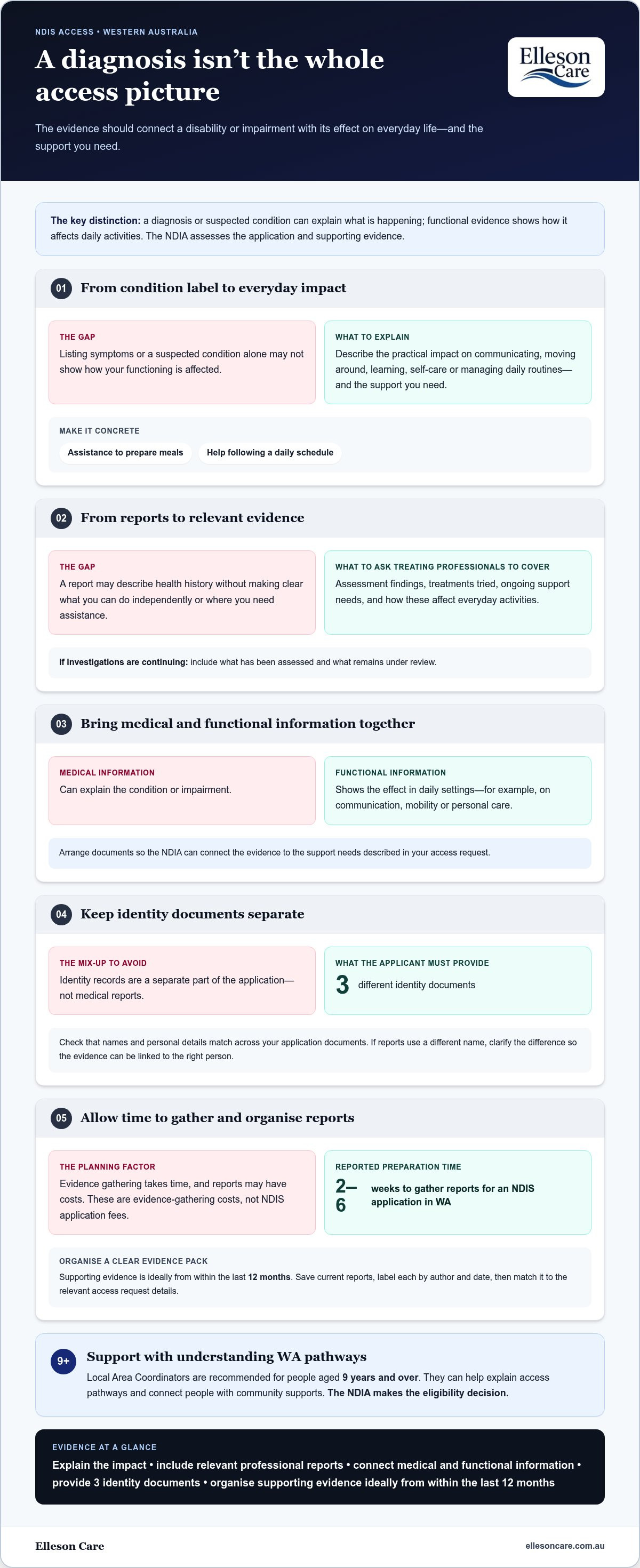
A final diagnosis is not the only relevant information in an NDIS access request. Your evidence should describe the disability or impairment, how it affects daily activities and the support you need.
In Western Australia, Local Area Coordinators are recommended for people aged 9 years and over. They can help you understand access pathways and connect with community supports, but the NDIA makes the eligibility decision.
- Describe how your condition affects everyday life. Explain the practical impact on tasks such as communicating, moving around, learning, self-care or managing daily routines. Use specific examples, such as needing assistance to prepare meals or follow a daily schedule. The purpose is to show how the impairment affects your functioning, not only to list symptoms or a suspected condition.
- Ask health professionals for relevant evidence. Reports from treating professionals can explain your health history, assessment findings, treatments tried and ongoing support needs. Ask them to describe what you can do independently, where you need assistance and how your needs affect daily activities. If investigations are continuing, include what has been assessed and what remains under review.
- Include medical and functional information together. Medical evidence can explain the condition or impairment, while functional evidence shows its effect in daily settings. For example, a report may describe a health condition and explain how it affects communication, mobility or personal care. Arrange the documents so the NDIA can connect the evidence to the support needs described in your access request.
- Gather identity documents separately. An NDIS applicant must provide 3 different identity documents. Keep identity records distinct from medical reports, and check that the names and personal details across your application documents match. If your reports use a different name, clarify the difference in your application so the evidence can be linked to the right person.
- Plan for report costs and preparation time. Gathering reports for an NDIS application in WA typically takes 2-6 weeks. These are evidence-gathering costs, not NDIS application fees.
- Organise and submit a clear evidence pack. Supporting evidence is ideally from within the last 12 months. Download and save current reports, label each document by author and date, then match it to the relevant access request details. If you need support with health needs while preparing your records, Clinical Support may be relevant.
NDIS eligibility requirements in Western Australia
Use these steps to organise your eligibility information before submitting an access request. The NDIA assesses your application and supporting evidence before making a decision.
-
Review the eligibility criteria
Check the age requirement first: a complete NDIS application must be submitted before you turn 65. Then consider whether your information explains the disability or impairment and its impact on everyday functioning. Focus on the evidence and support needs relevant to your circumstances, rather than relying on a diagnosis label alone. Avoid leaving the application until the last moment, as the age requirement applies when you submit a complete application.
-
Prepare eligibility information and evidence
Collect information that helps the NDIA understand your situation, including relevant reports from treating health professionals and examples of daily support needs. Keep details consistent across your forms and documents, and explain how each report relates to your circumstances. If you’re an Australian applicant preparing evidence, organise it so the decision-maker can follow the connection between the impairment, its functional effects and the supports you need.
-
Complete the eligibility assessment
Submit your access request with the information needed to assess your eligibility. The NDIA reviews your application and supporting evidence before deciding whether you meet the requirements. Read each question carefully, answer it directly and include relevant documents. If the NDIA requests more information, respond to the specific point with relevant evidence rather than sending unrelated material.
- Record the decision and review your options. If the NDIA declines your application, read the decision carefully and identify which eligibility requirement or evidence issue affected the outcome. In Australia, you can request an internal review within three months of a declined application. Prepare information that responds to the reasons in the decision, and keep a copy of your request and supporting documents.
- Consider applying again if your circumstances change. You can apply to the NDIS again if your situation changes and you have more information and evidence that may show you’re eligible. For example, new reports may explain functional effects that weren’t clear in your earlier application. Organise the updated evidence around what has changed, what it demonstrates and how it relates to the eligibility requirements.
Assessment information and screening
NDIS access assessment and worker screening are separate processes in Western Australia. Follow these steps to prepare for the process relevant to you.
- Identify which assessment you need. An NDIS access assessment considers whether an applicant meets participant eligibility requirements. An NDIS worker screening check assesses whether a person is suitable for NDIS work. A worker check does not decide access to participant funding, and an access decision does not replace worker screening.
- Start a WA worker check through DoTDirect. Log in to or register for a DoTDirect account, then select “NDIS” in the top toolbar. The Western Australian NDIS Check process is governed by the National Disability Insurance Scheme (Worker Screening) Act 2020. A person who lives, or intends to live, in WA, or is engaged or proposed for NDIS work there, may apply through the WA Screening Unit.
- Prepare the required identity documents. A WA NDIS Check applicant provides four identity documents: one commencement of identity document, one primary use in the community document and two secondary use in the community documents. Bring original documents. Together, they must show your full name, date of birth and photograph. Each document can be used only once across the three categories.
- Complete identity verification and the application process. The WA worker screening check involves three steps. After applying online, attend a Department of Transport Driver and Vehicle Services Centre to complete the process, unless you can use alternate lodgement. The Department of Transport and Major Infrastructure conducts checks on behalf of the Department of Communities and the NDIS.
- Understand who assesses the screening information. The Department of Communities Screening Unit assesses worker check applications and advises applicants of the outcome. Its assessment considers national criminal history, NDIS Commission disciplinary and misconduct information, your application self-disclosure and other information relevant to suitability. The transport department supports the application process but does not assess screening applications.
- Keep screening requirements separate from access evidence. For an NDIS access request, organise the documents that explain eligibility and support needs. For worker screening, focus on the identity categories and suitability information requested through the WA process. If your identity documents show a former name, provide evidence of the name change as well. A worker check clearance issued in any Australian state or territory can be used across Australia while valid. According to the Department of Communities, Western Australia, a clearance is valid for five years, subject to ongoing monitoring.
NDIS access in Perth and regional WA
For an NDIS access request form, contact the NDIA on 1800 800 110, Monday to Friday, 8am-8pm. In Western Australia, Local Area Coordinators can help eligible age groups understand access pathways and connect with community supports.
-
Find access support in WA
Start by identifying the pathway relevant to your age and circumstances. In WA, Local Area Coordinators are recommended for people aged 9 years and over. The NDIS early childhood approach supports children younger than 6 with developmental delay, and children younger than 9 with disability, alongside their families.
If you live outside Perth, use the same age and evidence considerations when preparing your access request. Contact the NDIA to find out who your NDIS partner is if you’re unsure. The NDIA phone line is open Monday to Friday, 8am-8pm, and can help you connect with the relevant access pathway.
-
Get an access request form or application help
Contact the NDIA to ask about the access request form and how to submit it. If you prefer a paper application, you can mail a completed NDIS application to the NDIA at GPO Box 700, Canberra ACT 2601. Keep a copy of your completed form and supporting documents before sending them.
For application help, a Local Area Coordinator can explain the access process for people aged 9 years and over. Families of children younger than 9 can ask about the early childhood approach. These supports can help you understand the next step, but the NDIA assesses the application and decides eligibility.
- Prepare for distance and access needs. To understand how to apply for NDIS in WA, write down your questions and the assistance you need to complete forms. For example, note whether you need help understanding a section, organising reports or communicating your support needs. This helps keep the conversation focused, whether you’re in metropolitan Perth or a regional community.
- Keep a clear record as you submit. Record the date you sent your application, how you submitted it and which supporting documents you included. If you mailed it from regional WA, retain your copy and note the destination address. When following up, refer to the application details and ask whether further information is required.
- Plan the next support conversation. When planning how to apply for NDIS in WA, write down what you need help with after the access request, such as understanding the process or discussing disability-related supports. If you’d like to explore support options alongside your application preparation, discuss your NDIS support needs.
Elleson Care: Aged Care Services
Elleson Care can support you alongside an NDIS application or after you receive a plan. Its NDIS Support Services and Clinical Support may suit people seeking person-centred disability support or nursing care, including wound management and post-hospital care. The NDIA assesses access and decides eligibility; Elleson Care provides care and support, not application decisions.
If you need support related to ageing, Elleson Care also offers Aged Care Services. Support is tailored to individual circumstances and delivered with dignity, through a holistic approach to healthcare and disability support. Contact Elleson Care when you’re ready to discuss care suited to your situation.
Contact Elleson Care to discuss your support needs.
Take your next step with a clear support plan
Understanding how to apply for NDIS in WA is one part of planning the support that feels right for you. Keep your priorities at the centre of each conversation: what would make daily life more manageable, which support matters most, and how would you like it delivered?
These priorities can guide conversations about care alongside the access process. Elleson Care provides NDIS Support Services and Clinical Support for people seeking disability and health-related care, as well as Aged Care Services for older people. The team takes a person-centred approach, shaping support around individual circumstances and dignity.
Contact Elleson Care to discuss the support you’re looking for and the next practical step. Contact Elleson Care for application support.
Take the process at your own pace, keeping your needs and preferences in every decision.
Frequently Asked Questions
Do I need an OT report to apply?
An occupational therapy (OT) report can support an application, but the evidence needs to explain your individual functional support needs. Ask your treating professionals what information they can provide, such as how an impairment affects daily activities or what assistance you require. Other evidence, including reports from treating specialists, may also help explain your circumstances.
How long does an NDIS application take in WA?
From preparation to a funded plan, a well-prepared application in WA typically takes 2-4 months. The time can vary depending on how quickly reports are gathered and whether the NDIA needs further information. An eligibility decision is only one stage; planning and activation follow approval. Keep copies of what you submit and respond to requests for information promptly to help keep your application moving.
How can I check the status of my application?
Contact the NDIA on 1800 800 110 to ask about your access request. The phone line for access requests is open Monday to Friday, 8am-8pm. Have your identifying details and application information ready, then ask whether your request has been received and if further evidence is needed. Write down the date of your call and any next steps, so you can follow up consistently.
How long will it take to process my application?
The NDIA says it will tell you whether you’re eligible within 90 days after receiving your application and all supporting evidence. In practice, an eligibility decision in WA often takes 4-8 weeks. These timeframes describe the access decision, not necessarily the full journey to a funded plan. If evidence is outstanding, organise it and provide it as soon as possible, as complete information can help your application move forward.
Is the NDIS available in regional WA?
Yes, people in regional Western Australia can apply for NDIS access under the same eligibility requirements as applicants in Perth. The relevant pathway can depend on age: Local Area Coordinators are recommended for people aged 9 years and over, while the early childhood approach supports eligible younger children and their families. If you’re unsure who your NDIS partner is, contact the NDIA and ask which access support applies to your location.
What does it cost to apply?
Costs may arise when you prepare supporting evidence, rather than from the access decision itself. These figures relate to evidence, not a complete application budget. Before arranging reports, ask each professional about the assessment required and any applicable rebates.
What are the application fees?
NDIS participant access and an NDIS Check for workers are separate applications. In WA, an NDIS Check costs A$145 for a paid employee and A$11 for a volunteer or unpaid worker. An eligible concession card holder pays A$80 for an NDIS Check application. These fees apply to worker screening, not participant access. Check which process you’re completing before budgeting or paying an application charge.
What identification documents will I need?
For an NDIS participant application, prepare 3 different identity documents. Worker screening has separate requirements: a WA NDIS Check applicant must provide four identity documents, one commencement of identity, one primary use in the community and two secondary use in the community documents. Bring original documents for worker screening, and ensure they collectively show your full name, date of birth and photograph. Don’t use the screening checklist as your participant application checklist.


