

What if the difference between a safe night at home and an emergency trip to Royal Perth Hospital wasn't just a matter of care, but a matter of clinical expertise? For many families across Western Australia, the line between daily assistance and complex clinical care often feels blurred. You may feel overwhelmed by technical jargon or fear that a lack of professional oversight could lead to avoidable hospitalisation. It's a heavy burden to carry, especially when you're trying to determine how to secure NDIS funding for nursing support Perth to keep your loved one safe.
We understand that managing complex health needs is about more than just paperwork; it's about the peace of mind that comes with professional clinical standards. This guide clarifies exactly what nursing tasks the NDIS funds, helping you distinguish between general support and specialised clinical care. We'll preview the evidence required for your next planning meeting and explain how local providers meet the latest 2025-26 pricing arrangements. By the end, you'll feel confident in your ability to advocate for the professional support needed to maintain safety and dignity at home.
Key Takeaways
- Learn how to identify clinical nursing care under the Disability-Related Health Supports category to ensure your funding matches your medical requirements.
- Understand the distinction between standard care and High Intensity Daily Personal Activities that specifically require the expertise of a Registered Nurse.
- Discover how to navigate NDIS funding for nursing support Perth by gathering the right clinical evidence from GPs and specialists before your planning meeting.
- Identify the specific complex health supports covered by the NDIS, such as enteral feeding management and professional wound care.
- Find out how local, Perth-based expertise can help you maintain safety and dignity at home through evidence-based nursing practices.
What is NDIS Funding for Nursing Support in Perth?
Accessing clinical care at home is a vital part of maintaining independence for many West Australians living with complex needs. When we discuss NDIS nursing, we aren't referring to general assistance with daily tasks. Instead, this term describes clinical care delivered by qualified professionals, specifically a Registered Nurse (RN) or an Enrolled Nurse (EN). This level of support ensures that medical needs are managed with the precision and safety that only clinical training provides.
This support is categorised under 'Disability-Related Health Supports' within the National Disability Insurance Scheme (NDIS). It's a specific stream of funding designed to manage health conditions that arise directly from a person's disability. For families in Perth, securing NDIS funding for nursing support Perth is often the deciding factor in whether a loved one can remain in their own home or must face long-term hospitalisation or a move into an aged care facility. It's about providing a stable, clinical foundation that allows individuals to live with dignity in their own community.
The Role of the NDIS in Clinical Care
It's helpful to understand where the NDIS starts and the WA State health system ends. Generally, the State government funds acute health needs, such as emergency surgery or treating a temporary illness. However, when a health requirement is a direct result of a disability, it falls under the NDIS. To qualify, the support must meet the 'reasonable and necessary' criteria. This means the nursing care must be effective, beneficial, and represent value for money while being tailored to the individual. In Western Australia, this prioritises person-centred care that respects the unique lifestyle and goals of the participant, ensuring they aren't just patients, but individuals with autonomy.
Who is Eligible for Nursing Support in WA?
Eligibility for this funding depends on the complexity of the clinical needs involved. Many participants who receive NDIS funding for nursing support Perth live with conditions such as spinal cord injuries, advanced neurological disorders, or other medically complex needs that require frequent monitoring. The NDIA evaluates whether these tasks require the high-level assessment skills of a Registered Nurse. By providing this clinical oversight, professional nursing services bridge the gap between hospital discharge and long-term stability at home. This specialised oversight helps prevent complications and ensures that Perth families have a reliable clinical partner in their corner.
Types of Nursing Care Funded by the NDIS
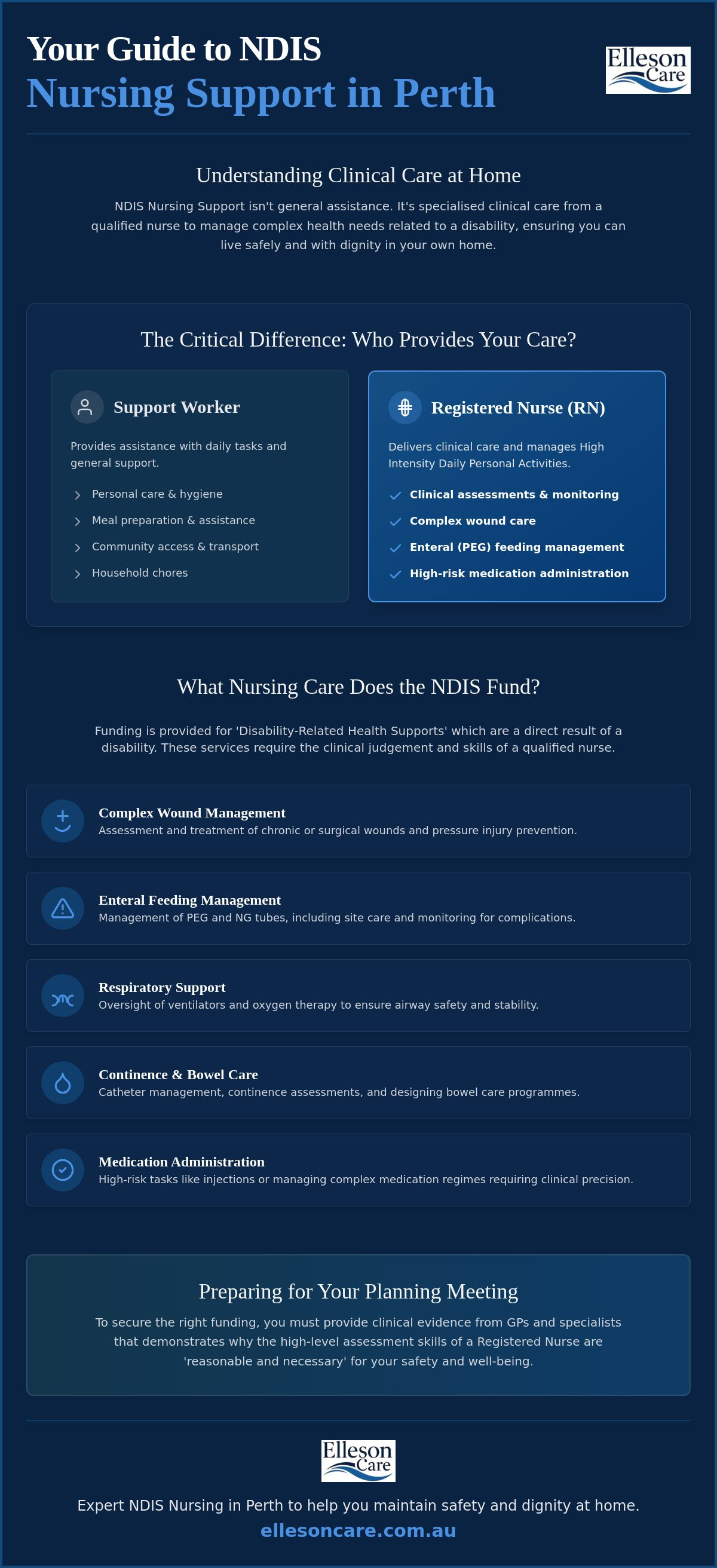
When exploring the specific types of clinical care available, it's essential to recognise that NDIS funding for nursing support Perth covers a broad spectrum of medical needs. This funding is designed to provide more than just the performance of a task; it ensures clinical oversight, risk assessment, and proactive health management. For many families, this professional intervention is what makes living at home a viable, safe reality. The NDIS typically provides funding for several key clinical areas:
- Complex wound management: This includes the assessment and treatment of chronic wounds, surgical incisions, or the implementation of rigorous pressure injury prevention strategies.
- Enteral feeding: Registered Nurses manage PEG and NG tube requirements, including site care, equipment monitoring, and troubleshooting complications.
- Respiratory support: This covers the management of ventilators and oxygen therapy, ensuring equipment is functioning correctly and the participant's breathing remains stable.
- Continence and bowel care: Nurses perform catheter changes, conduct comprehensive continence assessments, and design bowel management programmes to prevent secondary health issues.
- Medication administration: This involves high-risk tasks such as subcutaneous injections or managing complex medication schedules that require clinical precision.
Specialised Clinical Supports
Certain health conditions require a level of expertise that goes beyond basic care. For instance, ventilator and respiratory support necessitates constant oversight from a Registered Nurse to manage airway safety and respond to clinical changes immediately. Regular clinical reviews are a core component of this support. These reviews allow nurses to adjust care plans before a minor health issue escalates into a crisis. This integrated approach is particularly beneficial for individuals who may also be receiving in home aged care perth, as it ensures that clinical safety remains the absolute priority regardless of the funding stream. It provides a seamless transition of care that respects the participant's long-term well-being.
Training for Carers and Families
A significant benefit of the scheme is that it also funds nurses to provide education. Understanding how NDIS funding for nursing support Perth applies to training can help families feel more in control of their daily routines. This process, known as 'delegation of care', involves a Registered Nurse training and supervising support workers or family members to perform specific clinical tasks safely. The RN remains legally and clinically responsible for the outcome, which means they must establish strict safety protocols and conduct regular competency checks. This model empowers your support team while maintaining the high clinical standards required for high-risk tasks. If you feel your current support needs more professional oversight, speaking with a clinical expert can help you understand how to incorporate this training into your plan.
Registered Nurse vs. Support Worker: Why the Distinction Matters
It's a common misconception that a dedicated support worker can manage every aspect of a loved one's home care. While support workers provide invaluable assistance with daily living, they don't possess the clinical training required to manage complex medical interventions. This distinction is vital because clinical care involves more than just following a checklist; it requires professional assessment skills to identify subtle changes in a person's health. Relying on non-clinical staff for medical tasks increases the risk of adverse events, such as infections or equipment failure, which can lead to avoidable hospitalisation. Understanding the difference is the first step in securing the right NDIS funding for nursing support Perth to ensure your family remains safe.
The NDIS classifies specific tasks as 'High Intensity Daily Personal Activities'. These are supports where the risk of a mistake is high and the consequences are severe. When a participant requires tracheostomy care, complex bowel management, or ventilator monitoring, the expertise of a Registered Nurse (RN) becomes mandatory. A nurse doesn't just perform the task; they use clinical reasoning to evaluate the participant's overall well-being during every interaction. This high-level oversight ensures that care remains proactive rather than reactive, prioritising the individual's long-term health and personal dignity.
When is a Nurse Legally Required?
Australian nursing standards and the NDIS Pricing Arrangements and Price Limits (PAPL) 2025-26 v1.1 establish clear thresholds for clinical care. A nurse is legally required when a task involves professional judgment that exceeds the training of a support worker. For example, while a support worker might assist with basic hygiene, only a nurse should manage a complex wound or assess a potential pressure injury. Perth providers have a strict duty of care to ensure that staff are working within their scope of practice. If a task carries a high clinical risk, it must be performed or supervised by an RN to meet West Australian health standards and NDIS compliance requirements.
The Value of Clinical Oversight
The true value of a Registered Nurse lies in their ability to spot early warning signs of deterioration. An RN can identify the beginning of a chest infection or a minor skin breakdown long before it becomes a medical emergency. This professional oversight extends to coordinating care with your GP or specialist, ensuring that your medical team is always informed of your progress at home. This level of clinical security is especially important when families are looking for respite care perth. Knowing that a qualified professional is managing complex needs allows family carers to take a necessary break with total peace of mind. Securing NDIS funding for nursing support Perth ensures that this clinical safety net is always in place, protecting the health and stability of the entire household.
Navigating the NDIS Planning Meeting for Nursing Funding
Preparing for an NDIS planning meeting can feel like a daunting task, especially when your family's safety depends on securing specialised clinical care. The National Disability Insurance Agency (NDIA) operates on a framework of evidence. To approve NDIS funding for nursing support Perth, planners require clear, documented proof that the support is 'reasonable and necessary'. It isn't enough to simply state a diagnosis; you must demonstrate how the clinical need impacts daily life and what risks arise if professional oversight is absent. Approaching the meeting with a structured, evidence-based mindset is the most effective way to ensure your plan reflects your actual requirements.
One of the most critical steps is ensuring that 'Nursing Assessments' are included as a specific line item in your plan. These assessments allow a Registered Nurse to formally document your clinical needs, which then serves as the foundation for ongoing funding. During the meeting, use the 'impact on daily life' framework to explain how nursing care enables independence. For example, rather than just listing 'wound care', explain how professional management prevents infections that would otherwise lead to hospitalisation and a loss of community participation. This clinical reasoning helps the planner understand the value of the investment in your long-term well-being.
The Evidence Checklist for Perth Families
To build a strong case, you should gather a comprehensive folder of medical documentation before your meeting. Planners and Local Area Coordinators (LACs) rely on these reports to justify funding allocations. Your checklist should include:
- Recent clinical assessments from Registered Nurses or specialists.
- Hospital discharge summaries that highlight complex care requirements.
- Reports from therapists (OTs or Physios) that mention the need for clinical monitoring.
- A clear statement of risk, detailing the potential for 'adverse events' without professional nursing.
Using specific terminology from the NDIS Pricing Arrangements and Price Limits 2025-26, such as 'Disability-Related Health Supports', can also help align your request with the agency's internal language.
Transitioning from Perth Hospitals to Home
For families currently managing a discharge from major facilities like Fiona Stanley, Royal Perth Hospital, or Sir Charles Gairdner, the transition home is a high-risk period. A 'Community Transition Program' approach is often necessary to ensure a safe handover from hospital staff to home-based providers. This is where a support at home program becomes invaluable, particularly during the critical first 48 hours. By having NDIS funding for nursing support Perth already discussed or in place, you can ensure that clinical equipment is set up and safety protocols are established the moment you walk through your front door. If you need assistance gathering the right clinical evidence for your next meeting, contact our nursing team for professional guidance.
Why Choose Elleson Care for NDIS Nursing in Perth?
Elleson Care stands as a dedicated partner for families seeking clinical stability within the home environment. As a West Australian owned and operated organisation, we prioritise the local community's health standards and cultural values above all else. Our leadership consists of Registered Nurses with over 22 years of clinical experience. This ensures that every care plan is built on a foundation of professional excellence. We understand that managing NDIS funding for nursing support Perth is often just one part of a larger healthcare journey. It's why we offer integrated management across NDIS, Aged Care, and DVA services. This provides a seamless experience for families who might be navigating multiple funding streams simultaneously.
Our holistic 'family approach' recognises that a disability or chronic condition affects the entire household. We don't just see a patient; we see an individual with a life, a family, and a desire for autonomy. By bridging the gap between clinical necessity and human warmth, we create a supportive environment where safety and dignity coexist. This steady, reliable presence allows families to move away from the stress of crisis management and toward a lifestyle of stability and confidence. Our goal is to provide the clinical security you need to focus on what matters most: your quality of life.
A Nurse-Led Approach to Disability Support
Choosing a nurse-led organisation offers a distinct advantage over generic disability agencies. At Elleson Care, our Registered Nurses remain at the forefront of leadership. This ensures that clinical standards are never compromised for administrative convenience. Our "Compassionate Expert" model means staff possess the technical proficiency to manage high-risk tasks, such as ventilator and catheter care, while maintaining a gentle, service-oriented touch. We believe that clinical authority should always be delivered with kindness, ensuring that every participant feels respected and secure in their own home.
Your Local Perth Partner in Care
Our commitment to the Perth community is rooted in a deep respect for individual autonomy. We work closely with you to ensure that your care is person-centred, reflecting your personal goals and cultural background. Whether you're navigating a new diagnosis or seeking to improve your current level of support, we provide the steady guidance needed to secure NDIS funding for nursing support Perth that truly meets your needs. We're here to advocate for your safety and well-being every step of the way. Contact Elleson Care today to discuss your NDIS nursing needs and discover how our professional clinical support can help you stay safe and independent at home.
Securing Your Clinical Safety and Independence
Navigating the complexities of clinical care doesn't have to be a solitary journey. By understanding the clear distinction between general assistance and the high-level expertise of a Registered Nurse, you're better equipped to advocate for the safety your family deserves. Securing NDIS funding for nursing support Perth is a vital step toward preventing hospital readmissions and ensuring that complex health needs are handled with professional precision. It's about building a clinical foundation that prioritises your well-being and personal dignity above all else.
As you prepare for your next planning meeting, remember that clear clinical evidence is your strongest tool. Partnering with a nurse-led team ensures that your care plan is grounded in evidence-based practices and a deep respect for your autonomy. At Elleson Care, we bring over 22 years of clinical experience to every household we serve. As a West Australian owned and operated provider, we're specialists in complex ventilator and wound care, dedicated to helping you maintain comfort in your own community.
Secure Professional Nursing Support for Your NDIS Plan – Contact Elleson Care Perth
You have the right to feel safe and supported in your own home. We're here to help you turn that goal into a steady, reliable reality that respects your lifestyle and your future.
Frequently Asked Questions
Can the NDIS fund 24/7 nursing care at home in Perth?
The NDIS can fund 24/7 nursing care if it is deemed reasonable and necessary for your clinical safety and disability needs. This level of support is typically reserved for individuals with extremely high-intensity requirements, such as those needing continuous ventilator monitoring or frequent, complex airway management. To secure this, you'll need comprehensive clinical evidence from specialists that justifies why around-the-clock professional oversight is essential for your well-being.
What is the difference between a Registered Nurse and an Enrolled Nurse under NDIS?
A Registered Nurse (RN) has completed a higher level of clinical education and is responsible for complex assessments, care planning, and the supervision of other staff. An Enrolled Nurse (EN) provides essential clinical care under the direction and supervision of an RN. Under NDIS standards, certain high-risk clinical tasks must be performed or overseen by an RN to ensure the highest level of safety and compliance.
Does NDIS nursing funding cover the cost of medical consumables like bandages or tubes?
NDIS funding for nursing support Perth covers the professional service provided by the nurse, but it does not cover the cost of the medical items themselves. Consumables such as bandages, catheters, or feeding tubes are generally funded through your Core Supports budget under the 'Consumables' category. It's important to ensure your plan includes a sufficient budget in this area to match the clinical requirements identified by your nursing team.
How do I add nursing support to my existing NDIS plan?
To add nursing support, you usually need to request a plan reassessment or lodge a 'Change of Circumstances' form with the NDIA. You must provide clinical reports from your GP or specialist that clearly outline your disability-related health needs and explain why clinical nursing is required. These reports should highlight the risks of not having professional support and how nursing will help you achieve your goals.
Can I use my NDIS nursing funding for palliative care at home?
The NDIS does not fund palliative care, as this is the responsibility of the Western Australian State health system. However, the NDIS will continue to fund your disability-related health supports while you are receiving palliative care from a state-funded provider. We can coordinate with palliative care teams to ensure your clinical disability supports remain stable and respectful of your personal dignity during this time.
Will the NDIS fund a nurse to attend school or work with me in Perth?
Yes, the NDIS can fund a nurse to support you in educational or workplace settings if your clinical needs are a direct result of your disability. This ensures you can participate in community and economic life safely. This support must be specifically requested in your plan and justified as a necessary requirement for you to engage in school or work activities alongside your peers.
How does Elleson Care coordinate with my Perth-based specialists and GPs?
Our team maintains regular, professional communication with your medical specialists and GPs to ensure your care is consistent and evidence-based. We share clinical progress notes, attend multidisciplinary meetings, and adjust your home care plan based on their medical advice. This collaborative approach ensures that your NDIS funding for nursing support Perth is used effectively to support your broader health and recovery goals.
What happens if my NDIS nursing funding runs out before my plan review?
If your funding is depleted early, you can request an unscheduled plan reassessment due to a change in your support needs. We assist families by providing detailed clinical documentation that shows the NDIA why your funding was insufficient or why your needs have increased. This evidence is vital for securing the additional resources required to maintain your clinical safety and prevent a gap in your essential care.


