

If you were told that a significant portion of your aged care funding could be consumed by administrative overheads before a single nurse reached your door, would you feel confident in your 2026 care plan? It's completely natural to feel a sense of unease as the Support at Home program introduces eight new classifications and quarterly budget cycles. When it comes to getting the most out of your home care package, many Perth families worry that vital clinical needs, such as professional wound care or palliative support, might be lost in the transition. You've worked hard to maintain your independence, and you deserve to know that every dollar is working toward your health and comfort.
We understand these concerns because we see the impact of the new regulations on our local community every day. This guide is designed to help you navigate these changes, ensuring you maximise your funding by focusing on nurse-led support rather than generic domestic help. We'll provide a clear roadmap for your 2026 funding, explain how to avoid the hidden fees often associated with large national providers, and help you find a trusted West Australian partner who prioritises actual hours of care over paperwork.
Key Takeaways
- Understand the transition to the 2026 Support at Home program and how the eight new classification tiers determine your quarterly budget.
- Discover practical strategies for getting the most out of your home care package by auditing your service mix and identifying unnecessary administrative overheads.
- Learn why prioritising nurse-led clinical support, such as professional wound care and medication management, is the most effective way to maintain independence and prevent hospital readmissions.
- Identify the specific funding pathways available for short-term restorative care and end-of-life support to ensure your family receives the appropriate level of intensity during critical times.
- Recognise the importance of choosing a Perth-owned provider with clinical leadership to ensure your care plan is managed with local expertise and professional integrity.
The Shift to Support at Home: What WA Families Need to Know in 2026
The Support at Home program is now the established standard for Aged care in Australia, having officially replaced the previous Home Care Packages (HCP) system. For families in Perth, this shift represents more than just a name change; it's a fundamental move toward a system that prioritises your ability to stay in your own home with dignity. The program is best defined as a coordinated approach to ageing-in-place that offers seniors streamlined access to clinical supports and highly personalised care pathways. By moving away from the old four-level structure, the government has created a more granular framework designed to respond precisely to your health needs. Getting the most out of your home care package in 2026 starts with understanding how these new classifications work for you.
Bridging the Gap: HCP Levels vs. New Classifications
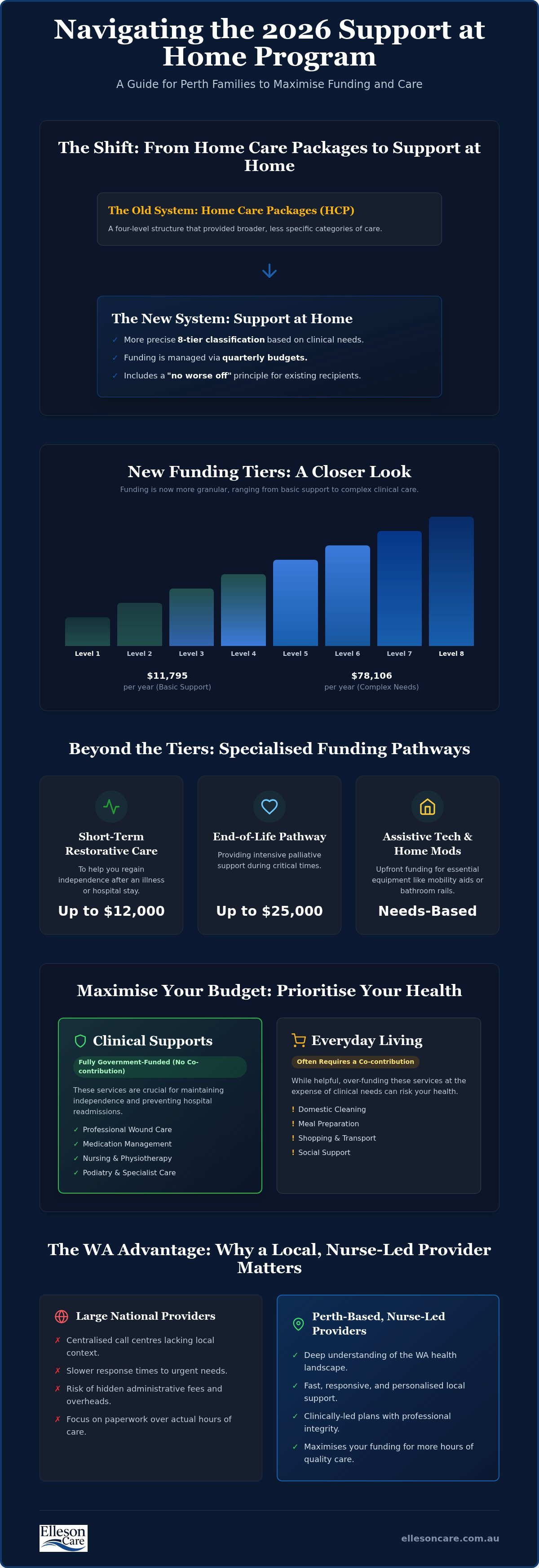
The transition from the old Level 1 to 4 packages into the new eight-tier system can feel overwhelming. Many Perth residents worry their funding will decrease, but the "no worse off" principle protects those who were already receiving or approved for a package on or before 12 September 2024. The new system ranges from Level 1 ($11,795 per year) for basic support to Level 8 ($78,106 per year) for complex clinical needs. Your specific classification is determined by a My Aged Care assessment, which now looks more closely at your clinical requirements. If your health needs have changed, such as requiring specialised wound management or palliative support, this new structure makes it easier to access the appropriate tier of funding. It's a more targeted way to ensure your budget matches your actual day-to-day reality.
The WA Advantage: Navigating Local Support
National reforms often feel distant when you're trying to organise care in suburbs like Nedlands, Joondalup, or Fremantle. This is where local Perth knowledge becomes vital. Large national providers often rely on centralised call centres that don't understand the nuances of the West Australian health landscape. In contrast, WA-based, nurse-led providers like Elleson Care help families interpret complex government jargon and turn it into a practical care plan. Having a local point of contact means you're speaking with someone who knows your community and can respond quickly to your needs. Getting the most out of your home care package is much simpler when your provider is just a short drive away, offering a steady, reliable presence in your life. We believe that true care starts with a local connection and a deep respect for your personal autonomy.
Assessing Your Classification: Are You Getting the Right Tier of Funding?
The Support at Home program classifies participants into eight distinct tiers, ranging from Level 1 for basic support to Level 8 for those with significant health challenges. These classifications are designed to be dynamic; they are not a "set and forget" label but a reflection of your current well-being. If you find your daily tasks are becoming more difficult, or a new health condition arises, you can seek a reassessment to ensure you are getting the most out of your home care package. Beyond the standard tiers, the 2026 system includes short-term pathways, such as restorative care providing up to $12,000 to help you regain independence after an illness, and an end-of-life pathway offering up to $25,000 for palliative support. There is also the Assistive Technology and Home Modifications (AT-HM) scheme, which provides upfront funding for essential equipment like mobility aids or bathroom rails, ensuring your home remains a safe sanctuary.
Identifying Clinical vs. Domestic Needs
Distinguishing between "Everyday Living" services and "Clinical Supports" is crucial for budget efficiency. Everyday living includes domestic tasks like cleaning and meal preparation, which often require a higher co-contribution from the recipient. Clinical supports, including nursing, podiatry, and physiotherapy, are fully government-funded with no co-contribution required. If your classification is primarily funding domestic help while your clinical needs, such as medication management or wound care, are neglected, your health may be at risk. Higher classifications often require professional nursing oversight to manage complex conditions effectively. Ensuring your budget prioritises these clinical services can prevent hospital admissions and extend your time at home.
The Reassessment Process in WA
When your health needs evolve, requesting a new assessment through My Aged Care is the first step toward securing more support. In the Perth metropolitan area, assessment timelines can fluctuate based on demand, but having professional evidence can streamline the process. A registered nurse can conduct a thorough clinical review, documenting changes in your mobility, cognitive health, or medical requirements. This professional documentation serves as vital evidence for the assessor, helping them understand why a classification upgrade is necessary. If you feel your current support no longer matches your reality, a clinical consultation with a Perth nurse can help you prepare for this conversation, ensuring your voice is heard and your care is properly funded.
Clinical Nursing vs. General Support: Balancing Your Care Budget
Deciding how to allocate your quarterly budget is a critical step in getting the most out of your home care package. While it's often tempting to prioritise domestic assistance like cleaning or gardening, the presence of a Registered Nurse provides far greater long-term value than a general domestic assistant. Professional nursing care, including expert wound management and medication administration, serves as a vital safeguard against hospital readmissions. By choosing a clinical-first approach, you aren't just paying for a service; you're investing in a professional oversight system that identifies health risks before they become emergencies. For a deeper look at how these services integrate into your life, you may wish to consult our Comprehensive Guide to Nursing Services in Perth.
The True Cost of "Cheap" Care
A common pitfall in the 2026 system is choosing providers based solely on low hourly rates for domestic help. These options often lack the robust clinical governance required by the Official guide to the Support at Home program. Without a nurse-led team overseeing your plan, subtle changes in your health can be missed by untrained staff. Additionally, some providers may obscure administrative costs within their service fees, even with the 10% cap on care management. Every dollar spent on inefficient administration is a dollar taken away from your actual care hours. Prioritising clinical expertise ensures your funding is used to maintain your health, which is the most effective way to stay at home longer.
Specialised Clinical Needs at Home
For families managing complex conditions, such as ventilator support or catheter care, the expertise of a nurse is non-negotiable. Our team at Elleson Care specialises in these high-intensity needs, ensuring that Perth residents can remain in their familiar surroundings safely. We manage pressure injuries and complex medication regimes with a level of precision that general support workers simply cannot provide. This nurse-led leadership, backed by 22 years of experience, ensures that palliative care and chronic disease management are handled with technical skill and profound empathy. Taking a holistic family approach ensures that both the individual and their loved ones feel supported. This proactive care saves significant emotional and financial costs by preventing unnecessary health crises and providing a steady, reliable presence in the home.
The Ultimate Value Checklist: Getting the Most from Your Support at Home Program
Ensuring you receive the full value of your funding requires more than just accepting a standard schedule. Getting the most out of your home care package in 2026 involves a regular, detailed review of how your quarterly budget is being utilised. Start by examining your monthly statement for "admin creep" or excessive unspent funds. Under the current Support at Home program rules, any unspent funds exceeding $1,000 or 10% of your quarterly budget, whichever is greater, are returned to the government. If you notice a growing balance, it's a clear sign that your care needs are not being fully met or your schedule requires adjustment to better support your well-being.
Next, audit your service mix to ensure you aren't over-spending on domestic cleaning while neglecting your clinical health. For a comprehensive look at how to structure this, our guide on In-Home Aged Care in Perth provides a nurse-led perspective on staying independent. Finally, verify the qualifications of every individual entering your home. In a system where national franchises often prioritise volume, choosing a local Perth provider ensures your care plan remains flexible and is managed by staff with verifiable clinical credentials. This local accountability is the foundation of a safe and effective care relationship.
Maximising Your Service Schedule
Efficiency in your care schedule can significantly increase the actual hours of support you receive. You can reduce travel fees by grouping domestic tasks or clinical visits on the same day, allowing more of your budget to go toward direct care. It's also worth exploring "Social and Community Participation" funding to combat the isolation many seniors feel in our sprawling Perth suburbs. If you're recovering from a hospital stay, ensure your provider discusses "Short-term Restorative Care" options. This pathway provides targeted funding to help you regain your strength and independence quickly, preventing a permanent decline in your health status and ensuring you stay in your own home longer.
Questions to Ask Your Provider in 2026
As the new regulations settle in, transparency is your best tool for advocacy. We recommend asking your current or prospective provider these direct questions to ensure they align with your health goals:
- "What percentage of my funding goes directly to care staff wages versus your head office overheads?"
- "How do you manage clinical emergencies or sudden health changes for your Perth clients?"
- "Are your care plans reviewed and signed off by a Registered Nurse with clinical experience?"
If your provider cannot give clear, immediate answers, it may be time to consider a more transparent, locally owned alternative. You can request a clinical review of your care plan to see how a nurse-led approach can better serve your specific needs and maximise your available funding.
Partnering with a Perth-Based, Nurse-Led Provider for Better Outcomes
Choosing a provider is the final, most impactful decision in your care journey. In the context of the 2026 reforms, getting the most out of your home care package requires a partner who understands the local Perth landscape and possesses the clinical authority to manage complex needs. Elleson Care brings over 22 years of nursing experience to every care plan, ensuring that your support is rooted in professional expertise rather than just administrative convenience. As a West Australian owned and operated service, we offer a level of local accountability that national franchises often struggle to provide. We believe that true care is person-centred, prioritising your dignity and personal autonomy while ensuring your health remains stable through every season of life.
Our "Family First" philosophy recognises that a home care package supports an entire household, not just an individual. We understand the silent stress often carried by family carers and aim to provide a steady, reliable presence that alleviates that burden. By taking a holistic approach, we ensure that both the recipient and their loved ones feel seen, heard, and supported throughout the ageing process. This commitment to the family unit creates a sense of stability, allowing you to focus on your relationships rather than the complexities of service coordination.
Why Clinical Leadership is the Gold Standard
Clinical leadership is often the difference between reactive crisis management and proactive health maintenance. Nurse-led teams are uniquely trained to identify subtle health risks, such as early signs of infection or changes in cognitive function, before they escalate into emergencies. This professional oversight provides families with a profound sense of peace of mind, knowing that a qualified expert is monitoring the care environment with a disciplined eye. Our commitment to evidence-based practice is particularly evident in our specialised wound management and palliative care services. By applying high-tier clinical standards within the comfort of your own home, we ensure that your medical needs are met without sacrificing the sanctuary of your personal space.
Taking the Next Step with Elleson Care
Transitioning your current package to a local specialist is a straightforward process that can significantly improve your daily quality of life. If you feel your current provider is too rigid or lacks the clinical depth you require, we invite you to take the next step toward a more personalised experience. We offer a consultation to review your 2026 Support at Home plan, helping you identify areas where your funding can be better utilised for clinical outcomes. Securing high-quality, nurse-led care in Perth is about finding a partner you can trust to advocate for your well-being. To begin this transition and ensure you are truly getting the most out of your home care package, contact our Perth nurse-led team today.
Securing Your Future with Confidence and Care
The transition to the Support at Home program represents a significant opportunity to refine your support and ensure it aligns with your evolving health needs. By focusing on the eight new classification tiers and prioritising clinical nursing over general domestic assistance, you're investing in your long-term independence. Getting the most out of your home care package isn't just about managing a budget; it's about securing a standard of care that respects your dignity and provides a sense of safety within your own home.
As a West Australian owned and operated provider, we bring 22 years of nurse-led leadership to every family we serve. Our expertise in clinical and complex care ensures that your plan is managed with technical precision and human warmth. You don't have to navigate these changes alone. We're here to provide the steady, reliable presence you need to move forward with confidence, knowing that your health is in expert hands.
Maximise your care with Perth’s nurse-led specialists—contact Elleson Care today. Your well-being is our highest priority, and we look forward to supporting your journey toward a healthier, more independent future.
Frequently Asked Questions
How has the Home Care Package system changed in 2026?
The system has transitioned into the Support at Home program, replacing the four-level Home Care Package model with an eight-tier classification system. Funding is now delivered in quarterly budgets rather than annual lump sums, with a 10% cap on care management fees. This change aims to provide more granular, health-focused support while ensuring that clinical care remains fully government-funded. It's a more responsive framework designed to help you stay in your home longer.
Can I use my Support at Home funding for clinical nursing in Perth?
Yes, clinical nursing is a core component of the program and is fully funded by the government with no co-contribution required from you. This includes professional services such as wound management, medication administration, and chronic disease monitoring. By prioritising these clinical services, you are getting the most out of your home care package and significantly reducing the risk of hospital readmission. Our nurse-led team in Perth specialises in these complex clinical requirements.
What are the 8 classifications in the Support at Home program?
The program features eight classification levels based on the intensity of your assessed needs. Annual funding begins at $11,795 for Level 1, providing basic support, and scales up to $78,106 for Level 8, which covers intensive clinical care. These tiers allow for more precise funding allocations than the old system. Your classification is determined by a My Aged Care assessment, which considers your physical health, cognitive needs, and daily living requirements.
How do I switch to a local Perth provider like Elleson Care?
Switching providers is a straightforward process that begins with reviewing your current contract for any notice periods. You don't need a new assessment to change providers; you simply need to notify My Aged Care of your intent to move. We recommend a clinical consultation first to ensure your new care plan is optimised. Once you have your referral code, our Perth-based team can manage the transition, ensuring there is no gap in your essential support.
Are there waitlists for Support at Home assessments in Western Australia?
Wait times for assessments in Western Australia can vary depending on your location and the urgency of your situation. While the government aims for timely reviews, high demand in the Perth metropolitan area can sometimes lead to delays of several weeks. If your health takes a sudden turn, you can request an urgent assessment. Having a registered nurse document your clinical needs can often help clarify the urgency of your request to My Aged Care.
What services are NOT covered by the Support at Home program?
The program does not cover general costs of living that are unrelated to your care needs. This includes items such as groceries, rent or mortgage payments, holidays, and entertainment. Additionally, it cannot be used for medical costs covered by Medicare, such as doctor visits or hospital stays. The funding is strictly reserved for services that support your independence and health at home, such as personal care, clinical nursing, and essential domestic assistance.
How do I know if I am getting good value from my care provider?
Good value is evidenced by high-quality clinical outcomes and transparent financial reporting. You should review your monthly statements to ensure that the majority of your funding is spent on direct care rather than administrative overheads. If your provider is nurse-led, they should be proactively identifying health risks and adjusting your care plan accordingly. Getting the most out of your home care package means seeing tangible improvements in your well-being and safety.
Does the Support at Home program cover home modifications in WA?
Yes, the program includes the Assistive Technology and Home Modifications (AT-HM) scheme. This provides upfront funding for essential changes to your home, such as installing grab rails, ramps, or bathroom modifications. These adjustments are designed to improve your safety and mobility, allowing you to navigate your Perth home with greater confidence. A registered nurse or occupational therapist can help identify which modifications are most critical for your ongoing independence.


