

What if accepting support could help you stay independent, rather than take choice away? If you’re exploring social support for seniors living alone Perth has to offer, it’s understandable to want connection without changing the routines and relationships that matter to you.
Living alone can make it harder to stay socially connected, especially when getting out or keeping up with everyday tasks becomes more difficult. Support doesn’t have to mean giving up control. It can reflect your preferences, from keeping in touch with friends and family to getting practical help at home that makes it easier to take part in activities.
This guide explains the difference between informal, community and in-home support, and how each may help older people in Perth maintain meaningful connections. You’ll also learn how personalised aged care, including community access and daily-living assistance, can support social participation while respecting personal choice. The aim is to help you identify one manageable next step that feels right for you.
Key Takeaways
- Explore what social support for seniors living alone Perth may involve. Living alone doesn’t necessarily mean feeling lonely.
- Consider how familiar routines and interests can make staying connected with people and local activities feel more comfortable.
- Compare informal support, community activities and organised assistance to find an approach that respects personal choice.
- Identify preferences and practical barriers first, then use My Aged Care for current information about assessments and aged-care services.
- Person-centred aged care, including community access and daily-living support, can help make social participation more manageable.
Social support for seniors living alone in Perth: why connection matters
Living alone can offer privacy, familiarity and control over daily routines. It doesn’t, by itself, reveal whether someone feels connected or would like more company. Social needs differ: one person may enjoy regular visits from family, while another may want help getting to a familiar group or staying in touch with friends online.
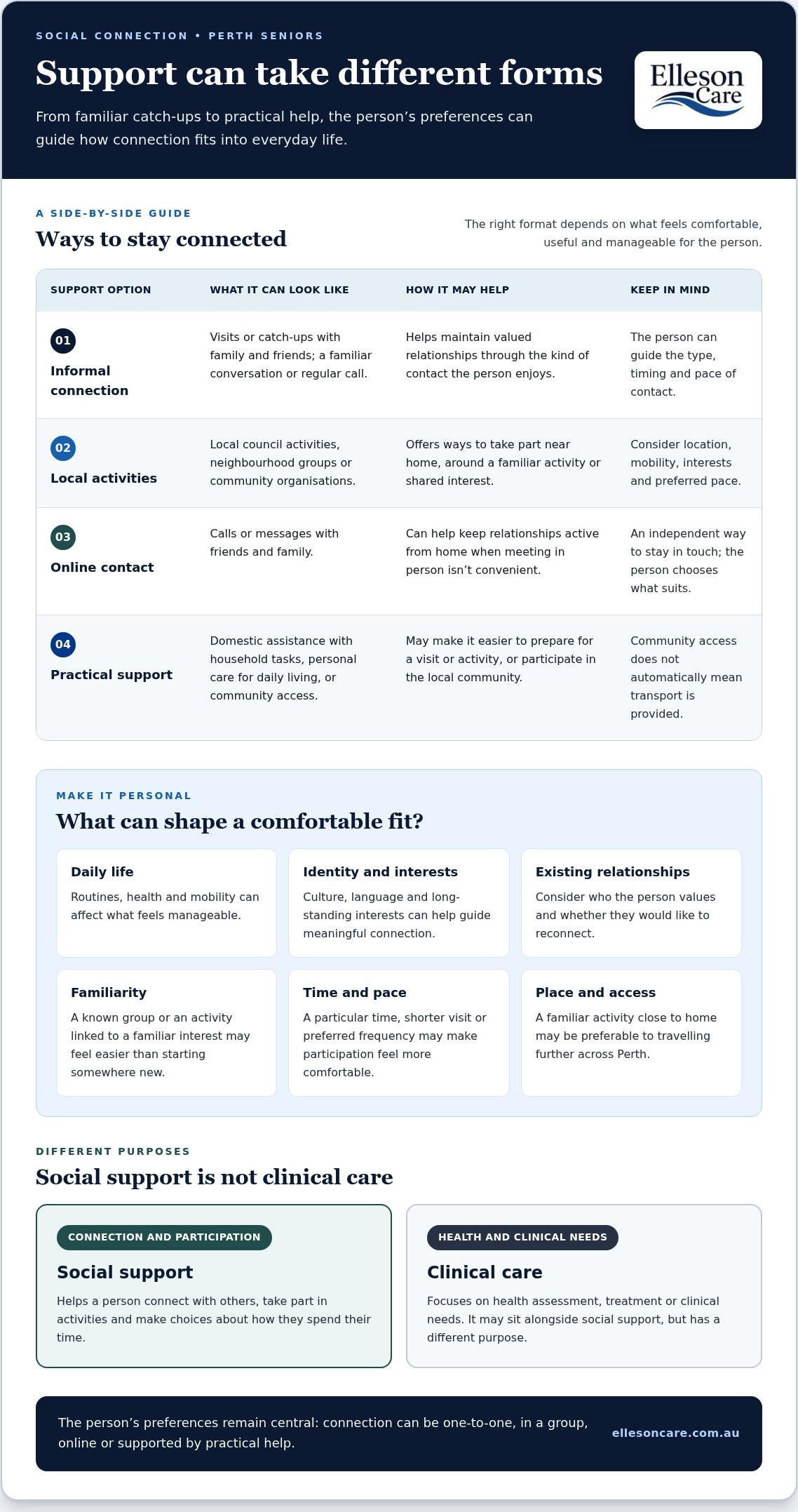
Social support is practical and relational help that enables a person to connect with others, participate in activities and make choices about how they spend their time. It differs from clinical care, which focuses on health assessment, treatment or clinical needs. Social support may sit alongside clinical care, but its purpose is to help connection and participation fit into everyday life. The importance of social support is commonly discussed in relation to the networks and assistance people can draw on.
For social support for seniors living alone Perth residents may consider, start with the person’s circumstances, not assumptions based on their address. Routines, mobility, health, culture, language, interests and existing relationships all shape what feels comfortable. A familiar activity close to home may be more appealing than travelling across Perth to try a new group. Someone who finds outings difficult may prefer a visit or online conversation.
What social support can mean in everyday life
Connection can take many forms: sharing a conversation, maintaining friendships, joining a familiar activity or taking part in community life. Practical assistance can sometimes make these connections easier, such as help getting ready for an outing. Online calls or messages may also help someone keep in touch when meeting in person isn’t convenient.
There’s no single schedule or format that suits everyone. The person should guide the type, timing and pace of support, including whether they prefer one-to-one company, a group setting or independent ways to stay in touch. Ask what they enjoy and what they’d rather avoid, then use their answers to shape support around their preferences.
When extra connection may be welcome
A change in routine can be a reason for a gentle check-in. Perhaps someone has stopped attending a regular activity, is finding an outing harder to manage, or has fewer chances to catch up with people they value. These changes may have practical reasons and don’t prove that the person feels lonely. Limited contact and living arrangements alone don’t tell the whole story.
Try an open, specific conversation: “Would you like to make it easier to get to your usual activity?” or “Is there someone you’d like to catch up with more often?” Listen before trying to solve the issue. The person may be content as things are, want a small adjustment or be ready to explore a new option. Their answer can guide a manageable next step, shaped around what matters to them.
How social support can help Perth seniors stay connected at home and locally
Regular, welcome contact can give everyday life a sense of connection and belonging. That might mean a familiar conversation over a cup of tea, a call with family or meeting others around a shared interest. The value isn’t measured by how busy someone’s calendar looks. A small number of meaningful interactions may suit someone better than frequent group activities.
In Perth, local council activities, neighbourhood groups and community organisations can offer ways to take part close to home. The Western Australian government support for seniors also provides information about initiatives for older people. To decide what may suit, consider the person’s location, mobility, interests and preferred pace, as well as what would make attending comfortable.
Useful social support reflects the person’s own goals, interests and preferred pace of connection. Familiarity can help: returning to a group someone already knows, choosing an activity linked to a long-standing interest or arranging a regular catch-up may feel easier than starting with something entirely new.
Choosing connection that feels familiar and meaningful
Start with what the person already enjoys and values. One-to-one visits may suit someone who prefers quiet conversation; a small group may feel welcoming to someone who likes shared activities. Cultural or community connections can help a person feel at ease, while online calls and messages can keep relationships active from home. The person decides what feels comfortable and how often they want to participate.
Think about the details as well as the activity. Is a particular time of day more convenient? Would a shorter visit feel more manageable? Does the person want to reconnect with someone they know or try a new interest? These questions can help shape a routine that feels natural rather than like another obligation.
Practical help that can make participation easier
Everyday tasks can affect how ready or able a person feels to connect. Domestic assistance can help with household tasks, while personal care supports daily living needs. Depending on the person’s circumstances, this practical support may make it easier to prepare for a planned visit or activity. It doesn’t decide what they do; their preferences remain central.
Community access can support participation beyond the home, such as attending a familiar activity or spending time in the local community. Community access doesn’t automatically mean transport is provided. Clinical nursing has a different purpose: it addresses health and clinical needs, while social support focuses on connection and participation. These can be considered as distinct parts of a person’s broader support. Elleson Care provides person-centred aged care support shaped around individual routines and choices.
Will social support reduce independence? Comparing informal and organised options
Accepting support doesn’t mean handing over control. The person can decide what help they want, who is involved and what they’d rather manage themselves. For social support for seniors living alone Perth residents may consider, the right balance depends on personal preferences and circumstances, not a fixed expectation about how often someone should socialise.
Different options offer different kinds of flexibility. Family and friends may already know the person’s routines, while community activities create opportunities to meet people through shared interests. Organised support can add planned, practical assistance when it’s useful. These approaches can work alongside one another rather than competing for a single place in someone’s life.
Informal connection, community activities and organised support
Informal contact might be a relative calling at an agreed time or a friend dropping in, if the person wants that involvement. Community activities offer connection around interests, culture or local events. Organised support involves assistance planned around agreed preferences and needs. It may help when practical tasks make participation harder or when a person wants a more structured arrangement.
| Option | Who provides contact | Where it happens | Person’s control |
|---|---|---|---|
| Informal connection | Family, friends or neighbours | At home, by phone or during a shared outing | Can choose who to involve and how often to connect |
| Community activities | Activity organisers and other participants | At a local venue or community setting | Can choose activities and whether to attend |
| Organised support | A support worker or care provider | At home or in the community, depending on the support | Preferences and agreed support needs guide the arrangement |
The options can complement each other. A person might keep regular family calls, attend a familiar community activity when they choose and receive practical in-home assistance with daily living. The mix can change as routines and needs change, without requiring every kind of support at once.
Keeping choice and dignity at the centre
Before arranging a visit or activity, ask what the person wants. Even a kind intention can feel intrusive if it changes someone’s routine without their agreement. Talk through practical details together, including timing, frequency, who will be involved and which activities feel welcome. The person may prefer to try one option first or decide that no change is needed.
Person-centred care respects autonomy while providing practical assistance in a way that reflects the individual’s choices. For example, support might focus on a task the person finds difficult while they continue to decide how to spend their time. Clear boundaries and regular opportunities to review arrangements can help keep support appropriate and comfortable.
How to find social support for seniors living alone in Perth
Finding a suitable option is easier when the plan starts with what the older person wants, rather than with a particular service. Discuss what matters to them, identify anything making participation difficult, then explore a next step together. This keeps the process practical and centred on the person’s choices.
Starting a conversation and identifying priorities
Choose a calm time and ask open questions. Which relationships or activities do they value? Is there something they miss doing? What would make it easier to take part? Listen without assuming that living alone or having fewer outings means the person feels lonely. They may want more contact, a small practical change or no change at all.
With the person’s consent, note their preferences and current situation. A short record can help explain what support may be useful and keep plans consistent.
- Preferred activities: Include interests, familiar places, cultural connections and preferred ways to socialise.
- Existing supports: Note who they already see or speak with, and what support they value.
- Practical barriers: Record concerns such as getting ready, household tasks, mobility or feeling comfortable in a group.
- Desired change: Describe what the person would like to do differently, in their own words.
Agree on one manageable next step, such as discussing a familiar activity or looking into a suitable support pathway. Don’t arrange visits or services on the person’s behalf without their agreement.
Understanding Perth aged-care pathways
My Aged Care is the Australian Government’s starting point for information about aged-care assessments and services. Its current guidance can help older people and their supporters understand how to seek an assessment and which support pathways may apply. Eligibility and access depend on the person’s circumstances, so use My Aged Care for up-to-date details rather than relying on older descriptions of the system.
As of October 2026, Support at Home is the ongoing program for older Australians who need support to live at home. It replaced Home Care Packages and Short-Term Restorative Care on 1 November 2025. The Commonwealth Home Support Programme continues to provide entry-level support; its planned transition to Support at Home will not occur before 1 July 2027. Current program information is also covered in The Support at Home Program in 2026.
For social support for seniors living alone Perth residents can start by matching the person’s goal with the practical help they need. Elleson Care provides person-centred aged care support shaped around individual preferences and daily-living needs. Discuss personalised aged care support as a possible step towards making social participation more manageable.
How Elleson Care Supports Social Connection at Home
Social connection can be part of a broader approach to support at home. Elleson Care provides person-centred aged care services shaped around each person’s needs, routines and preferences, with dignity and respect at the centre. For older people considering social support for seniors living alone Perth, practical assistance can help make daily life and community participation more manageable while leaving personal decisions in their hands.
A person-centred approach to support at home
Support starts with understanding what matters to the person: how they prefer their day to run, which daily tasks they want help with and what they would like to keep doing themselves. Personal care and domestic assistance address daily-living needs, while community access supports participation beyond the home. The type and focus of assistance should reflect the individual, not a standard routine imposed on them.
For example, help with household tasks may give someone more time for a valued interest, while personal care can assist with aspects of their daily routine. Community access can support involvement in local activities in line with the person’s choices. It doesn’t guarantee that someone will feel connected, replace friendships or family relationships, or determine how often they take part.
Social participation and daily-living needs can influence one another. Support should be discussed in a way that respects privacy, comfort and the person’s boundaries. They can say which tasks they want help with, what they’d prefer to do independently and whether their priorities change over time.
Taking the next step with Elleson Care
Elleson Care is West Australian owned and operated, and its team is led by registered nurses. The team brings over 20 years of combined experience across nursing, healthcare, NDIS management and risk management. This experience informs a holistic approach to care, considering practical needs alongside the person’s wellbeing, preferences and goals for staying involved in everyday life.
Seniors and families can begin by noting what the person wants support with, what they already manage comfortably and which activities or relationships they value. This can make an initial conversation more focused and help keep the person’s priorities at the centre. For further context about care at home, see the guide In-Home Aged Care in Perth.
If you’re considering aged-care support in Perth, discuss person-centred support with Elleson Care. A conversation can help you explore support that reflects the individual’s needs and preferences, at a pace that feels comfortable.
Choose a next step that feels right
A meaningful change doesn’t need to begin with a full schedule or a major adjustment. One conversation about what the person wants to keep doing, or what they’d like to make easier, can offer a clear place to start. Priorities may shift over time, so leave room to review what feels comfortable and useful.
For families considering social support for seniors living alone Perth, the older person’s own voice is the most important guide. Support should make space for personal routines and relationships, not replace them. A small, agreed step can help clarify whether further assistance would be welcome.
Elleson Care is a West Australian owned and operated provider, with over 20 years of combined experience across nursing, healthcare and care management. Its aged care support includes personal care, domestic assistance and community access, shaped around individual needs and preferences. Discuss person-centred support with the Elleson Care team to explore a suitable next step. Start with one priority and take things at a pace that feels right.
Frequently Asked Questions
Can social support help a senior living alone in Perth stay connected?
Yes, social support can help a senior maintain relationships and take part in activities that matter to them. For example, someone might value a regular phone call with a relative, an occasional visit with a friend or a group activity in their local area. The best fit depends on the person’s preferences and circumstances. Living alone doesn’t automatically mean someone feels lonely or wants organised support.
What does social support for seniors include?
Social support may include companionship, group activities, community or cultural participation, and help to connect with others online. Someone might prefer a video call with family or attending a local interest group. In-home aged care can also provide practical assistance, such as personal care, domestic assistance and community access, where appropriate. The type and arrangement of support should reflect the individual’s needs and choices.
How can I talk to an older parent about social support?
Begin by asking what your parent enjoys and whether there’s an activity or relationship they’d like to make more time for. You could ask, “Is there anything you’d like to do more often?” or “Is anything making that difficult?” Avoid assuming they need help because they live alone. Ask permission before making arrangements, then agree on one small next step together, such as exploring a familiar local activity.
Is social support available through aged care in Australia?
Yes, social support is among the aged-care service types described by My Aged Care. As of October 2026, Support at Home is the ongoing program for eligible older people who need support to live at home, while the Commonwealth Home Support Programme continues to provide entry-level support. Assessment, eligibility and access depend on individual circumstances. Check My Aged Care for current official information about pathways and services.
What happens if a senior does not want social support?
Respect their decision. They may feel content with existing relationships, prefer informal contact or simply not want to make changes now. Rather than revisiting the issue repeatedly, ask what kind of contact they welcome and whether there’s a practical concern they’d like help with. Keep the conversation open without pressure. If their preferences change, they can consider options then, with their autonomy and dignity respected.
Can in-home aged care support community participation in Perth?
It can. In-home aged care may include community access, alongside personal care and domestic assistance, depending on the person’s needs and preferences. For example, someone may want support to take part in a community activity they value. Community access doesn’t necessarily mean transport is provided. Elleson Care provides person-centred aged-care services in Perth, and discussing the person’s priorities can help shape suitable support.


