

What does a DVA case manager do, and who coordinates the different parts of a veteran’s support? It’s understandable to feel unsure. Case management can involve different people and programmes, and the role doesn’t replace an advocate or a treating health professional.
In general, DVA case management helps coordinate services, develop or manage a support plan, and keep track of progress. The exact role depends on the veteran’s needs. A DVA rehabilitation delegate, rehabilitation consultant or care coordinator may each have a part to play, with different responsibilities.
This guide explains the purpose and limits of DVA case management, how it differs from advocacy and clinical care, and what details about your circumstances and goals may help you prepare for a conversation. It also outlines practical next steps. Elleson Care’s DVA care services are coming soon and are not currently offered. The organisation provides aged care, NDIS support and clinical care, including in Perth.
Key Takeaways
- Understanding what does a DVA case manager do can help you know who may coordinate support and what their role covers.
- Case management, advocacy and clinical care have different purposes. Knowing the distinction can help you direct questions to the right person.
- Before a conversation, note your priorities, current supports, day-to-day challenges and questions so you can explain what matters to you.
- Next steps depend on your circumstances and the relevant DVA pathway. Coordination does not guarantee eligibility or a particular outcome.
- Elleson Care’s DVA care services are coming soon and are not currently offered.
What does a DVA case manager do for veterans and families?
DVA processes and support pathways can feel difficult to follow, particularly when health, daily living and administrative needs overlap. It’s reasonable to want to know who can help coordinate next steps and what that support covers.
What does a DVA case manager do? Case management is coordinated support shaped around a person’s circumstances and needs. Depending on the pathway, it can help clarify priorities, connect relevant services and organise communication about a support plan. It doesn’t replace clinical treatment, claims advocacy or decisions about eligibility.
There isn’t one role or job title that covers every form of case management across DVA. Different programmes may involve different staff or coordinators. The Department of Veterans' Affairs (Australia) is the government department responsible for veterans’ support, but the coordination available depends on the individual’s situation and the relevant pathway.
What is the DVA Client Support Program?
DVA’s Coordinated Client Support Branch offers programmes for clients with complex needs. The Client Support Program, also referred to in DVA information as Coordinated Client Support, is tailored and time-limited. It may provide a single or primary DVA contact to help a client navigate relevant services when additional, comprehensive support is needed. It is a specific programme, not a service automatically assigned to every veteran.
Who may be involved in a case-management conversation?
The veteran is central to conversations about their needs, preferences and goals. A family member or other support person may be involved where appropriate and with the veteran’s agreement. Their input can help explain practical day-to-day concerns, while discussions should respect the veteran’s wishes and privacy.
Depending on the pathway, a conversation may involve a DVA staff member or a coordinator connected with a particular programme. Their focus is to understand what support may be relevant and explain possible next steps. For example, a veteran might describe difficulty keeping track of appointments alongside challenges with daily activities. A coordinator may help clarify which needs to discuss and how these relate to the relevant support pathway. That conversation does not confirm eligibility or guarantee a particular service.
Think of case management as a coordinating function rather than one universal DVA position. The person involved, the scope of support and how long it continues can vary according to the programme and individual circumstances. Families can contribute useful context, guided by the veteran’s agreement.
How can a DVA case manager coordinate support?
Coordination can make a complicated support picture easier to discuss and follow. A case manager or programme coordinator may help clarify a person’s needs, identify relevant pathways and organise communication about agreed actions. The role is not to provide every service directly, but to help the different parts of a support plan connect where the relevant programme allows.
For example, a veteran managing a chronic health condition might need to discuss how appointments, daily routines and existing care fit together. A coordinator could help identify questions to raise with the relevant DVA contact or care team. This illustrates coordination, not a promise that a particular service or programme will be available.
Eligibility and service decisions remain governed by the relevant DVA processes. A coordinator can help explain or organise steps within a pathway, but doesn’t make every formal decision, provide clinical treatment or represent a veteran in a claim. Information about support available through other government arrangements, including Services Australia support for veterans, can also help clarify which organisation or pathway a question relates to.
How may a case manager support communication with DVA?
A primary contact is available only where the relevant programme provides one. In that setting, the contact may help the veteran understand whom to speak with about an issue and keep track of agreed follow-up. It doesn’t mean one person controls all DVA services or can determine the outcome of every request.
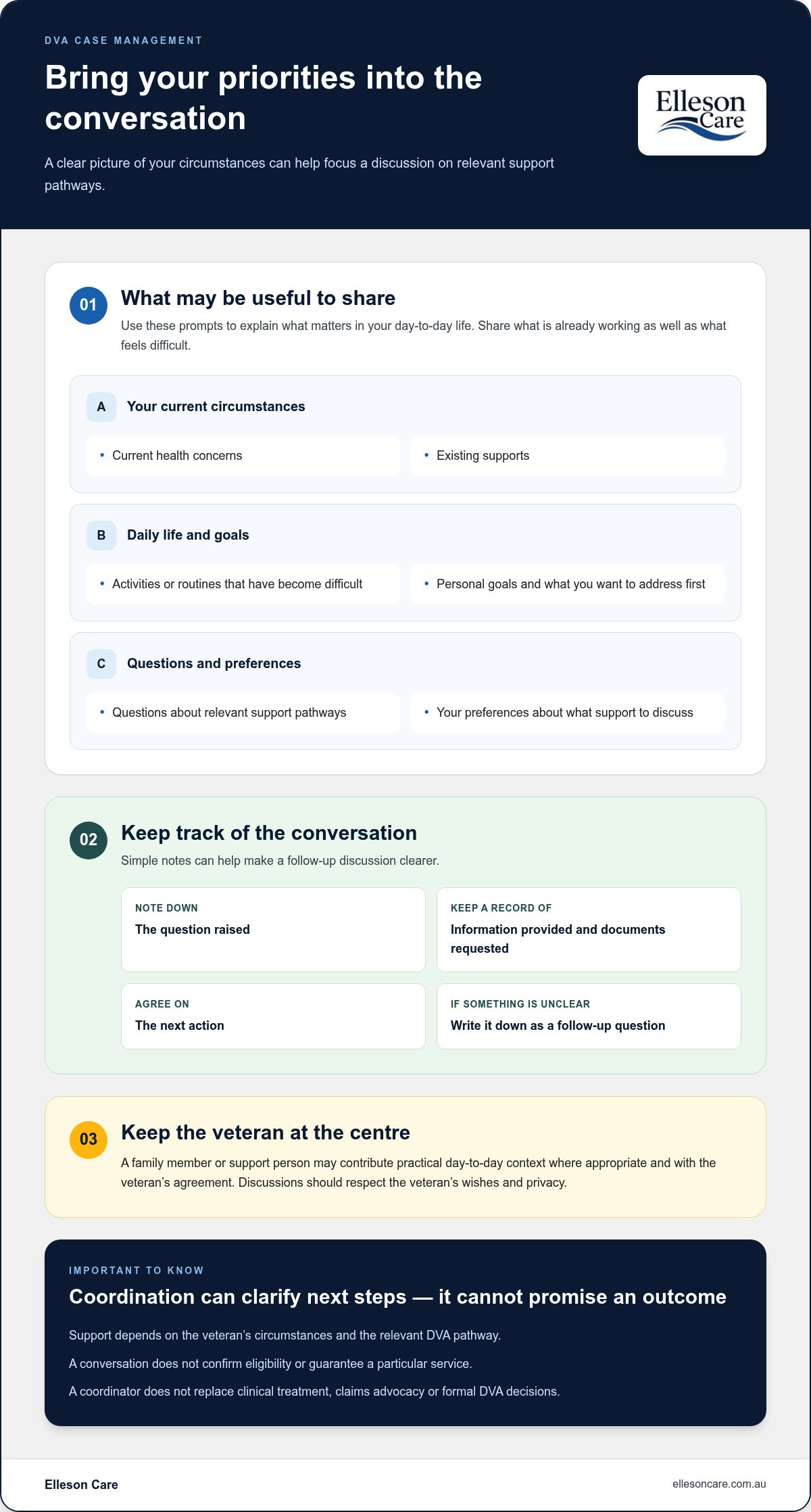
Simple records can make conversations clearer. Before or after a discussion, note the question raised, the information provided, any documents requested and the next action agreed. If a point remains unclear, write it down as a follow-up question. These notes can help keep the next conversation focused, but don’t replace official advice or decisions.
How can support be tailored to individual wellbeing needs?
Support discussions are more useful when they reflect the person’s circumstances, not just a list of services. Relevant context might include current health concerns, daily activities that have become difficult, existing supports, personal goals and what the veteran would like to address first. Sharing what is already working can be just as helpful as identifying gaps.
For instance, one person may want help understanding how separate appointments fit into their care, while another may need to explain how a health issue affects routines at home or participation in work. These details can guide a conversation about relevant pathways, without guaranteeing a particular service or result. A person-centred discussion keeps the veteran’s priorities and preferences in view.
Elleson Care’s DVA care services are coming soon and are not currently offered. Its current services include aged care, NDIS support and clinical care. To learn about the organisation’s person-centred care approach, visit Elleson Care online.
DVA case manager, advocate or healthcare provider: what is the difference?
These roles can be involved in the same support journey, but they do different work. Knowing which role you need can help you direct a question to the right person and avoid expecting one professional to manage every part of your situation. Put simply, a case manager coordinates support, an advocate assists with representation or claims matters, and a healthcare provider delivers clinical care.
Use this comparison as a general guide. A person’s exact contacts and responsibilities depend on the relevant DVA pathway and the professionals involved.
| Role | Main focus | Example |
|---|---|---|
| Case manager or coordinator | Organising communication and coordinating relevant support within a programme or plan. | Helping clarify priorities and track agreed follow-up. |
| Veterans’ advocate | Assisting a veteran with representation and claims-related processes. | Helping prepare information for a claim or understand administrative steps. |
| Healthcare provider | Assessing or treating health needs within their professional scope. | A GP assessing a health concern or a nurse providing nursing care. |
The roles may communicate or contribute to a shared plan, with the veteran’s agreement where appropriate. That doesn’t make them interchangeable. A case manager doesn’t automatically represent a veteran in a claim, and an advocate doesn’t provide clinical treatment simply by assisting with claims matters. Each professional’s responsibilities remain tied to their role and the pathway involved.
What does a veterans’ advocate do instead?
An advocate can help a veteran understand and prepare for claims or representation matters, including organising relevant information and supporting communication about a claim. Their role is distinct from coordinating care or making a clinical assessment. For guidance about advocate roles and current support options, use DVA’s official advocacy information. A case manager shouldn’t be assumed to determine a claim outcome or represent every client.
When is clinical care a separate need?
Diagnosis, treatment and nursing care are clinical responsibilities. A GP may assess symptoms and discuss treatment; a nurse may provide wound care within their scope. A coordinator can help keep care-related communication organised, but doesn’t replace the clinician responsible for assessment or treatment. If a health concern needs clinical attention, discuss it with an appropriate treating professional.
This distinction also matters when considering care organisations. Elleson Care’s team brings clinical nursing experience, which is separate from DVA case-management duties. The organisation’s DVA care services are coming soon and are not currently offered. Understanding the boundaries between coordination, advocacy and clinical care can help veterans and families ask clearer questions and seek the right kind of support for each need.
How can veterans prepare to speak with a DVA case manager?
A little preparation can make a support conversation feel more manageable. You don’t need to have every detail or document ready. The aim is to explain what’s happening, what matters most to you and what you’d like clarified. Preparing notes can support a focused discussion, but it doesn’t guarantee acceptance into a programme or a particular outcome.
If you’re unsure what a DVA case manager does in your specific pathway, include that among your questions. Understanding the person’s role can help you know what they may be able to coordinate and which matters need to be raised elsewhere.
What information may help explain a veteran’s needs?
Make a brief note of the issues you’d like to discuss and how they affect everyday life. You might include changes in health or routines, support already in place, and any practical difficulty you want to address first. Keep it relevant to the conversation; there’s no need to gather sensitive personal records unless they’re requested or directly useful.
Where available, bring relevant DVA correspondence or a short list of questions. You could organise your notes under these prompts:
- Current concerns: What has changed, and what feels most important to address?
- Existing supports: Who is currently involved, and what is working well?
- Immediate questions: What do you need explained about the process or next steps?
- Personal priorities: What would you like support to help you work towards?
These notes are prompts, not a checklist you must complete. If a topic is difficult to discuss, you can say so and ask to take it one step at a time.
What questions can families ask?
Family members or carers can help by listening, taking notes or offering relevant context, when the veteran wants them involved. Before the conversation, agree what the veteran is comfortable sharing and whether they want the support person to speak or simply be present. Privacy preferences and consent should guide their involvement.
Useful questions may include:
- What does your role cover in this support pathway?
- Who should we contact about the next steps we’ve discussed?
- What follow-up should we expect, and how will we know what action is needed?
- How can the veteran’s preferences be included in future discussions?
Keep a record of the answers and any agreed actions. If something isn’t clear, ask for it to be explained in another way. It’s reasonable to clarify what happens next without assuming that a particular service or decision has been approved.
Routine case-management conversations aren’t emergency support. If someone is in immediate danger or needs urgent assistance, call 000. For non-urgent information about aged care, NDIS support and clinical care in Perth, explore Elleson Care’s person-centred support. Its DVA care services are coming soon and are not currently offered.
What to expect next, and where person-centred support fits
After a discussion with DVA, the next step depends on the veteran’s circumstances, the pathway being considered and current DVA processes. The conversation may clarify which needs require follow-up, what information is relevant and who is responsible for the next action. If the pathway or contact changes, ask how you’ll be kept informed and where to direct further questions.
Case management can help coordinate support, but it doesn’t guarantee eligibility, approval for a service or a particular result. Formal decisions sit within the relevant DVA processes. Keeping a clear record of agreed actions can help the veteran and any support person understand what is happening, without assuming that a discussion itself confirms an outcome.
How can a support plan remain centred on the veteran?
A useful support discussion makes room for the veteran’s goals, preferences and consent. Plans should reflect what matters to the person, not only the tasks that are easiest to arrange. The veteran can explain what feels manageable, what they’d like to work towards and which parts of their situation they want addressed first.
As circumstances change, it can help to say what is working and what may need review. For example, a support arrangement that once fitted well may no longer reflect a change in health or daily routine. Raising this clearly gives the people involved a chance to consider the current situation through the appropriate pathway. It doesn’t assure a particular adjustment or outcome, but it keeps the discussion grounded in the veteran’s experience.
How does Elleson Care relate to this topic?
Respect, dignity and person-centred support are important principles in care. Elleson Care is a West Australian-owned provider focused on aged care, NDIS support and clinical care. Its team includes former ADF personnel alongside clinical and healthcare professionals, with more than 20 years of combined experience across nursing, healthcare, NDIS management and risk management. This background informs the organisation’s understanding of veterans’ needs, but it is distinct from DVA case-management responsibilities.
Elleson Care’s DVA care services are coming soon and are not currently offered. The role of a DVA case manager is shaped by the relevant DVA pathway, while care providers deliver support within their own service scope.
For veterans and families in Perth interested in current aged care, NDIS support or clinical care, visit the Elleson Care homepage. For questions about a DVA pathway or decision, use the relevant DVA contact process and keep the veteran’s preferences at the centre of each conversation.
Take your next step with confidence
As you consider what support may be helpful, focus on the outcome that matters most to you and the person best placed to discuss it. A clear question can be a useful starting point, whether you’re preparing for a DVA conversation or looking at care needs more broadly. Understanding what a DVA case manager does can help you direct each question to the right role, while keeping the veteran’s preferences at the centre.
The organisation’s current focus is person-centred aged care, NDIS support and clinical care, guided by dignity and respect. To explore its current support in Perth, learn about Elleson Care’s person-centred support.
You don’t need to resolve every question at once. Taking one considered step at a time can help you move forward with greater clarity and confidence.
Frequently Asked Questions
What does a DVA case manager do?
A DVA case manager may help coordinate communication and support for a veteran with complex needs through a relevant programme. If you’re asking what a DVA case manager does in a particular situation, the answer depends on the pathway and the person’s circumstances. DVA’s Client Support Program is tailored and time-limited. A case manager’s involvement doesn’t itself confirm eligibility, treatment, funding or a claim decision.
Does every veteran have a DVA case manager?
No, veterans shouldn’t assume they’ll automatically be assigned a case manager. DVA’s Client Support Program is for clients with complex needs, and support is tailored to individual circumstances. A veteran in Perth can review current DVA information to understand available pathways and how to engage with them. Asking about a programme is a way to seek guidance, not a guarantee of entry or ongoing case management.
Can a DVA case manager approve a claim?
A case manager shouldn’t be treated as the person who decides or guarantees a claim outcome. They may help coordinate communication or support within a programme, while claims proceed through the relevant DVA processes. If the main concern is how to present a claim or seek representation, advocacy is a separate role. Use current DVA guidance to identify the appropriate process for your specific claim question.
Is a DVA case manager the same as a veterans’ advocate?
No, a case manager and a veterans’ advocate have distinct roles. Case management may focus on coordinating support and communication within a relevant pathway, while an advocate may assist with representation or claims matters. For example, a question about following up a support plan differs from seeking help to prepare claim information. If you’re unsure which role fits your need, start by identifying the issue you want help with.
Can family members speak with a DVA case manager?
Family members may support a veteran in discussions, but the veteran’s preferences, consent and privacy should guide their involvement. The programme’s communication processes may also affect how a family member can participate. A practical approach is to agree beforehand whether they’ll listen, take notes or ask questions. They can help record actions discussed, while keeping decisions about the veteran’s support centred on the veteran.
What should I prepare before speaking with a DVA case manager?
Prepare a brief note of the veteran’s main concern, what they hope to clarify and any question that needs an answer first. If relevant, have DVA correspondence to hand, but there’s no need to collect unrelated or sensitive records for a general discussion. A family member can also note how the veteran would like them to contribute. Preparation can help focus the conversation, but doesn’t determine programme access.
Does Elleson Care currently provide DVA case management?
No. Elleson Care is West Australian owned and operated, with founders who include former ADF personnel and experienced healthcare professionals. Its combined experience spans nursing, healthcare, NDIS management and risk management. Perth veterans seeking DVA guidance can use current DVA information for pathway-specific support.


