

A clean, workable home can support independence, not just keep chores at bay. NDIS domestic assistance in Perth can help with everyday tasks such as cooking and cleaning, and may include personal care when it aligns with the participant’s plan. Funding is for disability-related support that meets the plan’s requirements, not general household convenience.
It’s understandable to want clear answers about what help is available, where it can be delivered and how it can fit into daily routines. This guide explains the kinds of in-home support involved, how plan funding shapes assistance and how support can help build daily living skills over time.
You’ll also learn what to consider when arranging support in Perth and how to take the next step with a provider. The aim is to make the options easier to understand, so decisions reflect the participant’s needs, goals and preferences.
Key Takeaways
- Understand how everyday help with cooking, cleaning and personal care may fit within a participant’s plan.
- See how Perth location and individual support needs shape where in-home assistance can be arranged.
- Explore ways support can build daily living skills by encouraging participation in everyday routines.
- Learn what to consider when describing household-task support needs in an NDIS planning conversation.
What Is NDIS In-Home Care in Perth?
NDIS in-home support can assist with personal care and everyday tasks, including cooking and cleaning. Supports must relate to disability needs and fit the participant’s plan.
Personal Care and Daily Activities
Personal care can involve help with daily routines such as washing, dressing and moving safely around the home. A support worker may also help with cooking, cleaning or medication prompts, depending on the participant’s needs and plan. The NDIS describes Assistance with Daily Life as support for everyday tasks at home, including cooking, cleaning and personal care when appropriate to the plan.
Home Care and Domestic Assistance
In-home care is a broad term for support delivered at home; domestic assistance focuses on household tasks such as cleaning and meal preparation. Personal care is a separate daily activity, although it may also take place at home. For example, a participant might need help preparing a meal and support with dressing. The key distinction is the task being supported and its connection to disability-related needs.
Support frequency depends on the participant’s plan and needs. Where continuity matters, agree on routines and how support workers will follow them.
Getting Started and Assessment
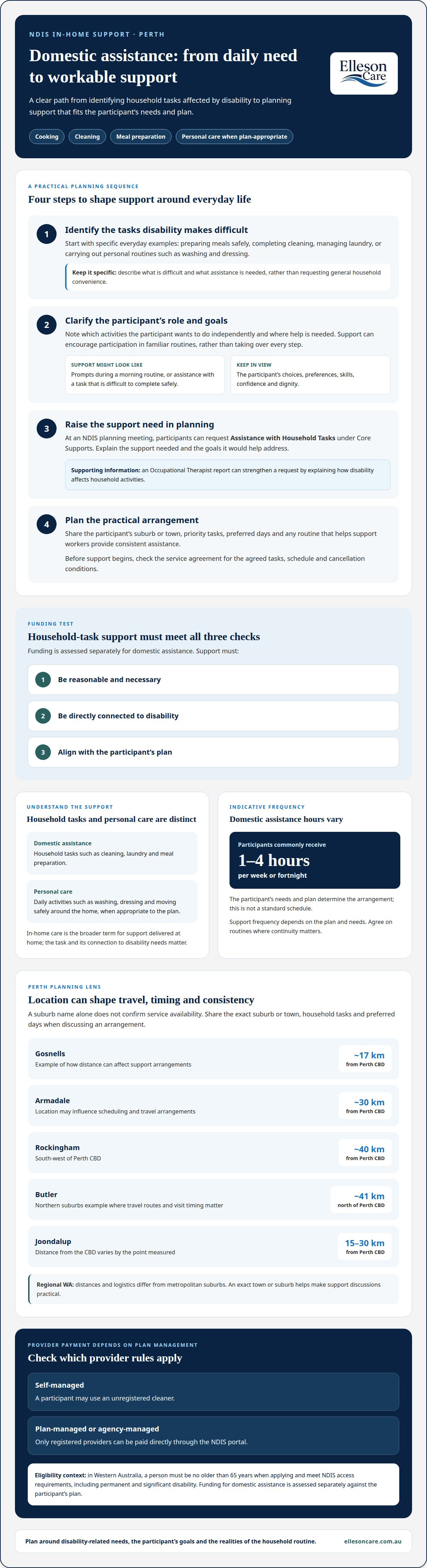
Start by identifying everyday tasks made difficult by disability. Note specific examples, such as being unable to prepare meals safely or complete cleaning without help. At an NDIS planning meeting, participants can request Assistance with Household Tasks under Core Supports. An Occupational Therapist report can strengthen a request by explaining how disability affects household activities.
Keep the request focused on the support needed and the goals it would help address. The NDIS may fund eligible disability-related support when it meets the participant’s plan requirements.
Eligibility for Domestic Assistance
In Western Australia, NDIS access depends on meeting scheme eligibility requirements. A person must be no older than 65 years when applying, and the NDIS supports eligible people with permanent and significant disability. The National Disability Insurance Agency says a person may qualify if one or more impairments substantially affect daily activities.
Funding for domestic assistance is assessed separately: the task must be reasonable and necessary, directly connected to disability and aligned with the plan. A self-managed participant may use an unregistered cleaner. For plan-managed and agency-managed participants, only registered providers can be paid directly through the NDIS portal.
Perth service areas
In-home assistance can be organised around a participant’s household tasks and location, but service coverage depends on where workers operate. Perth’s metropolitan area includes suburbs spread across the north, south, east and coast, so a suburb name alone doesn’t establish whether a particular support arrangement is available.
Metropolitan and regional coverage
For a participant in Armadale, roughly 30 kilometres from Perth’s CBD, location may shape scheduling and travel arrangements. Rockingham is about 40 kilometres south-west of the CBD, while Gosnells is approximately 17 kilometres away. These examples show why families should include the home address when discussing cleaning, laundry or other activities. Travel is one factor that can affect support arrangements.
Regional Western Australian locations involve different distances and logistics from metropolitan suburbs. Identify the participant’s exact suburb or town, the household tasks they need help with and their preferred days. This makes it easier to discuss a practical, consistent arrangement for support at home.
Northern suburbs and local planning
Perth’s northern suburbs extend well beyond the inner city. Butler is approximately 41 kilometres north of Perth’s CBD, while Joondalup sits between 15 and 30 kilometres from the CBD. These distances help explain why workers’ travel routes and visit timing matter when planning recurring support.
For example, a household in Butler may need to coordinate laundry and cleaning around a regular routine. Families can prepare a short list of priority tasks and explain which activities the participant wants to do independently.
Service agreements and cancellations
Before support begins, read the service agreement for the agreed tasks, schedule and cancellation conditions. If changing an NDIS provider, review the existing agreement for notice or cancellation requirements, then give reasonable notice in line with its terms. This helps families plan the transition and manage household tasks between arrangements.
For guidance on support arrangements, explore NDIS support services and consider how location, travel and routine fit the participant’s needs.
Daily living skills and independence
NDIS daily living assistance can support personal activities and household routines while respecting the participant’s choices. In Perth, the tasks and the participant’s plan shape how support is arranged.
Support with Personal Activities
Assistance with personal activities can help someone practise routines such as dressing, grooming or getting ready for the day. The support worker’s role should reflect what the participant wants to do independently and where help is needed. For example, a worker might give prompts during a morning routine rather than complete each step. This keeps support focused on the person’s skills, preferences and dignity.
Clear routines can also help participants build confidence with familiar tasks over time.
Daily Life Funding and Assistance
NDIS funding for in-home care is mainly provided through Core Supports, under Assistance with Daily Living. Participants may use relevant core support funding for in-home care when it appears in their plan. In Perth, support could include meal preparation, personal care or help with household activities linked to disability needs.
Participants commonly receive between 1 and 4 hours of domestic assistance per week or fortnight, depending on their needs. The plan and support goals guide the arrangement, rather than a standard schedule for everyone.
Funded Domestic Assistance and Price Limits
The NDIS may fund domestic assistance when it is reasonable and necessary, directly connected to disability and consistent with the participant’s plan. Household Tasks can include help with cleaning and other domestic activities. Participants can request “Assistance with Household Tasks” under Core Supports at their planning meeting, describing the tasks they cannot manage independently.
For current price limits, the National Disability Insurance Agency’s pricing schedule sets appropriate maximum prices for applicable NDIS supports. The relevant limit depends on the support item and its pricing arrangements; the schedule is not one price for all domestic assistance. Any agreed pricing changes should be communicated before they apply.
Meaning of NDIS domestic assistance
NDIS domestic assistance in Perth means help with household tasks when disability affects a participant’s ability to manage them. It is not simply a cleaner for general convenience. The support must be clearly connected to the person’s disability and align with their NDIS plan. For example, difficulty doing laundry because of limited mobility may support a request for assistance.
The practical distinction is the purpose of the help. A funded support worker might assist with meal preparation while encouraging the participant to practise safe steps, rather than taking over the task. For another person, cleaning may be the priority because disability makes essential household activities difficult. The task, the participant’s needs and their plan all matter.
Domestic assistance can be arranged to respect preferences and develop skills. A participant might choose which rooms need attention first, learn a manageable cleaning routine or take part in preparing a shopping list. These specific activities can support greater involvement in daily life. The worker’s role should reflect the participant’s goals, not impose a routine that disregards them.
To explain a request, describe the task, how disability affects completing it and what assistance would enable. For example, note that preparing meals requires help chopping ingredients or that laundry cannot be carried safely. An Occupational Therapist report can strengthen a request by explaining functional needs. This connects the requested support with everyday activities and the participant’s goals.
Keep the distinction clear: NDIS funding is intended for eligible disability-related support that meets plan requirements, not household help unrelated to disability. A participant’s plan guides what can be funded, while their preferences shape how assistance is delivered. To discuss support that reflects daily routines and individual goals, talk through your NDIS support needs.
Elleson Care: Aged Care Services
Elleson Care provides NDIS Support Services for people seeking support shaped around disability-related needs and daily routines. If you’re considering assistance at home, start by identifying the tasks that matter, the goals in the NDIS plan and the participant’s preferences.
Elleson Care also provides Aged Care Services and Clinical Support. These services may suit people whose needs extend beyond household assistance, such as those requiring clinical nursing alongside disability support. The right starting point depends on the person’s circumstances and the assistance they need.
Share what daily activities are difficult and what support would help you work towards greater independence. Contact Elleson Care to discuss your support needs.
Take the next step towards support that fits
Planning NDIS domestic assistance in Perth can start with a conversation at home. Invite the participant to identify which routines matter most, what they want to do independently and where assistance would make daily life more manageable. A short list of priorities can keep support discussions focused on the person’s goals and preferences.
It can also help to consider what progress would look like in everyday terms. That might mean taking part in meal preparation, building confidence with a household routine or having more energy for preferred activities. These goals can guide an arrangement that respects the participant’s choices and adapts as needs change.
Elleson Care is available to discuss support needs and possible next steps. Contact Elleson Care to discuss support and begin a conversation at your own pace. A thoughtful plan can make it easier to move towards greater independence, one practical step at a time.
Frequently Asked Questions
What does NDIS Domestic Assistance mean?
In practice, domestic assistance covers household tasks a participant needs help managing and how that support is arranged. Before support starts, note priority tasks, preferred routines and what the participant wants to do themselves. For example, agree whether a visit will focus on sorting laundry or changing bed linen. Clear expectations help the participant and worker understand the purpose of each visit.
Are Domestic Assistance Available for Seniors?
Yes, seniors may receive domestic assistance through aged care support, depending on their circumstances and eligibility for the relevant program. The NDIS and aged care are separate support pathways, so age and individual needs affect which may apply. A senior living at home can consider what household help would make daily routines more manageable, then explore the pathway suited to their situation.
Does the NDIS Fund In-Home Disability Support?
Yes, the NDIS can fund eligible disability support delivered at home. Visits can be organised around changes in a participant’s routines, communication needs or household circumstances. Participants can discuss practical arrangements with their support team, such as how workers should share updates or record completed tasks. This can make day-to-day support easier to coordinate.
How to Choose the Right NDIS Provider Perth Participants Can Trust?
For Perth participants, trust grows through respectful communication, clear responsibilities and staff suited to the support required. Elleson Care’s team is led by registered nurses with over 22 years of experience. A first conversation can cover communication preferences, important personal routines and what a respectful visit looks like, helping everyone understand expectations before support becomes part of everyday life.
What Is NOT Covered?
The NDIS generally does not pay a family member for domestic assistance if that person lives with the participant. This matters in households that rely on informal help. Be clear about the support being requested and who would deliver it. Distinguish the participant’s requested funded support from an assumption that a relative will be paid for their usual household contribution.
How do NDIS participants get domestic assistance added to their plan?
Keep a record of assistance received, tasks completed and changes in needs or goals. At a plan review, use those notes to explain what has worked and what remains difficult. This gives a practical account of how support is being used and whether the current arrangement still fits the participant’s daily requirements.


