

A home should be a sanctuary of personal dignity, not a facility defined by a roster. For many Perth families, exploring ndis independent living options often feels like a difficult choice between the rigid structure of a group home or the frightening prospect of managed risk. You might feel restricted by the lack of choice in traditional models, yet the thought of moving away from constant supervision brings a valid sense of anxiety regarding clinical safety. It's a complex balance to strike, especially when NDIS jargon and multi-stage funding processes make the path forward feel obscured.
We believe that true independence requires more than just a house; it requires a stable, clinical safety net that evolves alongside you. This guide is designed to help you reclaim your autonomy while maintaining the highest standards of care. You'll discover how the 2026 ILO framework allows for a personalised approach that feels like a genuine home rather than a clinical setting. We will walk you through the Exploration and Design stages, explain how nurse-led oversight provides peace of mind, and provide a clear roadmap for families ready to organise a future built on choice, safety, and respect.
Key Takeaways
- Learn why ndis independent living options offer a flexible, person-centred alternative to traditional group homes, prioritising your choice in how and with whom you live.
- Master the two-stage NDIS process, focusing on why the initial "Exploration and Design" phase is vital for creating a truly personalised and sustainable lifestyle.
- Clearly distinguish between the relational nature of ILO and the rostered model of SIL to ensure you select the support structure that best aligns with your long-term independence.
- Discover how to integrate a clinical safety net into your home environment, providing the professional oversight necessary to maintain safety without sacrificing personal dignity.
- Understand the unique benefits of a nurse-led approach in Perth, where clinical expertise and registered nurse oversight support your transition to a more autonomous life.
What are NDIS Independent Living Options (ILO)?
At its heart, ndis independent living options represent a shift from traditional care models toward a life built on personal preference. Rather than fitting into an existing vacancy, you design a support structure that fits your life. It's essential to understand that ILO is a service model, not a physical building. While Specialist Disability Accommodation (SDA) refers to the house itself, and Supported Independent Living (SIL) usually involves 24/7 rostered staff in a group setting, ILO focuses on the "how" and "with whom" of your daily life. Under the National Disability Insurance Scheme (NDIS), this model allows for a highly tailored approach where no two arrangements look the same.
An ILO plan creates a bridge between professional care and the natural rhythms of life. It combines paid support workers with informal networks, such as family, friends, or even neighbours who provide a sense of belonging and security. This blend ensures that your support is sustainable and deeply rooted in your local community.
The Core Philosophy: Choice, Control, and Community
Choice and control aren't just NDIS buzzwords; they're the foundation of a dignified life. In Western Australia, many families are moving away from the clinical feel of group homes. They want their loved ones to live in a place that feels like a home, perhaps with a host family or a co-resident who provides companionship and light support. This model encourages community participation and helps participants build lasting relationships within their local Perth neighbourhoods. By involving informal supports, the plan becomes more resilient and less reliant solely on professional intervention, fostering a genuine sense of home.
Who is ILO Best Suited For?
Selecting ndis independent living options is often the ideal choice for individuals who require regular assistance but don't need a staff member onsite 24 hours a day. It suits those who value their privacy and want the freedom to choose their own housemates. Whether you have a physical disability or intellectual support needs, ILO provides the flexibility to scale your support as your skills grow. It's about finding that "sweet spot" where safety is guaranteed through professional oversight, but the individual remains the architect of their own day. This approach is particularly effective for those who are ready to explore greater levels of independence within a secure, planned framework.
The Two-Stage Process of Designing Your ILO Plan
Securing ndis independent living options isn't a one-off event. It's a deliberate, two-part journey designed to ensure your home life is both safe and sustainable. The NDIA mandates this structure to prevent participants from being rushed into arrangements that don't meet their long-term clinical or social needs. Your support coordinator plays a vital role here. They act as a guide through the bureaucracy, ensuring every piece of evidence aligns with your personal goals for independence. This methodical approach provides a sense of stability for families who may feel overwhelmed by the transition.
Stage 1: Exploration and Design
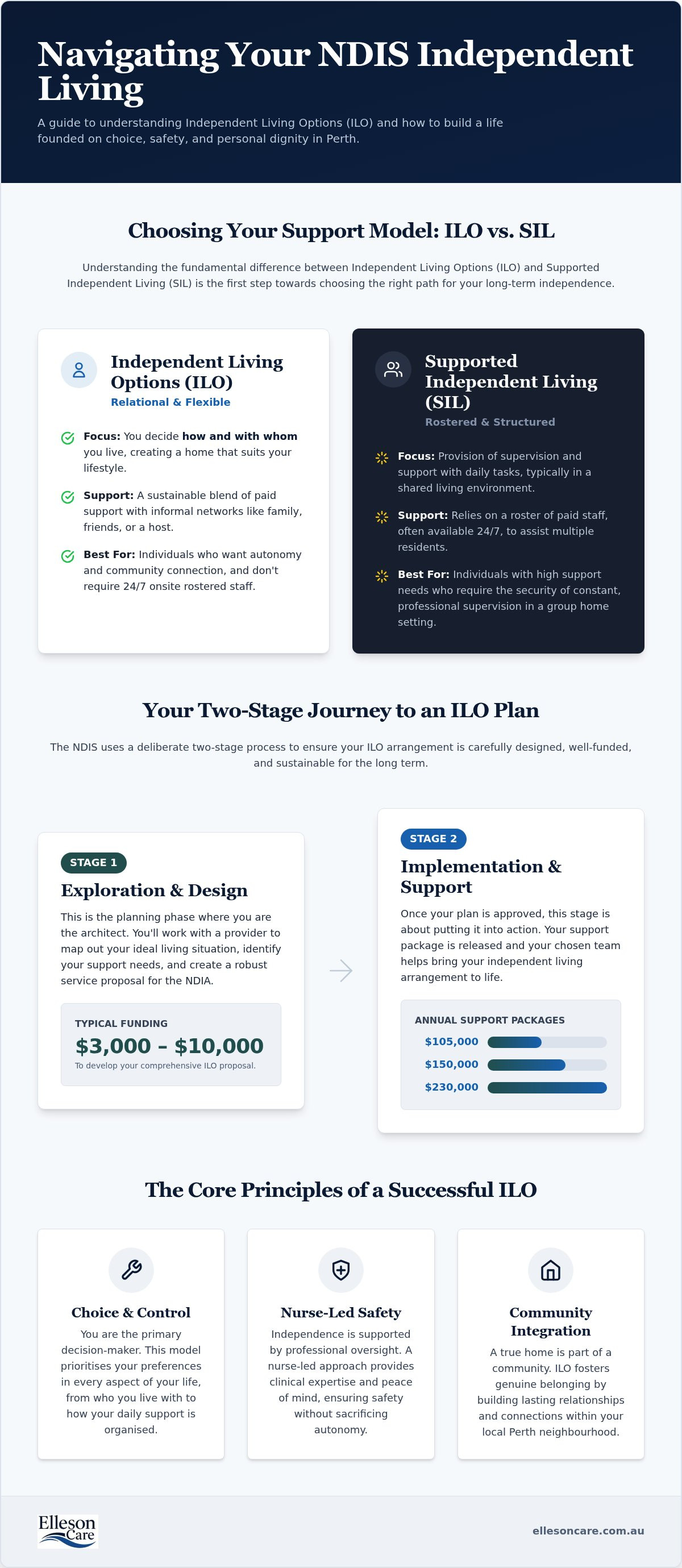
In Stage 1, you work closely with a provider to map out your ideal life. This phase usually attracts funding between $3,000 and $10,000, as outlined in the official NDIS explanation of ILO. You'll explore whether you want to live with a host family, a supportive housemate, or perhaps alone with a strong network of neighbours. It's about more than just a floor plan. You'll identify your safety requirements and clinical needs to create a robust service proposal. This stage is your opportunity to be the architect of your own future, ensuring the final plan reflects your unique lifestyle in Perth.
Stage 2: Implementation and Ongoing Support
Once your proposal is approved, you move to Stage 2: Implementation. This is where the funding for your actual supports is released. Depending on your specific requirements, these annual packages can reach $105,000, $150,000, or $230,000. During this stage, your chosen team puts the plan into action, monitoring how the primary and supplementary supports interact in your daily life. It's a living arrangement that needs constant oversight to ensure you feel safe and supported. If your needs change or your independence grows, the plan must be adjusted to remain fit-for-purpose. If you're feeling overwhelmed by the paperwork, our team can help you organise your ILO journey with professional clarity and clinical expertise.
Regular reviews are essential for long-term success. They allow you to reflect on what's working and what needs refinement. By treating the plan as a living document, you ensure that your support network grows alongside your confidence. This ongoing monitoring protects your dignity and ensures that your ndis independent living options remain a source of freedom rather than a source of stress.
ILO vs. SIL: Choosing the Right Support Model for Your Goals
Choosing between Supported Independent Living (SIL) and Individualised Living Options (ILO) is a pivotal decision for any family. While both models aim to foster independence, they operate on fundamentally different philosophies. SIL is primarily a rostered model, where professional staff are scheduled to provide 24/7 care, often within a shared residence. In contrast, ndis independent living options focus on a relational approach. This model prioritises the connections you have with the people you live with, whether they are paid housemates, host families, or supportive neighbours.
There is a common misconception that ILO is merely "SIL lite" or a scaled-back version of traditional care. This isn't the case. ILO is a distinct framework designed for those who value flexibility over a fixed roster. Funding also differs significantly; SIL usually involves a set daily rate for shared support, whereas ILO funding is unbundled and tailored to the specific arrangement designed during your exploration phase. By following the official NDIS guidelines on ILO, families can see that this model is about building a life, not just filling a shift.
When is SIL the Better Option?
For individuals with high-intensity clinical or behavioural needs, SIL remains a vital and effective support model. If you require the constant presence of onsite professional staff to manage complex health conditions or immediate safety risks, the 24/7 rostered nature of SIL provides a necessary level of security. Shared SIL environments also offer a consistent social presence, which is beneficial for those who thrive in a communal setting. For families managing these higher tiers of complexity, integrating specialised nursing services into a SIL plan ensures that clinical safety is never compromised while living in the community.
Why ILO is Gaining Popularity in Perth
Many Perth families are turning to ndis independent living options because they seek "ordinary life" outcomes. ILO allows participants to live in a typical suburban street, perhaps with housemates who aren't NDIS participants. This integration into the local Western Australian community often leads to better personal outcomes and a deeper sense of belonging. It can also be more cost-effective for the scheme because it leverages informal supports, such as a neighbour who might check in of an evening, rather than relying solely on high-cost professional rosters for every interaction.
To help determine which path is right for you, consider this brief checklist:
- Do you prefer a consistent team of rostered staff (SIL) or a mix of paid and natural supports (ILO)?
- Is 24/7 onsite professional supervision a clinical necessity for your safety?
- Do you want to choose exactly who you live with, including people without disabilities?
- Is your primary goal to live in a communal "group home" setting or a private residence in the community?
Practical Steps for Implementing a Safe and Sustainable ILO
The most common question families ask when exploring ndis independent living options is whether a loved one will be safe without 24/7 onsite supervision. It's a valid concern. Independence should never come at the cost of clinical security. A sustainable ILO arrangement is built on a clinical safety net that remains invisible during the good times but is immediately responsive when needed. This involves more than just a support worker; it requires a coordinated system of professional oversight and community connection. We believe that safety is the foundation upon which independence is built.
Organising back-up support is a critical part of this framework. You need a clear, documented protocol for when primary carers are unavailable due to illness or personal leave. Without this, the arrangement becomes fragile and stressful for the family. Additionally, active community access is the best defence against social isolation. By ensuring you are known in your local Perth neighbourhood, you create a natural circle of eyes and ears that adds an informal layer of protection. This community-based approach ensures that you are seen and valued as a neighbour, not just a service recipient.
Building Your Support Team in Perth
Success depends on finding the right mix of paid professionals and informal companions. We focus on matching personalities rather than just filling a slot on a roster. You want people who share your interests and respect your personal space. In Western Australia, local providers help facilitate these community connections by identifying hosts or housemates who truly align with your values. This relational approach ensures that the people in your home are there because they want to be, fostering a genuine sense of belonging and mutual respect within the household.
Risk Management and Emergency Planning
A robust "What If" plan is non-negotiable for any independent living arrangement. This document covers everything from medical emergencies to environmental risks like power outages or equipment failure. Incorporating assistive technology, such as smart sensors or communication devices, can enhance safety without invading your privacy. Registered nurses are instrumental in this process, performing regular audits of the ILO environment to ensure all clinical risks are managed effectively. With over 22 years of experience in complex care, our team understands how to spot potential issues before they become emergencies. This high-tier professional oversight provides families with the reassurance that their loved one is safe and their dignity is maintained. If you're ready to design a secure and autonomous future, you can contact our clinical team to discuss your specific needs.
Why a Nurse-Led Approach Enhances Independent Living in Perth
At Elleson Care, we view ndis independent living options through a clinical lens that prioritises safety without compromising personal dignity. While the ILO model is inherently social and relational, many participants in Western Australia require a higher level of medical oversight to live safely in the community. As a nurse-led provider with over 22 years of experience, we provide a bridge between complex healthcare and home life. Having a registered nurse oversee the design of your support plan adds a layer of security that traditional models often lack. It means your "What If" plan isn't just a document; it's a clinically sound strategy managed by experts who understand the nuances of disability care.
We pride ourselves on being a WA-owned and operated partner. This local expertise allows us to understand the specific challenges Perth families face, from navigating local hospital discharge processes to finding the right community supports. Our "Family Approach" centres the participant and their loved ones, ensuring that every decision respects the individual's autonomy while providing the family with much-needed peace of mind. We don't just see a participant; we see a person with a right to a stable and secure home life.
Clinical Governance for Independent Living
Managing complex health needs like wound care or medication management within an ILO setting requires rigorous clinical governance. Our registered nurses don't just provide oversight; they actively train support workers to handle specific clinical tasks safely. This ensures that your daily support team is competent and confident in following evidence-based practices. For those transitioning from different care environments, such as in home aged care perth, our nurse-led model provides a familiar, professional framework that makes the shift to NDIS supports feel stable and secure.
Holistic Wellbeing and Dignity
True independence extends beyond clinical tasks. We focus on your emotional and social health, ensuring that your ndis independent living options facilitate a life that is rich in connection. This is particularly vital for our community transition program, which supports individuals as they move from hospital settings back into their own homes. We advocate for your right to a life that feels like home, supported by a team that is both technically proficient and fundamentally kind. If you are ready to explore a more autonomous future, Contact Elleson Care today to begin designing your personalised ILO plan with the support of a compassionate expert.
Designing a Future Built on Choice and Security
Choosing the right path for independence is a significant milestone for any family in Western Australia. By exploring ndis independent living options, you are prioritising a life defined by personal preference and community connection rather than a fixed roster. We have seen how the two-stage process ensures your arrangement is sustainable; meanwhile, the distinction between ILO and SIL allows you to select the model that truly aligns with your long-term goals. A home should always be a place of sanctuary, where safety and dignity are guaranteed through professional oversight.
As a West Australian owned and operated provider, Elleson Care is committed to being your steady partner in this transition. Our team is led by registered nurses with over 22 years of experience, ensuring your plan is backed by high-tier clinical expertise and a deep respect for your autonomy. We specialise in both clinical and NDIS support, providing the expert guidance needed to navigate complex care needs with confidence. You don't have to navigate this path alone. Start your journey to independence with a nurse-led ILO consultation at Elleson Care. We look forward to helping you build a life that is as safe as it is free.
Frequently Asked Questions
What is the difference between ILO and SIL under the NDIS?
Supported Independent Living (SIL) usually involves a fixed roster of professional staff providing 24/7 care, often in a shared home. In contrast, ndis independent living options focus on a relational approach. This model allows you to live with a host or housemate, mixing paid professional help with natural supports like friends or neighbours. It's a more flexible framework designed for those who want an ordinary life in the community rather than a rostered facility.
Can I use ILO funding to pay for my rent or board in Perth?
No, you can't use ILO funding for rent, board, or standard living expenses. The NDIS is designed to cover disability-related supports, while day-to-day costs like groceries, utilities, and housing remain the responsibility of the participant. You'll need to use your own income or pension to manage these expenses. However, your plan can include funding for a provider to help you learn how to manage a household budget or maintain your tenancy safely.
How much funding can I get for the ILO Exploration and Design stage?
Funding for the Exploration and Design stage typically falls between $3,000 and $10,000. This investment allows you to work with a professional provider to map out your goals, preferences, and clinical safety needs. It's a vital phase where you create your service proposal before moving to the implementation stage. Having this funding ensures you have the time and professional guidance to build an arrangement that is both safe and truly personalised to your life.
Can I live with my family and still have an Independent Living Option?
Yes, you can certainly live with your family while utilising ndis independent living options. This model is often used to supplement the care your family already provides, allowing for a mix of informal and paid supports. It's a helpful way to gain more autonomy within the family home or to begin a gradual transition into a more independent living situation. The plan is designed to grow with your confidence, ensuring your support network is always fit-for-purpose.
What happens if my ILO arrangement stops working or I feel unsafe?
Every arrangement includes a mandatory "What If" plan to manage medical emergencies or changes in your living situation. If you feel unsafe or the model isn't meeting your needs, you should contact your provider or support coordinator immediately. They'll help you review your supports and make necessary adjustments to your plan. Your safety and dignity are the highest priorities, and the framework is designed to be responsive so that your wellbeing is never compromised.
Do I need a Support Coordinator to set up an ILO?
While it's not a strict requirement, having a Support Coordinator is highly recommended for navigating the two-stage ILO process. They provide essential help in evidencing your needs to the NDIA and finding the right providers in Perth. A coordinator can also assist in managing the transition, ensuring that every part of your service proposal aligns with your long-term goals. Their expertise simplifies the administrative burden, letting you focus on the excitement of your new independence.
Can I have ILO if I have complex clinical needs like a ventilator?
Yes, you can access ndis independent living options even with complex clinical needs, provided there is a robust clinical safety net in place. For participants requiring ventilator care or complex medication management, a nurse-led approach is essential. Registered nurses can train your support team and perform regular audits to ensure your care remains at a high standard. This professional oversight allows you to live safely in the community while maintaining your personal autonomy and dignity.
How do I find a provider in Perth to help me design my ILO?
You should look for a provider with a strong clinical background and a deep understanding of the local WA landscape. It's helpful to choose a partner who is nurse-led, as they can provide the professional governance needed for a safe home environment. Ask potential providers about their experience with the Exploration and Design stage and how they match participants with hosts or housemates. A provider like Elleson Care can offer the steady, expert guidance required to build a sustainable future.


