

Imagine the relief of finally bringing your loved one home, only to find that the joy is overshadowed by a constant, gnawing worry about their breathing equipment. It's completely natural to feel overwhelmed when managing high-intensity clinical needs outside of a hospital setting. You want the absolute best for your family. However, the fear of a medical emergency or the struggle to find support workers who truly understand complex ventilation can be exhausting for everyone involved.
Finding reliable ndis ventilator support perth shouldn't mean compromising on safety or the comfort of your own home. This article explains how specialised, nurse-led care provides the clinical precision needed for safety while protecting the personal dignity of NDIS participants. We'll explore the benefits of high-intensity clinical oversight, the importance of adhering to registered provider standards, and how a local, family-centred approach creates a stable and secure environment for your whole household.
Key Takeaways
- Understand how high-intensity clinical care enables NDIS participants to transition safely from hospital settings to the comfort of their own homes.
- Learn about the vital role Registered Nurses play in providing clinical governance and personalised care plans for individuals requiring ndis ventilator support perth.
- Discover the essential environmental requirements for a safe home setup, including managing Perth’s specific climate factors to protect sensitive medical equipment.
- Gain practical insights into navigating NDIS funding by understanding the High Intensity Support Skills Descriptors and preparing for plan reviews.
- Recognise the advantages of partnering with a local, nurse-led provider that prioritises clinical excellence and a holistic family-centred approach.
What is NDIS Ventilator Support and Who Needs It?
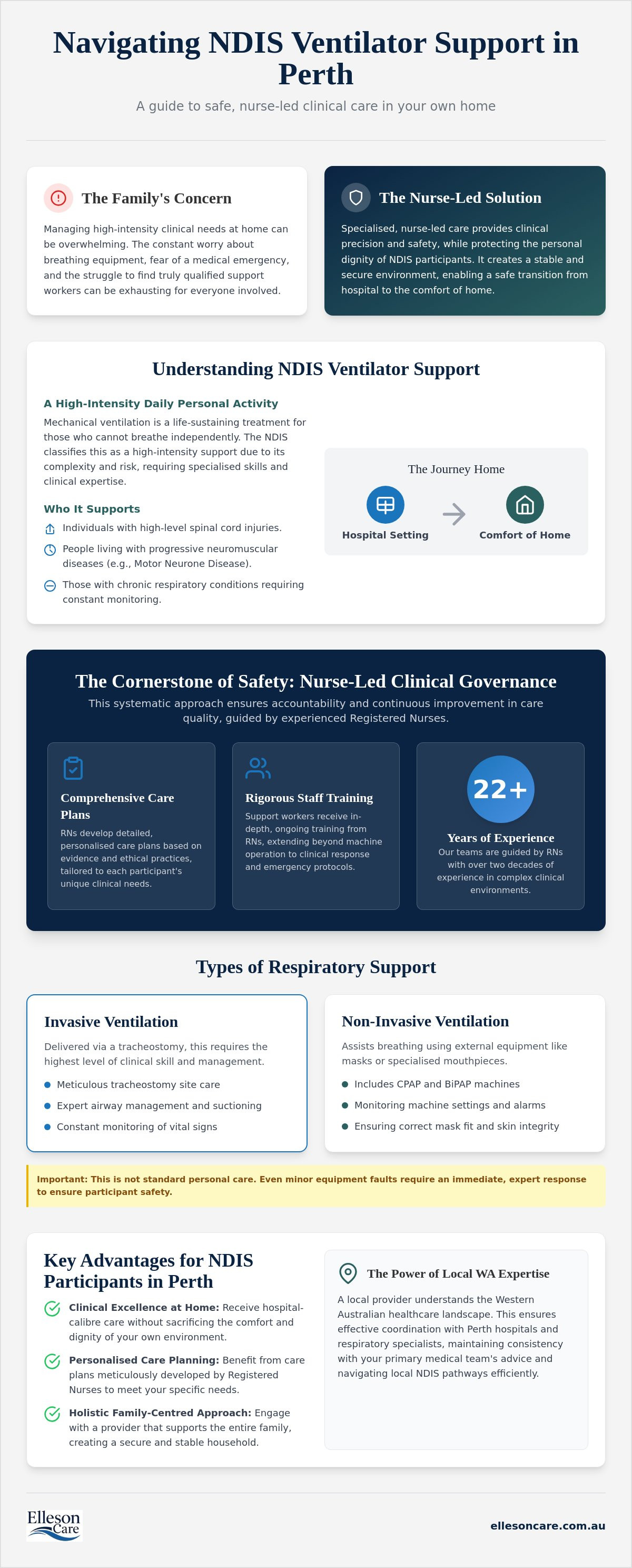
Mechanical ventilation is a life-sustaining treatment that assists or replaces the natural work of breathing for individuals who cannot maintain adequate respiratory function independently. Within the NDIS framework, this is classified as a high-intensity daily personal activity. This designation signifies that the support required is complex and carries a higher level of risk, necessitating specialised skills. For many families seeking ndis ventilator support perth, this funding is a vital resource. It enables participants to access the clinical expertise of Registered Nurses within their own homes, ensuring that medical needs are met without sacrificing the comfort of a familiar environment.
This level of support serves a diverse group of people with varying clinical backgrounds. It's often essential for individuals living with high-level spinal cord injuries, progressive neuromuscular diseases such as Motor Neurone Disease, or chronic respiratory conditions that require constant monitoring. While these participants once faced long-term stays in clinical institutions, the shift towards home-based care in Western Australia has transformed lives. Perth families are increasingly opting for nurse-led home support because it prioritises personal dignity and family unity. It allows a participant to remain an active member of their household while receiving the same calibre of care they would find in a hospital setting.
Types of Respiratory Support Covered
Respiratory care is tailored to the specific needs of the individual and generally involves either invasive or non-invasive methods. Invasive ventilation is delivered via a tracheostomy, which requires meticulous site care and airway management. Non-invasive options, such as CPAP or BiPAP, utilise masks or specialised mouthpieces to assist breathing. It's important to distinguish this from standard personal care. While a general support worker might assist with daily tasks, high-intensity clinical support involves monitoring machine settings, clearing secretions, and responding to equipment alarms. Professional clinical oversight is non-negotiable here, as even a minor equipment fault requires an immediate, expert response to ensure the participant's safety.
The Importance of Local Care in Western Australia
Understanding the Western Australian healthcare landscape is crucial for a smooth transition from hospital to home. A local provider understands the specific WA health standards and can coordinate effectively with Perth's major hospitals and respiratory specialists. This local connection ensures that the clinical care plan remains consistent with the advice of the participant's primary medical team. For a broader perspective on how these supports fit into a total care plan, you can refer to our guide on Nursing Services in Perth. Choosing a provider with deep roots in the community means you have a partner who understands the local NDIS pathways and is committed to delivering high-quality ndis ventilator support perth that feels both professional and personal.
The Critical Role of Nurse-Led Clinical Governance
Managing high-intensity care like ventilator support involves a level of responsibility that extends far beyond daily routine tasks. It requires a deep understanding of respiratory physiology and the ability to interpret subtle changes in a participant's condition. For families seeking ndis ventilator support perth, the primary concern is often safety. This safety is guaranteed through clinical governance; a systematic approach that ensures healthcare services are accountable for continuously improving their quality. When a Registered Nurse (RN) leads the team, they bring a level of clinical intuition and expertise that a general support worker simply cannot provide alone. At Elleson Care, our support teams are guided by RNs with over 22 years of experience in complex clinical environments, ensuring every participant receives care that is both technically sound and deeply personalised.
Clinical Oversight vs. General Support
Clinical governance is the cornerstone of safe home-based care. By adhering to the National Model Clinical Governance Framework, we ensure that every intervention is ethical, evidence-based, and focused on the best possible outcomes for the participant. Registered Nurses play a pivotal role in this process by developing comprehensive care plans and providing rigorous training to support workers. They don't just teach a worker how to press buttons; they ensure each staff member passes a formal competency sign-off. This "Compassionate Expert" model ensures that while the clinical standards are hospital-grade, the delivery of care remains warm, respectful, and focused on the individual's dignity.
Emergency Management and Risk Mitigation
Living safely at home with a ventilator requires meticulous planning for every possible scenario. Our nursing leaders develop robust emergency protocols that are specific to the layout and location of each Perth home. We consider factors like power backup, equipment redundancy, and clear pathways for communication during a crisis. Because medical needs don't follow a nine-to-five schedule, having access to 24/7 clinical backup is essential for high-intensity participants. We also conduct regular audits of clinical records and equipment logs to identify and mitigate risks before they escalate. This disciplined approach to safety allows families to rest easy, knowing their loved one is in capable hands. If you are seeking a provider that balances clinical rigour with genuine care, you can explore our range of NDIS support services to see how we can assist your family.
The role of the RN also includes the ongoing monitoring for signs of respiratory distress or equipment failure that might be missed by those without clinical training. They act as a bridge between the participant and their wider medical team, ensuring that any changes in health are communicated and acted upon immediately. This proactive stance is what differentiates a nurse-led service from a generalist provider, offering a higher level of security for those requiring ndis ventilator support perth.
Living Safely at Home with Ventilator Support
Transitioning from a clinical setting to a private residence is a significant milestone that requires meticulous environmental planning. A stable home environment is the foundation of long-term wellbeing, but it demands more than just a spare room. High-intensity care necessitates a dedicated space for medical equipment, ensuring there's enough room for both the primary ventilator and its essential backups. Power reliability is a critical concern. We work with families to assess their home's electrical capacity and establish secondary power sources, such as uninterruptible power supplies (UPS), to protect against unexpected outages. This level of preparation turns a house into a safe haven where clinical needs are met without the sterile atmosphere of a hospital ward.
Perth's unique environment introduces specific challenges for sensitive medical hardware. Our local climate is often characterised by extreme summer heat and high levels of airborne dust, both of which can impact the performance of respiratory equipment. High temperatures can cause machines to overheat, while dust can clog filters more rapidly than in other regions. We help families implement cooling strategies and more frequent filter replacement schedules to ensure the equipment remains in peak condition. By choosing ndis ventilator support perth that understands these local factors, you ensure that your home setup is resilient enough to handle the Western Australian elements.
The psychological benefits of staying in one's own home are profound. Being surrounded by family, pets, and personal belongings fosters a sense of identity that can be lost in institutional care. It allows for greater social participation, enabling participants to host friends or engage in community activities on their own terms. This autonomy is vital for mental health. We focus on integrating clinical routines into the fabric of daily life, ensuring that medical care supports the participant's lifestyle rather than dictating it.
Equipment Management and Maintenance
Reliable ventilation depends on a disciplined maintenance routine. Support teams conduct daily checks on pressure settings, alarm functionality, and battery health to prevent equipment failure before it occurs. Organising supplies is equally important. We maintain a structured inventory of filters, tubing, and humidification components so that nothing is ever left to chance. Because we are West Australian owned and operated, we maintain close relationships with local equipment providers and technicians. This local network ensures that if a technical issue arises, expert help is never far away, providing an extra layer of security for the household.
Holistic Care: More Than Just a Machine
True clinical excellence looks beyond the ventilator itself to address the participant's total health. For those using mechanical ventilation, maintaining skin integrity and meticulous oral hygiene is essential to prevent complications such as pressure sores or secondary infections. Our "Compassionate Expert" approach means we treat the person, not just the condition. This extends to the whole family. We recognise that carers and loved ones need support too, so we provide guidance and reassurance to help them manage the emotional aspects of home-based clinical care. Protecting the participant's dignity and autonomy remains our highest priority in every interaction.
Navigating NDIS Funding for High Intensity Support
Securing the right funding for ndis ventilator support perth is the vital bridge between a clinical necessity and the reality of living safely at home. The National Disability Insurance Agency (NDIA) utilises a specific framework known as the High Intensity Support Skills Descriptors to define the level of expertise required for complex care. For ventilator management, these descriptors are rigorous. They mandate that support staff possess specialised knowledge in airway management and emergency response. Understanding how these descriptors apply to your specific situation is the first step in ensuring your plan reflects the true cost of high-quality, nurse-led care.
Preparation for an NDIS plan review is essential when complex clinical needs are involved. You must provide clear, evidence-based justification for why Registered Nurse oversight is required rather than standard support work. Detailed clinical reports, respiratory assessments, and equipment logs serve as the necessary proof to demonstrate that your safety depends on professional governance. A skilled Support Coordinator plays a pivotal role here. They act as your advocate, translating clinical requirements into the specific language used by the NDIA to secure the appropriate levels of funding for your household.
NDIS Registration Groups for Clinical Care
Funding for ventilator support typically spans two primary registration groups. Registration Group 0104, High Intensity Daily Personal Activities, covers the day-to-day assistance required for participants with complex needs. However, the professional oversight and training are often funded through Registration Group 0114, Community Nursing Care. This group allows for Registered Nurses to develop care plans and provide the essential competency sign-offs for your support team. It's important to understand how these integrate with your core and capacity-building budgets to ensure there are no gaps in your clinical coverage.
Reporting and Compliance Requirements
The NDIS maintains strict Practice Standards for high-intensity supports to ensure participant safety. This means every aspect of care must be meticulously documented for potential audits. Detailed clinical records, incident reports, and equipment maintenance logs are not just bureaucratic requirements; they are essential safety measures. At Elleson Care, we manage this complex paperwork on your behalf. We ensure all documentation meets the highest NDIS standards, allowing you and your family to focus on daily life rather than administrative burdens. If you need assistance with your funding journey, you can contact us to discuss our Clinical Support options and how we help Perth families maintain their independence.
Our team ensures that every support worker is not only trained but remains compliant with the latest evidence-based practices. This ongoing commitment to quality is what makes ndis ventilator support perth sustainable for the long term. By choosing a provider that prioritises clinical governance, you ensure that your funding is used effectively to maintain a safe and stable home environment.
Why Choose Elleson Care for Ventilator Support in Perth?
Choosing a provider for such a critical service is a decision that impacts every member of your household. Elleson Care stands apart as a West Australian owned and operated organisation, which means we aren't a distant national franchise. We're part of the local community, with a deep understanding of the Perth health network and the specific needs of NDIS participants in our state. Our leadership team consists of Registered Nurses with more than 22 years of experience in high-intensity clinical care. This expertise ensures that your ndis ventilator support perth is managed with the highest level of professional discipline while remaining grounded in human kindness.
Our person-centred philosophy ensures that your personal goals and dignity are never sidelined by your medical requirements. We believe that clinical excellence should empower you to live the life you choose, not restrict it. Whether you're transitioning from hospital to home or seeking a more reliable support team, we provide the expert guidance needed for a seamless experience. We act as a steady, reliable presence for families who need to know that their clinical care is in the best possible hands.
Our Holistic Family Approach
We recognise that a ventilator doesn't just affect the individual; it changes the dynamics of the entire home. Our approach is fundamentally family-centred, ensuring that carers and loved ones are supported and informed at every stage. In a city as diverse as Perth, we pride ourselves on providing culturally sensitive care that respects the unique background of every family we serve. We don't just treat a clinical condition. We support a person within their family unit, building long-term relationships based on trust and professional integrity. This holistic view ensures that the emotional well-being of the household is prioritised alongside physical health.
Get Started with Specialist Support
Taking the first step towards more secure support is straightforward. Our nursing team begins with an initial clinical assessment to understand your specific needs and home environment. From there, we develop a personalised care plan that is designed to grow and adapt alongside you. This plan is not static; it's a living document that we review regularly to ensure it remains aligned with your health goals and NDIS requirements. We're here to provide the stability and peace of mind you deserve while ensuring you receive high-quality ndis ventilator support perth.
Contact Elleson Care today to discuss your NDIS ventilator support needs in Perth.
Empowering Your Independence with Clinical Excellence
Transitioning to home-based care is a significant journey that requires a delicate balance of technical precision and deep human empathy. By prioritising nurse-led clinical governance, families can ensure that high-intensity needs are met with the highest safety standards while protecting the personal dignity of their loved ones. We have explored how a holistic, family-centred approach transforms complex medical requirements into a stable, dignified lifestyle within the local community. When you are searching for ndis ventilator support perth, it is essential to partner with a provider that understands both the clinical rigour required and the importance of a familiar, supportive home environment.
As a specialised high-intensity NDIS provider, Elleson Care is proud to be West Australian owned and operated. Our team is led by Registered Nurses with over 22 years of experience, ensuring that every participant receives care that is evidence-based and deeply compassionate. We are dedicated to helping local families thrive by providing the expertise needed to manage complex respiratory needs with confidence and ease. Secure Nurse-Led NDIS Support for Your Home Care Needs and take the first step towards a safer, more independent future. Your journey toward home-based independence is supported by a team that is fundamentally invested in your quality of life.
Frequently Asked Questions
Is it safe to use a ventilator at home under the NDIS?
Yes, home-based ventilation is safe when it's managed under a rigorous clinical governance framework led by qualified health professionals. NDIS practice standards require registered providers to have specific risk management plans and emergency protocols in place. This ensures that hospital-grade safety is maintained within your own home, allowing for both clinical security and personal dignity.
What level of training do support workers need for ventilator care?
Support workers must complete specialised training and receive a formal competency sign-off from a Registered Nurse before they can provide care. This training covers machine operation, alarm responses, and airway management. At Elleson Care, our nursing leaders ensure every staff member is technically proficient and confident in managing the specific respiratory needs of the participant.
Can the NDIS fund a Registered Nurse to visit me at home in Perth?
Yes, the NDIS can fund Registered Nursing services under the Community Nursing Care registration group for participants with complex clinical needs. This funding allows for regular clinical reviews, care plan development, and staff training. It's a standard component for those requiring ndis ventilator support perth to ensure ongoing safety and health monitoring.
What happens if there is a power outage while using a ventilator at home?
Every home-based ventilation setup must include a robust emergency plan that specifically addresses power failure. This involves using internal machine batteries and external backup batteries that provide several hours of autonomous power. We also assist families in registering their household with local utility providers as a priority location for power restoration during outages.
Does Elleson Care provide 24/7 support for high-intensity needs?
We provide clinical support tailored to the high-intensity needs of our participants, with Registered Nurses overseeing the daily care delivery. Our nurse-led governance ensures that your support team is prepared for 24/7 care requirements within the home. This provides families in need of ndis ventilator support perth with a steady, reliable presence for long-term stability.
How do I add ventilator support to my NDIS plan?
You can add this support by requesting a plan review and providing clinical evidence from your respiratory specialist or hospital team. This documentation must justify the need for high-intensity support and professional nursing oversight. Working with an experienced Support Coordinator can help ensure the request is framed correctly within the NDIS High Intensity Support Skills Descriptors.
What is the difference between CPAP and a life-support ventilator?
CPAP provides a continuous stream of air to keep airways open, while a life-support ventilator actively breathes for the participant by delivering controlled volumes of air. Ventilators are more complex and require higher levels of clinical monitoring and alarm management. Both fall under respiratory support, but life-sustaining ventilation requires the specialised oversight provided by a nurse-led team.
Can I still access the community while on a ventilator?
Yes, accessing the community is a primary goal of the NDIS and is entirely possible with portable equipment and trained support. We focus on integrating clinical care with social participation, allowing you to attend events or visit friends safely. Our team ensures that all necessary backup equipment and supplies are prepared for any community outing.


