

The most effective NDIS goals are often outcome-blind. They focus on the life you wish to lead rather than the nursing hours or specific services you think you need. We understand that setting goals for your NDIS plan can feel like a daunting task, especially with the 2026 legislative reforms introducing a new framework planning model. It's natural to feel concerned about how to articulate complex clinical needs without losing the funding that maintains your independence and dignity.
You deserve a plan that reflects your actual daily life and support requirements. This guide will show you how to craft meaningful, outcome-focused goals that secure the right clinical and social support for your well-being. We'll explore the transition to support needs assessments and provide you with a practical approach to drafting goals. By the end, you'll have the confidence to enter your planning meeting with a clear list of draft goals and an understanding of how your personal aspirations link to reasonable and necessary support.
Key Takeaways
- Understand how the 2026 legislative reforms prioritise whole-of-life outcomes to ensure your plan remains stable and effective.
- Master the art of setting goals for your NDIS plan by focusing on your desired life outcomes rather than specific service hours or brand names.
- Learn the "So That" formula to bridge the gap between your clinical needs and the social or economic participation goals the NDIA requires.
- Discover how to gather high-quality clinical evidence from your nursing team to support your claims for reasonable and necessary funding.
- Explore the benefits of partnering with a nurse-led Perth provider to translate your high-level goals into daily, practical support.
What are NDIS Goals and Why Do They Matter in 2026?
The process of setting goals for your NDIS plan is your opportunity to define your future. Goals are much more than administrative requirements; they're the personal roadmap for your independence and community involvement. Within the National Disability Insurance Scheme (NDIS), a goal represents what you want to achieve, develop, or learn. Following the passage of the National Disability Insurance Scheme Amendment (Securing the NDIS for Future Generations) Act in August 2026, the focus has shifted significantly toward "whole-of-life" outcomes. This means the NDIA now looks more closely at how your goals contribute to your long-term stability and social participation.
When you're setting goals for your NDIS plan, it's vital to understand that these statements are the keys that unlock your funding. The NDIA cannot provide support unless it directly relates to a goal you've identified. However, a common point of confusion is the difference between a goal and a support. A goal is the outcome you desire, such as improving your physical health to participate in local sports. The support is the service you receive to get there, such as specialised clinical nursing or physiotherapy. Keeping this distinction clear ensures your plan remains focused on your aspirations rather than just your medical needs.
The Role of Goals in Your NDIS Journey
Your goals help the NDIA understand your unique circumstances beyond a clinical diagnosis. They provide a narrative of your life and your aspirations for the future. For the best results, your goals should be written in your own words. This ensures they reflect your genuine desires rather than generic clinical terminology. Under the new framework planning model introduced in July 2026, goals must align clearly with the "reasonable and necessary" criteria. This creates a logical bridge between your daily challenges and the professional care required to overcome them.
Common Misconceptions About Plan Goals
A frequent myth is that listing more goals will result in a higher budget. In reality, the NDIA prioritises quality over quantity. A few well-defined, outcome-focused goals are often more effective than a long list of vague intentions. Another misconception is that goals must only focus on your disability. You're encouraged to include lifestyle aspirations, like building social connections or finding meaningful employment. It's also essential to recognise that the NDIS funds the pursuit of these goals, not a guaranteed result. The scheme provides the resources and professional support needed to give you the best possible chance of success.
Categorising Your Aspirations: Short-term vs. Long-term Goals
Effectively setting goals for your NDIS plan requires a thoughtful look at both your immediate needs and your future dreams. The NDIA typically looks for a combination of short-term objectives, which you hope to achieve within the next 12 months, and medium to long-term aspirations that may take several years to realise. For individuals with complex needs, clinical nursing support often acts as the foundation for these goals. It's difficult to focus on finding a job or moving house if your daily health requirements aren't managed with professional care and stability.
When you begin this process, it's helpful to seek tips for deciding your NDIS goals from advocacy groups to ensure your voice remains central. You'll need to balance "Capacity Building" goals, which focus on developing new skills, with "Core Support" requirements that maintain your current level of health and safety. This balance ensures you're not just surviving, but actively working toward a more independent life. Our team at Elleson Care can help you align these clinical needs with your broader personal milestones.
Examples of Short-term Milestones
Short-term goals are the practical steps you take to improve your quality of life right now. These milestones are often specific and measurable. For many in the Perth metro area, this might include:
- Improving physical mobility or stamina to enjoy visits to King's Park or local community centres.
- Developing communication skills to more clearly express your preferences and health needs to your support workers.
- Learning to manage daily health routines, such as medication or wound care, with less intensive supervision from family members.
Visualising Your Long-term Future
Long-term goals are the "big picture" changes that define your identity and place in the community. These aspirations provide the NDIA with a clear sense of where you're heading. Significant long-term goals might involve:
- Achieving a transition to Independent Living Options (ILO), allowing you to live in a home of your choice with the right support.
- Maintaining a stable and safe home environment through consistent nursing services that prevent hospital admissions.
- Engaging in meaningful volunteer work or part-time employment within the Perth disability sector to build social and economic connections.
By categorising your goals this way, you create a clear path for your planning meeting. It demonstrates to the NDIA that you have a logical plan for your development, supported by the clinical care necessary to make those dreams a reality. This structured approach helps ensure that every aspect of your well-being is considered, from immediate medical safety to long-term social inclusion.
The Secret to "Fundable" Goals: Outcomes Over Services
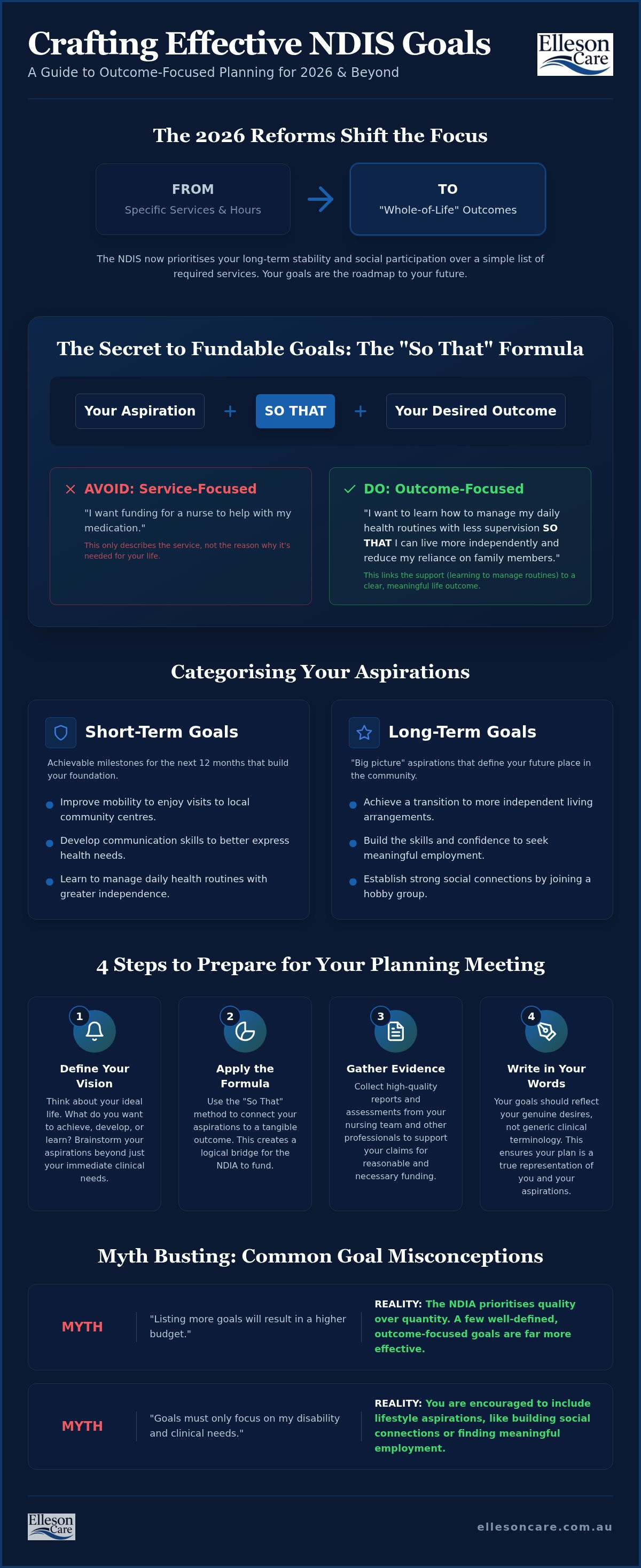
One of the most common reasons for plan rejection or insufficient funding is a misunderstanding of how the NDIA views goal statements. When setting goals for your NDIS plan, it's essential to focus on the life you want to lead rather than the specific services you require. The NDIS typically rejects goals that name specific brands or request a set number of hours, such as "I want 10 hours of Elleson Care." This is because the NDIS is designed to be flexible; it funds the outcome, and you choose the provider. By focusing on the functional impact of your disability on your daily life, you create a stronger case for the supports that will help you overcome those barriers.
To make this easier, we recommend the "So That" Method. This simple formula ensures your goals are outcome-focused. You start with the action you want to take and follow it with "so that" to explain the benefit. For example, "I want to improve my physical health so that I can participate in community outings without fatigue." This approach clearly demonstrates the purpose of the funding to the planner and helps them see the direct link between your aspirations and your support needs.
Service-Based vs. Outcome-Based Wording
Changing your wording can significantly impact how your plan is managed. Consider the difference between these two approaches:
- Service-Based: "I need a support worker to take me shopping." This is often viewed as a request for a specific person rather than a goal.
- Outcome-Based: "I want to increase my independence in the community so that I can manage my own grocery shopping."
The outcome-based version is far more likely to be approved. It allows for flexible funding because it identifies a skill you are building or a level of independence you are maintaining. It shows the NDIA that the support worker is a tool to reach a specific life milestone, rather than just a convenience.
Clinical Goals in a Social Framework
Individuals with complex medical needs often ask how to secure nursing care if they can't explicitly ask for a nurse in their goals. The secret lies in framing your clinical requirements within a safety and independence framework. For instance, if you require ventilator support, your goal isn't "to have a nurse monitor my ventilator." Instead, it might be "to maintain a stable and safe health environment at home so that I can remain connected to my family and community."
By documenting the "why" behind your health needs, you show that clinical nursing support is the essential foundation for your social goals. Collaborating with your Registered Nurse to draft these statements ensures your clinical evidence matches your personal aspirations. This professional documentation proves that medical safety is the prerequisite for your independence, making the link to reasonable and necessary support undeniable for the planning team.
Step-by-Step: Preparing for Your NDIS Planning Meeting
The success of setting goals for your NDIS plan often depends on the meticulous work you do before the meeting begins. Start by reviewing your current plan to identify what worked and what didn't. Perhaps your circumstances have changed in the last year, or you've identified new aspirations for your independence. This reflection ensures your next plan is grounded in your lived experience, providing a clear baseline for the supports you will request. You should also gather your "Evidence of Disability." Reports from your clinical team are vital because they provide the technical justification for the supports you need to pursue your goals.
Once you've reflected on your journey, draft 2nd or 3rd clear statements using the outcome-focused formula discussed earlier. Having these written down helps you stay on track during the discussion. On the day of the meeting, remember that you don't have to go alone. You're entitled to bring a family member, a professional advocate, or a member of your nursing team for support. Their presence can provide emotional stability and help clarify complex clinical points if the planner needs more detail. Being well-prepared allows you to lead the conversation with confidence.
Gathering Professional Evidence
Professional evidence is the backbone of a successful NDIS application. We recommend requesting "Impact Statements" from your current service providers. These documents shouldn't just list your diagnosis; they must clearly link your health needs to your social and economic goals. For example, a report might explain how managing a chronic wound allows you to attend a community group. There's immense value in having a nurse-led team provide detailed progress notes, as these offer the clinical authority planners look for when approving complex supports.
The Role of Your Support Coordinator
A support coordinator acts as a vital bridge between your personal needs and the technical requirements of the NDIA. They're experts at translating your daily challenges into "NDIS-speak," ensuring your goals are framed in a way that aligns with current legislation. In 2026, you can choose to have your planning meeting via phone, video, or in-person at a Perth office. Your coordinator can help you navigate these channels and provide tips for staying calm and assertive. If you need help preparing for your next review, contact our Perth-based team today to ensure your goals are supported by expert clinical evidence.
Partnering with a Perth NDIS Provider to Reach Your Milestones
Setting goals for your NDIS plan is a significant first step, but the true transformation occurs when those aspirations are translated into daily action. At Elleson Care, our nurse-led approach ensures that your clinical requirements are managed with professional precision, which allows you to focus entirely on the milestones that matter most to you. We believe that your care should be as unique as your personal journey. By monitoring your progress through regular internal reviews, we ensure your supports remain relevant as your life evolves. This proactive stance prevents your plan from becoming stagnant and ensures you're always moving toward greater independence and well-being.
The transition from a planning meeting to implementation requires a partner who understands the local landscape. Our West Australian expertise is vital for those living in the Perth metro area, as we have established relationships with local health networks and community centres. We don't just provide a service; we act as a steady, reliable presence in your life. This consistency is particularly important for individuals with complex clinical needs, where stability is the prerequisite for any social or economic participation. We're here to help you turn the technical language of your 2026 plan into a practical, supportive reality.
Personalised Care for Perth Families
Our commitment to dignity, autonomy, and clinical excellence is at the heart of our service delivery. As a West Australian owned and operated organisation, we have a deep respect for the Perth community and the families who live here. We adopt a holistic, family-centred approach that supports both the participant and their wider support network. This ensures that everyone involved feels safe, informed, and respected throughout the care process. Our expertise in complex clinical care, including wound management and ventilator support, provides the high standard of safety needed for you to engage fully with your community and pursue your personal goals with confidence.
Ready to Start Your Next Chapter?
Moving from a written plan to meaningful action requires a partner who is both technically proficient and emotionally invested in your quality of life. Our process involves carefully matching support workers and nurses to your specific aspirations, ensuring a seamless fit with your lifestyle and personality. We invite you to have a confidential discussion about your future needs and how our professional team can support your journey. Contact Elleson Care today to see how we can help you achieve your 2026 NDIS goals through compassionate, nurse-led support that prioritises your independence and personal dignity.
Empowering Your Future Independence
Success in setting goals for your NDIS plan depends on shifting your focus from the specific services you receive to the life you want to live. By using the "so that" method and prioritising outcomes over brand names, you create a flexible roadmap that the NDIA can readily support. It’s equally important to gather robust clinical evidence that demonstrates how your professional care acts as the foundation for your social and economic participation in the Perth community.
Transitioning from a draft list of aspirations to a finalised plan requires a partner who understands the clinical complexities of your care. As a West Australian owned and operated provider, we pride ourselves on delivering personalised, person-centred care that respects your dignity and autonomy. Our nurse-led clinical expertise ensures that your daily health needs are managed with the highest standards of safety, giving you the freedom to pursue your long-term milestones with confidence. We're here to help you navigate the 2026 reforms and turn your aspirations into a sustainable reality. Discuss your NDIS goals with the nurse-led team at Elleson Care to begin your next chapter with stability and professional support.
Frequently Asked Questions
How many goals should I have in my NDIS plan?
You should ideally aim for two to three short-term goals and one or two medium-to-long-term goals. The NDIA prioritises the quality and clarity of your aspirations over the total number listed. Setting goals for your NDIS plan that are broad and outcome-focused allows for greater flexibility in how your funding is used. Focus on the milestones that will have the most significant impact on your daily life and independence rather than listing every minor task.
Can I change my NDIS goals once the plan has started?
Yes, you can change your goals, but it usually requires a plan variation or a scheduled review. If your circumstances change significantly, you should contact the NDIA to discuss an update. You will need to provide evidence explaining why the new goals are necessary and how they align with your current support needs. This ensures your plan remains a living document that accurately reflects your life situation and your evolving aspirations for the future.
Will the NDIS fund a specific brand of equipment if I put it in my goals?
The NDIS does not fund specific brands or service providers named within your goals. Goals must remain outcome-blind to ensure you have the flexibility to choose the equipment or provider that best suits your needs. For example, instead of naming a specific wheelchair brand, your goal should focus on increasing your mobility so that you can access the Perth community. Once funding is approved, you can then select the specific product or service you prefer.
What happens if my goals don’t match the funding the NDIS provides?
If your goals don't align with your funding, it usually means the NDIA requires more evidence to prove the support is reasonable and necessary. Funding is not automatically granted just because a goal is listed. You must demonstrate a direct link between the support requested and the pursuit of your goal. If you feel the funding is insufficient to reach your milestones, you can request a plan reassessment. Providing detailed clinical reports from your nursing team can help bridge this gap.
Do I need a different goal for every type of support I receive?
No, a single, well-drafted goal can often cover several different types of support. For instance, a goal about increasing community participation can justify funding for a support worker, transport assistance, and social group fees. When setting goals for your NDIS plan, think about the broad outcome you want to achieve. This approach creates a more flexible plan and reduces the administrative burden of managing multiple specific goals for every individual service you utilise.
How do I write a goal for someone with complex clinical or nursing needs?
Focus on how clinical stability enables social and personal outcomes. Instead of focusing on the medical procedure itself, describe the lifestyle benefit it provides. A goal might be to maintain optimal health and respiratory stability so that you can participate in family gatherings and community events. This framing ensures that complex nursing care is viewed as an essential foundation for your independence. It clearly links your medical safety to your right to live a full life.
What is the difference between a short-term and a medium-term goal?
Short-term goals are achievements you hope to reach within the next 12 months, such as learning to use public transport or improving your physical stamina. Medium-term goals are broader life changes that may take several years to accomplish. These might include moving into independent living or completing a vocational training course. Both types are important because they show the NDIA that you have a logical plan for both your immediate needs and your long-term future.
Can my family help me write my NDIS goals?
Yes, involving your family and support network in the goal-setting process is highly encouraged. Your loved ones often have a unique perspective on your strengths and the barriers you face daily. Their input can help you articulate aspirations that are both ambitious and realistic. While the goals must ultimately reflect your own desires and autonomy, a collaborative approach ensures that your support network is aligned with your vision for a more independent life in Perth.


