

What if the most challenging part of securing support wasn't the NDIS paperwork, but finding a provider who truly understands the clinical complexities of your family's daily life? For many Western Australians, the search for reliable home care disability services often feels like a choice between basic domestic help and the high-level nursing care they actually require. It's exhausting to feel as though you're constantly repeating your story to providers who don't quite grasp the medical nuances of your situation.
You deserve a care plan that prioritises your dignity and safety without compromising your independence at home. This guide provides a clear, step-by-step pathway for managing disability support in Perth for 2026. We'll explore the latest NDIS pricing adjustments, including the 4.36 per cent indexation, and how to identify providers with the clinical nursing expertise necessary to manage complex health requirements. By the end of this article, you'll have a practical roadmap to ensure your family receives the high-tier professional support they deserve.
Key Takeaways
- Learn how to accurately assess your home care disability requirements by documenting daily challenges and identifying specific clinical needs like wound management.
- Gain clarity on the 2026 funding landscape, including the latest NDIS price limits and the Support at Home Program for West Australians.
- Understand why selecting a nurse-led organisation in Perth is vital for ensuring clinical safety and professional accountability.
- Discover how to bridge the gap between basic domestic assistance and high-level nursing to maintain long-term independence and dignity.
- Develop a practical plan of action that ensures all medical and personal care requirements are met with consistent, expert precision.
What is Home Care for Disability and How Does it Work in WA?
Home care disability support isn't merely a checklist of tasks; it's a comprehensive framework designed to uphold a person's independence while ensuring their clinical safety. In Western Australia, this support spans a broad spectrum of services. It might begin with simple domestic help but often extends to complex, nurse-led clinical care for those with high-intensity needs. The fundamental goal is to provide the right level of assistance so that individuals can remain in the familiar comfort of their own suburbs, surrounded by the people and places they love.
The landscape of Disability in Australia has evolved significantly, reaching a pivotal point in 2026. We've seen a decisive shift towards person-centred care, a model that places the individual at the heart of every decision. This approach acknowledges that you're the expert in your own life. Rather than fitting into a rigid, pre-determined service schedule, your support is tailored to your specific goals, medical requirements, and daily rhythms. It represents a move away from the "one size fits all" mentality of the past.
Choosing to stay at home rather than moving into a residential facility is a powerful statement of autonomy. For many Perth families, the home is a sanctuary where memories are kept and dignity is preserved. A holistic approach to home care disability services recognises this emotional connection. It also understands that disability affects the entire family unit. When professional support is integrated correctly, it relieves the pressure on primary carers, allowing family members to return to their roles as partners, parents, or children rather than just being full-time support workers.
The Core Pillars of In-Home Support
Effective support is built on three essential foundations. Personal care focuses on the private aspects of daily life, such as showering, dressing, and hygiene, always delivered with the utmost respect for privacy. Domestic assistance ensures the living environment remains safe and organised, covering tasks like light cleaning or meal preparation. Finally, community access facilitates social participation. Whether it's a trip to a local Perth park or attending a social club, this pillar prevents isolation and encourages active engagement with the world.
Who Can Benefit from Disability Home Care?
The reach of home care disability services is diverse. It provides vital mobility and clinical support for individuals with physical disabilities who require specialised equipment or wound management. For those with intellectual disabilities, it offers the routine and life-skills coaching necessary to navigate daily challenges with confidence. We also see many seniors with disabilities who find themselves in the complex space between the NDIS and the Aged Care systems, requiring a provider who understands how to bridge that gap with professional clinical support.
How to Assess Your Home Care Needs: A Step-by-Step Guide
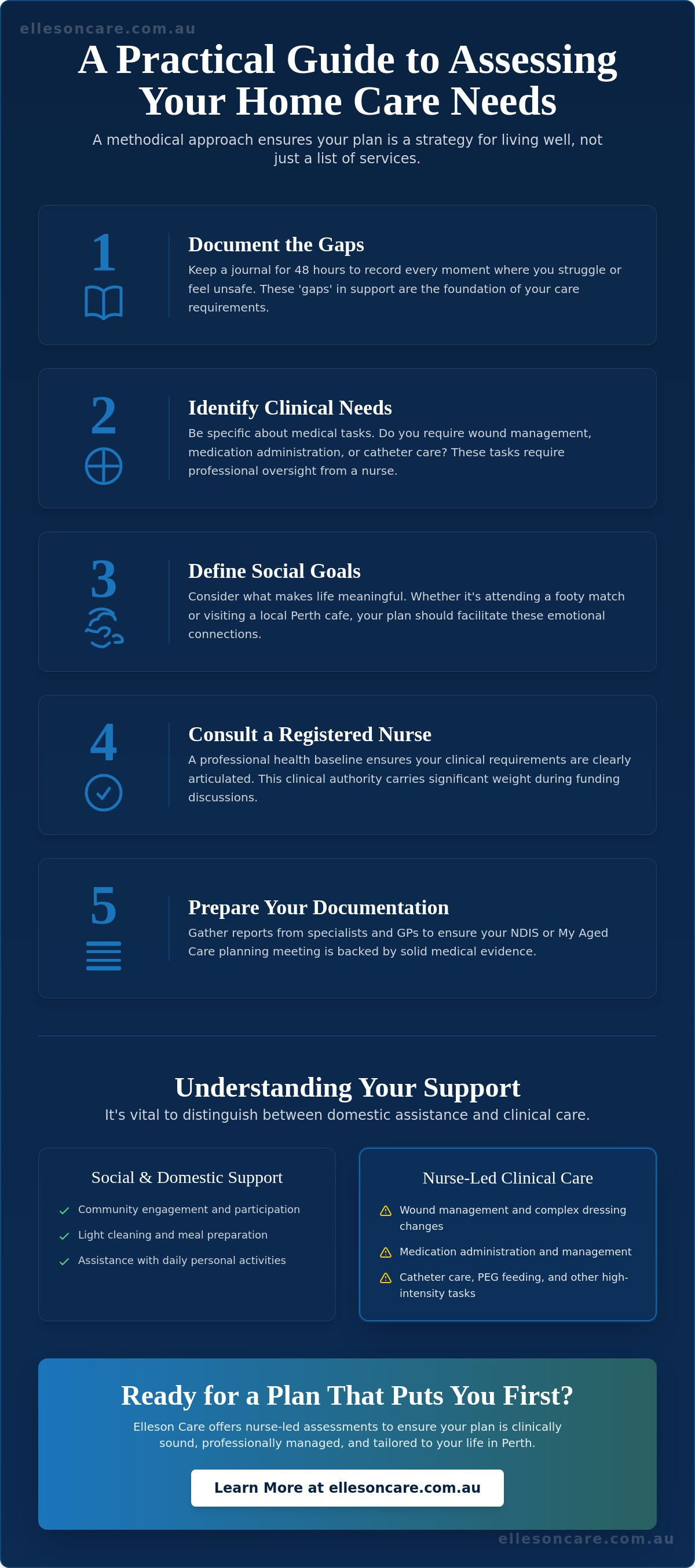
Determining the right level of support is a deeply personal process that requires both honesty and clinical insight. A thorough assessment ensures that your home care disability plan isn't just a list of services, but a strategy for living well. To secure the best outcomes, you should approach this task methodically before meeting with government assessors.
- Step 1: Document the gaps. Keep a journal for 48 hours to record every moment where you struggle or feel unsafe. These 'gaps' in support are the foundation of your care requirements.
- Step 2: Identify clinical needs. Be specific about medical tasks. Do you require wound management, medication administration, or catheter care? These tasks require professional oversight.
- Step 3: Define social goals. Consider what makes life meaningful. Whether it's attending a footy match or visiting a local Perth cafe, your plan should facilitate these emotional connections.
- Step 4: Consult a Registered Nurse. Having a professional health baseline ensures that your clinical requirements are articulated clearly. This clinical authority carries significant weight during funding discussions.
- Step 5: Prepare your documentation. Gather reports from specialists and GPs to ensure your NDIS or My Aged Care planning meeting is backed by evidence.
The Difference Between Clinical and Social Support
It's vital to distinguish between domestic assistance and clinical care. While social support workers are wonderful for community engagement, they aren't trained for complex medical interventions. Clinical nursing oversight is essential for conditions requiring ventilator support or complex enteral feeding. This ensures that high-risk tasks are performed safely within the home environment. For those navigating mental health challenges, understanding psychosocial disability is equally important, as it requires a different approach to functional support and emotional regulation.
Preparing for Your Assessment in Perth
Local knowledge is your best asset when navigating the Western Australian system. Accessing resources through Disability Services in Western Australia can help you understand state-specific pathways. We also recommend involving allied health professionals, such as Occupational Therapists or Physiotherapists, to assess your home environment for safety and accessibility. Their reports provide objective data that supports your request for specific equipment or home modifications. Consulting with an experienced team about clinical support services can help you identify these needs early, ensuring no detail is overlooked during your official assessment.
Navigating Funding: NDIS, My Aged Care, and DVA in 2026
Securing the right financial support is often the most overwhelming hurdle when organising home care disability services. In 2026, the Australian funding landscape is structured to offer more flexibility, but it requires a clear understanding of which 'bucket' your needs fall into. For West Australians under the age of 65, the National Disability Insurance Scheme (NDIS) remains the primary pathway. It's designed to fund 'reasonable and necessary' supports that help you achieve your goals and maintain independence.
How you manage these funds significantly impacts your choice of providers. You can choose to be Self-Managed, giving you total control over hiring and payments; Plan-Managed, where a professional handles the financial administration; or NDIS-Managed, where the NDIA pays providers directly. As of 2026, NDIS price limits have seen a 4.36 per cent indexation adjustment. This means the standard hourly rate for a support worker during weekday daytime is now $70.23. Understanding these figures helps you budget your plan effectively across the year.
For older West Australians, the system changed significantly on 1 November 2025, when the Support at Home Program replaced the old Home Care Package system. This new model focuses on clinical safety and transparency, with participants contributing a percentage of service costs based on their income and assets. Veterans also have access to specific pathways through the Department of Veterans' Affairs (DVA). As of 1 January 2026, the DVA assessment fee for community nursing is $161.50, though clinically required services remain fully funded for eligible Gold and White Card holders.
Choosing the Right Funding Pathway
Eligibility is the first gate you must pass. The WA Government Disability Services portal provides essential guidance on state-specific eligibility criteria. If you're approaching 65, you'll need to decide whether to stay with the NDIS or transition into the Support at Home Program. This transition requires careful planning to ensure your clinical nursing care remains uninterrupted. Veterans should verify their card status early, as DVA funding often covers high-level clinical support and domestic help that other schemes might not.
Maximising Your Plan for Home Support
Your NDIS plan is divided into categories like 'Core Supports' for daily living and 'Capacity Building' for developing skills. If your health requirements become more complex, you have the right to advocate for increased clinical nursing hours. This isn't a static process; your needs will change over time. Working closely with a Support Coordinator allows for regular plan reviews, ensuring your funding matches your current reality. Don't wait for a crisis to request a review if you notice your clinical safety or independence is at risk.
How to Choose a Disability Support Provider in Perth
Selecting a partner for your home care disability journey is a decision that extends far beyond simple scheduling. It's about finding a team that aligns with your clinical needs and your personal values. You should prioritise 'nurse-led' organisations where healthcare professionals, rather than just business administrators, direct the care strategy. This structure ensures that every support worker operates under the guidance of someone who deeply understands the medical nuances of your condition. It provides a layer of safety that is indispensable for families managing complex health requirements.
Local Perth ownership is another vital factor to consider. When a provider is based here in Western Australia, they possess a genuine understanding of the local community and its specific health networks. This proximity creates a higher level of accountability; you're a person with a name, not just a number in a national database. You should also verify that the agency is a registered NDIS provider and check the clinical credentials of their management team. Beyond the technical qualifications, personality matching is essential. Your support workers will be part of your daily life, so finding a 'cultural fit' is necessary for a respectful and comfortable home environment.
Questions to Ask Potential Care Agencies
Before committing to a provider, you should feel empowered to ask direct questions about their operational standards. A transparent agency will be happy to discuss their protocols in detail. Consider including these questions in your initial meeting:
- What specific process do you use to match support workers to a client's personality and goals?
- How does your team handle clinical concerns or emergencies that arise after hours?
- Are your staff trained to provide specialised care, such as catheter management or complex wound care?
The Importance of Continuity of Care
Consistency is the foundation of trust in any care relationship. Having a stable, familiar team allows for a deep understanding of your routines and preferences, which significantly improves your quality of life. Local Perth providers are often better equipped to offer this stability than large national chains, as they focus on building sustainable, local teams. For those who may be navigating the intersection of disability and ageing, our nurse-led guide to in-home aged care in Perth offers additional insights into how professional oversight maintains independence. If you're ready to discuss a personalised plan that puts your clinical safety first, we invite you to learn more about our NDIS support services.
The Elleson Care Approach: Professional Clinical Support at Home
Our approach to home care disability is shaped by over 22 years of nursing expertise. This clinical foundation allows us to bridge the gap between basic assistance and the high-level medical oversight many families require. As a locally owned West Australian provider, we understand the specific challenges faced by Perth households. We don't operate like a distant national franchise; we're members of your community who are deeply invested in the safety and well-being of our neighbours. This local focus ensures a higher level of accountability and a more responsive standard of care.
We operate with a 'Family-First' philosophy. We recognise that a disability diagnosis or a change in health status affects every member of the household. Our care plans are developed to support the individual's autonomy while providing much-needed stability for their loved ones. This holistic view ensures that your home remains a place of comfort rather than a clinical environment. Whether we're managing complex clinical needs such as ventilator support or providing compassionate palliative care, our focus remains on preserving the dignity and personal identity of those we serve.
Specialised Nursing and Disability Care
Clinical safety is the cornerstone of our service delivery. We specialise in high-intensity supports, including complex wound management, medication administration, and assisting with post-hospital transitions. At Elleson Care, our Registered Nurses don't just oversee plans; they actively train and supervise our support workers. This ensures that every member of your team has the specific skills required to manage your unique health profile. We're committed to evidence-based practices that prioritise your clinical safety while respecting your right to make choices about your daily life.
Getting Started with Elleson Care
The path to professional support begins with a thorough, respectful conversation. Our initial consultation process is designed to listen to your goals first. We want to understand what a 'good day' looks like for you and how we can facilitate that through expert care. We also believe in the power of a unified health strategy. Our team collaborates closely with your existing GPs, specialists, and allied health professionals to ensure our support complements your broader medical treatment. If you're looking for a partner who combines clinical authority with genuine human warmth, Contact our Perth team to discuss your home care needs today.
Taking the Next Step Toward Secure Home Support
Organising professional support is about more than just filling a schedule; it's about building a foundation for a dignified life in the comfort of your own home. By accurately assessing your clinical needs and understanding the 2026 funding updates, you've already taken the most significant steps toward long-term stability. Whether you're navigating the recent NDIS indexation or transitioning to the Support at Home Program, having a clear plan ensures that your health requirements are met with precision and respect.
Choosing the right partner for home care disability services is the final piece of the puzzle. As a Western Australian owned and operated provider, we bring over 22 years of nursing experience to every care plan we develop. Our status as a registered NDIS and DVA provider ensures that your clinical safety is managed by experts who deeply understand the local system. We're here to protect your independence through high-tier, nurse-led support that prioritises your personal comfort above all else.
Book a clinical consultation with our Perth nursing team to discuss how we can support your family's unique journey. You don't have to navigate these complexities alone; a steady and knowledgeable partner is ready to help you move forward with confidence.
Frequently Asked Questions
What is the difference between home care and disability support?
Home care is a broad term for any professional service delivered within a person's residence to assist with daily living. Disability support is a specialised subset of this care that focuses on addressing functional impairments and achieving specific life goals. While home care disability services often include domestic help, they also encompass complex clinical nursing and social participation strategies tailored to an individual's unique NDIS or DVA requirements.
Can I get NDIS funding for home care if I am over 65?
You generally cannot submit a new application for NDIS funding once you have turned 65. Instead, older West Australians access support through the government's Support at Home program. However, if you were already an NDIS participant before your 65th birthday, you have the right to choose whether to remain in the scheme or transition into the aged care system, depending on which model better suits your clinical needs.
How do I find a registered NDIS provider in Perth?
The most reliable way to find a registered provider is through the NDIS Provider Finder tool on the official NDIS website. You can filter results by location to find organisations operating specifically within Perth suburbs. It is beneficial to look for providers who maintain a local physical presence, as this ensures they have a genuine understanding of the Western Australian healthcare network and can offer better accountability for their staff.
What clinical services can a nurse provide at home for a disability?
Registered Nurses provide a range of high-level medical interventions that go beyond the scope of a standard support worker. These services include complex wound management, catheter care, enteral feeding, and medication administration. For individuals with high-intensity needs, a nurse can also manage ventilator support and tracheostomy care, ensuring that even the most complex health requirements are handled safely and professionally within the home environment.
Can home care disability support help with post-hospital recovery?
Yes, professional support is often vital for ensuring a safe transition from a hospital ward back to your own home. This type of home care disability assistance focuses on recovery milestones, such as managing surgical wounds or assisting with temporary mobility restrictions. By having clinical nursing oversight during this period, you reduce the risk of readmission and ensure that your home environment is modified to support your ongoing rehabilitation.
How much does home care for disability cost in Western Australia?
The cost of services is governed by the NDIS Pricing Arrangements and Price Limits, which are updated annually to reflect economic changes. These limits set the maximum amount a provider can charge for specific categories of support, such as personal care or community access. For most participants, these costs are fully covered by their NDIS plan funding, provided the services are deemed reasonable and necessary for their specific situation.
What happens if my support worker is unwell or can't make it?
Established care agencies maintain a local team of professionals to ensure that your essential services are never interrupted. If your regular support worker is unable to attend, the provider should have a contingency plan to supply a qualified replacement who is familiar with your care requirements. This continuity is essential for maintaining your safety and routine, particularly when your support involves critical clinical tasks or medication schedules.
Can I use my Home Care Package for disability-related modifications?
Under the Support at Home program, you can access funding for minor and major home modifications if they are necessary for your safety and independence. This might include installing grab rails, ramps, or specialised bathroom fixtures. To access this funding, an Occupational Therapist must typically conduct an assessment and provide a formal recommendation stating that the modification is essential for your functional support and long-term well-being.


