

What if the secret to remaining independent in your Perth home isn't about proving how well you manage, but being brave enough to share your most difficult days? Many Western Australian families feel a deep sense of anxiety when they first approach a my aged care assessment; they often fear that one "wrong" answer might lead to a loss of autonomy. It's completely natural to worry about being judged or "failing" the visit, especially when you know that occupancy rates in local facilities are sitting above 95 per cent.
We understand that you want to maintain your dignity while securing the clinical and personal help you deserve. This guide will show you exactly how to prepare for and manage the new Single Assessment System so you can access the Support at Home program effectively. We'll walk you through the application steps, explain what the assessors are looking for, and provide the clarity you need to achieve a successful result that keeps you living safely and comfortably in your own community.
Key Takeaways
- Understand how the streamlined Single Assessment System determines your eligibility for different levels of government-funded support.
- Prepare effectively by applying the "worst day" principle during your my aged care assessment to ensure your clinical needs are fully recognised.
- Identify the essential documents and healthcare details you need to have ready to ensure a professional and stress-free home visit.
- Navigate the application steps with ease, from the initial online contact to the vital telephone screening process.
- Gain the clarity needed to interpret your outcome letter and select a local Perth provider that prioritises your dignity and independence.
What is a My Aged Care Assessment and Why is it Necessary?
A my aged care assessment is far more than a simple eligibility check; it's a vital clinical conversation that secures your future independence. By participating in this process, you're taking the first step toward accessing the Support at Home program, which replaced the previous Home Care Package model in late 2025. This professional evaluation ensures that every individual receives a level of care that is both safe and sustainable. It's designed to protect your rights, ensuring that your specific clinical needs are met by qualified professionals rather than being left to chance.
The assessment serves as the official gateway to Australian government funding. Without this formal review, families cannot access the subsidies that make high-quality clinical support and aged care services affordable. It provides a structured way to determine exactly what level of assistance is required to keep you safe. This might include help with personal care, clinical nursing, or modifications to your home environment. By establishing a clear baseline of your health and mobility, the process ensures the care plan developed is perfectly aligned with your personal goals and dignity.
The Purpose of the Assessment in the Australian Care System
The primary goal of the assessment process is to facilitate a fair and transparent distribution of taxpayer-funded resources. This Overview of aged care in Australia highlights how the national framework prioritises those with the greatest clinical requirements. Under the new Single Assessment System, assessors use the Integrated Assessment Tool to identify potential health risks before they escalate into medical emergencies. This proactive approach allows for the creation of a tailored care plan that focuses on your well-being and long-term comfort within your own home.
Why Perth Families Should Start the Process Early
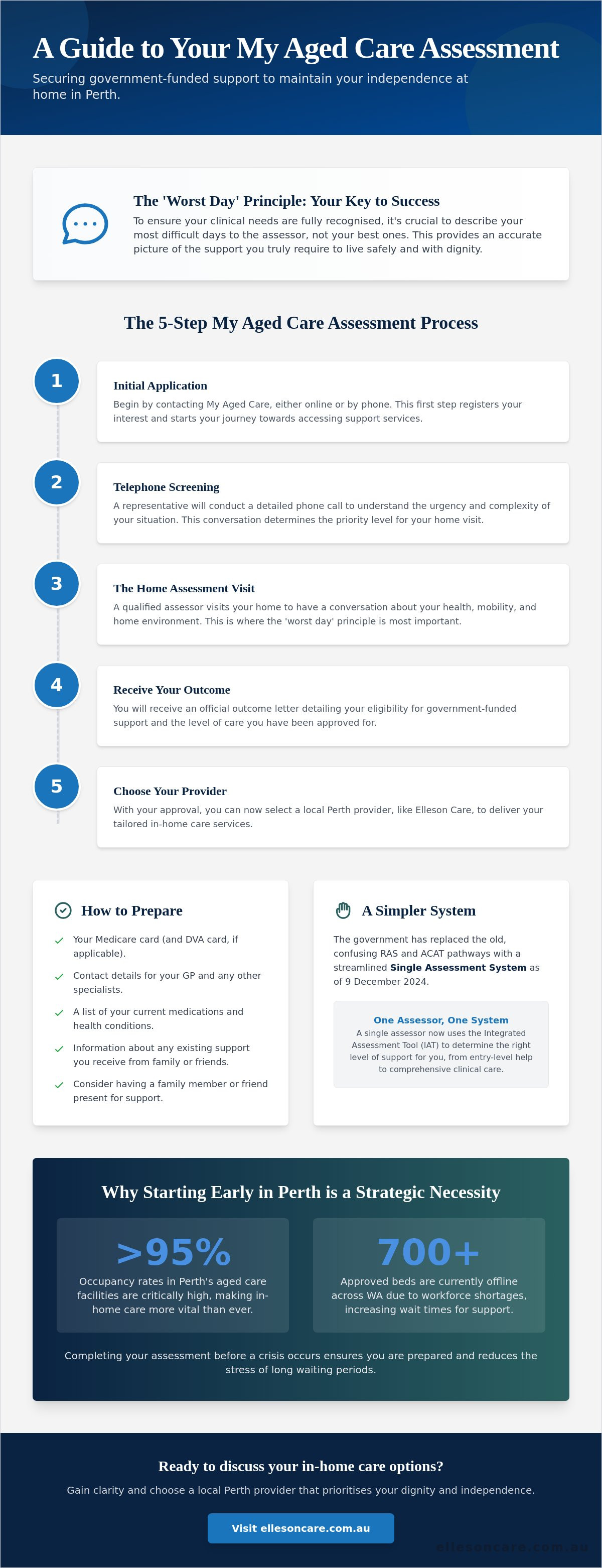
In Western Australia, starting this journey early is a strategic necessity. Recent data shows that aged care occupancy rates in Perth are exceptionally high, often exceeding 95 per cent. With over 700 approved beds currently offline across the state due to workforce shortages, the demand for community-based support has never been higher. By completing your my aged care assessment before a health crisis occurs, you ensure that you're already "in the system" when you need help most.
Securing your place early helps mitigate the stress of long waiting times that are common across the state. It's about being prepared rather than reactive. For those looking to understand how this fits into the local landscape, exploring in home aged care Perth can provide valuable context on the nurse-led support available once your funding is approved. This forward-thinking approach ensures that you remain in control of your care journey, rather than having decisions made for you during a sudden decline in health.
RAS vs ACAT: Understanding the Two Main Assessment Types
While many Perth families still recognise the terms Regional Assessment Service (RAS) and Aged Care Assessment Team (ACAT), the Australian government transitioned to a Single Assessment System on 9 December 2024. This change was designed to simplify your journey, ensuring you don't have to contact multiple organisations to find the right level of support. During your my aged care assessment, a single assessor now uses the Integrated Assessment Tool (IAT) to determine whether you require entry-level assistance or more comprehensive clinical care.
This streamlined approach means the initial phone screening is more important than ever. When you first contact My Aged Care, the representative will ask detailed questions to gauge the urgency and complexity of your situation. This conversation dictates the priority level of your visit. If your circumstances change after this call, or if you feel the depth of your clinical needs wasn't fully captured, you can request a review of your screening results before the home visit occurs. You can find detailed guidance on how to apply for an assessment through the official government portal.
Entry-Level Support for Daily Living
For those who only require a small amount of help to stay safe at home, the assessment focuses on the Commonwealth Home Support Programme (CHSP). This was historically the domain of the RAS. It typically covers basic services such as light gardening, domestic cleaning, or transport to appointments. It's often the ideal starting point for Western Australian seniors who remain largely independent but find certain physical tasks are becoming a struggle. These services are designed to be flexible, allowing you to maintain your lifestyle without unnecessary intervention.
Assessments for Complex and Clinical Home Care
If your needs involve chronic health conditions or significant mobility challenges, the assessor will evaluate your eligibility for the Support at Home program. This replaces the old ACAT system for Home Care Packages (HCP) Levels 1 through 4. This part of the evaluation is crucial for accessing professional home care services in Perth, including wound care and clinical nursing. The assessor also determines eligibility for transition care or residential care. For steady guidance, you might consider speaking with the team at ellesoncare.com.au.
How to Prepare for Your Home Assessment Visit
A successful my aged care assessment relies on preparation that is both practical and emotional. While it's natural to want to present your best self to a visitor, this is the one occasion where you must focus on your most challenging moments. This approach, often called the "Worst Day" Principle, ensures the assessor understands the full extent of the support you need to remain independent. By documenting your struggles accurately, you help the clinical assessor build a case for the appropriate level of funding.
Before the assessor arrives at your Perth home, ensure you have your essential documentation organised. This includes your Medicare card, the contact details for your General Practitioner, and a comprehensive list of your current medications. It's also helpful to walk through your home and identify specific areas where you struggle physically, such as high cupboards or steep steps. Taking the time for preparing for your assessment in this way allows you to feel more in control of the conversation.
Communicating Your Clinical and Personal Needs
During the visit, you'll be asked about your mobility, personal care routines, and cognitive health. It's important to distinguish between "managing" a task and actually "thriving" while doing it. For example, you might be able to shower yourself, but if it leaves you exhausted for the rest of the day, that is a significant clinical consideration. If you minimise your daily struggles during the visit, you risk being allocated a level of funding that fails to cover the essential clinical care you require to stay safe.
Involving Your Family and Support Network
We strongly recommend having a trusted family member or friend present during your my aged care assessment. They can act as an advocate, offering context or details that you might overlook or feel hesitant to mention. Within the My Aged Care system, you can formally nominate a "Registered Supporter" who is authorised to speak on your behalf and help manage your care journey. This support person ensures the assessor sees the full picture of your daily living challenges, from missed meals to difficulty managing complex medication schedules. Their presence provides a steadying influence during what can be a deeply personal conversation.
The Step-by-Step My Aged Care Application Process
The journey to securing professional support follows a structured path designed to ensure your clinical needs are met with precision. This process begins with a formal application, which serves as the foundation for your my aged care assessment. In Western Australia, where demand for residential beds has grown by an estimated 24 per cent over the last decade, being "in the system" early is the most effective way to protect your future autonomy.
Navigating the Online Application and Phone Screening
You can initiate your request through the My Aged Care website or by calling 1800 200 422. Before you begin, ensure you have your Medicare card and the details for your General Practitioner ready. The initial telephone screening typically takes about 10 to 15 minutes. During this call, a representative will ask questions to determine the urgency of your situation and whether you require an interpreter or culturally specific support. It's important to be clear about any immediate safety risks or recent health changes. This information dictates how quickly your home visit is scheduled. Given that over 700 approved beds in WA are currently offline due to workforce shortages, a clear and accurate screening call is vital to ensure you aren't lost in the queue.
What Happens During the Face-to-Face Visit?
Once your screening is processed, a professional assessor will visit you at home. This face-to-face my aged care assessment usually lasts between one and two hours. It's a collaborative process where the assessor develops a "Support Plan" based on your input and clinical requirements. You have the right to ask questions, take breaks, and involve your family throughout the entire conversation. The assessor isn't there to judge your housekeeping or lifestyle; their role is to identify how the system can best support your independence through the new Support at Home program.
Following the visit, you'll receive an formal outcome letter detailing the support levels you've been approved for. This letter is your key to accessing clinical care. Because occupancy rates in Perth are currently sitting above 95 per cent, selecting a reliable partner who understands the local landscape is essential. Once you have your approval letter, you can contact the expert team at ellesoncare.com.au to discuss how our nurse-led aged care services can help you remain safely and comfortably in your own home.
After the Assessment: Choosing a Local Perth Provider
Receiving your official outcome letter is a significant milestone in your journey toward better support. This document details the specific classification you've been assigned within the Support at Home program, following your my aged care assessment. It's important to distinguish between being "approved" for care and being "assigned" a funding level. Because Western Australia faces unique challenges, including high occupancy rates and workforce shortages, understanding your priority level helps you plan realistically for when your services will commence. This letter is your tool for securing the clinical and personal assistance required to maintain your independence.
Choosing a provider is a deeply personal decision that goes beyond simply finding someone to help with chores. It's about finding a partner who respects your autonomy and understands the clinical complexities of ageing. While the government provides a directory of services, these lists don't always reflect the philosophy of care an agency provides. Transitioning from the assessment phase to receiving active support should feel like a natural progression toward a more secure and comfortable lifestyle in your own home.
Evaluating Aged Care Agencies in Perth
When you begin comparing local providers, prioritise clinical expertise and staff consistency. A nurse-led approach is often the most effective way to ensure better health outcomes, as it places your well-being under the supervision of qualified medical professionals. Local ownership is another vital factor to consider. Perth-based agencies often have established relationships with local health networks and a deeper commitment to the Western Australian community. Before signing a home care agreement, ask potential providers how they ensure you see the same familiar faces each week and how they handle changes in your health needs.
How Elleson Care Supports Your Post-Assessment Journey
At Elleson Care, we provide a steady, reliable presence for families who want more than just basic assistance. Our holistic approach to aged care services and clinical support ensures that your dignity is always the primary focus. We specialise in managing complex requirements, such as medication administration and professional wound care, with the precision that only experienced clinical staff can offer. We understand that your goals are unique, and we work to ensure your funding is utilised in a way that truly enhances your quality of life.
We act as your advocate, ensuring that the support plan developed during your my aged care assessment is translated into practical, high-quality care. By focusing on person-centred principles, we help you navigate the transition into professional support with confidence. Our team is dedicated to providing the stability and expert care you need to remain safely in your Perth home, surrounded by the community you know and love.
Taking the Next Step Toward Supported Independence
Your journey through the my aged care assessment is a significant step toward preserving your dignity and safety at home. By focusing on your clinical needs and preparing thoroughly for the home visit, you ensure that the Support at Home program reflects your actual daily requirements. We've explored how understanding the Single Assessment System and being honest about your "worst days" are the most effective ways to secure the level of funding you deserve.
Once you have your approval, the final piece of the puzzle is selecting a partner who prioritises your well-being. Elleson Care is a WA owned and operated provider with over 22 years of experience in nurse-led care. We specialise in complex clinical home support, ensuring that your medical and personal needs are handled with expert precision. If you're ready to move forward, you can book a consultation with our Perth nursing team to discuss your care needs. We're here to provide the steady, professional guidance your family needs to navigate this transition with peace of mind. You don't have to manage these changes alone; expert help is available right here in Perth.
Frequently Asked Questions
How long does it take to get a My Aged Care assessment in Perth?
The waiting time for a my aged care assessment in Perth depends largely on the priority level assigned during your initial telephone screening. While urgent clinical situations are prioritised for quicker visits, standard assessments can take several weeks or even months due to the current high demand for services across Western Australia. We recommend starting the application process as soon as you notice a change in your ability to manage daily tasks at home.
Can I choose who comes to my home for the assessment?
You aren't able to select the specific individual who conducts your home visit, as assessors are allocated based on the availability of the local workforce. However, the government ensures that all assessors are trained professionals who must follow strict clinical and ethical guidelines. If you have specific cultural requirements or prefer a male or female assessor for comfort, you can mention this during your initial phone call to see if your request can be accommodated.
What happens if my application for aged care is rejected?
If your application is unsuccessful, you have the right to request a formal review of the decision by contacting My Aged Care directly. It's helpful to gather updated clinical evidence or a letter from your GP that clearly outlines your struggles with daily living. If your health declines or your circumstances change significantly in the future, you can always re-apply for a new my aged care assessment to ensure your current needs are accurately reflected.
Do I have to pay for a My Aged Care assessment?
There is no charge to undergo a my aged care assessment; the evaluation process is a free service provided by the Australian Government. This ensures that all seniors in Perth have equal access to professional support regardless of their financial status. While the assessment itself is free, you may be asked to contribute toward the cost of your actual care services once they are approved and commenced, depending on your income and assets.
Can a family member apply for an assessment on my behalf?
A family member, friend, or carer can apply for an assessment for you, provided they have your verbal or written consent. You can formally nominate them as a "Registered Supporter" within the My Aged Care system, which allows them to manage your information and speak with assessors on your behalf. This is a practical way to ensure that your clinical needs are fully communicated, especially if you find navigating the online portal or phone calls difficult.
What is the difference between the Support at Home program and the CHSP?
The Commonwealth Home Support Programme (CHSP) is designed for entry-level assistance with simple tasks like basic cleaning, gardening, or transport. The new Support at Home program, which replaced Home Care Packages in late 2025, is intended for individuals with more complex clinical needs who require higher levels of funding. Your assessment determines which program is most appropriate based on the intensity and frequency of the professional nursing or personal care you require.
How do I prepare my home for the assessor’s visit?
Preparing your home involves identifying the specific areas where you feel unsafe or struggle with physical tasks. You don't need to "tidy up" for the assessor; it's actually better for them to see the environment as it truly is on your most difficult days. Ensure that paths are clear and have your medications, Medicare card, and any relevant health reports from your doctor ready on a table so you can discuss your clinical history comfortably.
Can I change my aged care provider after the assessment?
You have the right to change your aged care provider at any time if you feel your current agency is not meeting your clinical or personal expectations. If you've been approved for funding but wish to switch to a local, nurse-led provider in Perth, you simply need to notify your current agency and follow the required notice period. Your funding will follow you to your new provider, ensuring your care continues without unnecessary interruption to your daily routine.


