

For a participant living with high-intensity needs, a piece of paper from a government agency isn't just a document, it's the foundation of their daily safety. You might feel overwhelmed by the technicalities of an ndis complex health care plan, wondering if the support arriving at your door in Perth is truly equipped for clinical tasks. It's a common anxiety to feel like a case number in a vast system, especially when the stakes involve complex ventilator support or intricate wound management. We understand that your primary goal isn't just compliance, it's the peace of mind that comes from knowing your loved one is in expert, compassionate hands.
You deserve a clear roadmap that bridges the gap between standard funding and high-tier clinical safety. This nurse-led guide will help you navigate the nuances of high-intensity supports, ensuring you can leverage NDIS funding to secure the professional nursing oversight your family requires. We'll examine how to transition from confusion to confidence by implementing a plan that respects individual autonomy while maintaining the highest medical standards. By the end of this article, you'll have a practical strategy to ensure that expert care is a consistent reality, not just a goal on a spreadsheet.
Key Takeaways
- Understand how an ndis complex health care plan acts as a vital bridge between clinical medical requirements and daily disability support to ensure safety and dignity.
- Learn to identify the essential components of a specialised plan, including personalised risk assessments and emergency protocols tailored for the Perth home environment.
- Discover the critical differences between standard NDIS plans and high-intensity supports, focusing on medical safety rather than just social participation.
- Gain a practical framework for choosing a provider in Western Australia, including how to verify their registration for High Intensity Daily Personal Activities.
- Recognise the importance of nurse-led oversight to ensure that support workers are properly trained and supervised by experienced clinical professionals.
What is an NDIS Complex Health Care Plan?
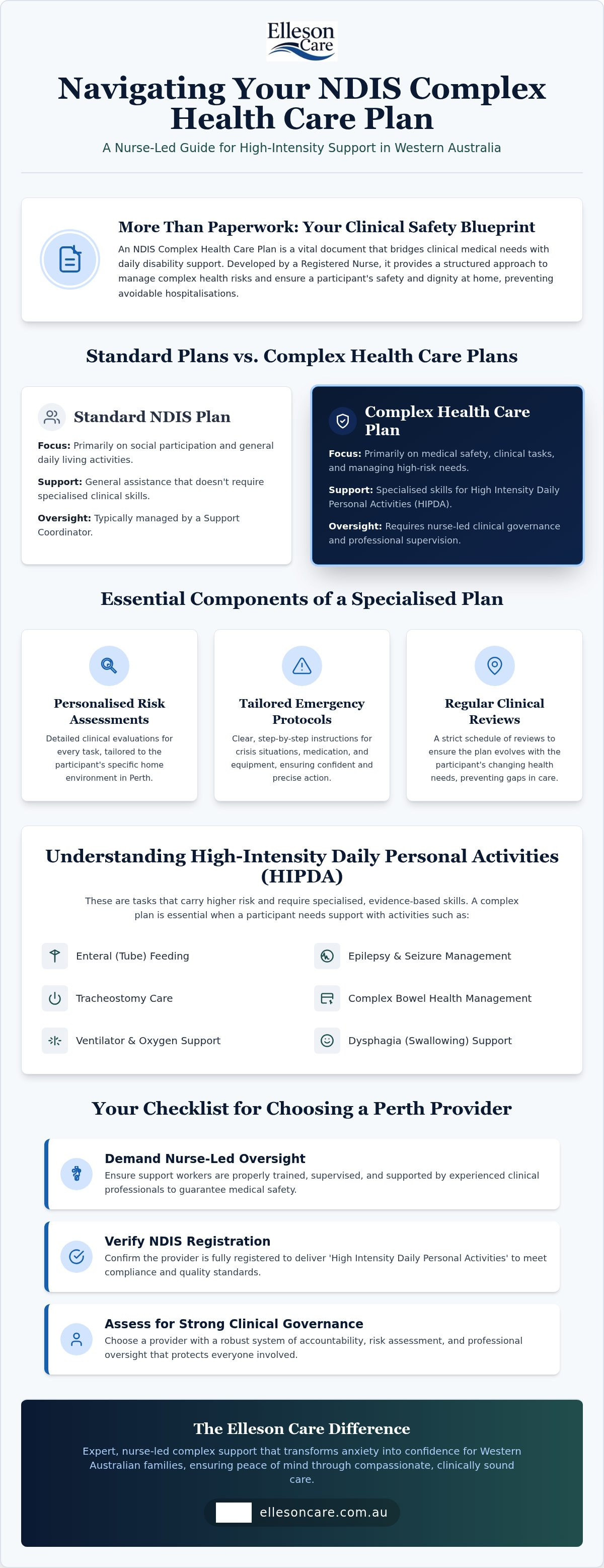
An ndis complex health care plan is far more than a simple administrative requirement. It's a comprehensive instructional document designed specifically for participants who require "High Intensity" support. Within the framework of the National Disability Insurance Scheme (NDIS), this document acts as the vital bridge between a person's clinical medical requirements and their daily disability support. Without this structured approach, there's a risk that essential health needs might be overlooked during routine care, leading to avoidable health complications.
Because the stakes are high, these plans must be developed by a qualified health professional, typically a Registered Nurse (RN). The document outlines exactly how to manage complex risks that could lead to hospitalisation if handled incorrectly. This includes detailed instructions for managing conditions like dysphagia (swallowing difficulties), epilepsy and seizures, or chronic respiratory issues. Essentially, an ndis complex health care plan is the clinical blueprint for a participant's safety.
The Role of High Intensity Personal Daily Activities (HIPDA)
The NDIS Quality and Safeguards Commission uses the term HIPDA to describe tasks that carry a higher level of risk and require specialised skills. Common triggers for needing a complex plan include enteral (tube) feeding, tracheostomy care, or complex bowel health management. These aren't standard caregiving tasks. They require precise, evidence-based techniques that go beyond what is taught in basic support worker training. A well-constructed plan ensures that every person in the support team knows exactly how to perform these clinical tasks safely and consistently, reducing the chance of error.
Why Clinical Governance Matters for Perth Families
For families in Perth, clinical governance is the invisible safety net that ensures high standards of care. It's the system of accountability that keeps the participant, the family, and the support workers protected. When a provider has strong clinical governance, every action taken is backed by professional oversight and rigorous risk assessment. This structure provides a sense of stability, ensuring that care isn't just well-intentioned, but medically sound and ethically delivered. It transforms the experience of care from a source of anxiety into a foundation for a dignified life, giving families the confidence that their loved ones are in expert hands.
The Essential Components of Specialised Clinical Support
A robust ndis complex health care plan is built on more than just high-level goals. It requires granular, clinical detail to be effective and safe. For participants in Perth, this means having detailed risk assessments for every clinical task performed throughout the day. It isn't enough to simply list a condition; the plan must specify how to manage it safely within the specific context of the participant's home environment. This level of detail ensures that every support worker understands the "why" behind the clinical procedures they perform.
Emergency protocols are a critical piece of this puzzle. These aren't generic templates. They're tailored to the individual's specific needs and local Perth medical facilities. When a crisis occurs, every second counts. Having clear, step-by-step instructions for medication administration and the use of specialised equipment ensures that support workers can act with confidence and precision. This structured approach reduces the risk of error and ensures that the participant's dignity is maintained even in stressful situations.
Health is never static. A high-quality ndis complex health care plan includes a strict schedule for regular reviews. As a person's needs evolve, the documentation must keep pace. This proactive approach prevents gaps in care that could lead to clinical decline. Whether it's a change in medication or a shift in mobility, the plan must reflect the current reality of the participant's health to remain a useful tool for the support team.
Managing Ventilator and Oxygen Support at Home
For participants dependent on respiratory technology, the safety provided by an RN-led team is essential. Managing ventilators and oxygen requires a deep understanding of clinical parameters and equipment maintenance. By integrating these needs into a holistic nursing services approach, families can rest assured that their loved ones are breathing safely. We ensure staff aren't just trained, but truly confident in operating life-sustaining technology within the home.
Wound Management and Pressure Injury Prevention
Skin integrity is a major concern for those with limited mobility. A complex plan must address wound care with a focus on prevention. Professional wound management plays a vital role in avoiding painful complications and hospital readmissions. We focus on training support workers to identify the earliest warning signs of pressure sores, such as skin discolouration or temperature changes. Catching these issues early is the key to maintaining long-term health and dignity. If you're feeling uncertain about your current clinical oversight, reaching out to a professional Perth-based nursing provider can help clarify your next steps.
Standard NDIS Plans vs. Complex Health Care Plans: Key Differences
While standard NDIS plans are excellent for fostering community connection and independence, an ndis complex health care plan serves a more critical, clinical purpose. A standard plan typically focuses on social participation, such as attending a local community group or receiving help with basic domestic tasks. In contrast, a complex plan is centred entirely on medical safety and the management of life-limiting risks. It's the difference between support for a "good life" and support that ensures "clinical stability."
Securing an ndis complex health care plan requires a significant amount of documented evidence from medical professionals. The NDIS won't provide high-intensity funding without detailed reports from specialists or Registered Nurses that justify the clinical necessity of the support. Additionally, the NDIS Quality and Safeguards Commission imposes much stricter audit requirements on providers delivering this level of care. This ensures that only organisations with the right clinical governance and expertise are permitted to manage high-risk health tasks.
Navigating the NDIS Price Guide for Complex Needs
When you move into the territory of complex care, the NDIS Price Guide shifts. Funding usually falls under "High Intensity" support categories, which carry a higher hourly rate than standard supports. This increased rate isn't just a number; it's designed to cover the cost of specialised training for your support team and the essential oversight of a Registered Nurse. It's vital to ensure your budget is structured correctly so that clinical safety isn't compromised by a lack of funds for staff supervision.
Identifying When You Need to Upgrade Your Plan
It's important to recognise the signs that a standard plan is no longer sufficient. If your loved one is experiencing increased hospitalisations or if a new diagnosis has introduced complex clinical risks, it's time to act. A standard plan might leave support workers out of their depth, creating a safety gap that can lead to health crises. If you notice these red flags, working closely with a support coordinator is the best way to advocate for a plan review. They can help gather the necessary evidence to prove that high-intensity funding is required to maintain a safe and dignified environment at home.
How to Implement Your Plan with a Perth NDIS Provider
Once your ndis complex health care plan is finalised, the focus shifts to practical implementation. This phase is where clinical theory meets the reality of daily life. It's essential to choose a partner who doesn't just see a set of tasks, but understands the person behind the care. To ensure a seamless transition into high-intensity support, follow these five foundational steps:
- Verify Registration: Confirm the provider is officially registered for High Intensity Daily Personal Activities. This isn't optional; it's a legal requirement for delivering complex care safely.
- Demand Clinical Leadership: Ask specifically if there is a Registered Nurse (RN) based here in Perth. Remote oversight from an interstate head office often lacks the responsiveness needed for complex cases.
- Review Training Protocols: Your provider should demonstrate a clear method for training staff on your specific clinical requirements, such as enteral feeding or seizure management.
- Confirm Emergency Backup: Ensure a 24/7 clinical "on-call" system is in place. You need to know exactly who to call if equipment fails in the middle of the night.
- Establish Communication: Create a structured loop between your family, the overseeing RN, and your treating doctors to ensure everyone stays informed as health needs change.
Vetting Potential Providers in Western Australia
When meeting a prospective provider, don't hesitate to ask direct, technical questions. Ask how they handle ventilator alarms or what their protocol is for a suspected aspiration. Local Perth knowledge is invaluable here. A provider who knows the local equipment suppliers and has established links with hospitals like Sir Charles Gairdner or Fiona Stanley can navigate logistics much faster. Beyond the clinical, look for a provider who values a holistic family approach, ensuring that the care plan supports the whole household's wellbeing.
Training Your Support Team at Home
The implementation of a complex plan relies on the "delegation of care." This is a formal process where an RN teaches and assesses non-clinical support workers to perform specific tasks safely. It requires a high level of discipline and ongoing supervision to maintain clinical standards. While the focus is on safety, it's equally important to maintain a warm, respectful environment. Your home should feel like a sanctuary, not a hospital ward. By ensuring consistency across different shifts, a nurse-led team can provide the stability your family needs. If you're ready to move from a generic plan to a specialised clinical solution, you can contact our Perth nursing team to discuss your implementation needs.
The Elleson Care Difference: Nurse-Led Complex Support in WA
As a West Australian owned and operated provider, we are deeply embedded in the Perth community. We don't view our participants as files or figures; we see them as neighbours and fellow Western Australians. This local focus ensures that our team is always within reach, providing a level of responsiveness that national providers often struggle to match. At the heart of our service is a commitment to the "Compassionate Expert" model, where high-tier clinical authority meets genuine human warmth.
Our leadership team consists of Registered Nurses with more than 22 years of clinical experience. This background is vital when managing an ndis complex health care plan, as it allows us to foresee clinical risks before they become emergencies. We specialise in high-intensity needs, including ventilator and oxygen support, wound management, and palliative care. By having RNs oversee our support workers, we provide a layer of safety that prioritises the dignity and autonomy of every individual we serve.
Our Approach to Complex Case Management
We believe that clinical care should never come at the expense of a person's lifestyle. Our nurses develop bespoke plans that reflect a participant's personal goals and aspirations, rather than just their medical diagnosis. We place immense value on family involvement, ensuring that communication is always transparent and respectful. This collaborative approach builds a foundation of stability and reliability, allowing for the long-term relationships that are so crucial in complex care. When we implement an ndis complex health care plan, we ensure it remains a living document that adapts as your life does.
Getting Started with Elleson Care
Transitioning to a new provider can feel like a daunting task, especially when moving from a hospital or residential facility. Our team is experienced in managing these transitions, ensuring that every clinical detail is captured and every support worker is thoroughly briefed. The process begins with a comprehensive assessment in your Perth home, where we listen to your needs and concerns. We invite you to reach out for a confidential conversation about how our nurse-led approach can provide the safety and peace of mind your family deserves. Starting the journey is as simple as a phone call to our local team.
Securing a Safer Future for Your Loved One
Transitioning to a high-intensity support model requires more than just a change in funding; it demands a shift toward clinical excellence and rigorous governance. By ensuring your ndis complex health care plan is backed by professional nursing oversight, you move away from the anxiety of the unknown and toward a structured, reliable environment. We've explored how identifying the right clinical components and vetting local providers can transform the quality of support your family receives.
As a WA owned and operated provider, we understand the local health landscape intimately. Our team is led by Registered Nurses with over 22 years of experience who specialise in ventilator care and complex clinical needs. We're here to provide the steady, expert presence you need to ensure your loved one lives with both safety and dignity. You don't have to navigate these complexities alone. Speak with our Registered Nurses about your NDIS Complex Health Care Plan today. We're ready to walk this path with you and provide the stability your family deserves.
Frequently Asked Questions
What is the difference between a health care plan and an NDIS plan?
An NDIS plan is the overarching document that outlines your goals and allocates funding for various supports like community access and domestic help. In contrast, an ndis complex health care plan is a specific clinical document designed to manage high-intensity medical risks. While the NDIS plan focuses on independence and social participation, the health care plan provides the technical instructions required for support workers to manage clinical needs safely within your Perth home.
Who is qualified to write an NDIS complex health care plan?
These plans must be developed by a qualified health professional with the appropriate clinical expertise. In most cases, a Registered Nurse (RN) is the ideal person to draft an ndis complex health care plan because they possess the medical knowledge to assess risks and create emergency protocols. At Elleson Care, our plans are led by RNs with over 22 years of experience, ensuring that every clinical instruction is evidence-based and tailored to the participant's specific requirements.
Does the NDIS pay for a Registered Nurse to visit me at home in Perth?
Yes, the NDIS provides funding for nursing services if they are considered reasonable and necessary for managing a disability-related health condition. This funding allows a Registered Nurse to visit your home in Perth to perform clinical tasks, oversee support workers, or conduct regular plan reviews. It's essential to ensure your plan includes specific line items for "High Intensity Daily Personal Activities" or "Community Nursing" to cover the costs of these professional clinical supports.
What are High-Intensity Personal Daily Activities (HIPDA)?
HIPDA refers to a category of NDIS supports that involve complex clinical tasks requiring specialised skills and oversight. Common examples include tracheostomy management, enteral feeding, and complex bowel care. These activities carry a higher level of risk, which is why the NDIS Quality and Safeguards Commission requires providers to meet specific practice standards. In Perth, choosing a provider with strong clinical governance ensures these tasks are performed safely by staff who have been properly trained and assessed.
How often should my complex health care plan be reviewed?
Your clinical plan should be reviewed at least once every twelve months to ensure it remains accurate and effective. However, a review is necessary sooner if there is a significant change in your health status, such as a hospitalisation or a new diagnosis. Regular reviews by a Registered Nurse help identify emerging risks and allow for adjustments in care strategies, ensuring that the support team always has the most current information to maintain safety at home.
Can a support worker perform clinical tasks like catheter care?
A support worker can perform certain clinical tasks, provided they have received specific training and a Registered Nurse has formally delegated the care. This process involves the RN assessing the worker's competency to ensure they can perform the task safely and according to the protocols in the health care plan. Ongoing supervision is required to maintain high standards of safety, particularly for tasks like catheter care, wound management, or medication administration in a home setting.
What happens if my NDIS funding doesn’t cover my complex nursing needs?
If your current funding is insufficient to cover essential clinical care, you may need to request a plan reassessment or a "change of circumstances" review. It's vital to gather strong medical evidence from your GP, specialists, and Registered Nurses to justify why high-intensity support is required for your safety. A Support Coordinator can assist Perth families in navigating this process, helping to advocate for the necessary budget to implement a safe and sustainable clinical care model.
How do I find a registered NDIS provider for complex care in Western Australia?
You can search the NDIS Provider Finder tool for organisations registered for High Intensity Daily Personal Activities. For families in Western Australia, it's often beneficial to choose a local, WA-owned provider like Elleson Care. Local providers offer greater responsiveness and a deeper understanding of the Perth health landscape. Ensure you ask potential providers about their clinical leadership and whether they have Registered Nurses on-site to supervise the delivery of complex health supports.


