

Imagine the moment you're told you can finally leave Fiona Stanley Hospital, only to realise the specialised equipment hasn't arrived and there's no clinical plan for your ndis hospital to home care perth once you're through the front door. It's a common fear that keeps many West Australians awake at night. You've spent weeks or months under constant medical supervision, and the thought of returning home without that safety net is naturally overwhelming.
We understand that the transition from a hospital ward to your own home requires more than just a transport booking; it demands a clinical bridge. In this guide, you'll learn how to navigate the NDIS transition with clinical oversight that prioritises your safety, dignity, and long-term recovery. We'll demystify the confusion between Medium Term Accommodation (MTA) and Core funding, explain how to manage high-intensity clinical needs like wound care or ventilator support, and provide a clear roadmap for a seamless, stress-free return to the community.
Key Takeaways
- Understand why the first 72 hours following discharge are the most critical for preventing medical complications and ensuring a stable recovery.
- Learn how to navigate NDIS funding, including the practical differences between using Core supports for daily living and Medium Term Accommodation (MTA) for temporary housing.
- Discover why complex clinical needs like ventilator support or wound management require the specialised oversight of a Registered Nurse during ndis hospital to home care perth.
- Follow a step-by-step approach to conducting home safety audits and organising essential equipment before leaving major Perth hospitals like Fiona Stanley or Royal Perth.
- Find out how local, nurse-led coordination provides a clinical bridge that prioritises your personal dignity and reduces the stress placed on family caregivers.
Navigating the Transition: Why Hospital to Home Care Matters in Perth
"Hospital to Home" (H2H) represents more than just a logistical shift; it's a clinical transition designed to ensure your safety as you move from acute hospital care back into the community. Within the National Disability Insurance Scheme (NDIS), H2H care provides the necessary funding and support to bridge the gap between the ward and your front door. For many in Western Australia, this period is marked by uncertainty. Choosing a local provider for ndis hospital to home care perth ensures that your transition is managed by professionals who understand the specific discharge protocols of Perth’s major health hubs, such as Fiona Stanley or Sir Charles Gairdner Hospital.
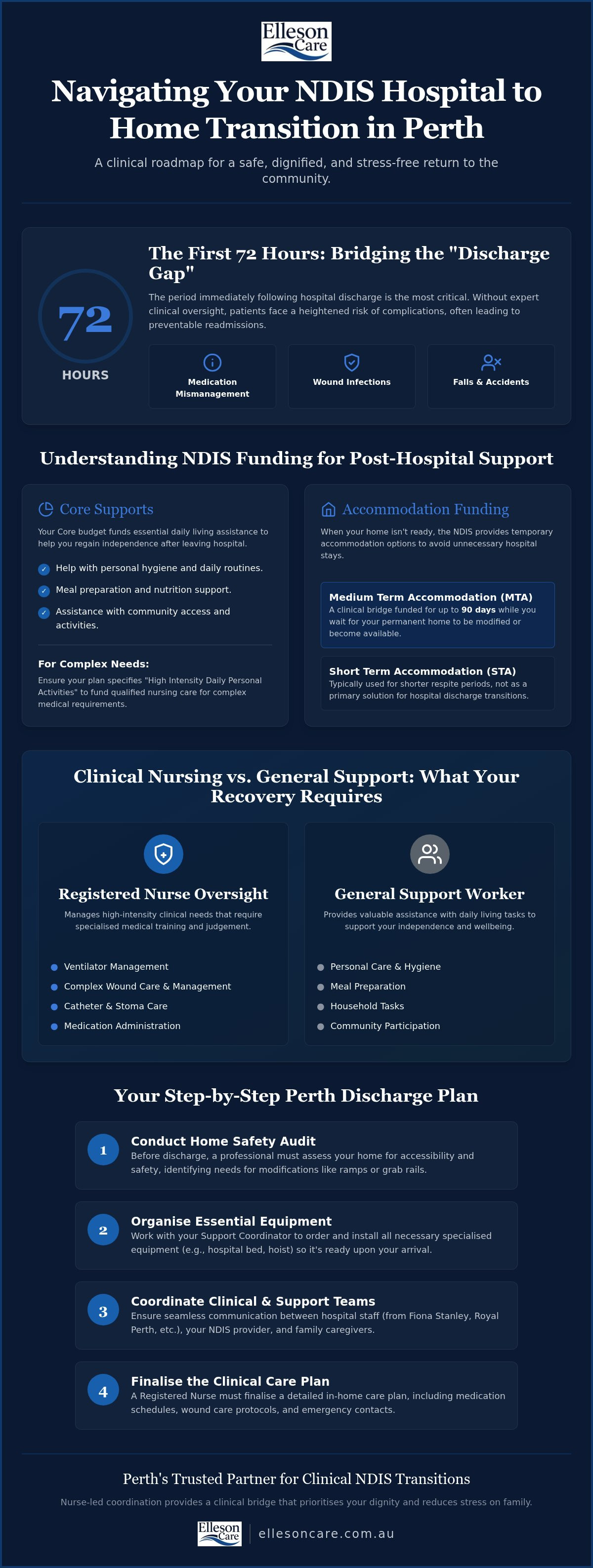
The first 72 hours after leaving a clinical setting are widely recognised as the most critical. This "Discharge Gap" is when the risk of medical complications is at its highest, often leading to avoidable hospital readmissions. Professional clinical oversight during these three days provides a safety net, ensuring that your recovery trajectory remains positive and your dignity is preserved. A local Perth response team can react quickly to changing needs, providing the stability required during those first few nights at home.
The Risk of Unmanaged Discharge
When a discharge is not managed with clinical precision, the consequences can be severe. Common complications include medication mismanagement, wound infections, or falls resulting from inadequate home modifications. While general support workers provide valuable assistance with daily living, they often lack the specialised training required to manage complex clinical needs like catheter care or ventilator support. This gap often forces family members into the role of primary carers, which carries a significant emotional and physical toll. Professional nurse-led oversight alleviates this burden, allowing families to focus on emotional support rather than medical tasks.
NDIS Post-Hospital Support Options
In Western Australia, the "From Hospital to Home" (FH2H) initiative facilitates a smoother exit from the health system. This programme works alongside your existing NDIS funding to provide immediate, short-term supports while your long-term plan is reviewed or established. Your Support Coordinator plays a pivotal role here, collaborating with hospital social workers and clinical providers to ensure every piece of equipment and every nursing hour is ready before you arrive home. This collaborative approach ensures that ndis hospital to home care perth is not just a service, but a comprehensive recovery strategy tailored to your specific clinical requirements.
Understanding NDIS Funding for Post-Hospital Support
Securing the right funding is the foundation of a safe and dignified recovery. When you transition via ndis hospital to home care perth, your Core Supports budget typically covers essential daily living assistance. This includes help with personal hygiene, meal preparation, and community access as you regain your independence. If your recovery involves complex clinical requirements, your plan needs to specify "High Intensity Daily Personal Activities." This category is essential for engaging qualified nursing staff to manage health risks that a standard support worker isn't trained to handle. The 2026-27 NDIS Pricing Schedule, which took effect on 1 July 2026, places a higher emphasis on unbundled services, meaning your plan must be precisely structured to cover every aspect of your clinical journey.
Medium Term Accommodation (MTA) vs. Short Term Accommodation (STA)
If your Perth home requires accessibility modifications or specialised equipment before you can return safely, Medium Term Accommodation (MTA) provides a vital clinical bridge. Unlike Short Term Accommodation (STA), which is generally intended for shorter respite periods, MTA is funded for up to 90 days. This ensures you don't remain in a hospital ward longer than necessary when you're medically fit for discharge. Eligibility depends on having a confirmed permanent home that is currently unavailable. We frequently assist families in navigating this middle ground, ensuring that specialised NDIS support services remain consistent while you wait for your permanent residence to be ready.
Accessing High-Intensity Nursing Funds
Securing funding for high-intensity nursing requires clear, evidence-based clinical justification. Whether you need ventilator management, catheter care, or complex wound treatment, the NDIA needs to see that these tasks require a professional level of skill. A Registered Nurse-led assessment is often the most effective way to document these needs for your NDIS planner. This assessment doesn't just list tasks; it explains the clinical risks involved and the specific outcomes expected from professional intervention. By providing this authoritative evidence, we help you secure the necessary funding to maintain your health and safety at home, ensuring that your recovery is supported by the right level of expertise from day one.
Clinical Nursing vs. General Support: What Your Recovery Requires
Determining the right level of assistance is a vital step in planning your ndis hospital to home care perth. While general support workers provide invaluable help with domestic tasks and social participation, they aren't equipped to manage acute medical needs. Clinical nursing involves a higher level of vigilance, where a Registered Nurse (RN) monitors your physiological stability and identifies subtle changes in your condition before they become emergencies. This professional oversight is particularly important when managing medication regimes that require precise timing and dosage, or when implementing pressure injury management plans to protect skin integrity during long periods of recovery.
Our approach at Elleson Care integrates clinical expertise with a deep respect for your autonomy. Every participant receives nurse-led oversight, ensuring that your daily care aligns with the recommendations of your allied health team. When an Occupational Therapist or Physiotherapist sets recovery goals, our nurses provide the clinical framework to meet those milestones safely. This coordination ensures that your medical needs are met without sacrificing the comfort and familiarity of your home environment.
Specialised Wound and Continence Management
Post-operative recovery often involves complex wound care that requires a sterile environment and expert assessment to prevent sepsis or delayed healing. Our nurses specialise in managing these clinical requirements, alongside continence support such as catheter and bowel care. These tasks are deeply personal, and having them performed by a skilled professional ensures both medical safety and the maintenance of your personal dignity. Clinical nursing provides the necessary oversight to identify early signs of infection, which significantly reduces the likelihood of unplanned hospital readmissions during the first few weeks at home.
Complex Respiratory and Ventilator Support
For individuals requiring respiratory assistance, the transition home involves managing sophisticated medical equipment like ventilators and oxygen concentrators. Our team, led by RNs with over 22 years of experience, specialises in this high-intensity support. We don't just manage the machinery; we conduct regular clinical audits to ensure equipment reliability and provide comprehensive training for family members. This education covers emergency protocols and troubleshooting, giving your loved ones the confidence to support you while knowing a professional clinical bridge is always in place. This methodical approach ensures that even the most complex respiratory needs are managed with discipline and kindness.
Step-by-Step: Organising Your Perth Home for a Safe Discharge
Transitioning from a clinical ward to your own residence is a significant milestone that requires precise coordination. Before you leave a major centre like Fiona Stanley or Royal Perth Hospital, a comprehensive home safety audit is essential. This process identifies potential hazards and ensures that the physical environment is ready for ndis hospital to home care perth. We focus on the practicalities of daily life, ensuring that clinical supplies and essential equipment, such as hospital beds or hoists, are not just delivered, but correctly installed and tested before your arrival.
A successful transition relies on a clear clinical handover. This is the moment where the responsibility for your care moves from the ward nurses to our community nursing team. We review your medical history, current medications, and recovery goals to ensure there is no lapse in support. To maintain stability, we establish a 24-hour care roster that provides consistent clinical oversight. This structure is vital for preventing caregiver burnout, offering families much-needed respite while ensuring you receive professional attention throughout the day and night.
The 48-Hour Pre-Discharge Checklist
The final two days before you leave hospital are often the most hectic. To ensure a smooth exit, you must confirm that all NDIS service agreements are signed and active. It's equally important to ensure your "Discharge Summary" is shared with your clinical nursing agency; this document is the roadmap for your immediate recovery. Finally, verify that any required home modifications, such as ramps or bathroom rails, are fully installed and safe for use. You can organise a pre-discharge home assessment with our team to ensure every detail is covered.
Settling in: The First Week at Home
The first week is a period of adjustment where we monitor for "post-hospital syndrome," which can include physical weakness or changes in mental health. As your strength improves, we work with you to adjust your care plan, gradually increasing your independence as milestones are met. For those who are dual-funded, we can also coordinate with In-Home Aged Care in Perth to ensure your support remains seamless across both systems. This holistic approach ensures that your return home is stable, dignified, and focused on your long-term well-being.
Why Elleson Care is Perth’s Trusted Partner for Clinical NDIS Transitions
Elleson Care stands as a dedicated partner for those requiring ndis hospital to home care perth. As a West Australian owned and operated provider, we possess an intimate understanding of the local healthcare landscape and the specific discharge protocols used within our state's hospitals. Our leadership team consists of Registered Nurses with more than 22 years of specialised experience in clinical environments. This expertise ensures that every decision made regarding your care is grounded in high-tier professional standards and a deep respect for your personal autonomy.
We adopt a holistic family approach that extends support beyond the individual participant. We recognise that a hospital discharge affects the entire household, and our role is to provide a sense of stability and reassurance for your loved ones. By seamlessly integrating clinical nursing with domestic assistance and community access, we create a unified support system. This means you don't have to manage multiple agencies; instead, you have one steady, reliable partner who is emotionally invested in your quality of life and long-term well-being.
Nurse-Led Excellence in Western Australia
Having a clinical expert as your primary point of contact changes the nature of your recovery. Our nurses act as your advocates, working directly with WA Health and the NDIS to streamline your return home and reduce administrative delays. This professional oversight ensures that your individual goals remain the focus of every care plan. We are committed to person-centred care, where clinical authority is always balanced with human warmth and a protective, advocacy-based nature.
Start Your Recovery Journey with Confidence
Transitioning to Elleson Care is a straightforward process, even if you are currently with another provider. Our clinical intake assessment is thorough and methodical, designed to identify exactly what you need for a safe and successful recovery. We take the time to listen to your concerns and answer your questions, ensuring you feel fully informed and respected before any supports begin. Contact Elleson Care today to organise your Perth hospital-to-home support and take the first step toward a stable, nurse-led recovery in the comfort of your own home.
Securing Your Clinical Bridge Back to the Community
Returning home after a hospital stay is a significant milestone that should be met with confidence rather than apprehension. We have explored how a clinical bridge protects you during the high-risk 72-hour discharge gap and why Registered Nurse oversight is vital for managing complex needs such as ventilator support or wound care. By understanding how to structure your NDIS funding for Medium Term Accommodation or high-intensity daily personal activities, you can ensure your transition is both stable and dignified.
As a West Australian owned provider led by Registered Nurses with over 22 years of clinical experience, Elleson Care specialise in high-intensity NDIS supports with a holistic, family-focused approach. We act as your advocates within the healthcare system, ensuring every clinical detail of your ndis hospital to home care perth is managed with professional discipline and genuine kindness. Our goal is to provide the steady, reliable presence you need to focus entirely on your recovery and long-term well-being.
Enquire about our Nurse-Led NDIS Hospital to Home services in Perth today to begin your journey toward a safe and supported recovery. You don't have to navigate this transition alone; we are here to support you every step of the way.
Frequently Asked Questions
What is the NDIS Hospital to Home (H2H) programme in Perth?
The NDIS Hospital to Home programme in Perth is a collaborative initiative between WA Health and the NDIA designed to prevent discharge delays. It focuses on identifying participants who are medically fit to leave but require specialised supports to do so safely. By assigning a Hospital Liaison Officer (HLO), the programme ensures that your NDIS plan is reviewed and funded for essential equipment and clinical nursing before you exit the ward, facilitating a stable transition.
How long does it take to arrange NDIS care before hospital discharge?
Arranging ndis hospital to home care perth should ideally begin several weeks before your expected discharge. While the NDIA prioritises hospital cases, it often takes two to four weeks to finalise service agreements, conduct home safety audits, and organise specialised equipment like hoists or hospital beds. Starting this process early with a clinical provider ensures that your nursing roster is confirmed and that your home environment is safe and ready for your arrival.
Can I get a Registered Nurse to visit me at home through my NDIS plan?
Yes, your NDIS plan can fund Registered Nurse (RN) visits if you have complex clinical needs that require professional oversight. This falls under High Intensity Daily Personal Activities and covers tasks such as wound management, ventilator support, and catheter care. At Elleson Care, our RN-led team provides these services with a focus on clinical excellence and personal dignity, ensuring you receive the high-tier medical support necessary for a safe and stable recovery at home.
What happens if my Perth home isn’t ready for my disability needs yet?
If your home requires accessibility modifications or equipment that hasn't arrived, the NDIS can fund Medium Term Accommodation (MTA). This funding provides up to 90 days of temporary, accessible housing while your permanent residence is made ready. MTA ensures you can leave the hospital ward as soon as you are medically fit, allowing you to begin your recovery in a community setting while ramps, rails, or other essential modifications are being completed at home.
Does NDIS funding cover wound care and medication management post-hospital?
NDIS funding covers wound care and medication management when these tasks require the skills of a clinical professional. If your recovery involves complex post-operative wounds or high-risk medication regimes, these supports are funded as clinical nursing services. This ensures a Registered Nurse manages your care, identifying early signs of infection or complications. This professional level of support is a vital component in maintaining your health and preventing avoidable hospital readmissions during the first month of recovery.
How do I choose the right NDIS provider for high-intensity clinical care in WA?
When selecting a provider for high-intensity care in Western Australia, look for a team led by experienced Registered Nurses. It's essential to choose a provider that specialises in your specific needs, such as ventilator support or complex wound management. A local Perth provider understands the WA health landscape and can coordinate effectively with hospital discharge teams. Prioritising a provider with a holistic, family-focused approach ensures that both your clinical needs and personal well-being are respected.
What role does a Support Coordinator play in the hospital discharge process?
A Support Coordinator manages the logistical transition from the hospital ward to your home. They work closely with hospital social workers and NDIS Liaison Officers to ensure your plan has sufficient funding for your new requirements. Their role includes sourcing equipment, setting up service agreements with clinical providers, and organising nursing rosters. By handling these complex arrangements, they allow you and your family to focus on recovery while ensuring that all supports are active upon discharge.
Can Elleson Care help if I have both NDIS and Aged Care funding?
Elleson Care is uniquely positioned to assist participants who are dual-funded by both the NDIS and Aged Care systems. Our nurse-led team understands the nuances of both frameworks, ensuring that your clinical nursing and domestic supports are delivered through a single, coordinated plan. This integrated approach removes the stress of managing multiple providers. We focus on maintaining your independence and quality of life, providing a steady and reliable presence that adapts as your care needs evolve.


