

Imagine sitting at your kitchen table in Joondalup at 2 AM, staring at a complex NDIS plan while your back aches from a day of manual handling tasks you weren't fully trained for. You might feel a crushing weight of guilt just for wishing you could step away for a few days of rest. It's a silent struggle many West Australian families face, but you don't have to carry the clinical and emotional load of a loved one's care entirely on your own shoulders.
We understand that your health is just as vital as the person you're supporting. This guide provides a professional roadmap for managing caregiver burnout Perth residents can use to reclaim their vitality. You'll learn to identify the clinical red flags of exhaustion and navigate the latest 2026 NDIS pricing updates to secure the respite funding you need. By shifting from a solo carer to a supported clinical partnership, you can establish a sustainable routine that ensures high-quality care without sacrificing your own well-being. We will explore how nurse-led support and West Australian resources can help you move from survival mode back into a life of balance.
Key Takeaways
- Learn to recognise the clinical red flags of physical and emotional depletion before they impact your long-term health and well-being.
- Understand how to navigate the 2026 West Australian Support at Home Program and NDIS Short-Term Accommodation funding to access essential respite.
- Discover practical strategies for managing caregiver burnout Perth families can use to build a sustainable care routine and set healthy boundaries.
- Explore the benefits of a nurse-led care model in reducing medical anxiety and providing professional clinical oversight for complex tasks.
- Gain the validation that your health is a priority, ensuring you remain a resilient and capable support for your loved one.
Beyond Tiredness: Understanding Caregiver Burnout in the Perth Context
It's a common misconception that burnout is simply the result of a few sleepless nights or a busy week of appointments. In a clinical sense, caregiver burnout is a state of total physical, emotional, and mental exhaustion. It typically occurs when you've been operating in survival mode for an extended period, prioritising your loved one's needs while consistently neglecting your own. This often triggers a persistent Carer Guilt cycle, where the mere suggestion of taking a break feels like a betrayal of your family responsibilities. Understanding Caregiver Burnout requires looking past the surface level of fatigue to recognise the deeper physiological depletion that occurs when your internal resources are spent.
Why Western Australian Carers Face Unique Pressures
Families in Perth navigate a specific set of environmental and social challenges that can accelerate the path to exhaustion. The prevalence of the fly-in fly-out (FIFO) lifestyle means many primary carers lack a consistent support partner at home. When a spouse or adult child is working on a remote site in the Pilbara for weeks at a time, the daily clinical and domestic load falls entirely on one person. Physical strain is also exacerbated by the local climate. Performing domestic assistance during a Perth heatwave is a significant physiological stressor that increases the risk of dehydration and heat-related fatigue. For those living in the Perth hills or the sprawling outer suburbs, geographic distance from community centres can turn quiet evenings into periods of profound mental isolation.
The Difference Between Stress and Clinical Burnout
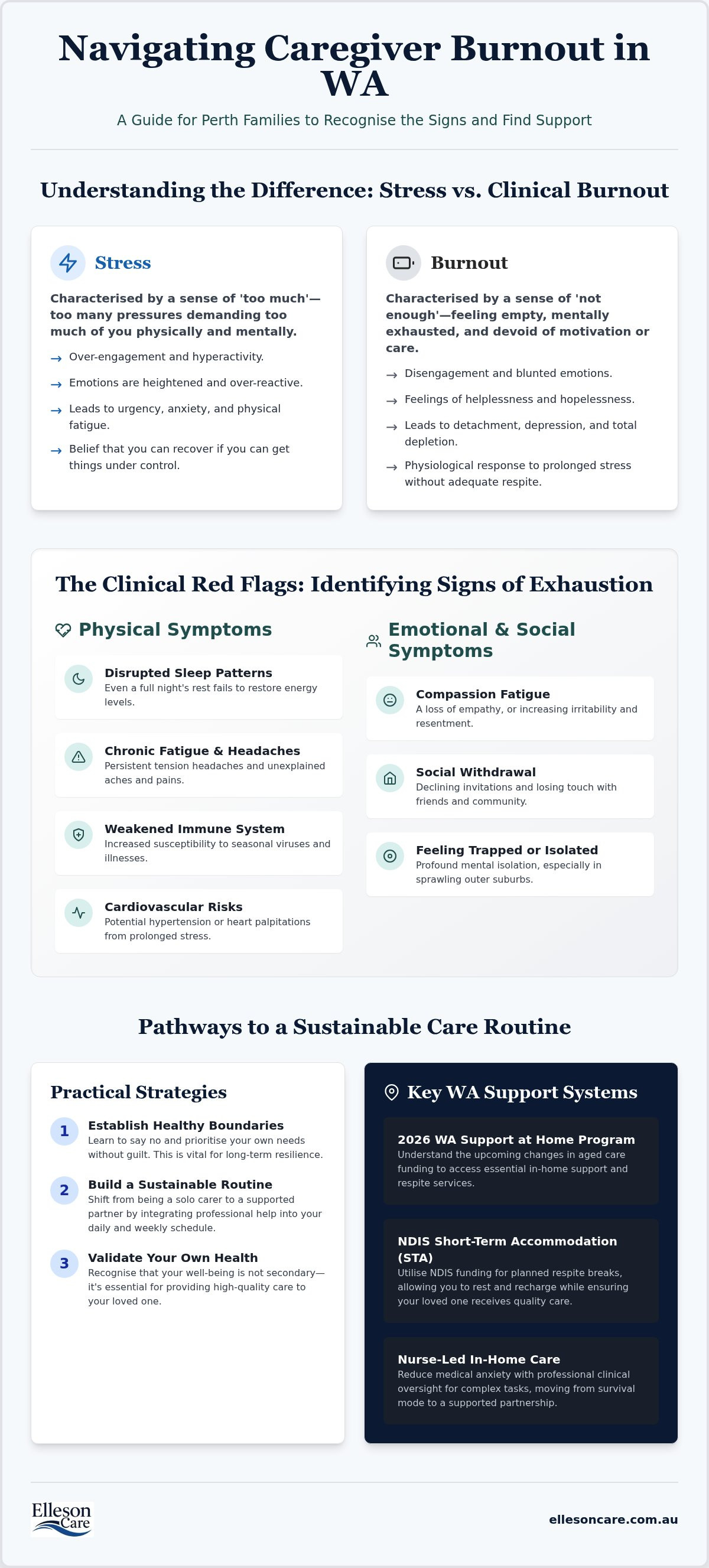
Distinguishing between daily caregiving stress and the point of clinical burnout is vital for your long-term health. Stress usually involves a sense of too much; you might feel overwhelmed by the volume of paperwork or the physical demands of manual handling, yet you still feel that if you could just get everything under control, you would be fine. Burnout is characterized by a sense of not enough, manifesting as a lack of energy, hope, or empathy. Burnout is a physiological response to prolonged caregiving without adequate respite. In Western Australia, this is frequently observed in the sandwich generation, individuals who are simultaneously managing the complex needs of ageing parents and the demands of their own growing children. Recognising these patterns is the first step in managing caregiver burnout Perth families must take to move toward a more sustainable, supported care model.
The Clinical Red Flags: Identifying Signs of Exhaustion
Identifying the transition from routine fatigue to clinical exhaustion is essential for the safety of both the carer and the individual receiving support. When you're managing caregiver burnout Perth demands can feel insurmountable, often leading to physiological changes that your body cannot ignore. These red flags serve as an early warning system, indicating that the current care arrangement is no longer sustainable. Addressing these signs is a vital step in managing caregiver burnout Perth families must take to ensure the long-term stability of the entire household.
Physical Symptoms: When Your Body Signals for Help
Physical depletion often begins with disrupted sleep patterns, where even a full night's rest fails to restore your energy levels. This chronic fatigue is frequently accompanied by unexplained aches, persistent tension headaches, or a weakened immune system that leaves you susceptible to every seasonal virus. Clinical research suggests a strong link between prolonged caregiving stress and long-term cardiovascular health risks, including hypertension. If you find yourself experiencing heart palpitations or a constant sense of physical dread, your body is effectively signalling for professional intervention. Accessing Carer Gateway support can provide an initial pathway to understanding these physical stressors and discovering available relief options.
Emotional and Social Withdrawal
Emotional exhaustion often manifests as a loss of empathy, sometimes referred to as compassion fatigue. You might notice an increasing sense of irritability or resentment toward the person you love, which can damage the delicate relationship between carer and recipient. Social withdrawal is another significant indicator; you may find yourself declining invitations to local Perth community events or losing touch with friends because the effort to engage feels too great. This isolation creates a feeling of being trapped within the home, further compounding the mental load and making the daily tasks of care feel like an impossible burden.
The cognitive impact of burnout is perhaps the most dangerous red flag. 'Brain fog' often leads to diminished concentration and poor decision-making, which can have serious consequences in a home care setting. Forgetting a medication dose or failing to notice a subtle change in a loved one's condition are common results of a mind that is simply too tired to function. This decline doesn't just affect your health; it directly impacts the safety and quality of care your loved one receives. Recognising these signs early allows you to seek help before a minor oversight becomes a medical emergency. Integrating professional clinical support into your routine is a proactive way to ensure your loved one remains safe while you take the time needed to reclaim your health.
Navigating Perth’s Support Systems: NDIS and Aged Care in 2026
The Australian healthcare landscape is undergoing significant transitions, particularly with the 2026 updates to the Support at Home Program in Western Australia. These changes aim to streamline access to services, yet the bureaucracy of My Aged Care and the NDIS remains a primary source of stress for many families. Successfully managing caregiver burnout Perth requires a clear understanding of how to leverage these systems to fund professional relief. By treating the support system as a clinical tool rather than an administrative hurdle, you can secure the resources necessary to maintain your own health while ensuring your loved one receives expert care.
When preparing for a My Aged Care assessment in Perth, it's helpful to have a structured checklist to ensure your needs are fully captured. Recognising the early signs of burnout is often the catalyst for this process. Your preparation should include:
- Current clinical documentation from a GP or specialist detailing the recipient's care needs.
- A comprehensive diary of daily care tasks, including 'hidden' hours such as overnight monitoring.
- Evidence of the primary carer's physical or mental health status.
- A clear list of goals focused on maintaining independence and safety within the home.
Maximising Your Home Care Package (HCP) for Respite
For those with Level 3 or 4 Home Care Packages, there is significant scope to fund professional nursing at home. These higher-tier packages are designed to support complex clinical needs, allowing you to delegate technical tasks to a Registered Nurse. This reduces the physical strain on your body and mitigates medical anxiety. You can find more detail on these tiers in our guide to in-home aged care Perth. Additionally, utilising 'Social and Community Participation' funding can provide the carer with essential windows of time to engage in their own health and social activities, which is a vital component of a sustainable care routine.
Accessing NDIS Respite and Community Support
Under the NDIS Pricing Schedule 2026-27, which came into effect on July 1, 2026, the structure for Short-Term Accommodation (STA) has been refined. Funding now distinguishes between participant accommodation and support worker accommodation, with each set at $162.85 per day, while support hours are claimed separately. This clarity allows for more precise planning of respite periods. If your caregiving demands have increased, your Support Coordinator can assist in requesting a plan review. They play a critical role in advocating for your wellbeing, ensuring the plan includes sufficient daytime care from local Perth disability services to prevent you from reaching a point of total depletion.
Practical Strategies for Managing Caregiver Burnout Perth Families Can Use
Sustainable caregiving is not a solo endurance test; it's a clinical partnership that requires structured planning. Managing caregiver burnout Perth families often find that the most effective strategy is the creation of a 'Care Circle'. This involves a step-by-step approach where you map out the specific medical and domestic needs of your loved one and delegate tasks to a combination of family members, friends, and professional providers. By sharing the clinical load, you ensure that no single individual is responsible for every aspect of care, which is the most reliable way to prevent long-term depletion and emotional fatigue.
Establishing firm boundaries between 'caring time' and 'personal time' is equally vital for your mental health. It's helpful to view your personal time as a clinical requirement rather than a luxury. This might involve using local Perth amenities, such as taking a micro-break at a local community centre or enjoying the quiet of a suburban park, to physically remove yourself from the care environment. These short intervals of rest allow your nervous system to reset and lower cortisol levels. Additionally, you must prioritise your own health through regular GP check-ups. Your doctor can monitor your blood pressure and mental well-being, providing a professional safeguard against the physical manifestations of prolonged stress that we've previously discussed.
Organising Professional Respite in Perth
There is a significant clinical difference between 'emergency' respite, which occurs during a crisis, and 'planned' respite, which is integrated into your lifestyle. Proactive planning allows you to choose the right environment and level of support for your loved one before you reach a point of exhaustion. Our guide to respite care Perth offers detailed advice on booking these services effectively. Utilising professional daytime care can also provide the necessary space for you to return to work or study, maintaining your own professional identity and social connections beyond your role as a carer.
Building a Sustainable Daily Routine
Reducing the 'invisible load' of housework is a practical way to conserve your energy for more complex clinical care tasks. By utilising professional domestic assistance for laundry, cleaning, or meal preparation, you free up significant mental capacity. Scheduling non-negotiable rest periods ensures your body has a predictable window for recovery. You might also consider utilising local Perth-based meal delivery or laundry services to simplify your daily logistics and reduce physical strain. If you're ready to transition to a more supported routine, our team is here to help you design a professional care plan that prioritises the health of your entire family.
Why Nurse-Led In-Home Care is the Gold Standard for Prevention
While general advice often focuses on surface-level self-care, true prevention of exhaustion requires a fundamental shift in how care is structured within the home. Managing caregiver burnout Perth residents face involves more than just finding a few hours of quiet; it requires the integration of high-level clinical oversight. Having a Registered Nurse oversee your loved one’s care plan transforms the household dynamic from one of constant medical anxiety to a structured, professional environment. This clinical partnership ensures that the weight of healthcare management is handled by experts, allowing you to return to your primary role as a family member rather than a clinical coordinator.
The Peace of Mind Provided by Clinical Expertise
One of the most significant stressors for family carers is the persistent fear of making a medical error. The burden of complex medication management and advanced wound care can lead to a state of constant hyper-vigilance, which is a direct precursor to burnout. By engaging professional nursing services, you delegate these high-stakes tasks to practitioners who bring a calm, steady confidence to the home. Our team is led by RNs with over 22 years of experience, providing a level of expertise that is invaluable for spotting subtle health changes early. This proactive clinical monitoring prevents unnecessary hospitalisations and significantly reduces the medical anxiety that often keeps carers awake at night.
Taking the First Step: A Professional Consultation
We believe that a professional assessment is one of the most compassionate acts you can perform for your family. It is not an admission of defeat, but a proactive step toward a sustainable future. Elleson Care takes a holistic family approach to healthcare, recognising that the well-being of the carer is inextricably linked to the quality of life of the recipient. We specialise in tailoring care plans to the unique needs of Perth households, ensuring that every domestic assistance task and clinical intervention is delivered with respect for your family's dignity and autonomy. Our nurse-led model ensures that even routine domestic tasks are performed with a focus on safety and clinical best practices. If you're feeling the weight of your current routine, we invite you to contact the Elleson Care team for a compassionate consultation. Together, we can design a support system that allows your family to thrive, ensuring you have the resilience to continue being the steady, loving presence your loved one needs.
Reclaiming Your Well-being Through Clinical Partnership
Your journey as a carer doesn't have to be defined by exhaustion or isolation. By recognising the clinical red flags of depletion and engaging with the updated 2026 NDIS and Aged Care frameworks, you can transition from a state of survival to one of sustainable support. Managing caregiver burnout Perth residents experience requires a proactive shift toward professional collaboration. This ensures that your own health is treated with the same priority as your loved one's care.
Elleson Care is a West Australian owned and operated provider, led by Registered Nurses with over 22 years of experience. We specialise in NDIS and Aged Care services, providing a holistic family approach that restores balance to your home. Taking the first step toward professional assistance is a profound act of compassion for both yourself and your family. If you're ready to explore a safer way forward, please book a clinical consultation with our Perth nursing team. You deserve a care routine that protects your vitality while ensuring your loved one receives the highest standard of clinical support. We are here to walk this path with you.
Frequently Asked Questions
What are the first signs of caregiver burnout I should look for?
The earliest indicators often include persistent physical exhaustion not resolved by sleep, coupled with a noticeable loss of empathy for your loved one. You might experience frequent tension headaches, a weakened immune system, or cognitive "brain fog" that makes daily decision-making difficult. Irritability and a desire to withdraw from social community events in Perth are also significant red flags. Recognising these clinical signs early is the first step in managing caregiver burnout Perth families must take.
Can I get NDIS funding specifically to help with caregiver burnout in Perth?
While the NDIS focuses on the participant, funding for Short-Term Accommodation (STA) and social participation is designed to provide essential respite for the primary carer. Under the 2026-27 pricing guidelines, you can access specific daily rates for accommodation and support hours to ensure your loved one is cared for while you rest. Discussing these needs with your Support Coordinator can help you request a plan review if your current caregiving demands are becoming unsustainable.
Is there a difference between respite care and permanent aged care placement?
Yes, the two services serve very different purposes. Respite care is a temporary support arrangement, often delivered in your own home or a short-term facility, designed to give the primary carer a break. In contrast, permanent aged care placement involves a long-term move into a residential facility. Our focus is on providing high-quality in-home aged care services that allow your loved one to remain independent while providing you with the professional relief needed to prevent burnout.
How do I deal with the guilt of wanting to use professional care services?
It's natural to feel a sense of guilt, but it's helpful to reframe professional support as a clinical necessity rather than a personal failure. Your health directly impacts the safety and quality of care your loved one receives. By integrating professional nursing or domestic assistance, you aren't stepping away; you're ensuring that the care environment remains stable and sustainable. Prioritising your well-being is the most compassionate act you can perform for your family.
What local Perth organisations offer support for family carers?
Several organisations provide vital resources for West Australian families. Carers WA is the peak body in the state, offering advocacy and support groups, while the Australian Government's Carer Gateway provides access to counselling and emergency respite. For clinical support, local providers like Elleson Care offer nurse-led home care that addresses complex medical needs. These local resources ensure that Perth carers have access to both emotional validation and practical, professional assistance within their own suburbs.
Can a Registered Nurse help me manage my loved one's complex medical needs at home?
Absolutely. A Registered Nurse brings a high level of clinical expertise to the home, managing complex requirements such as wound care, medication administration, and ventilator support. This professional oversight significantly reduces the medical anxiety often felt by family carers. With over 22 years of nursing experience, our team can identify subtle health changes early, ensuring your loved one receives expert clinical care while you focus on maintaining your own physical and mental health.
How often should I schedule respite to prevent burnout effectively?
Clinical best practice suggests that respite should be a proactive, scheduled part of your routine rather than an emergency response. Many families find that a regular weekly or fortnightly window of professional support is most effective for managing caregiver burnout Perth. This consistency allows your body and mind to recover predictably. The frequency should be tailored to the complexity of the care required and your own energy levels, ensuring a sustainable long-term arrangement.


