

If you are managing complex clinical needs within your own home, is your care team backed by a formal regulatory safety net, or are you carrying the full weight of that risk alone? With over 69,000 NDIS participants now residing in Western Australia, the local landscape has become increasingly complex. Choosing a registered ndis provider in Perth is often the first step toward replacing that uncertainty with a sense of clinical security and professional reliability.
We recognise that the fear of substandard care or the confusion surrounding NDIS audit standards can be a significant burden for families. It's natural to feel anxious about managing high-intensity supports without the assurance that your provider meets the highest national benchmarks. This article will show you how opting for a registered service provides essential financial protection and clinical safety through mandatory audits and professional oversight. You'll gain a clear understanding of how the 2026 quality and safeguard standards work to protect your family's dignity and long-term wellbeing.
Key Takeaways
- Understand the rigorous audit and compliance standards that a registered ndis provider must maintain to ensure your safety and personal dignity.
- Learn how the NDIS Quality and Safeguards Commission's reporting framework acts as a vital shield against neglect or substandard service.
- Identify the essential differences in insurance and professional indemnity that provide financial and clinical security for your family.
- Discover how to navigate the NDIS Provider Register to verify a firm's credentials and ask the right questions during your first meeting.
- Explore the unique advantages of a nurse-led support model where clinical expertise ensures a higher standard of daily care and risk management.
What is a Registered NDIS Provider?
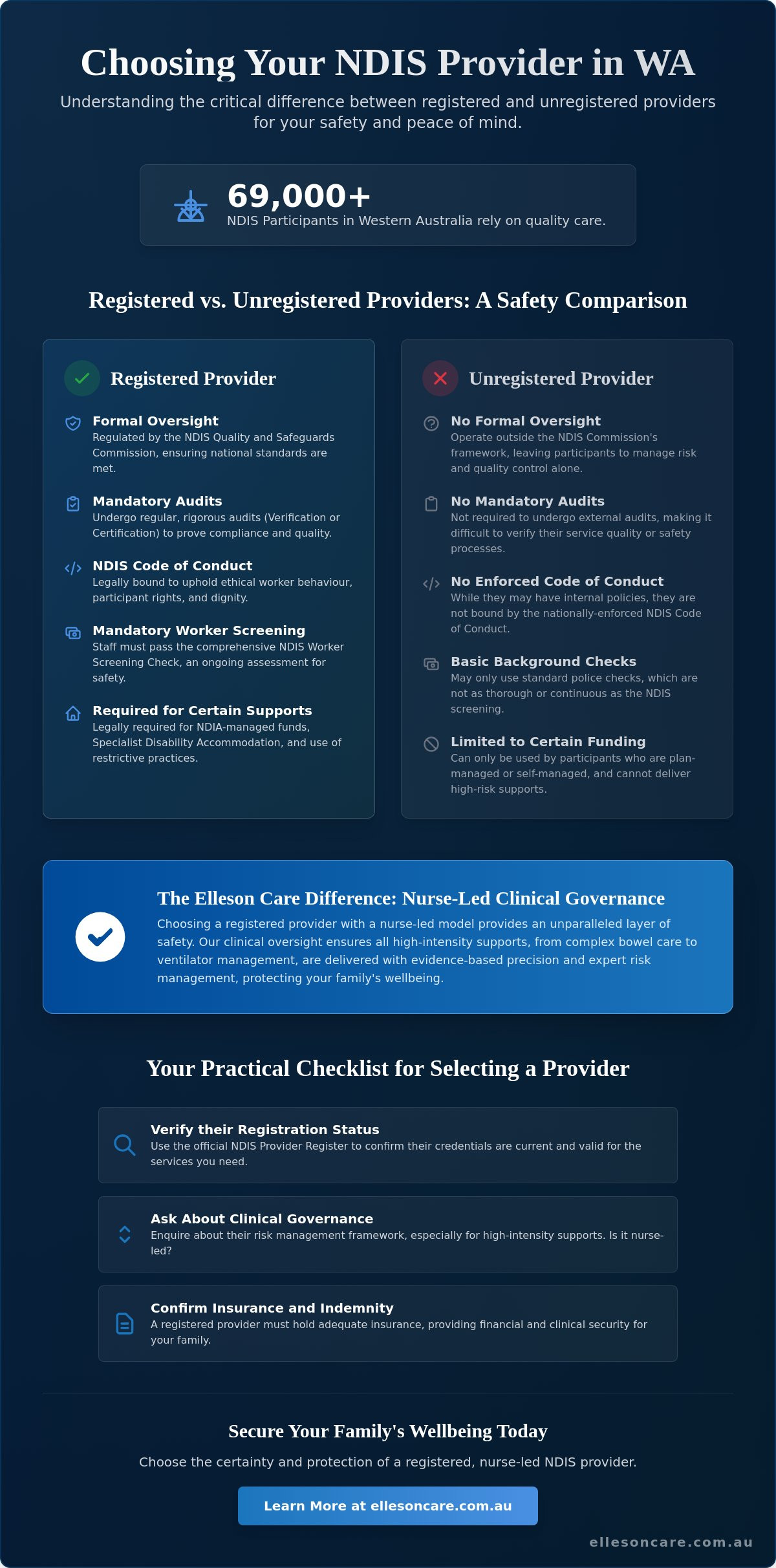
A registered ndis provider is an individual or an organisation that has undergone a rigorous assessment process to meet the stringent requirements set by the NDIS Quality and Safeguards Commission. This registration isn't merely a formality; it represents a solemn commitment to the safety, rights, and personal dignity of every person living with a disability. Within the National Disability Insurance Scheme, these providers are audited against national standards to ensure they possess the clinical expertise and operational integrity required to deliver high-quality support. In Western Australia, the Commission actively monitors provider behaviour and compliance, ensuring that local services remain accountable to the 69,231 participants currently residing in the state.
Registration is categorised into specific groups based on the level of risk and complexity involved in the support. Whether a provider offers domestic assistance or complex clinical care, they must prove their capability within these specific registration groups. This ensures that a registered ndis provider is qualified for the exact type of service they are delivering. Providers undergo different audit pathways depending on their size and the complexity of their services. "Verification" is generally for lower-risk supports, while "certification" involves a more intensive audit for complex, high-risk services.
The Legal and Ethical Foundations of Registration
Every registered provider must adhere to the NDIS Code of Conduct, which dictates ethical worker behaviour and promotes the autonomy of participants. This framework requires mandatory worker screening and background checks to protect vulnerable individuals from harm. By following the NDIS Practice Standards, providers ensure that care is person-centred and evidence-based. These standards aren't just rules; they're the foundation of a stable and respectful relationship between you and your care team.
Who Must Be Registered?
While some participants can choose unregistered providers, certain high-risk supports legally require a registered entity. This includes the use of restrictive practices and the delivery of Specialist Disability Accommodation. Additionally, if your funding is NDIA-managed, you're required to use a registered provider. This differs from plan-managed or self-managed streams, where there's more flexibility. Many Perth families still choose registered providers regardless of their management type, seeking the added layer of clinical oversight and financial security that registration guarantees.
The NDIS Quality and Safeguards Commission Standards
The NDIS Quality and Safeguards Commission oversees a framework designed to ensure every registered ndis provider operates with transparency and accountability. These standards are not just a bureaucratic checklist; they are the benchmarks for safety and quality. Unlike a standard business licence, registration requires a provider to adhere to core modules that cover everything from risk management to the quality of clinical care. This oversight ensures that the provider's operations are aligned with the national expectations for disability support.
A critical component of this oversight is the "Reportable Incidents" framework. This system mandates that providers must notify the Commission of any serious incidents, such as neglect or abuse, within strict timeframes. It acts as a vital safety net, ensuring that concerns are never ignored or hidden. Additionally, the NDIS Worker Screening Check provides a level of security that far exceeds a standard police check. It involves an ongoing assessment of a worker's history across all states and territories, ensuring that those who enter your home are safe and trustworthy. This is especially relevant in 2026 as the Commission introduces even more rigorous oversight for high-risk services.
To maintain their status, providers must undergo regular external audits. These assessments verify that the provider's internal processes actually translate into better outcomes for participants. It's about maintaining a high centre of care excellence where the individual's needs always come first.
Clinical Governance and Risk Management
For families managing high-intensity daily personal activities, clinical governance is essential. A registered ndis provider must have robust systems to manage medical risks, such as complex bowel care or ventilator management. We believe that clinical oversight from Registered Nurses is the gold standard for this type of support, as it ensures that care is evidence-based and safe. If you are looking for a partner who prioritises these safety standards, you can learn more about our clinical approach. Every provider must also maintain a transparent feedback and complaints system, allowing you to voice concerns without fear of retribution.
Continuity of Support and Emergency Planning
Life is unpredictable. Your care should remain stable even when circumstances change. Registered providers are required to have documented continuity plans for service interruptions. This includes planning for staff illness or extreme Perth weather events like heatwaves or winter storms. Regular reviews of support plans ensure that your care remains relevant to your goals while preserving your autonomy. During transitions, such as moving between care teams, these standards ensure your dignity is respected and your routine is maintained without disruption.
Registered vs. Unregistered Providers: Key Differences for Participants
Choosing between a registered and an unregistered provider is one of the most significant decisions a Perth family will make. While the NDIS offers flexibility, this choice involves a fundamental trade-off between administrative ease and clinical security. A registered ndis provider must maintain comprehensive insurance, including public liability and professional indemnity, which offers a vital safety net if something goes wrong. Unregistered providers are not legally required to hold these same levels of protection, which can leave participants and their families vulnerable to financial and clinical risks that are often difficult to manage alone.
The financial framework also differs significantly between these two options. Registered providers are bound by the NDIS price guide 2026, ensuring that you are charged fairly and within the limits set by the NDIA. If your funding is NDIA-managed, you are restricted to using registered providers to ensure your budget is spent on services that meet national quality benchmarks. For self-managed participants, the "flexibility" of using unregistered workers might seem appealing, but it introduces a clinical dilemma. Without the oversight of a registered entity, the responsibility for verifying worker qualifications and safety rests entirely on your shoulders.
The Benefits of Choosing a Registered Provider
Opting for a registered organisation provides an immediate sense of peace of mind because they must demonstrate ongoing compliance with the NDIS Practice Standards. This registration allows you to access specialised ndis home care services that require high-level certification, such as complex wound care or respiratory support. Beyond technical skills, registration ensures accountability. If you are unhappy with your care, you have access to the NDIS Commission’s formal complaints process, providing a structured pathway to resolution. Registered providers also invest heavily in the professional development of their staff, ensuring that your support team is always up to date with the latest evidence-based practices.
Potential Drawbacks and Misconceptions
There is a common misconception that a registered ndis provider might be "too corporate" or less personal than an independent worker. In reality, the cost of registration is an investment in a sustainable and safe workforce. It funds the rigorous auditing and clinical oversight that keeps participants safe. Local Perth providers like Elleson Care prove that you don't have to sacrifice a family feel for professional standards. By maintaining a nurse-led model, we combine the warmth of a small team with the disciplined safety protocols required by the NDIS Commission. This balance ensures your care is both deeply personal and clinically beyond reproach.
Selecting the Right Provider in Perth: A Practical Guide
Finding the right support is a deeply personal journey that requires more than a simple database search. While the NDIS Provider Register is a helpful starting point to verify if a firm is a registered ndis provider in Western Australia, a digital entry only tells part of the story. You need to look for a partner who understands the local Perth health landscape and can navigate the specific challenges of our geography. A provider with strong local ties can often coordinate more effectively with local hospitals and GPs, ensuring your care transitions are seamless and integrated.
When evaluating potential partners, look closely at their leadership and clinical structure. Does the organisation have Registered Nurses on staff to act as clinical leads? Having an RN oversee your support plan means that complex medical risks are managed with professional precision. This level of expertise is what distinguishes a high-tier registered ndis provider from a standard agency. It ensures that your support workers are not just following a checklist but are operating under professional supervision that prioritises your clinical safety.
Key Questions for Prospective Providers
During your initial consultation, don't hesitate to ask direct questions about their operational resilience. Their answers will give you a clear indication of their commitment to the NDIS Practice Standards. You should consider asking:
- How do you handle emergencies or staff absences at short notice to ensure my care isn't interrupted?
- What specific, evidence-based training do your support workers receive for complex clinical needs, such as tracheostomy care or PEG feeding?
- Can you explain your internal process for managing and reporting incidents to ensure transparency and safety?
Their responses should be clear, documented, and focused on your personal dignity. If you're ready to partner with a team that prioritises these rigorous standards, you can request a consultation with our clinical team to discuss your specific requirements.
Assessing Cultural and Clinical Fit
Technical skills are vital, but the "human touch" is what makes long-term support sustainable for your family. A comprehensive disability services perth guide can help you understand how local providers tailor their approach to our community's unique needs. We believe in matching support workers not just on their clinical qualifications, but on their personality and shared interests. This ensures that the person entering your home is someone you feel comfortable with and can trust.
A holistic family approach is essential for long-term NDIS success. Your provider should feel like an extension of your support network, respecting your home environment while providing disciplined, professional care. This cultural alignment ensures that support feels like a genuine partnership rather than an intrusion, allowing you to focus on your goals with a steady and reliable team behind you.
The Elleson Care Difference: Nurse-Led Disability Support
Elleson Care stands as a registered ndis provider with a foundation built on over 22 years of professional nursing experience. This clinical background isn't just a part of our history; it's the lens through which we view every support plan we develop. Our Registered Nurses oversee every aspect of care, from complex clinical interventions to daily domestic assistance. This model ensures that while your practical needs are met, your medical safety is never compromised. We operate as "Compassionate Experts," balancing technical proficiency with a deep respect for your personal dignity and autonomy.
Navigating the NDIS can be an overwhelming experience for many families. We assist Perth participants in implementing their plans, ensuring that funding is utilised effectively to achieve long-term wellbeing. Our team acts as a steady partner, helping you understand the complexities of the system while providing the reliable, evidence-based support you deserve. By combining clinical authority with human warmth, we provide a sense of stability for individuals navigating complex care needs.
Specialised Clinical Nursing at Home
Our expertise extends to high-intensity supports that require a sophisticated understanding of healthcare. We provide specialised nursing for wound management, ventilator support, and palliative care within the NDIS framework. Many of our participants come to us during the critical period of transitioning from hospital to home. We bridge this gap by establishing a safe, nurse-led environment that maintains clinical standards while prioritising the comfort of your own residence. Having a nurse-led team means that potential risks are identified and managed before they become emergencies, providing a level of security that is essential for complex care.
A Family Approach to Care
Being West Australian owned and operated gives us a unique perspective on the needs of our local community. We aren't a distant corporation; we're local professionals who understand the Perth healthcare system intimately. This local knowledge allows us to provide more personalised, responsive support that truly reflects your lifestyle and goals. We believe that care is a collaborative process, so we involve your whole family in the planning stages. This ensures that your autonomy is preserved and that the support we provide aligns with your family's values and routines.
If you're currently with another provider or are just beginning your journey, transitioning your plan to a registered ndis provider like Elleson Care is a structured and supportive process. We can guide you through the necessary steps to ensure there is no disruption to your essential support. Our goal is to provide a steady, reliable presence in your life, ensuring that you feel fully informed and respected every step of the way.
Securing Your Family’s Future with Trusted Clinical Support
Choosing the right support is about more than just filling a roster; it's about establishing a foundation of safety and personal dignity. By selecting a registered ndis provider, you ensure that your care team is held to the highest national standards of clinical governance and ethical conduct. This choice provides the insurance, auditing, and professional oversight necessary to manage complex risks within the comfort of your own home.
As a West Australian owned and operated organisation, we remain deeply committed to the wellbeing of our local community. Our nurse-led team brings over 22 years of clinical experience to every support plan, ensuring full compliance with the NDIS Quality and Safeguards Commission standards. If you are ready to experience the stability of professional, compassionate oversight, please partner with a registered NDIS provider that puts clinical safety first—contact Elleson Care today. We look forward to supporting your family with the steady, reliable care you deserve.
Frequently Asked Questions
Is Elleson Care a registered NDIS provider in Perth?
Yes, Elleson Care is a fully registered ndis provider serving the Perth metropolitan area. We maintain rigorous compliance with the NDIS Quality and Safeguards Commission to ensure our clinical and domestic supports meet the highest national standards. Our registration reflects a deep commitment to providing safe, nurse-led care that prioritises the personal dignity of West Australian families.
Can I use an unregistered provider if my NDIS plan is NDIA-managed?
No, you're required to use a registered provider if your funding is managed by the NDIA. The National Disability Insurance Agency mandates that participants with agency-managed plans partner with a registered ndis provider to ensure all services meet mandatory safety and quality benchmarks. This requirement acts as a vital safeguard for your funding and the clinical quality of the care you receive.
What is the difference between a verified and a certified NDIS provider?
The primary difference lies in the level of risk associated with the services and the intensity of the audit process. Verification is typically for providers offering lower-risk supports, involving a desk audit of their policies and procedures. Certification is a more rigorous pathway for those delivering complex or high-risk clinical services, requiring a comprehensive onsite audit to verify their clinical governance and operational safety.
Does a registered provider cost more than an unregistered one?
Both types of providers are bound by the NDIS Pricing Arrangements and Price Limits for the services they deliver. While a registered provider manages higher overheads due to mandatory auditing and insurance requirements, they can't charge more than the maximum rates set by the NDIS. This ensures you receive regulated care and professional oversight without exceeding your allocated budget.
How do I check if a provider’s registration has been suspended or revoked?
You can verify a provider's current status by searching the NDIS Provider Register on the official NDIS Quality and Safeguards Commission website. This public database is updated regularly and includes detailed information on any compliance actions, suspensions, or revocations. It's a transparent tool designed to help you ensure your care team remains in good standing and meets national requirements.
Why is clinical nursing important for some NDIS participants?
Clinical nursing is essential for participants with high-intensity needs that involve significant medical risk. Registered Nurses provide the specialised expertise required for complex tasks such as tracheostomy care, ventilator management, or advanced wound care. This professional oversight ensures that your support workers are properly trained and that your health is monitored by a qualified expert who can manage clinical risks effectively.
What should I do if I am unhappy with my current registered NDIS provider?
You should first attempt to resolve any concerns through the provider's internal feedback and complaints process. If you don't feel the situation has been addressed properly, you can lodge a formal complaint with the NDIS Quality and Safeguards Commission. They have the authority to investigate your concerns and ensure that providers are meeting their legal and ethical obligations to participants.
How often do registered NDIS providers undergo audits?
Registered providers typically undergo a comprehensive audit every three years to renew their registration. In addition to this major review, many providers are subject to mid-term monitoring assessments to ensure they're maintaining ongoing compliance with the NDIS Practice Standards. This cycle of regular evaluation ensures that the quality of care remains consistent and that safety protocols are strictly followed over the long term.


