

What if the difference between simply staying at home and truly thriving there came down to the heart behind the hands that support you? For many families in Perth, the search for ndis home care services often begins with a sense of uncertainty. You might worry about navigating the latest 2026 Price Guide or feel anxious that support will become a series of transactional tasks rather than a meaningful relationship. It's natural to seek a balance where your clinical safety is managed with professional authority while your personal dignity is held with the utmost warmth.
We understand that your goal isn't just to receive assistance, but to maintain the independence that makes your house a home. This guide provides clarity on how NDIS funding works in the current landscape, what specific supports are covered, and how to choose a provider that prioritises your long-term well-being. We will examine the transition to the new framework planning and offer practical advice on finding a reliable partner who is as invested in your personal goals as you are. By the end of this article, you will feel empowered to make informed decisions that bring peace of mind to your entire family.
Key Takeaways
- Understand how ndis home care services provide personalised support within your residence to meet "reasonable and necessary" daily living requirements.
- Identify the specific types of funded assistance available to you, ranging from domestic help and meal preparation to essential community access.
- Learn the vital distinction between Core Supports for your immediate needs and Capacity Building funding used to develop your future skills.
- Discover how to align your NDIS "Home and Living" goals with nurse-led care to ensure your clinical safety is never compromised.
- Gain a clear roadmap for selecting a Perth-based provider that prioritises a relational, family-centred approach over a transactional one.
What are NDIS Home Care Services? A Definition for Participants
At its core, ndis home care services represent a commitment to ensuring that individuals with a disability can live safely and comfortably within their own four walls. Unlike traditional models of care that often required individuals to move into residential facilities, this modern approach brings the support to you. It's a personalised suite of assistance tailored to your specific functional needs, designed to foster a sense of security and belonging in your familiar surroundings. Ultimately, NDIS home care is a respectful partnership that provides the practical support necessary for you to exercise autonomy and live with dignity in your own home.
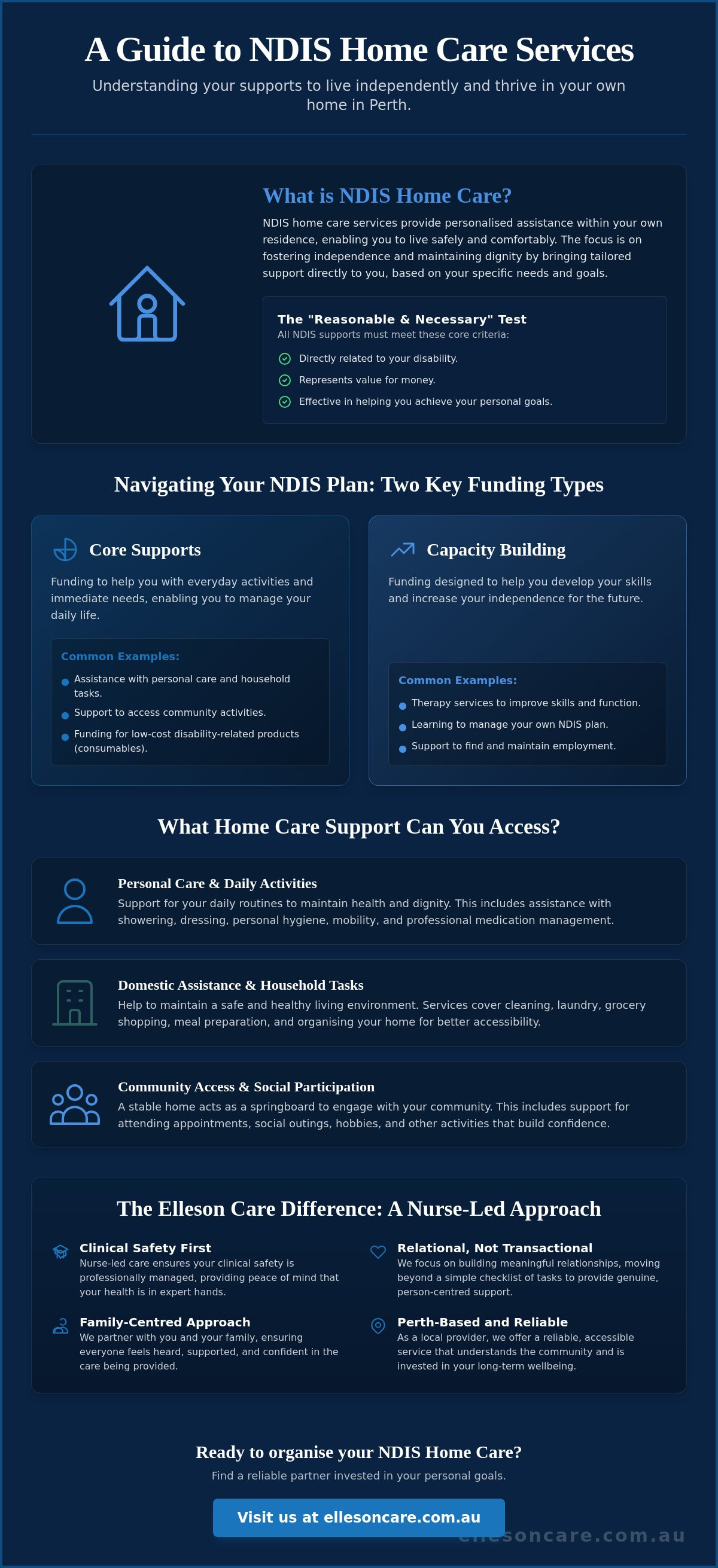
To receive funding, every support must meet the "reasonable and necessary" criteria set by the National Disability Insurance Scheme (NDIS). In the context of daily living, this means the support must be directly related to your disability, represent value for money, and be effective in helping you achieve your goals. It isn't about luxury; it's about providing the essential tools and hands-on help that bridge the gap between your current capabilities and your aspirations for an independent life.
While it shares some similarities with in-home aged care in Perth, the focus is distinct. Aged care services generally address the challenges associated with the ageing process. Conversely, NDIS home care focuses on functional impairment across various life stages, with a heavy emphasis on building capacity and facilitating community participation from a stable home base.
The Role of the NDIS in Daily Living
The introduction of the scheme has marked a significant shift in Western Australia, moving away from institutionalised care towards a model that celebrates community-based living. By providing reliable ndis home care services, the scheme reduces the physical and emotional burden on family carers, allowing them to return to their roles as parents, partners, or children rather than full-time support workers. This stability at home acts as a springboard, giving participants the confidence to engage in social activities and employment.
Who is Eligible for In-Home Support?
Eligibility for these supports is determined during your planning meeting. Generally, you must be under 65, live in Australia, and have a permanent and significant disability that affects your ability to perform daily tasks. The NDIA reviews your specific goals to see if home care is the most appropriate way to support your independence. It's essential to have a current plan that includes line items for Assistance with Daily Life to access these services from a registered provider.
What Support Can You Access? Types of Funded NDIS Home Care
Understanding the scope of ndis home care services begins with recognising that support is rarely one-size-fits-all. The NDIS Home and Living Supports framework ensures that funding is allocated to help you maintain a safe, functional environment that reflects your personal preferences. Whether you require help with the morning routine or more complex clinical oversight, the goal remains the same: to provide a steady, reliable presence that fosters your independence.
Personal Care and Daily Activities
Daily routines form the foundation of a dignified life. Support workers provide essential assistance with showering, dressing, and personal hygiene, always prioritising your comfort and privacy. Beyond basic tasks, this category often includes health monitoring and medication management. When these services are delivered with clinical expertise, they provide families with the reassurance that their loved one's physical well-being is being professionally monitored. It is this balance of human warmth and healthcare proficiency that ensures your daily needs are met with the highest standards of care.
Domestic Assistance and Household Tasks
A well-maintained home is vital for safety and mental well-being. Domestic assistance covers a range of tasks, including cleaning, laundry, and organising living spaces to improve accessibility. Carers also assist with grocery shopping and the preparation of nutritional meals, ensuring your dietary requirements are met without the stress of managing the kitchen alone. If you feel that your current household support could benefit from a more structured, professional approach to home care, exploring nurse-led domestic assistance can provide an extra layer of clinical safety.
Complex Clinical Needs and Assistive Technology
For participants with more intensive requirements, home care plans can incorporate complex clinical supports. This includes specialised services such as wound care, catheter management, or ventilator support, all delivered within the comfort of your residence. Alongside this, the NDIS often funds assistive technology to enhance home safety. These tools, ranging from simple grab rails to advanced electronic communication aids, work in tandem with your support team to reduce risks and empower you to move through your home with greater confidence.
Social and Community Participation
Your home should serve as a launchpad for social inclusion, not a barrier to it. Support workers help you engage with the local Perth community by assisting with transport to appointments or local events. This support is designed to build your confidence in using public transport and navigating social settings independently. By strengthening your connection to the world outside your front door, home-based support ultimately helps you achieve a more vibrant and connected lifestyle.
Core Supports vs. Capacity Building: Navigating Your Plan
To truly benefit from ndis home care services, it's vital to understand how your budget is structured. Think of it as a dual strategy for both your current comfort and your future growth. While the terminology can seem complex, the distinction usually comes down to whether a service supports your needs today or builds your skills for tomorrow. Many participants mistakenly believe they must choose between receiving hands-on help and pursuing independence, but a well constructed plan uses both categories to create a comprehensive support system.
Understanding Core Support Line Items
Core Supports are designed for "today". They address your immediate, everyday requirements to ensure you can live safely in your residence. The most common category used within ndis home care services is Assistance with Daily Life. This funding covers essential tasks such as domestic cleaning, laundry, and personal care. It also extends to transport and consumables, such as continence aids, which are necessary for maintaining your health and hygiene. NDIS funding is designed to be flexible within these broad budget categories, giving you the power to adjust your daily assistance as your priorities or health needs change.
Capacity Building for Greater Independence
Capacity Building is focused on "tomorrow". These funds are dedicated to helping you learn new skills or regain the ability to perform tasks yourself. Under the Improved Daily Living line item, you might access specialised training for yourself or your carers. This often involves allied health assessments where physiotherapists or occupational therapists provide a professional roadmap for your home care strategy. By focusing on skill development, you build the confidence required to manage household tasks with less supervision over time, reducing your long term reliance on external support.
The Synergy of Professional Coordination
The most effective care happens when these two categories work in harmony. For example, a nurse-led team might manage your complex clinical requirements under a Core Support budget while simultaneously coordinating with a therapist under Capacity Building to improve your mobility. This approach ensures your clinical safety is never compromised while you actively work toward specific NDIS plan goals. By integrating immediate help with future-focused training, your provider helps you maintain a stable home environment that also serves as a place of personal growth. This holistic oversight ensures that every hour of support delivered is a step toward a more autonomous life.
How to Organise NDIS Home Care Services in Perth
Securing the right ndis home care services requires a methodical approach that balances your practical needs with your personal preferences. The process begins with a careful review of your NDIS plan. You should identify your specific "Home and Living" goals, as these objectives will dictate the type of support you can engage. Whether you aim to improve your daily living skills or require intensive clinical oversight, having a clear vision of your desired outcomes ensures that your funding is utilised effectively.
Once your goals are established, the next step is to research disability services in Perth that align with your values. We recommend prioritising providers that offer nurse-led care. Having Registered Nurses oversee your support team adds a vital layer of clinical safety, particularly if you have complex health requirements. After identifying potential partners, conduct thorough interviews to gauge their expertise. Ask about their staff screening processes and how they ensure clinical standards are maintained within a home setting.
Before care commences, you must establish a formal Service Agreement. This document should clearly outline your expectations, the frequency of visits, and the specific tasks to be performed. It's a protective measure that ensures transparency for both you and the provider. We suggest starting with a trial period. This allows you to assess the compatibility between yourself and the support worker, ensuring the relationship is built on mutual respect and trust. If you are ready to begin this journey, you can contact our Perth team to discuss a tailored support plan.
What to Ask a Potential Provider
Selecting a partner in your care is a significant decision. You should feel empowered to ask direct questions regarding their capability and ethical standards. Consider the following:
- Are your support workers specifically trained to manage my unique disability needs?
- What protocols do you have in place for handling emergencies or providing after-hours clinical support?
- How do you ensure that the care provided is culturally sensitive and respectful of my family's traditions?
The Benefits of a Local Perth Provider
Choosing a local provider offers distinct advantages for Western Australian families. Local teams possess an intimate understanding of the WA health system and NDIS networks, which facilitates smoother coordination of your care. Face-to-face assessments and home visits are easier to organise, allowing for a more responsive and personalised service. Furthermore, engaging a West Australian owned and operated business ensures that your support is delivered by people who are truly invested in the well-being of the Perth community. This local connection fosters a sense of stability and reliability that larger, national organisations often struggle to replicate.
The Elleson Care Difference: Nurse-Led Disability Support
Elleson Care provides a holistic, family-centred approach to ndis home care services, rooted in the belief that every participant deserves a life of dignity and purpose. With over 22 years of combined healthcare experience within the Perth community, our leadership team understands the intricate balance between professional clinical oversight and genuine human connection. We don't simply assign a worker to a task; we build a supportive environment where your personal preferences and lifestyle are respected. Our meticulous matching process ensures that your support worker is a companion who shares your values and understands your specific goals, fostering a relationship built on trust and mutual respect.
The defining feature of our service is the clinical leadership that guides every interaction. By having Registered Nurses lead our support teams, we offer a level of safety and reliability that is essential for families navigating complex care. This professional oversight means that every support worker is trained to a higher standard, with a deep understanding of health monitoring and ethical practices. It provides a steady, calm presence for participants, ensuring that your ndis home care services are delivered with a quiet confidence that emphasises your well-being and personal autonomy above all else.
Clinical Excellence in the Home
Our clinical background allows us to manage complex health requirements that often fall outside the scope of standard disability support. We specialise in managing intricate needs such as wound care and catheter management, ensuring these tasks are integrated seamlessly into your daily routine. This expertise is particularly vital for participants transitioning from hospital to home, where professional nursing support can prevent complications and promote a smoother recovery. Every staff member is trained under strict evidence-based guidelines, ensuring that your clinical safety is never compromised while you remain in the comfort of your own residence.
Your Partner in Reaching NDIS Goals
We view ourselves as an advocate and partner in your journey toward independence. Our team collaborates closely with Support Coordinators to ensure that your plan is utilised to its full potential, helping you achieve the specific outcomes you've set for your life. Because your needs and aspirations will naturally change over time, we provide personalised care plans that evolve with you. We remain committed to the "human touch" in every interaction, prioritising your dignity and ensuring that you feel empowered to lead a life that is both independent and deeply connected to your community.
Empowering Your Journey Toward Independence
Navigating the NDIS doesn't have to be a solitary path. By understanding the distinction between your immediate daily needs and your long-term capacity building goals, you can create a support system that truly serves your lifestyle. The right ndis home care services should offer more than just assistance; they should provide a sense of stability and professional security within your own home. Choosing a provider that understands the local Western Australian landscape ensures your care is responsive and deeply connected to your community.
Elleson Care is a West Australian owned and operated provider led by Registered Nurses with over 22 years of healthcare experience. We specialise in both complex clinical care and daily disability support, ensuring your safety is managed with expert precision and human warmth. Contact Elleson Care today to discuss your NDIS home care needs with our clinical team.
You deserve a partner who respects your autonomy and is deeply invested in your personal well-being. We look forward to supporting you as you reach your specific plan goals and maintain the independence you value most.
Frequently Asked Questions
Can NDIS pay for a cleaner at my home?
Yes, the NDIS can fund domestic cleaning if your disability prevents you from performing these tasks yourself. This support typically falls under the "Assistance with Daily Life" category within your Core Supports budget. It is essential that this need is identified as "reasonable and necessary" during your planning meeting to ensure the funding is correctly allocated to maintain a safe and hygienic living environment.
What is the difference between NDIS home care and a Home Care Package?
The primary difference lies in the eligibility criteria and the intent of the programs. NDIS home care is designed for individuals with a permanent and significant disability, generally those who enter the scheme before the age of 65. In contrast, a Home Care Package is part of the Australian aged care system, intended to support older Australians to remain living independently as they experience the challenges associated with ageing.
How much NDIS funding can I get for home care services?
Funding amounts are not fixed; they are determined based on your individual functional needs and personal goals. The NDIA assesses what is reasonable and necessary for your specific situation to determine the level of ndis home care services you require. Your plan will reflect the hours of support needed to maintain your clinical safety and independence, ensuring your budget aligns with your long term aspirations.
Can I choose my own support workers with Elleson Care?
Yes, we prioritise your choice and control by involving you directly in the selection process. We take great care to match support workers to your personality, interests, and specific disability needs. This methodical approach ensures that the relationship is built on mutual respect and trust, ensuring that your care feels personal and supportive rather than a series of transactional tasks.
Does the NDIS fund 24-hour care at home?
The NDIS can fund 24-hour support if it is deemed reasonable and necessary for your safety and well-being. This is often provided through Supported Independent Living (SIL) or intensive daily activity funding for those with complex needs. Such arrangements require comprehensive evidence and professional assessments to justify the high level of care required to keep you safe within your own residence.
What happens if my NDIS plan doesn’t have enough funding for home care?
If your circumstances change or your current funding is insufficient, you can request a plan reassessment from the NDIA. It's important to provide updated functional assessments or clinical reports that clearly demonstrate why additional support is required for your safety. We can assist by providing professional documentation that outlines your clinical requirements and the impact on your daily independence and quality of life.
How do I change NDIS providers in Perth if I am not happy?
Changing providers in Perth involves reviewing your current service agreement to confirm the required notice period, which is typically two to four weeks. Once you have identified a new provider that better aligns with your goals, you simply need to notify your current one in writing. This process is designed to be straightforward, ensuring you always have the freedom to choose support that meets your standards.
Is clinical nursing covered under NDIS home care services?
Clinical nursing is covered under ndis home care services when the support is directly related to your disability and requires the skills of a professional nurse. This includes specialised tasks such as catheter care, complex wound management, or the administration of medication. Having nurse-led oversight ensures these clinical tasks are performed with professional expertise, providing you and your family with essential peace of mind.


