

What if the latest changes to your funding weren't just a source of bureaucratic stress, but a framework designed to protect the quality of care your family receives? For many families in Perth, the release of the ndis price guide 2025 often brings a wave of concern regarding potential funding shortfalls and the difficulty of securing high-standard clinical support. It's completely natural to feel a sense of trepidation when the rules shift, especially when the health and dignity of a loved one are at the centre of every decision.
We recognise the weight of these responsibilities and we're here to provide the steady, professional guidance you need. By understanding the 2025 pricing updates through a clinical lens, you can move from a place of uncertainty to one of informed confidence. This article will help you decode the essential changes to price limits and therapy rates, offering expert insights on how to manage your budget effectively while ensuring your family accesses the high-quality, nursing-led care they deserve. We'll look at the new national pricing standards and the expanded age limits for early childhood support, providing a clear roadmap for the year ahead.
Key Takeaways
- Understand the transition from the traditional price guide to the NDIS Pricing Arrangements and Price Limits 2025-26 to stay informed about annual funding caps.
- Identify the specific price limit increases for essential supports, such as assistance with daily living and community participation, to ensure your budget remains accurate.
- Learn how to use the 2025 Support Catalogue to find item codes and allocate funding across your core, capacity building, and capital support categories.
- Discover practical strategies for managing your ndis price guide 2025 budget, including the importance of regular clinical reviews and check-ins with your Support Coordinator.
- Explore the benefits of a nurse-led clinical support model in Perth, which prioritises safety and expert oversight for participants with complex care needs.
What is the NDIS Pricing Arrangements and Price Limits 2025?
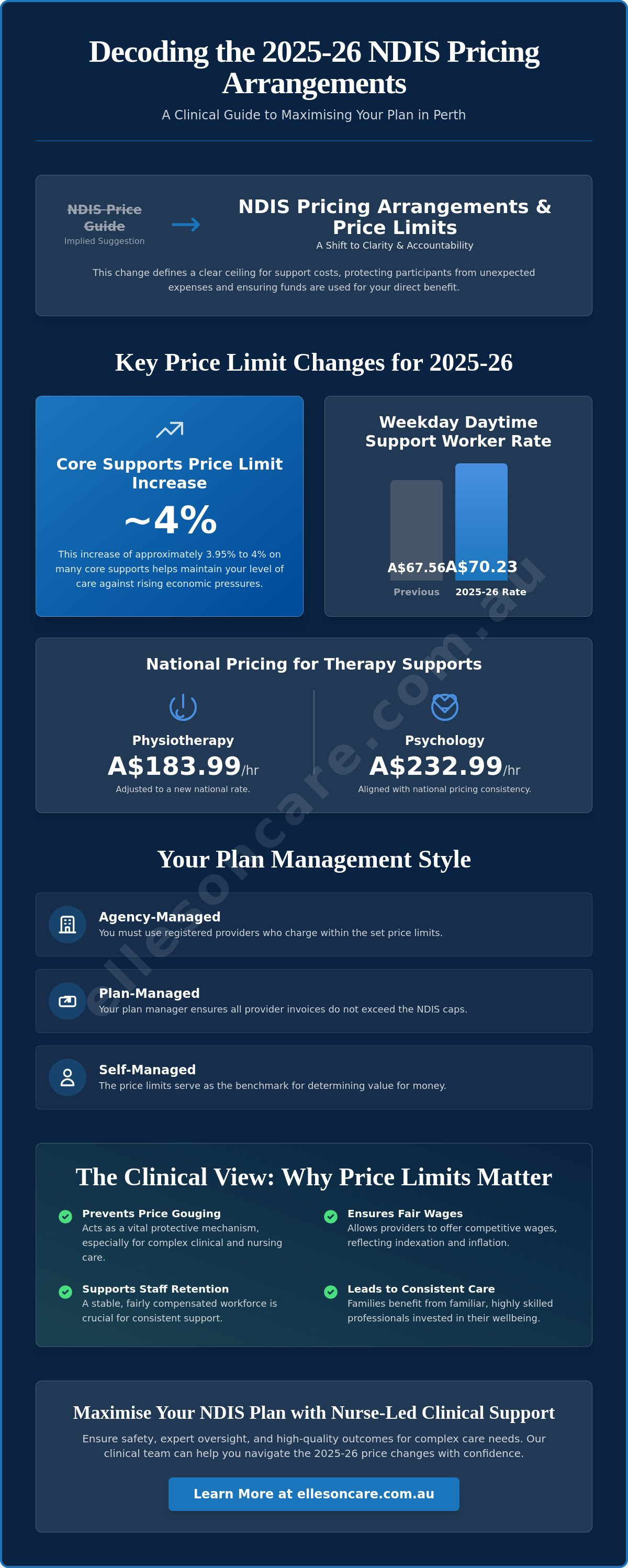
The document formerly known as the National Disability Insurance Scheme (NDIS) Price Guide has undergone a significant transformation. Now titled the NDIS Pricing Arrangements and Price Limits, it serves as the essential financial compass for participants across Western Australia. Each year, the National Disability Insurance Agency (NDIA) reviews these caps to ensure they reflect the current economic environment, including wage growth and the rising costs of delivering safe, evidence-based care. For families in Perth, the ndis price guide 2025 is more than just a list of costs; it's a structural guarantee that your funding is being used ethically and sustainably.
These annual updates are not arbitrary. They occur to account for inflation and the mandatory indexation of wages, ensuring that the people who provide your care are fairly compensated. This creates a more stable workforce, which is vital for participants who rely on consistent, high-quality clinical support. Understanding the ndis price guide 2025 helps you plan for the financial year with a sense of stability, knowing exactly how your budget translates into hours of support. Whether you are self-managed, plan-managed, or agency-managed, these limits provide a framework for your service agreements and protect your plan from being exhausted prematurely.
- Agency-Managed: You must use registered providers who charge within the set price limits.
- Plan-Managed: Your plan manager ensures that all invoices from your providers do not exceed the NDIS caps.
- Self-Managed: While you have more flexibility, the guide remains the benchmark for determining value for money and ensuring your funding lasts the full duration of your plan.
Why the Name Changed from 'Price Guide'
The shift in terminology from a "guide" to "arrangements and price limits" reflects a move towards greater transparency and accountability. While the word "guide" might imply a suggestion, "price limits" clearly define the ceiling for support costs. This clarity is particularly helpful for families in Perth when they are negotiating service agreements with new providers. It ensures that expectations are clear from the outset, reducing the risk of unexpected out-of-pocket expenses and ensuring that every dollar in your plan is utilised for your direct benefit.
The Clinical Perspective on Pricing
From a clinical standpoint, price limits function as a vital protective mechanism. They prevent price gouging, which is especially important for participants requiring complex clinical support or specialised nursing care. When pricing is fair and consistent, it supports the long-term sustainability of the WA disability sector. It allows providers to offer competitive wages, which is the primary driver for staff retention in a competitive labour market. For your family, this means more consistent care from familiar, highly skilled professionals who are emotionally invested in your well-being.
Key Updates and Price Limit Changes for 2025-26
The transition into the new financial year brings significant adjustments to how funding is allocated and spent. Effective from 1 July 2025, the updated NDIS Pricing Arrangements and Price Limits introduced a price limit increase of approximately 3.95% to 4% for many core supports. This adjustment is designed to help families maintain their level of care despite rising economic pressures. When reviewing your ndis price guide 2025 documentation, you will notice that the weekday daytime support worker rate has risen from A$67.56 to A$70.23 per hour. These changes ensure that the support structures you rely on daily remain viable and high-quality.
Significant shifts have also occurred within therapy supports. The NDIA has moved towards national pricing consistency, which has resulted in some rates decreasing while others have stabilised. For instance, physiotherapy price limits have been adjusted to a national rate of A$183.99 per hour, while psychology now sits at A$232.99 per hour. It's vital to monitor these shifts closely, as they directly impact how many hours of allied health support your budget can sustain. Managing these changes requires a steady hand and a clear understanding of your plan's goals. If you feel overwhelmed by these numbers, reaching out for professional clinical support can help you align your budget with your health priorities.
Support Worker Cost Model Updates
The NDIS calculates support worker costs using a complex model that accounts for the Fair Work Commission’s annual wage review. This ensures that the ndis price guide 2025 reflects the real-world cost of employing skilled professionals in Western Australia. For Perth agencies, these sustainable pricing levels are essential for maintaining a workforce that is well-trained and ethically supported. When providers are paid fairly, they can invest in better training and supervision, which leads to a safer and more dignified experience for the individuals they serve.
Therapy and Clinical Nursing Limits
Clinical nursing interventions remain a cornerstone of support for participants with complex health needs. The 2025-26 updates continue to provide specific caps for Registered Nurses and specialised clinical supports, ensuring that high-level medical oversight is accessible within the scheme. While some therapy rates, such as art and music therapy, saw reductions to A$156.16 per hour in late 2025, the limits for complex nursing care are designed to uphold rigorous clinical standards. Balancing these complex needs within the new price limits requires a methodical approach to plan management, ensuring that safety is never compromised for the sake of the budget.
- Support Coordination: Level 1 rates increased to A$80.06 per hour, while Level 2 and 3 remain steady at A$100.14 and A$190.54 respectively.
- Psychosocial Recovery Coaching: Weekday daytime rates have risen to A$105.43 per hour.
- Therapist Travel: Claims for labour costs are now capped at 50% of the relevant therapy support's hourly limit.
Navigating NDIS Support Categories: Where Your Funding Goes
Understanding how your plan is structured is the first step toward reclaiming a sense of control over your care journey. The ndis price guide 2025 divides funding into three primary pillars: Core, Capacity Building, and Capital Support. Each category serves a distinct purpose in your daily life, and knowing the difference helps you allocate resources where they are needed most. To find specific item codes for your service agreements, you should refer to the Official NDIS Pricing Arrangements and Price Limits support catalogue. This document acts as the master list, ensuring that every service, from personal care to specialised equipment, is correctly categorised and funded within the NDIA's established caps.
Core supports remain the most versatile part of your budget, allowing you to move funds between sub-categories like 'Assistance with Daily Life' and 'Social and Community Participation' as your needs fluctuate. This flexibility is essential for maintaining a high quality of life. For many participants, clinical nursing is also a vital component of the Capacity Building (Health and Wellbeing) category. This ensures that expert medical oversight is integrated into your long-term goals, rather than just being a reactive measure. By viewing your budget as a toolkit for independence, you can ensure that every A$ spent is a direct investment in your safety and comfort.
Core Supports: The Foundation of Daily Care
Core funding is designed to assist with the functional needs of everyday living. When searching for disability services Perth families often focus on this category for domestic help and personal care. It's important to remember that price limits vary significantly based on when support is delivered. For example, support worker rates for a public holiday or a Sunday are much higher than a standard weekday rate. Additionally, the 'Consumables' sub-category within Core is often overlooked; it covers everyday items related to your disability, and the ndis price guide 2025 provides clear boundaries on what can be claimed to prevent plan depletion.
Capacity Building: Investing in Your Future
While Core supports handle the "now," Capacity Building focuses on the "next." This category is where you find NDIS home care services that aim to improve your independence over time. It includes funding for training, skill development, and therapeutic interventions. For those with complex needs, Support Coordination is a critical Capacity Building line item. A skilled coordinator helps you manage these complex categories, ensuring you don't overspend in one area while neglecting another. They act as a professional bridge between the technical rules of the scheme and the practical reality of your clinical care requirements.
Practical Tips for Managing Your NDIS Budget in Perth
Managing an NDIS plan in Western Australia requires more than just tracking receipts; it involves a methodical review of your funding against the latest ndis price guide 2025 benchmarks. Because the Perth market has unique provider dynamics and geographical challenges, staying ahead of your spending is essential for maintaining consistent care. One of the most effective ways to ensure your budget remains healthy is to schedule regular check-ins with your Support Coordinator. These sessions allow you to compare your actual spending against the 2025-26 price limits, ensuring that no single support category is being exhausted too quickly.
A common oversight for many families is the failure to account for "hidden" costs that can quietly erode a budget. In WA, provider travel is a significant factor due to the sprawling nature of our suburbs. While the ndis price guide 2025 caps therapist travel labour at 50% of the hourly rate, these costs still add up over a twelve-month plan. You should also ensure that your service agreements clearly define charges for non-face-to-face support, such as clinical report writing or the development of specialised care plans. Establishing these boundaries early protects your funding for direct support hours.
Avoiding 'Price Shock' Mid-Plan
A common concern for families is the "burn rate," which is the speed at which your funding is spent relative to the time remaining in your plan. If your required clinical supports exceed the current NDIS price limits, you may find yourself facing a shortfall before your next review. To prevent this, we recommend a nurse-led audit of your clinical care hours. This professional review ensures that every hour of support is medically justified and accurately coded, which is vital when requesting plan variations or additional funding from the NDIA. If you are concerned about your current budget sustainability, you can enquire about our clinical support services to help align your care needs with your available funding.
The Role of Plan Management in 2025
For many Perth families, choosing a Plan Manager provides a necessary layer of protection and peace of mind. Plan Managers are experts in the technical updates of the Price Guide, ensuring that all provider invoices are compliant with the 2025-26 Pricing Arrangements and Price Limits. They act as a financial safeguard, identifying overcharges or incorrect item codes before they impact your plan. This allows you to focus on the human side of care, knowing that the administrative and regulatory requirements are being handled with professional precision. By ensuring your providers are paid accurately and on time, you also build stronger, more reliable relationships with your support team.
- Review Service Agreements: Ensure all agreements reflect the 1 July 2025 price updates.
- Monitor Travel Claims: Track how much of your budget is being used for provider travel versus direct care.
- Audit Care Hours: Use a clinical perspective to ensure your support hours are being used efficiently.
Choosing a Nurse-Led Provider to Maximise Your NDIS Plan
Selecting the right provider is a decision that balances financial pragmatism with the deeply personal need for safety and dignity. While many agencies operate within the standard limits of the ndis price guide 2025, a nurse-led model like Elleson Care offers a level of clinical oversight that transforms a budget into a comprehensive care strategy. With over 22 years of clinical experience, our team understands that complex care requires more than just filling hours; it requires an evidence-based approach that anticipates health needs before they become emergencies. This professional expertise ensures that your funding is utilised efficiently, prioritising high-impact clinical support that truly improves quality of life.
We believe that person-centred care must respect both your personal autonomy and your financial boundaries. By organising support around your unique goals, we ensure that every decision made aligns with your values and your budget. Our commitment to families in Western Australia is built on a foundation of integrity and steady, reliable presence. We don't just provide services; we partner with you to navigate the complexities of the scheme, ensuring that your loved one receives the highest standard of care without the stress of managing a fragmented support team. This holistic view of well-being is what defines our family-focused approach in Perth.
The Elleson Care Difference in Perth
Our approach to clinical nursing and specialised disability support is rooted in a deep respect for the individual. We help Perth families navigate the ndis price guide 2025 updates by providing clear, transparent communication about how changes affect their specific care plans. By removing the administrative burden and clinical uncertainty, we allow families to focus on their relationships rather than the bureaucracy of the NDIA. Families across WA often share how our compassionate expertise has provided them with a sense of stability they hadn't found elsewhere, highlighting the peace of mind that comes from having a steady, experienced partner by their side.
Next Steps: Reviewing Your Plan with Us
If you are looking for a provider that combines clinical authority with human warmth, we invite you to take the next step in your journey. You can book a consultation to discuss your specific 2025 NDIS budget requirements and explore how our nurse-led model can support your goals. We specialise in transitioning clients from hospital to home within the NDIS framework, ensuring that the return to a familiar environment is safe, disciplined, and fully supported. Joining the Elleson Care family means choosing a partner who is emotionally invested in your quality of life and technically proficient in the nuances of specialised care. We are here to provide the reliable, professional support your family deserves in Perth.
- Clinical Consultation: Discuss your 2025 funding and how to prioritise your health goals.
- Hospital Transition Support: Ensure a safe and structured move back to your Perth home.
- Ongoing Budget Oversight: Benefit from regular reviews to ensure your plan remains sustainable.
Empowering Your Care Journey in 2025
Understanding the shifts within the ndis price guide 2025 is the first step toward securing a stable and dignified future for your family. We've explored how the new national pricing standards for therapy and the indexation of support worker rates are designed to maintain the quality of care you receive in Western Australia. By categorising your funding effectively and conducting regular clinical audits of your budget, you can ensure that every dollar is utilised to its fullest potential. Your peace of mind matters. Managing these technical updates doesn't have to be a solitary burden; professional guidance can provide the clarity you need to move forward with confidence.
As a West Australian owned and operated provider led by Registered Nurses with over 22 years of clinical experience, we specialise in navigating complex care requirements with precision and heart. We're committed to upholding the highest evidence-based standards while respecting the unique needs of every family we serve. Secure your peace of mind; contact Elleson Care for expert NDIS support in Perth today. You deserve a partner who is both technically proficient and deeply invested in your well-being. Together, we can create a sustainable path that prioritises safety, independence, and personal comfort for the years ahead.
Frequently Asked Questions
What is the difference between the NDIS Price Guide and Pricing Arrangements?
The document formerly known as the NDIS Price Guide was renamed to the NDIS Pricing Arrangements and Price Limits to better reflect its role as a mandatory regulatory framework. While the old name suggested a set of suggestions, the current title clarifies that the NDIA sets firm price caps that providers must not exceed. This change ensures that every participant has a clear understanding of the maximum amount they should pay for their essential supports.
Will my NDIS funding increase automatically to cover the 2025 price limit changes?
The NDIA typically applies automatic indexation to the remaining funds in your plan to account for increases in price limits for core supports. This ensures that your ability to purchase hours of care isn't reduced when support worker wages rise. You don't usually need to request a plan review for these specific adjustments, but it's a good idea to check your "My NDIS" portal to confirm your budget has been updated correctly.
Can NDIS providers charge more than the price limit in 2025?
Registered providers are strictly prohibited from charging more than the caps set out in the NDIS Pricing Arrangements and Price Limits. For those who are self-managed, there is technically more flexibility to negotiate rates, but the NDIA still requires that all spending represents "value for money." Most families find that the established limits provide a safe benchmark that protects their funding from being depleted by overcharging.
How do I find the specific price limit for my support item in WA?
You can find specific rates by downloading the NDIS Support Catalogue, which is a detailed list provided by the NDIA in Excel or CSV format. This catalogue includes every support item code and the maximum price allowed in Western Australia for the current financial year. Because pricing can vary by state, ensuring you're looking at the WA-specific column is vital for accurate budget planning and service agreements.
What are 'non-face-to-face' support claims and how are they priced?
Non-face-to-face supports are essential tasks performed by your provider that don't involve direct contact, such as writing clinical reports or developing specialised care plans. These activities are charged at the same hourly rate as your standard support but must be clearly outlined and agreed upon in your service agreement. This transparency ensures that the administrative side of your clinical care is funded without surprising you with unexpected costs.
Does the NDIS Price Guide 2025 cover clinical nursing at home?
Yes, the ndis price guide 2025 includes specific line items for clinical nursing delivered by Registered Nurses, Enrolled Nurses, or Nurse Practitioners. These supports are fundamental for participants with complex health needs and are typically funded under the Capacity Building or Core categories. Having these specific caps ensures that high-level medical oversight remains accessible and affordable for families who require professional clinical intervention within their own homes.
How does provider travel affect my NDIS budget in Perth?
Providers are allowed to claim for the time they spend travelling to your location, but for therapy supports, this is capped at 50% of the hourly rate. In a geographically large city like Perth, these travel costs can accumulate quickly and impact your overall budget. It's important to discuss travel expectations with your providers early to ensure that enough funding remains for the direct clinical hours you need to achieve your goals.
What should I do if my NDIS plan doesn't have enough funding for the new rates?
If the automatic indexation of the ndis price guide 2025 doesn't cover your required support hours, you should contact the NDIA to request a plan reassessment or a "change of circumstances" review. Providing strong clinical evidence from your nurse-led support team can help demonstrate why your current funding is insufficient to meet your safety and care needs. Taking proactive steps ensures that your support remains consistent and your health isn't compromised by budget shortfalls.


