

What if your monthly statement was a source of clarity rather than a cause for concern? For many families in Western Australia, opening a care statement often feels like deciphering a foreign language, especially following the recent transition to the Support at Home program. You have likely felt the frustration of seeing substantial portions of your funding consumed by administrative layers rather than actual nursing or support services. Prioritising avoiding hidden costs in home care packages, or their modern Support at Home equivalents, is about more than just numbers; it's about ensuring your dignity and comfort remain the primary focus of every dollar spent.
We believe that transparency should be the foundation of any care relationship, yet we recognise how easy it is to feel overwhelmed by shifting regulations and complex fee structures. This guide will help you audit your budget to ensure your funding is directed toward genuine care rather than corporate overheads. We will explore how the 10% care management fee cap protects your quarterly budget, what the July 2026 government price caps mean for your provider choices, and how a clinical, nurse-led approach can help you maximise your actual hours of support.
Key Takeaways
- Understand how the transition to the Support at Home program has streamlined fee structures, including the mandatory 10% cap on care management.
- Learn practical strategies for avoiding hidden costs in home care packages by identifying unexplained sundry charges and third-party service markups.
- Discover how to conduct a monthly audit of your statement to reconcile the hours of support delivered against the hours charged to your budget.
- Evaluate providers based on clinical expertise rather than just the lowest fee to ensure your health needs are accurately and ethically met.
- Gain clarity on how local, nurse-led care management prioritises your dignity and maximises the actual hours of care you receive.
Understanding the Home Care Package Fee Structure in 2026
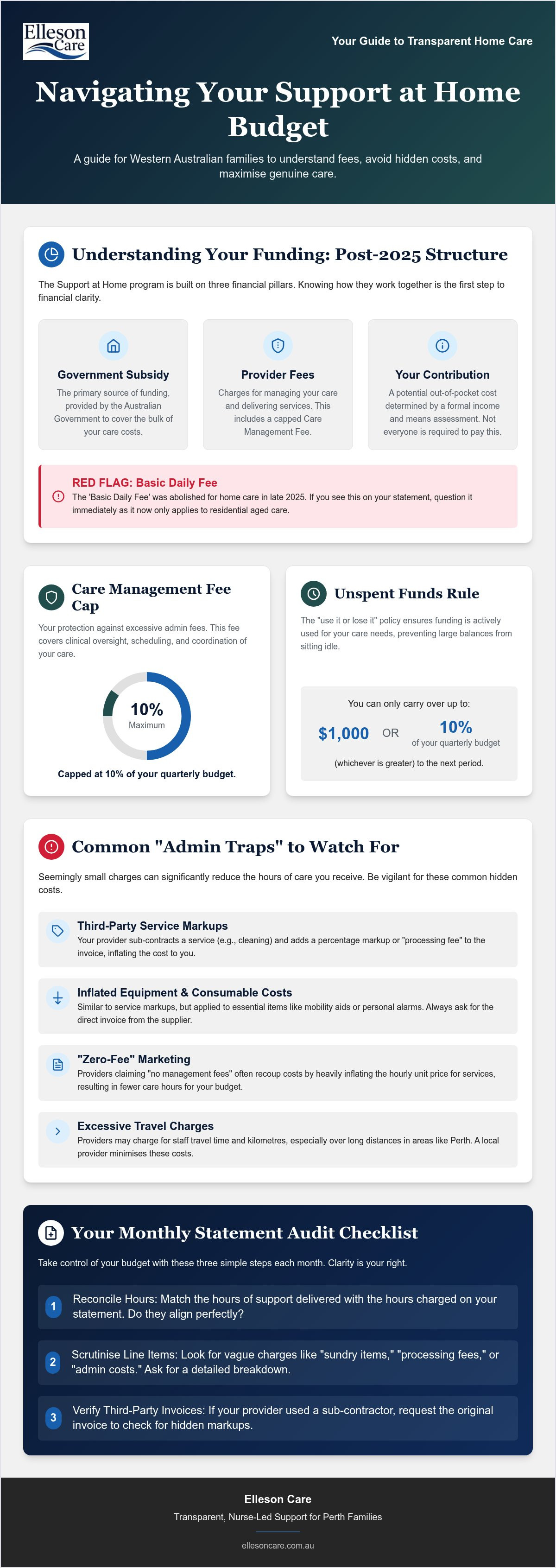
The landscape of Aged Care in Australia underwent a significant transformation on 1 November 2025. The shift from the old Home Care Package system to the Support at Home program was designed to bring clarity, yet many Perth families still find the fee structure opaque. Understanding the three primary pillars—the government subsidy, provider fees, and your own contribution—is the first step in avoiding hidden costs in home care packages. While the government provides the bulk of the funding, providers manage these funds, and your personal contribution is determined by a formal means assessment. It is vital to recognise that the "Basic Daily Fee," which was once a standard out-of-pocket cost for home care, was abolished in late 2025. Today, any such fee only applies to residential aged care settings, so seeing it on a home support statement is an immediate red flag.
Beware of "zero-fee" marketing. When a provider claims they charge no management fees, they must recoup their operational costs elsewhere. Often, this is achieved by significantly inflating the hourly unit price for services like domestic assistance or nursing. You might find that while you aren't paying a visible monthly fee, your total hours of care are drastically reduced because the "cost per hour" is well above the industry average.
The Support at Home Transition in WA
The 2026 regulations have moved away from the old Level 1 to 4 system. Instead, support is now based on a schedule of services with set prices. This standardisation aims to ensure that a person in Joondalup pays the same for a clinical service as someone in Fremantle. However, Western Australian families must remain vigilant. Although the government will introduce strict price caps on 1 July 2026, some providers may use the interim period to "pad" their margins through service markups. True value isn't found in the lowest headline rate, but in how much of your subsidy actually reaches the frontline staff who support you at home.
Fixed vs. Variable Costs in Your Budget
Your budget is split between fixed costs and variable service charges. Care management is now capped at 10% of your quarterly budget, providing a level of protection against the high administrative fees of the past. Variable costs include the actual hours of nursing, allied health assessments, and personal care you receive. Another critical change involves unspent funds. As of 2026, you can only carry over up to $1,000 or 10% of your quarterly budget to the next period. This "use it or lose it" approach means that accurate, nurse-led clinical assessments are essential to ensure your funding is utilised effectively for your health needs rather than sitting idle in a provider's account.
Common Hidden Costs and "Admin Traps" to Watch Out For
While the 2026 regulations have introduced more stringent oversight, certain "admin traps" continue to diminish the value of support for West Australians. One of the most frequent issues involves third-party service markups. If your provider sub-contracts a cleaning or gardening service, they might add a "processing fee" or a percentage markup on top of the contractor's invoice. This means you are paying more for the same service than if it were delivered directly. Similarly, "processing fees" on subsidised equipment, such as mobility aids or personal alarms, can quietly inflate the price of essential items. Ensuring you receive a direct invoice for these goods is a key part of avoiding hidden costs in home care packages.
Travel and "kilometre" charges are another area where costs can spiral, particularly in the sprawling Perth metropolitan area. Some providers charge for the time and distance a staff member travels to reach your home. If your provider is based in the northern suburbs but sends staff to Rockingham, these travel fees can consume a significant portion of your daily budget. Choosing a local provider with a clear policy on travel costs ensures that more of your funding stays where it belongs: on your actual care.
The Care Management Fee Explained
Under the Support at Home program, the care management fee is capped at 10%. However, the quality of this management varies wildly. You should expect this fee to cover clinical oversight from a Registered Nurse who monitors your health status and adjusts your support plan as your needs change. If you rarely hear from your coordinator or if your plan hasn't been reviewed in months, you may be paying for "management" that provides little actual value. High-tier providers prioritising transparent pricing models ensure that this fee translates into genuine clinical advocacy and safety.
Exit Fees and "Setup" Costs
In 2026, the legislative landscape in Western Australia has become much more protective of the consumer. Exit fees, which once acted as a financial barrier to switching providers, have been largely abolished or strictly limited. Despite this, some families still encounter "onboarding" or "initial assessment" fees. These are often presented as essential setup costs but can eat into your first month of funding before a single hour of care is delivered. Reviewing the official Home Care Package costs and fees can help you identify which charges are standard and which are unnecessary additions. Always ask for a detailed breakdown of what is included in an "assessment" to ensure you aren't paying for a generic administrative task under a clinical name.
How to Audit Your Monthly Home Care Statement
A diligent monthly audit is the most effective tool for avoiding hidden costs in home care packages and the new Support at Home budgets. Your statement should be a clear reflection of the care you received, not a source of confusion. To begin your audit, reconcile the hours of service delivered against the hours charged. Use a simple calendar or care log to track every visit. If your statement shows five hours of domestic assistance but your records show only four, you must raise this discrepancy immediately. Small errors, if left unaddressed, can compound over time and significantly deplete your available funds.
Next, scrutinise any entries labelled as "miscellaneous," "sundry," or "other." These vague descriptors often hide administrative markups that lack a clear clinical or practical justification. You should also verify the unit prices for different service types. Clinical nursing, delivered by a Registered Nurse, will naturally have a higher unit rate than domestic assistance or social support. However, these rates must remain consistent with your signed service agreement. Finally, ensure the government subsidy listed on your statement matches your current ACAT assessment level. You can verify the expected subsidy amounts by referring to the official government guide on Home Care Package fees.
Red Flags in Your Statement
Certain patterns on a statement should prompt an immediate conversation with your provider. Watch for multiple "coordination" entries related to a single service request. For instance, if you requested a one-off home maintenance task, you should not see several separate charges for "organising" that task. Inconsistent hourly rates are another concern. While weekend care in Perth often attracts higher rates due to penalty shifts, these increases should be clearly defined and predictable. A sudden, unexplained drop in your "available balance" without a corresponding increase in service hours is perhaps the most serious red flag, suggesting that administrative fees or backdated charges may have been applied without your knowledge.
Asking the Right Questions to Your Provider
When you identify a discrepancy, approaching your provider with specific, calm questions is essential. You might use a script such as: "Can you provide a breakdown of the third-party markup on this equipment?" or "Why does this coordination fee appear three times for one gardening request?" It is also your right to request a "ledger view" of your unspent funds. This provides a detailed history of every cent that has entered and exited your account. For a clearer understanding of what constitutes fair pricing, compare your statement against the Support at Home program benchmarks. This ensures your provider's charges align with the standards expected of ethical, transparent care in Western Australia.
Comparing Providers: Finding Value-for-Money in Perth
Selecting a provider based solely on the lowest headline fee is a common pitfall that can lead to unexpected financial strain. True value is measured by the quality and consistency of the care that actually reaches you, rather than the percentage taken for management. In Western Australia, many national providers operate with significant corporate overheads, which often results in higher unit prices for basic services to cover their administrative costs. Choosing a local, Perth-owned provider is a strategic move in avoiding hidden costs in home care packages, as local knowledge often translates to more efficient scheduling and reduced travel-related charges.
When comparing your options, it is essential to evaluate the qualifications of the staff managing your budget. You should determine whether you are paying for oversight from a junior coordinator or a Registered Nurse with extensive clinical experience. A nurse-led model provides a level of safety and foresight that administrative-heavy providers cannot match. By identifying health risks before they escalate, clinical experts ensure that your funding is used for preventative support rather than reactive, emergency measures.
The Clinical Advantage
Proactive nursing services represent a substantial "hidden saving" for families with complex health needs. Professional oversight in areas such as wound management and medication reviews can prevent hospital readmissions, which are both physically distressing and a significant drain on a care budget. When a Registered Nurse oversees your plan, they bring a level of clinical accuracy that ensures every service listed in your budget is necessary and effective. This advocacy-based approach protects your funds from being spent on generic supports that do not address your primary health goals.
Flexibility and Choice
The degree of flexibility a provider offers can also impact your long-term costs. You should ask whether you have the freedom to choose your own gardener or cleaner, or if you are restricted to a "preferred" list of subcontractors who may charge inflated rates. Some families find that involving themselves in the coordination of these domestic tasks helps keep management costs low. Whether you opt for a fully-managed service or a more collaborative arrangement, the provider should offer a transparent partnership that respects your right to choose who enters your home and how much they are paid.
To see how clinical expertise can protect your budget and improve your quality of life, explore our nurse-led care options today.
Elleson Care: Transparent, Nurse-Led Support for Perth Families
At Elleson Care, we believe that the transition to the Support at Home program should be a period of stability rather than stress. Our model is built on the principle of 100% transparent pricing, ensuring that every dollar of your government funding is accounted for and directed toward your wellbeing. By eliminating the layers of corporate management that often inflate service rates, we focus on avoiding hidden costs in home care packages through direct, nurse-led coordination. Our Registered Nurses bring over 22 years of clinical experience to every assessment, providing an authoritative yet gentle presence that ensures your clinical needs are met with absolute accuracy. This steady, reliable presence provides families with the peace of mind that their loved ones are in safe hands. We prioritise ethical standards above all else, ensuring that our clinical support remains both technically proficient and fundamentally kind.
The 2026 reforms bring new rules for unspent funds and service caps. Our team specialises in translating these regulations into practical, easy-to-follow care plans that maximise your hours of support. Our nurses don't just fill out paperwork. They use their decades of clinical background to advocate for you, ensuring that equipment processing fees or service markups never find their way into your budget. We believe that professional care is most effective when it is delivered with a human touch, prioritising your autonomy and personal dignity at every stage of the journey.
Why Our Perth Roots Matter
Being West Australian owned and operated is more than a point of pride; it's a practical advantage for the families we serve. Our local roots in Perth mean our team understands the specific geographic challenges of the metropolitan area, which allows us to minimise travel-related fees that often catch families by surprise. We don't view our clients as package numbers. Instead, we treat each individual with the dignity and professional respect they deserve, providing direct access to decision-makers who are deeply invested in the quality of life of our local community. Because we live and work in the same suburbs as our clients, our local knowledge of the WA health system is a significant asset. We can coordinate with local GPs and specialists more effectively than a national call centre ever could, ensuring a seamless experience for your family.
Start Your Transparent Care Journey
The complexities of the 2026 aged care reforms can feel daunting, but you don't have to manage them alone. We offer a complimentary review of your current monthly statement to help you identify any discrepancies or unexplained charges. This service is part of our commitment to helping families understand in-home aged care in Perth with complete transparency. If you feel that your current support plan is not delivering the value you expected, booking a consultation with our Registered Nursing team is the first step toward a more secure and ethical care partnership. We are here to provide the steady, disciplined, and compassionate expertise your family needs to navigate the future of home care with confidence.
Take Control of Your Support at Home Journey
Ensuring your funding is directed where it matters most requires a blend of vigilance and professional partnership. By understanding the new 2026 fee structures and conducting regular audits of your monthly statements, you can protect the integrity of your care budget. Prioritising avoiding hidden costs in home care packages and Support at Home plans isn't just about saving money; it's about ensuring your dignity and health are never compromised by administrative bloat or unnecessary markups.
We are here to provide the stability your family needs during this transition. As a West Australian owned and operated provider, we offer nurse-led clinical expertise and a steadfast commitment to no hidden third-party markups. We believe that every individual deserves a care plan that is as transparent as it is compassionate, managed by experts who prioritising your clinical safety above corporate overheads.
If you are ready to ensure your funding is working as hard as possible for your wellbeing, we invite you to Book a Transparent Care Consultation with our Perth Nursing Team. Together, we can build a foundation of trust that allows you to focus on what truly matters: living well and independently in your own home.
Frequently Asked Questions
What is a reasonable percentage for package management fees in 2026?
Care management fees are now strictly capped at 10% of your quarterly budget under the Support at Home program regulations. This cap was introduced to ensure that the majority of government funding is spent on actual care services rather than administrative overheads. When comparing providers, ensure that a lower management fee doesn't lead to higher hourly unit costs for nursing or cleaning services.
Can a provider charge me more than the My Aged Care price guide?
Until the introduction of mandatory government price caps on 1 July 2026, providers are permitted to set their own rates as long as they are published transparently. It's essential to compare your provider's pricing against the national averages found on the My Aged Care website. This comparison is a practical step in avoiding hidden costs in home care packages and ensures you aren't paying a premium for standard support.
Are exit fees still legal for Home Care Packages in Western Australia?
Exit fees have been largely abolished across Australia to protect your right to switch providers without financial penalty. If you decide to move to a more transparent or local Perth provider, you should not be charged a fee for closing your account or transferring your funds. Always check your service agreement, but modern legislative changes have made these charges a thing of the past for most participants.
How do I know if I am being overcharged for clinical nursing services?
You can identify overcharging by reconciling the hourly rate on your statement with the agreed schedule of fees in your contract. Clinical nursing, delivered by a Registered Nurse, should be billed at a professional rate that reflects their expertise without added "coordination" markups. If you notice unexplained fluctuations in these rates outside of standard weekend penalty shifts, you should request a detailed ledger from your provider.
What happens to my unspent funds if I switch to a more transparent provider?
Your unspent funds will be transferred to your new provider, though 2026 regulations now limit quarterly carry-overs to $1,000 or 10% of your budget, whichever is greater. The previous provider is required to reconcile your account and transfer the balance within a specific timeframe, usually 60 days. This ensures your accumulated funding remains available to support your ongoing health and independence goals.
Can I use my Home Care Package to pay for home modifications without a huge markup?
Yes, essential home modifications are covered, but you must be vigilant about third-party "processing fees" that some providers add to tradespeople's invoices. To ensure you are avoiding hidden costs in home care packages, ask for a direct breakdown of the contractor's quote. A transparent provider will facilitate these modifications without adding significant administrative margins to the cost of the work.
Is the Basic Daily Fee mandatory if I cannot afford it?
The Basic Daily Fee for in-home care was officially abolished on 1 November 2025 with the commencement of the Support at Home program. This fee now only applies to individuals living in residential aged care facilities. If you are receiving support in your own home, you cannot be charged a basic daily fee, regardless of your financial circumstances or income assessment results.
How does the new Support at Home program affect my existing budget?
The Support at Home program has transitioned the system from broad package levels to a more transparent, service-based model. For those who were already receiving care before the change, the "No Worse Off" principle ensures your funding levels remain protected. This new structure makes it easier to track exactly how your budget is being utilised for specific clinical and domestic supports each month.


