

What if your NDIS plan could help you build skills and make choices, as well as provide day-to-day support? If you’ve searched for “capacity building supports NDIS explained”, you may be trying to understand what this funding is for and how it connects with your goals.
NDIS terms and budget categories can be difficult to interpret, especially when capacity building, Core and Capital supports seem to overlap. It’s understandable to wonder which supports may fit your circumstances and what your plan allows.
This guide explains capacity building in plain language, with examples of supports that may help develop skills, confidence and independence. You’ll also learn how it differs from everyday Core assistance and Capital funding for equipment or modifications, what to check in your plan, and where to seek individual guidance. Support options depend on your stated goals, plan funding and applicable NDIS rules, so examples aren’t a guarantee that a particular service will be funded.
Key Takeaways
- Understand what capacity building is designed to develop and how it may relate to your NDIS goals.
- Learn how to distinguish capacity building from Core and Capital supports when reviewing your plan.
- Use “capacity building supports NDIS explained” as a starting point for understanding plan terminology, then check the current category names and funding arrangements in your plan.
- Follow a practical sequence to connect your goals with possible supports and confirm whether they suit your plan and circumstances.
- Use a person-centred checklist to consider provider experience, communication, safety and continuity when exploring support options in Perth.
What are NDIS capacity building supports, and what are they for?
NDIS plan language can be difficult to interpret, particularly when category names don’t explain what a support is intended to do. NDIS capacity building supports are intended to help a participant develop skills, independence or capacity in areas connected with their goals. They focus on building a person’s abilities, rather than promising a particular result.
That is the central idea behind “capacity building supports NDIS explained”. The term describes a broad purpose, not a guarantee that a particular service will be included in or paid for by every plan. Suitability depends on the participant’s circumstances, stated goals, plan wording and current funding arrangements. For background on the scheme, see this overview of the National Disability Insurance Scheme.
How does capacity building relate to NDIS goals?
Goals can help participants, families and supporters discuss what a support might help develop. For example, a goal about managing daily routines could prompt a conversation about practising everyday tasks. A goal about taking part in local activities might lead to exploring ways to build confidence in community settings. Similarly, a goal focused on emotional wellbeing or communication might lead to exploring counselling and mental health supports, such as those outlined at wjwcounselling.org.
These are illustrative examples, not confirmation that a particular service or activity is funded. Consider the connection between a proposed support and a goal alongside the participant’s plan and individual circumstances. A goal helps frame the discussion, but it doesn’t establish funding eligibility on its own.
Who may use capacity building supports?
Participants may explore capacity building options that relate to their needs and plan. Families and carers may also want clearer explanations to help them understand plan information or take part in conversations about support. The participant’s preferences and involvement should remain central.
Choice and dignity matter throughout these discussions. Participants should have the opportunity to express what is important to them, how they prefer to communicate and what kind of assistance feels appropriate. Support may look different from one person to another, even when goals appear similar. The practical question is whether an option fits the person, their goals and current plan arrangements, not simply whether it carries a capacity building label.
Which NDIS capacity building categories may appear in a plan?
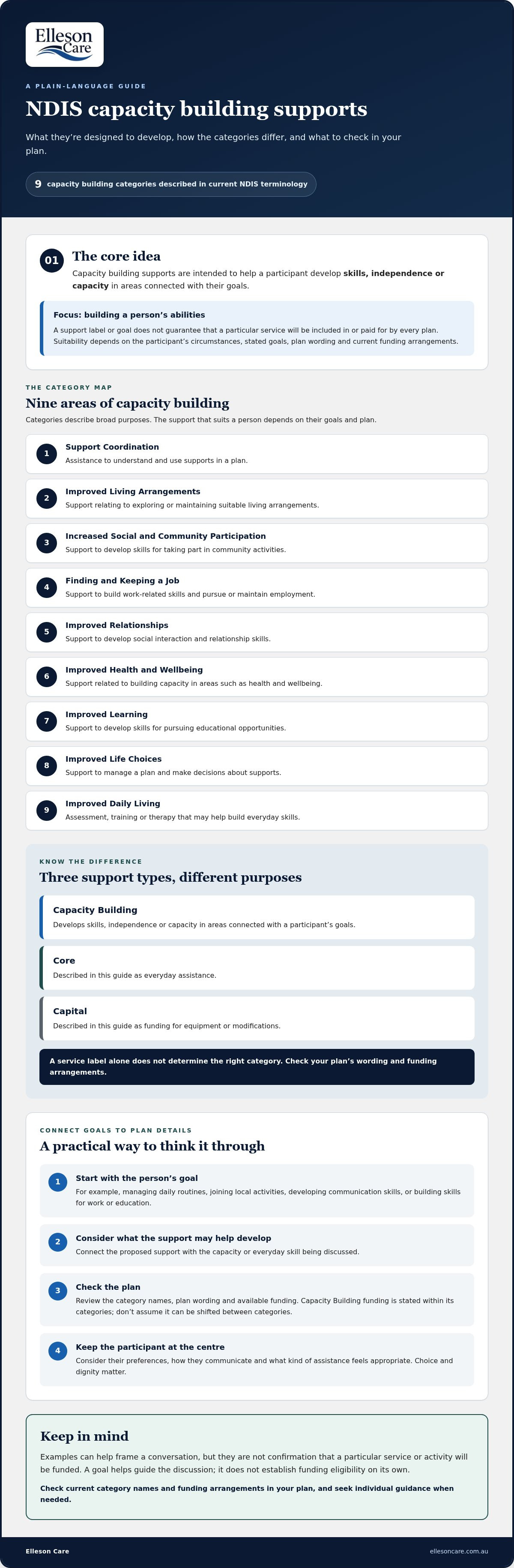
Capacity building funding is organised into categories that describe different areas of support. Current NDIS terminology includes nine categories, covering support coordination, living arrangements, social and community participation, employment, relationships, health and wellbeing, learning, plan management and daily living. The Official NDIS guide to capacity building provides current explanations and examples.
In plain language, the categories are:
- Support Coordination: assistance to understand and use supports in a plan.
- Improved Living Arrangements: support relating to exploring or maintaining suitable living arrangements.
- Increased Social and Community Participation: support to develop skills for taking part in community activities.
- Finding and Keeping a Job: support to build work-related skills and pursue or maintain employment.
- Improved Relationships: support to develop social interaction and relationship skills.
- Improved Health and Wellbeing: support related to building capacity in areas such as health and wellbeing.
- Improved Learning: support to develop skills for pursuing educational opportunities.
- Improved Life Choices: support to manage a plan and make decisions about supports.
- Improved Daily Living: assessment, training or therapy that may help build everyday skills.
These category names describe broad purposes, not a promise that a particular service is funded. Capacity Building funding is stated within its categories, so check the wording and available funding in your own plan rather than assuming it can be shifted between categories.
What kinds of goals can capacity building support address?
Goals may relate to organising a daily routine, developing communication skills for relationships, building confidence to join community activities, strengthening skills for work or education, or practising tasks that support greater independence. In areas involving interpersonal dynamics or emotional health, services like Benessere Marriage and Family Therapy, Inc illustrate how tailored psychotherapy can support individuals and families navigating relationship challenges. These examples show how a goal can frame a discussion about capacity, but not every goal or support will suit every participant or plan.
Are therapy and everyday support both capacity building?
Not automatically. A service label alone doesn’t determine its funding category. Therapy may focus on developing a particular skill, while practical assistance may help with an everyday task. How either is treated depends on the plan, the support’s purpose and current NDIS arrangements. Check the plan and seek individual guidance from the NDIA, a planner or another appropriate adviser if you’re unsure. You can also explore Elleson Care’s NDIS support services in Perth as one provider option, while confirming suitability and funding separately.
Capacity building, Core and Capital supports: what is the difference?
Understanding the purpose of each budget can make an NDIS plan easier to interpret. In brief, capacity building is about developing skills or independence, Core supports help with everyday activities and participation, and Capital supports are for specific equipment, home modifications or other approved capital items. These funding purposes differ, even when supports seem related.
| Support type | Broad purpose | Illustrative example |
|---|---|---|
| Capacity Building | Develop skills, independence or capacity related to a participant’s goals. | Structured support to practise a skill or build confidence. The example is illustrative, not confirmation of funding. |
| Core | Assist with everyday activities, consumables, transport or social and community participation, as set out in the plan. | Practical help with an everyday activity or participating in the community. |
| Capital | Fund approved higher-cost items or modifications, such as assistive technology or changes to a home. | An approved piece of equipment or home modification identified in the plan. |
This is a broad comparison, not a way to decide funding from a service name alone. “Capacity building supports NDIS explained” points to the purpose of that budget, but an individual support must still fit the participant’s plan and current NDIS rules. Funding is generally not flexible between the main budget types, and Capacity Building funding is stated within its categories.
Can one support relate to more than one funding purpose?
Potentially. Similar-looking assistance can serve different purposes depending on what is provided and why. For instance, help with a daily task might be practical assistance on one occasion, while another support may focus on developing the participant’s skills to do that task. This example doesn’t assign either support to a funding category. Check the plan wording and current NDIS guidance before making decisions.
Does unused capacity building funding roll over?
Don’t assume unused funding will roll over, remain available or move between categories. The answer can depend on the participant’s plan and applicable funding arrangements, so a general rule may not reflect an individual situation. Review the plan for any funding periods or stated conditions, then confirm what applies with the NDIA, a planner or another appropriate contact.
How can you connect your NDIS plan to capacity building supports?
A clear process can help you move from broad goals to informed questions about possible supports. Review your goals, check the relevant wording and funding in your current plan, identify what’s unclear, then discuss suitability and service arrangements with an appropriate contact or provider. This process can guide a discussion, but it doesn’t guarantee funding or approval.
If you’ve been searching for “capacity building supports NDIS explained”, use your plan as the reference point. A service name alone isn’t enough to establish that it fits a particular category or is covered by your funding.
- Start with your goals. Note which goals you’d like to work towards and the skills or capacity you hope to develop.
- Check your plan. Look for relevant stated supports, category information, funding arrangements and any conditions.
- Record what’s unclear. Write down questions about how a proposed support relates to your goals and whether it appears consistent with your plan.
- Confirm suitability. Ask an appropriate plan contact or potential provider about the support, delivery arrangements and funding before it begins.
What should you check in your plan first?
Look for the goals relevant to the support you’re considering, along with stated support information and any conditions or funding details in your current plan. If the wording is unclear, note the specific question rather than assuming a service is eligible because of its name. Check current NDIA information or ask your planner, support coordinator or another appropriate plan contact to clarify what applies to your circumstances.
What questions can you ask a potential provider?
Ask how the proposed support could relate to your goals and preferences, and what the service would involve. You might also ask about staff experience, communication that works for you, how safety is considered and how you’ll review whether the support remains suitable. Clarify practical service arrangements and confirm funding suitability before support starts. These questions can help you make an informed choice without replacing NDIA or planner guidance.
If you’re considering NDIS support services in Perth, you can discuss your support needs with Elleson Care. Check service suitability and funding against your plan and individual circumstances.
Finding person-centred NDIS capacity building support in Perth
Choosing a provider is about more than finding a service with a relevant name. A good fit should respect the participant’s choices, communication needs and stated goals, while giving them a meaningful role in decisions about their support. If you’re looking up “capacity building supports NDIS explained”, remember that a provider’s service information can help you understand what it offers, but doesn’t determine whether the support is funded under your plan.
What does person-centred capacity building look like in practice?
Person-centred support starts with the individual: their strengths, preferences, routines and desired outcomes. For example, community access might take account of how a participant prefers to communicate and take part. Assistance with daily living could reflect the participant’s choices and the skills they want to practise. These are illustrative possibilities only. They don’t confirm funding eligibility or guarantee progress.
Before choosing a provider, consider asking:
- Relevant experience: Has the provider worked with people whose support needs or goals are similar?
- Support approach: How will the participant’s preferences, strengths and communication needs shape the support?
- Safety: How will the provider discuss and respond to the participant’s safety needs?
- Continuity: How will the provider communicate about changes and review whether the support remains suitable?
When should you ask for more guidance?
Seek clarification if you’re unsure how a plan describes a support, what its purpose is or whether it may be funded under the participant’s current arrangements. A provider can explain its services and discuss whether they appear to align with the participant’s goals. Direct questions about NDIS eligibility, plan decisions or funding interpretation to the NDIA, a planner or another appropriate plan contact.
Elleson Care is a West Australian owned and operated provider of NDIS and clinical support services in Perth. Its NDIS supports include community participation, personal care and domestic assistance, and its team is led by registered nurses with more than 22 years of experience. Whether a service is suitable or funded depends on the participant’s plan, goals and circumstances.
If you’d like to explore the service side, you can discuss NDIS support options with Elleson Care. For guidance on plan wording or funding decisions, check with the NDIA or an appropriate plan contact.
Take the next step with confidence
Understanding capacity building supports NDIS explained starts with recognising their purpose: they may help develop skills or independence related to a participant’s goals. Core and Capital supports serve different purposes, and a service name alone doesn’t confirm how it can be funded. Review the current plan wording and funding arrangements, then seek clarification if anything is unclear.
Choosing support should also reflect the participant’s preferences, communication needs and circumstances. Elleson Care is a West Australian owned and operated provider serving Perth, with NDIS support that includes community participation, personal care and domestic assistance. Its team is led by registered nurses with more than 22 years of experience. Whether a particular service suits a participant or can be funded depends on their plan and individual situation.
To discuss available services, explore NDIS support services with Elleson Care. For questions about eligibility, plan decisions or funding, check with the NDIA or an appropriate plan contact. Take the process one step at a time, keeping the participant’s goals and choices at the centre.
Frequently Asked Questions
What are capacity building supports in the NDIS?
Capacity building supports are intended to help a participant develop skills, independence or capacity in areas connected with their goals. The phrase “capacity building supports NDIS explained” describes this general purpose, not confirmation that a particular service is included in a plan. Check your current plan wording and official NDIS information, and ask an appropriate plan contact if you’re unsure how a support or funding arrangement applies to your circumstances.
What are examples of NDIS capacity building supports?
Examples may relate to developing daily living skills, relationships, learning, work, health or community participation, depending on the participant’s goals and plan. Therapy or mentoring may be relevant in some circumstances, but a service name alone doesn’t confirm its funding category or eligibility. Before choosing support, consider its intended outcomes, check your plan and verify the current NDIS guidance that applies to your situation.
How is capacity building different from Core supports?
Capacity building generally focuses on developing skills or capacity, while Core supports generally relate to everyday assistance or participation. The purpose of a support matters: similar-looking services could be treated differently depending on what’s provided and the participant’s plan. Check current NDIS descriptions and your own plan wording rather than assuming a support’s funding category from its service name alone.
Can I choose my own capacity building provider?
Provider choice depends on your circumstances, plan arrangements and applicable NDIS requirements. Before support begins, ask whether the provider can deliver what you need, how the support could relate to your goals and what service arrangements apply. Check funding suitability against your plan and current NDIS guidance. A provider can explain its services, but can’t guarantee that a particular support will be funded.
How do I know whether a support is included in my NDIS plan?
Review your current plan, including its goals, stated support information and any conditions. If the category or funding arrangement isn’t clear, ask your plan contact or seek clarification through an appropriate NDIS channel. Don’t rely only on a provider’s service description to determine whether a support is included. NDIS terminology and guidance can change, so confirm current information before making decisions.
Can capacity building supports help me become more independent?
They may help you develop skills or confidence connected with personal goals, which could support greater independence over time. Outcomes vary according to the participant, the support and how well it suits their circumstances. Before starting, discuss what matters to you, the practical outcomes you’d like to work towards and how you’ll review the support. No particular result should be treated as guaranteed.
Are NDIS capacity building supports available in Perth?
People in Perth can explore support options with providers serving the local area, but availability and suitability depend on individual needs and provider arrangements. Ask about service location, staff experience and how the support may relate to your goals, then check funding against your plan. Elleson Care provides NDIS support services in Perth. Contact the provider to discuss whether its current services may suit your circumstances.


