

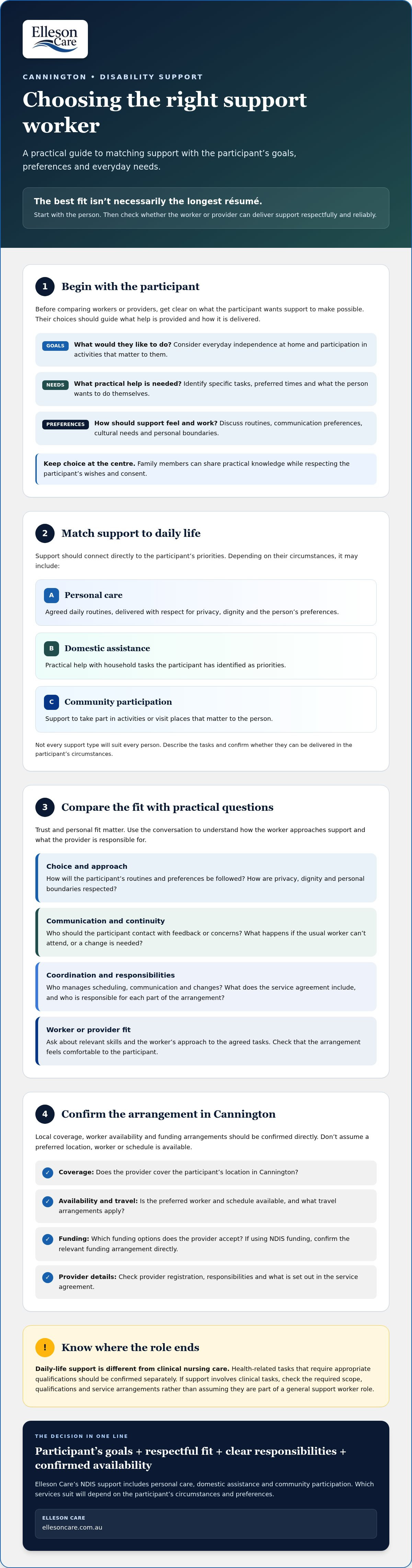
The right disability support worker in Cannington isn’t necessarily the person with the longest résumé. Start with the participant’s goals, preferences and support needs, then consider which worker or provider can meet them respectfully and reliably.
Trust and personal fit matter, but it can be difficult to assess a worker’s experience or understand what a provider is responsible for. Support should reflect the participant’s choices, not simply fit a standard routine.
This guide explains how to clarify support needs, compare providers and ask useful questions before making an arrangement. You’ll learn what to discuss about a worker’s skills and approach, how to confirm availability in Cannington, and what to check about funding, provider registration and responsibilities. Elleson Care’s NDIS support includes personal care, domestic assistance and community participation. Which services suit will depend on the participant’s circumstances. A clear process can help families make an informed choice and keep the participant’s goals at the centre.
Key Takeaways
- Identify the participant’s everyday support needs, goals and preferred routines before comparing workers or providers.
- Ask practical questions about choice, continuity, communication and service scope when assessing a disability support worker in Cannington.
- Clarify who coordinates support and how changes, feedback and communication will be managed.
- Before arranging support, confirm Cannington coverage, travel arrangements, worker availability and which funding options the provider accepts.
- Consider whether personal care, domestic assistance or community participation suits the participant’s circumstances and preferences.
Choosing a disability support worker in Cannington
Finding support is about more than matching a list of tasks. Trust, choice and a comfortable working relationship matter, especially when support is part of someone’s daily routine. A disability support worker in Cannington may assist with practical activities, but the arrangement should reflect the participant’s needs, preferences and goals.
A disability support worker provides practical assistance with daily life and participation. Clinical nursing care involves health-related tasks that require appropriate qualifications and should be confirmed separately. A worker may be engaged individually, with the participant or family coordinating arrangements, or support may be organised through a provider. Ask who manages scheduling, communication, changes and continuity, and check what the service agreement includes. Families considering support funded through the National Disability Insurance Scheme (NDIS) should also confirm which funding arrangements a provider accepts.
What support can a disability support worker provide?
Support should connect directly to what the participant wants or needs help with. Depending on the arrangement, it may include:
- Personal care: assistance with agreed daily routines, delivered in a way that respects privacy, dignity and the person’s preferences.
- Domestic assistance: practical help with household tasks the participant has identified as priorities.
- Community participation: support to take part in activities or visit places that matter to the person.
Not every support type will suit every person. Describe the tasks and ask the worker or provider to confirm whether they can deliver them in the participant’s circumstances. If support involves clinical tasks, check the required scope, qualifications and service arrangements rather than assuming they are part of a general support worker role.
Why a good personal fit matters in Cannington
Respectful communication and reliability can make support feel more predictable. Before agreeing to an arrangement, discuss routines, communication preferences, cultural needs and personal boundaries. A participant may, for example, prefer an explanation before receiving assistance or want tasks done in a particular sequence. Discussing these preferences helps assess whether a worker’s approach feels suitable.
Ask how continuity is handled if the usual worker can’t attend, and how the participant can raise concerns or request a change. Confirm directly whether the provider covers the participant’s location in Cannington and whether the preferred worker and schedule are available. Local availability shouldn’t be assumed. The participant’s comfort and choice should guide the decision.
Match disability support in Cannington to personal goals and daily life
Before discussing workers or schedules, clarify what the participant wants support to make possible. That might mean managing a morning routine with more independence, keeping the home comfortable or taking part in a regular community activity. Start with the person’s priorities rather than a standard list of services, because the same assistance won’t suit everyone.
Good disability support is shaped around the person, not fitted to a standard package. Wherever possible, the participant should lead decisions about what help feels appropriate and how it is delivered. Family members can contribute practical knowledge, while respecting the participant’s wishes and consent.
Start with the support goals that matter to the participant
Ask what the person would like to do more independently at home and in the community. Separate immediate daily assistance from longer-term participation goals. For instance, someone may need help with a morning routine while also working towards visiting a local library or joining an activity. These are prompts, not assumptions about what any participant should want.
Turn each priority into practical details to discuss with a provider: the task, how often support may be needed, preferred times and what the participant would like to do themselves. This helps define the role and assess whether the arrangement supports the person’s goals without taking over tasks unnecessarily.
Consider personal care, household tasks and community participation
Depending on the participant’s circumstances, support may involve personal care, domestic assistance or community access. Discuss what each activity means in practice. Household support might focus on particular tasks, while community participation could involve assistance to attend an activity the participant has chosen.
- Routines: Which times or sequences help the person feel comfortable?
- Communication: How should a worker share information, offer choices and check understanding?
- Continuity: How important is a familiar worker, and what should happen if plans change?
NDIS plan funding and eligibility for particular supports depend on individual circumstances. Check current NDIS guidance and discuss the participant’s plan and funding arrangements with the relevant contact and prospective provider before making commitments. The NDIS Quality and Safeguards Commission is an official source of information about quality and safety in NDIS services.
Families considering Elleson Care can discuss the participant’s goals to help determine whether its NDIS supports, including personal care, domestic assistance, and social and community participation, may suit their circumstances. See Elleson Care’s NDIS support and confirm directly which services and funding arrangements are relevant.
Compare disability support workers and providers using practical questions
Assess a disability support worker in Cannington by how their approach fits the participant’s needs, not by a job title or profile alone. Comparing an individual worker with a provider-led arrangement can also clarify who handles coordination and what the participant or family may need to manage.
| What to compare | Questions to ask |
|---|---|
| Choice | How much input does the participant have in meeting or choosing the worker? Can they explain their preferences or request a change? |
| Continuity | How are absences or worker changes managed? Can the arrangement support consistency where possible? |
| Service scope | Which specific tasks can the worker or provider deliver, and what falls outside the agreed support? |
| Communication | Who is the main contact for updates, feedback, concerns and changes to arrangements? |
| Local availability | Is support available at the participant’s location in Cannington, and do the proposed times and travel arrangements suit? |
With an individual worker, the participant or family may be more directly involved in agreeing on tasks, schedules and communication. A provider-led arrangement may have a separate coordination contact, so clarify what the provider manages and what remains the participant’s responsibility. Don’t assume either arrangement automatically offers more choice or continuity. Ask how it works in practice.
Questions to ask before choosing a support arrangement
Ask how the proposed support connects to the participant’s goals and whether the requested tasks fall within the worker’s or provider’s service scope. Find out how workers are introduced, how a suitable match is considered and what happens if the arrangement isn’t working. Clarify how schedule changes are communicated and how feedback or concerns can be raised and followed up.
The Australian Government’s guide to finding and choosing a provider offers a useful reference. Use it alongside questions specific to the participant’s circumstances.
Check experience, boundaries and communication
Ask about experience with the tasks and communication approach the participant needs. A diagnosis alone doesn’t establish whether a worker is a good fit. The person’s preferences, consent and comfort matter too. Agree on privacy, decision-making and personal boundaries before support begins, including how the worker should offer assistance and respect a decision to decline it.
If a requested task is clinical, ask whether it needs a separate nursing assessment or delivery, and confirm who can provide it. General disability support experience doesn’t confirm that a worker is qualified or able to perform clinical tasks.
Arrange disability support in Cannington: availability, funding and first steps
Once the participant’s priorities are clear, check the practical details before agreeing to support. This sequence can help keep discussions focused and avoid assumptions about location, scheduling or funding.
- Define the support needed: Note the tasks, preferred routine and outcomes the participant wants support to achieve.
- Check location coverage: Ask whether the provider currently supports people in Cannington and whether travel conditions apply.
- Discuss funding: Explain the participant’s funding arrangement and confirm whether the provider can work with it.
- Agree on service details: Review the supports, schedule, responsibilities and communication arrangements before services begin.
Confirm Cannington coverage and service availability
Contact providers directly to check whether they currently support participants in Cannington. A general service description doesn’t confirm local coverage or that a suitable worker is available for a particular support need.
Be specific about preferred days and times, the type of assistance required and where it will take place. Ask whether travel arrangements affect how support is delivered and what the provider can offer if a worker or schedule changes. Confirm the details for the participant’s circumstances rather than assuming local response times or availability.
Clarify funding, service agreements and next steps
Before services begin, discuss how the participant’s plan is managed and whether the proposed support and provider arrangements fit the available funding. NDIS funding and rules depend on individual circumstances, so check current guidance and confirm details with the relevant plan contact, plan manager or provider. Ask the provider to clarify its registration status if that matters to the participant’s funding arrangement.
Read the service agreement carefully. Check that it describes the agreed supports, each party’s responsibilities, how communication and schedule changes will be handled, and any cancellation terms. Raise anything unclear before signing and keep a copy for reference. If broader help understanding an NDIS plan would be useful, a support coordinator may be able to discuss plan navigation. Confirm what assistance is available in the participant’s situation.
If you’re considering Elleson Care, you can discuss disability support needs and goals and ask directly about Cannington coverage, service availability and funding arrangements. This can help establish whether the available support aligns with the participant’s preferences before deciding on next steps.
How Elleson Care can discuss disability support in Cannington
Once the participant’s priorities and questions are clear, families can consider whether a provider’s services and approach may suit. Elleson Care is a West Australian-owned provider offering person-centred NDIS support, aged care and clinical services. Its disability support includes personal care, domestic assistance, and social and community participation. The right combination depends on the participant’s needs and preferences.
A person-centred approach with broader care experience
A conversation about support can begin with what the participant wants to achieve, what assistance they prefer and how they would like it incorporated into daily life. They may want practical help with a household routine or support to participate in community activities. Sharing these priorities helps establish whether the service scope matches the goals, rather than assuming every available support is appropriate.
Elleson Care’s team is led by registered nurses with over 22 years of experience. That background may be relevant if the participant also has clinical support needs, but it doesn’t mean every support worker is a nurse or that clinical care is needed for every arrangement. Ask which professional is responsible for clinical requirements and confirm separately whether a specific task can be assessed and delivered within the service’s scope.
Discuss whether the service may suit your circumstances
Before deciding whether Elleson Care may be suitable for a disability support worker in Cannington, explain the participant’s goals, preferred support arrangements and any relevant clinical requirements. Ask which supports can be provided in their circumstances, who will deliver them and how the agreed approach will respect the participant’s choices and boundaries.
Confirm current service availability and travel coverage in Cannington directly. Discuss preferred days and times, funding arrangements and service agreement details before proceeding. Where relevant to the participant’s plan, check provider registration status and accepted funding arrangements with the provider.
These questions can help families assess fit without feeling pressured to decide immediately. Elleson Care can discuss the participant’s support needs and clarify whether its services may align with them.
Take the next step towards support that fits
Choosing a disability support worker in Cannington starts with the participant’s goals, routines and preferences. Use those priorities to compare worker and provider arrangements, then clarify who coordinates support, how communication works and what happens if plans change.
Before services begin, check that the requested support is within the provider’s scope, that Cannington coverage and availability suit your needs, and that the funding arrangement is understood. These conversations can help families make a considered choice while keeping the participant’s voice central.
Elleson Care is a West Australian-owned provider with a team led by registered nurses with over 22 years of experience. Its NDIS support includes personal care, domestic assistance, and social and community participation. As the right services depend on each person’s circumstances, discuss needs and confirm local availability directly.
Contact Elleson Care to discuss your support needs and find out whether its services may suit your circumstances in Cannington.
Frequently Asked Questions
How do I find a disability support worker in Cannington?
Start by identifying the support tasks, routines and goals that matter to the participant, then contact providers or workers to compare arrangements. Ask whether they currently support people in Cannington, whether the requested tasks are within their service scope, and whether preferred days and times are available. In Perth, check funding arrangements and coordination responsibilities before agreeing to services, and involve the participant in decisions wherever possible.
What should I ask a disability support worker before choosing them?
Ask about their experience with the specific support tasks, how they communicate and respect privacy, and how they’ll support the participant’s choices and boundaries. Clarify which tasks are included, who handles scheduling and what happens if the worker is unavailable or the arrangement needs to change. If clinical tasks are involved, confirm separately whether they require assessment or delivery by an appropriately qualified health professional.
Can an NDIS support worker help with personal care and community access?
NDIS support may include personal care and assistance with social or community participation, depending on the participant’s needs, plan and service arrangement. Be specific about the help required, such as assistance with a daily routine or support to attend a chosen community activity. Confirm which tasks the provider can deliver and discuss whether the supports fit the participant’s funding and circumstances before services begin.
How do I know whether an individual worker or a provider is right for me?
Consider how much coordination the participant or family wants to manage. With an individual worker, you may need to agree directly on schedules, tasks and communication. A provider may have its own coordination arrangements, so ask what it manages and what remains your responsibility. Compare choice, continuity, service scope, feedback processes and local availability. The best fit depends on the participant’s preferences and support needs.
Does Elleson Care provide disability support in Cannington?
Elleson Care provides NDIS support in Perth, including personal care, domestic assistance, and social and community participation. Cannington coverage, travel arrangements and worker availability need to be confirmed directly; they can’t be assumed from general service information. Contact Elleson Care with the participant’s support needs and preferred arrangements, and ask which services may be available and whether the funding arrangement is accepted.
Can NDIS funding pay for a disability support worker?
NDIS funding may cover disability support when it aligns with the participant’s plan and individual circumstances. Funding eligibility and arrangements can vary, so check current rules and discuss the proposed support with the participant’s plan contact, plan manager or provider before committing. Confirm how the service will be arranged and whether the provider accepts the participant’s funding management type. Don’t assume every support task is funded.
What happens if my support worker is unavailable or not the right fit?
Ask in advance how absences, schedule changes and requests for a different worker are handled. Find out who to contact, how much notice is normally provided when plans change, and whether an alternative arrangement may be available. If the fit doesn’t feel right, explain the concern and discuss adjustments or a change with the worker or provider. Keep the participant involved and agree on next steps that respect their preferences.


