

Supporting someone you love shouldn’t mean carrying every part of their care alone. If you’re searching for carer support services Perth, it can be hard to distinguish services designed for you as a carer from practical help for the person receiving care. It’s also understandable if your own wellbeing has slipped down the list while you balance appointments, daily tasks and family life.
This guide explains support pathways for unpaid carers in Perth and WA, including Carer Gateway, Carers WA and, for carers supporting someone with mental health challenges, HelpingMinds. You’ll learn how carer-specific support differs from services for the person in your care, and where government payments may fit. We’ll also cover how suitable care at home, such as personal care, domestic assistance or clinical nursing, can ease day-to-day pressures as part of a wider support plan. Start by identifying what would make your week more manageable and which pathway best fits that need.
Key Takeaways
- Find a starting point for carer support services Perth by matching the help you need with the right pathway.
- Distinguish carer-focused support from services arranged for the person receiving care.
- Use a simple plan to note pressure points, discuss preferences and choose a practical next step.
- See how suitable in-home aged care, NDIS support or clinical nursing can ease some day-to-day caring demands.
- Understand how support for the person you care for can complement, rather than replace, help for you as a carer.
Carer support services in Perth: recognising when support could help
An unpaid carer is someone who regularly helps another person because of disability, illness, ageing or other support needs, without being employed to provide that care. Carers may be partners, relatives or friends. They might live with the person, visit regularly or coordinate care from a distance, alongside work, study and other family responsibilities.
Carer support services provide practical and emotional support to help unpaid carers manage their caring role and look after their own wellbeing. They are different from services arranged to meet the care recipient’s needs. If you’re looking into carer support services Perth offers, begin by noting which parts of your caring role are becoming difficult. That can help you identify whether you need information, connection, emotional support or practical help with the care arrangement.
Who is considered an unpaid carer in Western Australia?
Carers WA describes carers as people who provide unpaid care and support to a family member or friend with a disability, mental illness, chronic condition, terminal illness or who is frail due to age. People’s circumstances differ, and you don’t need to share a home or be related to someone to provide meaningful support.
That support might include helping with daily routines, getting to appointments, managing household tasks or keeping track of changing needs. Some carers provide hands-on assistance; others offer regular supervision, advocacy or coordination. The person receiving support may have formal services in place while a friend or family member continues to provide unpaid care. For general background on the wider aged care system, see this overview of Aged care in Australia.
When might a Perth carer benefit from extra support?
There isn’t one point at which every carer should seek help. You might notice that caring tasks are taking more time, becoming harder to coordinate or leaving little room for rest. Other signs can include feeling isolated, struggling to meet work or family commitments, or finding it difficult to keep up with your own appointments and interests. These experiences don’t mean you’ve failed, and they won’t apply to every carer.
Think about what has changed and what would make the week more manageable. You might need time to attend an appointment, help with a recurring task, someone to talk through the pressures, or clearer information about available support. For unpaid carers navigating personal stress or relationship strain, reaching out to individual and relationship therapy services such as Mindbender Counseling can be a practical way to make caring more sustainable, rather than waiting until you feel depleted.
Write down the tasks you manage and when pressure tends to build. For example, note which appointments or household tasks are difficult to fit in, and what support would make a difference. This can make it easier to explain your situation and identify a useful next step. Routine carer services are not emergency response. If you or the person you support is in immediate danger, call 000 for emergency assistance.
Where to find carer support services in Perth and WA
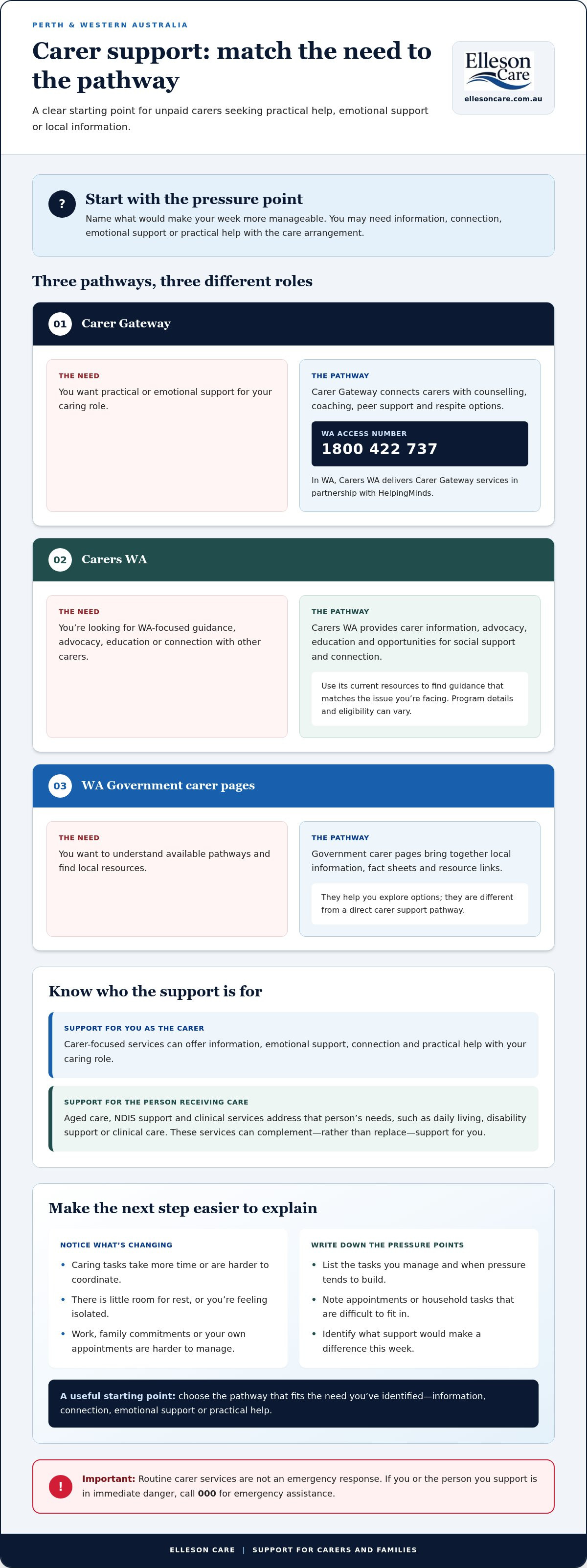
Several pathways serve unpaid carers in Perth, each with a different role. Carer Gateway is the national entry point for practical and emotional support. In Western Australia, Carers WA delivers Carer Gateway services in partnership with HelpingMinds. Carers WA also provides carer information, advocacy, education and opportunities for connection. WA Government pages bring together local information, fact sheets and resource links.
Start with the need you want to address. For someone to talk to, peer connection or practical help with your caring role, explore carer-focused services. If the person you support needs help with daily living, disability support or clinical care, look at services intended for them. The National Carer Strategy provides broader context on national efforts to recognise carers and support their wellbeing.
Carers WA and local information for family carers
Carers WA is a local starting point for carer-related information, advocacy, education and social support in WA. Its resources can help you understand your role and find relevant guidance or connection. Look for information that matches the issue you’re facing, such as understanding carer rights or connecting with other carers. Program details and eligibility can vary, so use Carers WA’s current information when deciding what to pursue.
Carer Gateway and WA Government resources
Carer Gateway connects carers with practical and emotional support, including counselling, coaching, peer support and respite options. In WA, call 1800 422 737 to access the pathway. WA Government carer pages serve a different purpose: they gather local information and links to resources, helping you explore options rather than providing the same direct support pathway.
Carer Gateway connects carers with support; WA Government pages help carers find local information and resources. Use the comparison below to choose a first step based on what you need.
| Pathway | Purpose | Likely audience | First access step |
|---|---|---|---|
| Carer Gateway | Practical and emotional carer support | Unpaid carers seeking support for their caring role | Call 1800 422 737 or visit Carer Gateway online |
| Carers WA | WA-focused information, advocacy, education and connection | Carers looking for local guidance or carer-focused resources | Explore current resources on the Carers WA website |
| WA Government carer pages | Local information, fact sheets and links to resources | Carers who want to understand available pathways | Search WA Government’s carer information pages |
These pathways focus on the carer. Aged care, NDIS support and clinical services are arranged around the needs of the person receiving care. If practical help at home could ease daily tasks, in-home aged care and support can form one part of a wider plan alongside carer-specific resources. Check official pages for current access details and eligibility, which can depend on the service and individual circumstances.
Carer support or support for the person receiving care: what is the difference?
First identify who a service is designed to support. Carer-specific services address the unpaid carer’s information, wellbeing and connection needs. Aged care, NDIS and clinical supports are organised around the needs of the person receiving care. The two types of support can work alongside each other, but they aren’t interchangeable.
Carer support strengthens the person providing unpaid care; care-recipient support assists the person with disability, illness, ageing or other support needs. For example, a carer might seek advice or peer connection while the person they support receives help with personal care or clinical needs. Keeping these pathways distinct can make it easier for Perth families to identify the right kind of help.
What carer-specific support is designed to address
Carer-focused support can include information, emotional support, education, advocacy and opportunities to connect with people in similar circumstances. Carer Gateway and Carers WA are examples of pathways that support carers in Australia and WA. The Government of Western Australia also provides information about disability support services for families and carers. Access and eligibility depend on each service’s current arrangements, so check its current guidance.
How professional support at home can complement family care
Support at home assists the person receiving care with tasks or health needs suited to their circumstances. Depending on the care plan, this may include personal care, domestic assistance, community access or clinical nursing. Sharing selected tasks with a professional can make the household routine more manageable while preserving the family carer’s role and the recipient’s preferences.
For instance, if a family member coordinates appointments and provides daily support, assistance with personal care or household tasks can ease some practical demands. It doesn’t provide the carer with counselling, advocacy or peer connection, so those needs may still call for a carer-specific pathway. When the demands of caregiving create stress within personal relationships or family dynamics, engaging specialised counselling through The Project of You | Trauma, Couples & Relationship Therapy Australia can help individuals and partners navigate these complex challenges. A considered plan can include both kinds of support.
| Support type | Who receives support? | Typical purpose | Example pathway |
|---|---|---|---|
| Carer-specific support | The unpaid carer | Information, emotional support, advocacy or connection | Carer Gateway or Carers WA |
| Aged care support | The older person receiving care | Assistance with care needs at home | My Aged Care or an in-home aged care provider |
| NDIS support | The NDIS participant | Disability-related supports aligned with their plan | The participant’s NDIS plan and supports |
| Clinical support | The person with health needs | Nursing or other clinical care | A suitable clinical care pathway |
Elleson Care provides aged care, NDIS support and clinical nursing in clients’ homes. These services address the recipient’s needs and can form part of a wider family support plan, rather than replacing carer-specific services. The in-home aged care guide explains how home-based support can help a person maintain independence while receiving care suited to their needs.
How to make a practical carer support plan in Perth
A support plan doesn’t need to solve everything at once. It can help you understand what’s happening, decide what needs attention first and identify a suitable pathway. Look at both sides of the caring arrangement: what would assist you, and what would help the person receiving care.
Try this simple sequence:
- Identify pressure points: note the tasks or times of day that are difficult to manage.
- Discuss needs and preferences: include the person you support wherever possible, and record how they’d like care to be provided.
- Find a relevant pathway: match carer wellbeing or information needs with carer-focused services, and care needs with services for the recipient.
- Review the plan: revisit what’s working and what has changed, then adjust the next steps.
A few notes on your phone or a page in a notebook can make a conversation with a service more useful. Record regular tasks, appointments, clinical needs, changes you’ve noticed and questions you want answered. Include your own commitments and when you need rest. Keeping the notes focused on the main pressure points makes the plan easier to act on.
Start with the tasks and pressures that matter most
Focus first on the parts of the week that have the greatest effect on daily life. You might note that getting ready in the morning takes longer, transport to appointments is difficult, or you’re unsure how to coordinate a health need. Include what you already manage well as well as the tasks where support could help. If possible, discuss your notes with the person receiving care so their preferences and choices guide the plan.
Connect with relevant Perth support and review the plan
Match the need to the pathway: seek carer-specific support for emotional wellbeing, connection or guidance, and explore services for the care recipient when practical or clinical assistance is needed. If you need planned time away from caring, consider what respite information or options may be relevant. The Perth respite care guide can help you understand this area.
Reviewing support regularly matters because a change in health, routine or family circumstances can alter what the carer and the person receiving care need. Set a reminder that suits your household, or review the plan when something noticeable changes. Keep the process manageable: update your notes, identify one priority and decide on one next step.
For care needs at home, suitable aged care, NDIS support or clinical nursing can help share practical tasks as part of a wider plan. To explore in-home care and support options, consider how assistance could fit the recipient’s needs and your household routine.
How Elleson Care can support care at home for Perth families
Elleson Care is a West Australian owned and operated provider offering person-centred aged care, NDIS support and clinical nursing in clients’ homes. For Perth families, in-home support can be one part of a broader plan. It focuses on the needs, preferences and daily life of the person receiving care, while carer-specific services support the unpaid carer’s own wellbeing.
Families can consider support when a particular task has become difficult to manage, needs change after a hospital stay, or professional assistance could complement the care already being provided. The aim is not to take over a family carer’s role. It is to identify help that supports the person at home and makes household routines more manageable.
In-home support shaped around the person’s needs
Support is tailored to individual circumstances, goals and routines. Personal care can assist with everyday activities, domestic assistance can help with household tasks, and community access can support participation beyond the home. The right mix depends on the person’s needs and preferences, and can be discussed as part of an individual approach to care.
For example, a family may consider assistance with a daily care task while continuing to provide companionship and make decisions together. Another person may need support to take part in community activities. These are starting points for a conversation, not a fixed package. A guide to nursing services in Perth can help explain how clinical care at home fits alongside other assistance.
Clinical expertise and a considered next step
Registered nurses lead the Elleson Care team, which has more than 22 years of experience. Clinical nursing can support needs such as wound management, post-hospital care or palliative support. These services address the care recipient’s needs; they aren’t a substitute for carer counselling, advocacy or peer connection.
Before discussing support, note the tasks the person wants help with, their usual routines, relevant clinical needs and what they would prefer to continue doing independently. Include the family carer’s perspective while keeping the recipient’s choices central. Clear priorities make it easier to consider how in-home support could fit into the wider care plan.
If you’re exploring carer support services Perth families can access, remember that support for the carer and care at home for the recipient serve different but complementary purposes. You can discuss in-home care with Elleson Care and consider how the support fits the person’s needs and preferences.
Choose one manageable next step for your family
You don’t need to resolve every caring pressure at once. Start with one priority, such as making a regular task easier or finding support that fits the person’s preferences. A small, considered change can help your household understand what is useful before adding anything more.
As you explore carer support services Perth families can access, keep the carer’s wellbeing and the care recipient’s needs in view as related but distinct parts of the plan. Carer-specific support can address your needs, while suitable help at home can assist the person you care for. Neither has to replace the relationship or involvement you value.
If in-home support could help with your family’s next step, Discuss in-home support for your family with Elleson Care. A conversation can help you consider what assistance suits the person receiving care and how it fits their routine. Take things one step at a time, with their preferences at the centre.
Frequently Asked Questions
Who is considered a carer in Australia?
A carer is generally someone who provides unpaid support to a person with disability, illness, mental health needs or age-related support needs. This may involve hands-on help, regular check-ins, arranging appointments or keeping track of important information. A carer can be a friend, partner or relative, and doesn’t need to live with the person. Someone employed to provide care as part of their paid work isn’t an unpaid carer in that role.
What carer support services are available in Perth?
Perth carers can access services such as counselling, coaching, peer support, practical assistance and respite information through Carer Gateway, delivered in WA by Carers WA in partnership with HelpingMinds. Carers WA also provides information and advocacy resources. If the need is for the person receiving care, rather than the carer, explore aged care, NDIS support or clinical care pathways. The right starting point depends on who needs support and what would help.
Is Carer Gateway available to carers in Perth?
Yes, Carer Gateway is available to unpaid carers in Perth. In Western Australia, its services are delivered by Carers WA in partnership with HelpingMinds. Call 1800 422 737 to discuss support options, including counselling, coaching and peer support. Services are free for carers, but access to particular supports depends on current arrangements and eligibility. If you’re unsure what to ask for, describe the caring tasks you manage and what feels most difficult.
Can in-home care help family carers?
Yes, in-home care can help indirectly by assisting the person receiving care with suitable daily tasks. For example, support with personal care or domestic assistance can help make the household routine more manageable. Discuss which tasks the person wants help with and which they prefer to do themselves. In-home care supports the recipient, so it doesn’t replace carer-specific counselling, advocacy or connection with other carers.
How do I find the right carer support service in Perth?
Start by identifying who needs help and what kind. You may need advice or someone to talk to, while the person you care for may need support with daily activities or health needs. Write down your main questions, then explore a relevant carer service or the recipient’s aged care or NDIS pathway. If coordinating appointments is becoming difficult, for example, note what support is already in place and what information would make the next conversation useful.
What happens if a carer needs a break from caring?
If you need time away, explore respite options through Carer Gateway or relevant supports for the person receiving care. Think about the length and timing of the break, the person’s usual routines and any assistance they’ll need while you’re away. This information can help clarify which pathway may suit your circumstances. Access and arrangements vary, so discuss your situation with the relevant service and allow time to plan where possible.
Does respite care support the carer or the person receiving care?
Respite care directly supports the person receiving care by arranging temporary assistance, while giving their unpaid carer time away from caring tasks. The break might allow the carer to rest, attend an appointment or manage other responsibilities. It’s distinct from counselling or peer support, which focuses directly on the carer. The form of respite and how it’s arranged depend on the recipient’s needs and the service pathway involved.


