

What if the right NDIS support could fit around your routines, rather than asking you to reshape your life around it? Finding an NDIS provider Perth participants can rely on means looking beyond a service list to what matters in everyday life: personal goals, familiar routines and individual support needs.
It’s understandable to feel uncertain about which supports will help, especially when coordinating daily living assistance with clinical care. Changes can feel disruptive, so support should respect a person’s choices, dignity and established routines. A practical approach starts with listening, then matching assistance to the person’s priorities.
In this article, you’ll learn how to connect NDIS goals with support at home and in the community, and what a respectful, person-centred relationship can look like. You’ll also see how Elleson Care’s Perth NDIS support, including personal care, domestic assistance and community participation, can sit alongside clinical nursing such as wound management and medication administration. Its registered-nurse-led team brings more than 22 years of experience and takes a holistic approach centred on individual needs.
Key Takeaways
- An NDIS provider delivers agreed disability supports; the NDIS scheme and a participant’s individual plan are separate.
- Before arranging support, note your priorities, preferred routines, communication needs and personal boundaries.
- When considering an NDIS provider in Perth, look for respectful communication, attention to routine and relevant support experience.
- Prepare for support by reviewing plan information, discussing daily routines and agreeing how communication and reviews will work.
- Elleson Care’s registered-nurse-led team brings more than 22 years of experience to person-centred NDIS support in Perth.
What does an NDIS provider in Perth do for participants?
An NDIS provider delivers agreed disability supports; the NDIS is the national scheme, and a participant’s plan sets out their funded supports. The provider’s role is to deliver relevant support in a way that reflects the participant’s circumstances and choices. The scheme and its funding arrangements are separate from the organisation or worker providing assistance.
The National Disability Insurance Scheme (NDIS) is a national scheme for people with disability. A participant’s individual plan relates to their support needs and funding, while a provider delivers particular services within that context. This distinction can make planning clearer: the plan is not the support itself, and a provider does not replace the scheme or determine a participant’s plan.
For someone looking for an NDIS provider in Perth, support should connect with what they want to do in daily life rather than follow a generic service template. That might mean assistance with personal care or domestic tasks, or support to take part in community activities. The right support depends on the person’s plan and circumstances.
How NDIS support can connect with everyday goals
Goals are personal priorities, not outcomes a service should impose. One participant may want to manage more of their morning routine; another may value getting out to a regular community activity. A provider can discuss how support could help with those priorities while respecting the person’s preferences, pace and boundaries.
It can help to describe a typical day and where assistance would make a practical difference. For example, a goal of participating in the community may involve support that fits around the person’s preferred activities and routines. The support will depend on the individual plan and circumstances, so avoid assuming the same arrangement suits everyone.
Why local Perth context matters to support
Support takes place in real settings: a person’s home, their usual routines and the community spaces they value. Discussing these details helps clarify what respectful assistance looks like, including how the person prefers tasks to be approached and what helps them feel comfortable. Local context means understanding the person’s day-to-day environment, not making assumptions about where they go or what they need.
Elleson Care is a West Australian owned and operated provider delivering person-centred NDIS support in Perth. Its support includes personal care, domestic assistance and social and community participation. Where clinical needs are part of a person’s support picture, clinical nursing such as wound management or medication administration addresses a different need from everyday living assistance. Both can be considered in light of the person’s individual circumstances.
Match Perth NDIS support to personal goals, routines and daily needs
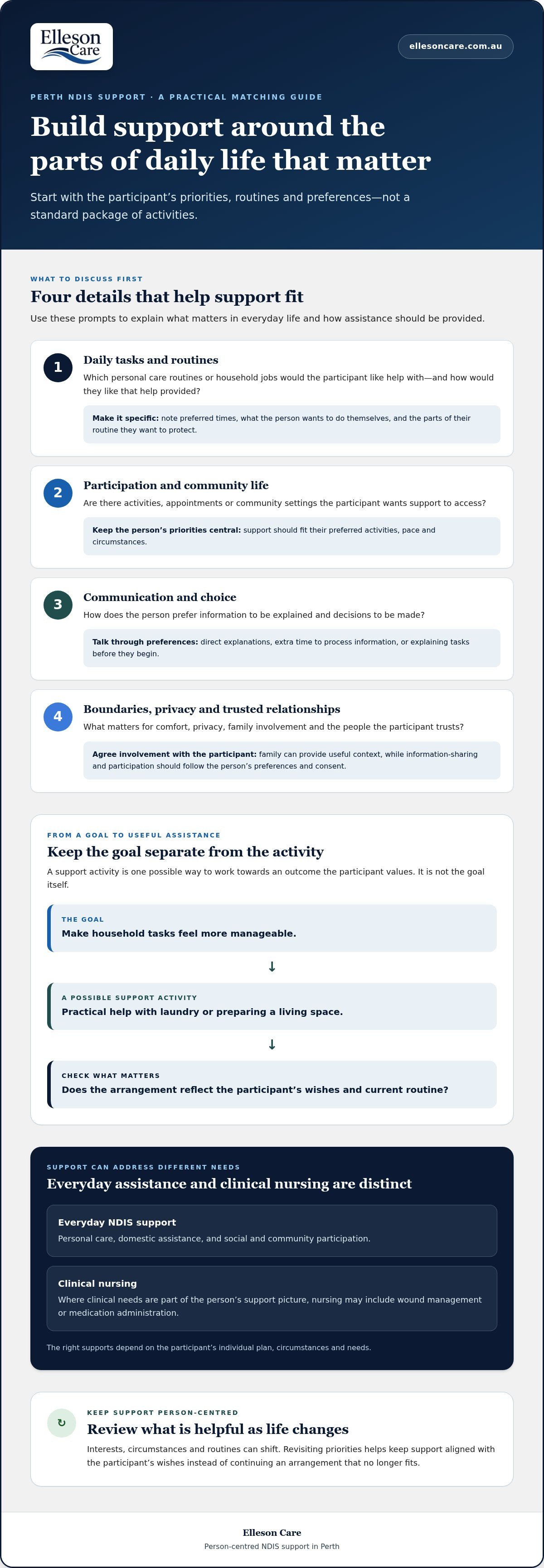
Useful support starts with the participant’s priorities, not a standard package of activities. Before discussing services, consider what the person wants to do more independently, what they would like help with and which parts of daily life they want to protect. These priorities give a provider a clearer picture of how support could fit into the person’s life.
It can help to note details that are easy to overlook in a brief conversation: preferred times for certain tasks, how the person likes information explained, what they prefer to do themselves, and who they want involved in decisions. These aren’t administrative extras. They help define respectful, practical assistance.
- Daily tasks: Which household jobs or personal care routines would the participant like help with, and how would they like that help provided?
- Participation: Are there activities, appointments or community settings they want support to access?
- Communication: Does the person prefer time to process information, direct explanations or a particular way of making choices?
- Boundaries and relationships: What matters for privacy, comfort, family involvement and the people the participant trusts?
Turn broad goals into practical support priorities
A broad goal becomes easier to discuss when it’s linked to a real situation. For example, a participant may want household tasks to feel more manageable, with practical help such as laundry or preparing a living space. The goal is the outcome the person values; the support activity is one possible way to work towards it, not the goal itself.
Priorities may change as circumstances, interests or routines shift. Reviewing what is helpful keeps support conversations centred on the participant instead of continuing with an arrangement that no longer reflects their wishes.
Include family, communication and cultural preferences
Family members can offer useful context, but their involvement should follow the participant’s preferences and consent. Agreeing who can receive information or contribute to conversations helps protect the person’s privacy and supports their role in decisions. Communication preferences may include allowing extra time, explaining tasks before starting or checking that the participant feels comfortable.
It’s also useful to discuss personal, cultural and household preferences without making assumptions. The NDIS Quality and Safeguards Commission provides information about quality and safeguards in NDIS services, helping participants understand the broader support environment.
Different support types can address different priorities. Personal care may assist with daily routines, domestic assistance may address household tasks, and community participation may support access to activities. Whether a particular support is suitable for NDIS funding depends on the participant’s current plan and circumstances. A service isn’t automatically funded simply because it relates to a goal.
Bring these preferences to a conversation about support. Elleson Care’s person-centred NDIS support in Perth is informed by individual routines and choices. Learn more about Elleson Care’s Perth NDIS support as you consider what matters most.
What makes NDIS support feel respectful, consistent and safe?
Respectful support should feel individual, not like a routine imposed on everyone. A participant’s preferences, consent and privacy should guide how assistance is offered. Clear communication helps them understand what is happening and express what they want. Respectful support protects choice and dignity through clear communication and attention to personal boundaries.
Use the comparison below to think about everyday practices that shape a support relationship. Look for clear examples of how each principle is put into practice, rather than relying on broad assurances.
| Area | Practical sign of person-centred support |
|---|---|
| Participant choice | The person is invited to express preferences and take part in decisions about their support. |
| Respectful communication | Workers explain tasks, listen to responses and adapt their approach to the person’s communication needs. |
| Routine | Important routines and preferences are discussed, so assistance can fit into the person’s day. |
| Continuity | Support information is communicated clearly, and familiar practices are followed where possible. |
| Relevant experience | The team’s experience is suited to the type of daily or clinical support involved. |
Participant choice, dignity and clear communication
Support should assist, not take over. For example, a worker might ask how a participant prefers help with a personal task, explain each step and allow time for the person to do what they can independently. Privacy, consent and the right to change their mind matter throughout. These practical behaviours help keep the participant’s voice central.
Consistency means clear communication and familiar support practices, so preferences and important information are not lost when arrangements change. For someone comparing providers in Perth, it’s useful to understand how routines and support information are communicated.
When daily support and clinical needs overlap
Personal care and domestic assistance support everyday activities, while nursing tasks address clinical needs and require appropriate expertise. A person may need both types of assistance as part of their wider support picture, but they are not interchangeable. Clinical requirements should be addressed by suitably qualified nursing professionals, with the specific support considered in light of the person’s circumstances and plan.
Elleson Care’s registered-nurse-led team provides NDIS support alongside clinical nursing, including wound management and medication administration. This brings daily living and clinical needs into a broader, person-centred understanding of support while keeping the nature of each need clear.
How to prepare for NDIS support at home or in the community
A little preparation can make the first support conversations clearer and more comfortable. You don’t need to share every personal detail straight away. Focus on what matters, how daily life works and the assistance the participant wants to discuss. Funding and service arrangements vary, so use the participant’s current plan information when considering what may fit.
These steps can help organise the conversation:
- Clarify priorities. Write down what the participant wants to do more independently, maintain or take part in, and what support they’d like to explore.
- Review plan information. Note relevant goals, supports and funding details in the current plan. If anything is unclear, record the question rather than assuming a particular service will be funded.
- Discuss routines. Describe practical preferences for support at home or in the community, such as the order of tasks, privacy needs and accessibility considerations.
- Agree communication. Talk about how the participant prefers information shared, how changes should be discussed and who, if anyone, they want involved.
- Review the arrangement. Agree how to share feedback and revisit support if routines, priorities or circumstances change.
Prepare priorities and practical information
A short written summary can help the participant explain their needs without having to remember everything during a conversation. It might include preferred routines, relevant access requirements and tasks where assistance is wanted. Share relevant health or safety information when it helps plan the support being discussed. The participant should guide what information is shared and with whom; there’s no need to provide unrelated medical or personal details.
For clinical needs at home, keep the distinction between everyday assistance and nursing care clear. Personal care or household support may sit alongside clinical support, but they address different needs. A discussion of nursing services at home in Perth can offer useful context when considering the clinical-care aspect of someone’s support picture.
Agree how support will work in everyday life
Before support begins, discuss the tasks involved, how the participant wants assistance offered and how communication will work if plans need to be reviewed. Clear expectations help the person retain choice and understand what to expect. Keep the conversation anchored to the participant’s plan and circumstances, rather than treating a service description as confirmation of funding.
If family members provide regular support, it may also help to discuss what periods of rest or other assistance would mean for the participant and their family. The guide to respite care in Perth is relevant to that conversation. To discuss NDIS support in Perth in relation to your priorities and routines, learn more about NDIS support from Elleson Care.
Elleson Care NDIS support in Perth: a nurse-led, person-centred approach
Elleson Care is a West Australian owned and operated provider supporting NDIS participants in Perth. Its registered-nurse-led team brings more than 22 years of experience, with a person-centred approach that considers daily living and clinical needs as distinct parts of a person’s wider support picture.
For someone seeking an NDIS provider in Perth, support should be shaped around personal priorities, not an imposed standard routine. The aim is to understand what assistance matters to the participant, how they prefer it to be provided and what helps them feel respected at home or in the community.
Daily living and community participation support
Elleson Care’s NDIS support includes personal care, domestic assistance and social and community participation. The right approach depends on the individual. Personal care can be planned around the person’s preferences, privacy and usual routines. Domestic assistance can focus on the household tasks they want help with, while community participation support can help them take part in activities that matter to them.
These supports are most useful when they preserve choice and dignity. A participant may prefer to complete some tasks independently, ask for help with others, or have a particular way they like their routine followed. Understanding those preferences helps keep support personal rather than generic. Community participation supports involvement without assuming a particular activity or transport arrangement.
Clinical nursing support at home
Daily living assistance and nursing care address different needs, even when both are relevant to one person. Elleson Care’s clinical nursing includes support relating to wound management, catheter care and medication administration. A registered-nurse-led team brings clinical experience to these needs, with support considered in the context of the person’s circumstances and plan.
For a broader overview of clinical care, the guide to comprehensive nursing services in Perth provides related information. Keeping clinical support distinct from personal care or domestic assistance can help participants and families describe what kind of help is needed and discuss it clearly.
Beginning a conversation can be straightforward. Describe the daily support that would make a difference, the routines you want respected and any clinical needs you’d like considered. These details keep the discussion focused on the person without assuming a particular arrangement or funding outcome.
If you’re looking for an NDIS provider in Perth, learn about discussing your NDIS support needs with Elleson Care.
Take the next step towards support that fits
Starting a conversation doesn’t require every detail to be settled. Begin by identifying what you’d like everyday support to make easier, what you want to continue doing for yourself, and what would help you feel comfortable with a support worker in your home or community. Those priorities can guide a practical discussion about next steps.
If you’re considering an NDIS provider in Perth, keep the focus on the participant’s voice. Support should be discussed with care, without pressure to make decisions before the participant is ready. Their needs and preferences can shape the conversation as it develops.
Elleson Care welcomes conversations about individual NDIS support needs in Perth. Discuss personalised NDIS support with Elleson Care and take a considered first step towards support shaped around what matters to you.
Frequently Asked Questions
Can an NDIS provider in Perth support me at home?
Yes, an NDIS provider in Perth may deliver supports at home when they relate to the participant’s needs and plan arrangements. This could include help with a personal care routine or household tasks. Before arranging support, identify the tasks involved and how the participant wants assistance provided. Funding suitability depends on individual circumstances and current NDIS rules, so check official guidance for scheme-specific details.
What support can an NDIS provider help with in Perth?
Support may cover daily living, personal care, domestic assistance, community participation or clinical needs, depending on the participant’s circumstances and plan. For example, someone might seek help maintaining their home routine and separate nursing input for a clinical need. Elleson Care provides support across these areas, with clinical nursing led by registered nurses. Discuss how each support relates to the participant’s goals, and check funding suitability against current NDIS guidance.
Do I need a registered NDIS provider in Perth?
Not every participant necessarily needs the same provider arrangement. Registration requirements can depend on the type of support and how the participant’s NDIS funding is managed, and rules may change. Check current information from the NDIS or NDIA before deciding which arrangements apply to your situation. If you’re comparing options, first clarify your funding management type and the specific support you’re seeking, then use current official guidance to understand relevant requirements.
Can NDIS funding cover nursing support at home?
Nursing support may be relevant for some participants, but funding depends on individual needs, plan arrangements and current NDIS rules. Elleson Care provides clinical nursing, including wound management and catheter care. This information isn’t a clinical assessment or a guarantee of funding. If nursing care is being considered, describe the care need and discuss how it relates to the participant’s circumstances, then check current NDIS guidance about funding suitability.
How much does NDIS support in Perth cost?
There isn’t one cost that applies to every NDIS support service in Perth. The amount can depend on the type of support, service arrangements and applicable NDIS pricing rules. Review current NDIS pricing information alongside the participant’s plan before making arrangements. To understand a proposed service, identify what support is involved and how it is delivered. Elleson Care can discuss support needs in light of individual circumstances, without assuming a single service arrangement suits everyone.
Can family members help organise NDIS support?
Yes, family members or nominees can be involved where appropriate, guided by the participant’s preferences, consent and decision-making rights. A family member might help note questions, explain a routine or support the participant to communicate what they want. The participant’s circumstances affect who is involved and how. For information about formal roles or authority under the scheme, refer to current NDIS guidance rather than assuming family involvement automatically grants decision-making authority.
What happens if my NDIS support needs change?
If support needs change, write down what’s different, how it affects everyday life and what the participant would like to do next. For example, a new difficulty with a regular task may prompt a conversation about support arrangements. A change in needs doesn’t automatically change funding or a plan; those decisions follow NDIS processes. Check current official guidance about the appropriate next step, and keep support discussions focused on the participant’s current wishes.
To discuss person-centred NDIS support in Perth, contact Elleson Care.


