

What should you look for in disability support providers when everyday assistance also needs to account for complex clinical care? It’s understandable to want clear answers about NDIS plan terminology, consistent support and safety at home, especially when someone’s dignity and wellbeing are at stake.
The right support should do more than match a plan. It should respect personal choice, help build community connections and provide clinical oversight when health needs are more complex. This guide explains how to understand NDIS supports and what nurse-led care can bring to in-home and community support in Perth.
At Elleson Care, our West Australian-owned team is led by registered nurses with more than 22 years of experience. We provide NDIS support alongside clinical care, including wound management, ventilator and oxygen support, and palliative care. Read on to learn how a holistic, family-focused approach can support safety, personal dignity and quality of life.
Key Takeaways
- Learn how Core, Capacity Building and Capital supports differ, so you can better understand how your NDIS plan may relate to daily and clinical needs.
- Compare disability support providers by considering personal and clinical fit, and how registration and insurance relate to safeguards.
- Explore how community participation and clinical support can work together to respond to a person’s goals and wellbeing.
- Understand how planned respite can support participants while giving family carers time to rest.
- See how a nurse-led approach brings clinical experience and a holistic family perspective to in-home and community support.
What Are Disability Support Providers and Why Does Choice Matter?
Within the NDIS, a provider is a person or organisation that delivers a funded support or supplies a product to a participant. Supports may assist with everyday activities, community participation or health-related needs. The relationship is personal: workers may enter someone’s home, assist with private routines and support decisions that shape daily life. A good fit therefore depends on more than whether a service matches a line in a plan.
Person-centred support starts with the participant’s preferences, communication style, culture and goals. A fixed routine can overlook what matters to an individual, even when tasks are completed. Support that adapts as goals and circumstances change can help someone practise skills, make choices and take part in their community. Over time, those experiences can contribute to greater independence and quality of life.
The Role of Providers in the NDIS Ecosystem
A provider delivers agreed supports in line with a participant’s plan and direction. A support coordinator has a different role: they help the participant understand and connect supports, while each service provider delivers the support they have agreed to provide. Clear communication between the participant, coordinator and providers can help connect day-to-day assistance with broader goals.
Registration status matters, but it isn’t the only measure of fit. Registered providers must meet the NDIS Quality and Safeguards Commission’s requirements for the supports they deliver. Unregistered providers may deliver some NDIS-funded supports, depending on the participant’s plan management and the type of support. Registration requirements are changing: from 1 July 2026, providers of Supported Independent Living (SIL) and digital platforms connecting participants with support workers must be registered. Existing SIL providers have a transition period to apply by 1 October 2026. Requirements depend on the support, so understand a provider’s status in the context of the service being delivered.
The NDIS Code of Conduct applies to NDIS providers and workers. For registered providers, the NDIS Practice Standards set expectations for safe, respectful, quality supports. In practice, support should protect privacy, dignity and choice, and be shaped around the person rather than imposed as a fixed routine.
Why Local Perth Expertise Makes a Difference
Local understanding can help connect support with everyday life. A West Australian-owned and operated organisation brings a local perspective to in-home and community-based care. Planning around a participant’s area, goals and preferred activities can make support more relevant to daily routines in Perth.
For someone managing ongoing health needs, continuity between home support and clinical care can be important. Elleson Care is nurse-led, with registered nurses bringing more than 22 years of experience to its work across NDIS and clinical support. A holistic approach considers the participant and their family while keeping personal preferences and goals at the centre. Effective support can go beyond immediate tasks, creating opportunities for connection, confidence and greater control over daily life.
Navigating Support Types: From Social Connection to Clinical Nursing
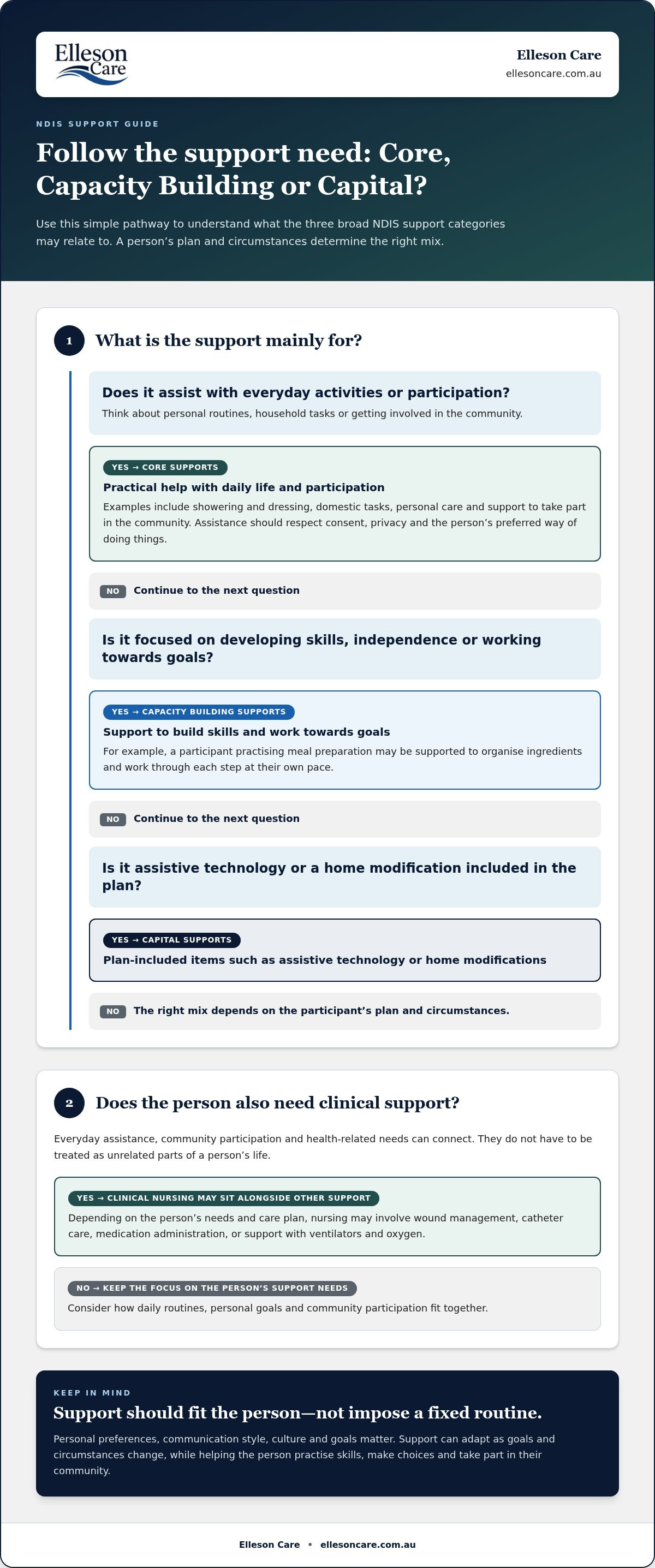
NDIS supports are grouped into three broad categories: Core, Capacity Building and Capital. Understanding these categories can help participants and families see how different supports may contribute to everyday routines, personal goals and safety at home. The right mix depends on a person’s plan and circumstances, and may include practical assistance as well as clinical care.
- Core Supports assist with everyday activities and participation, including personal care, household tasks and getting involved in the community.
- Capacity Building Supports focus on developing skills, independence and the ability to work towards goals, including developmental therapies and psychological support such as those provided by Firststep Psychology & Child Development Centre.
- Capital Supports relate to items such as assistive technology or home modifications, where these are included in a participant’s plan.
These categories aren’t separate parts of a person’s life. Someone may need help getting ready at home, support to attend a community activity and clinical oversight for a health need. Disability support providers can consider how these needs connect, rather than treating social participation and health support as unrelated tasks. Holistic healthcare considers the whole person, including their health, routines, relationships and goals. For families navigating early developmental milestones, comprehensive assessment services like the Stars Assessment Program similarly demonstrate how evaluating delays in infants and toddlers creates a clear foundation for targeted support.
Core Supports and Daily Living Assistance
Core assistance can help with personal routines such as showering and dressing, as well as domestic tasks that make a home easier to manage. Support should be provided with consent, privacy and respect for the person’s preferred way of doing things. Small choices matter, from the order of a morning routine to how household tasks are organised.
Support workers can encourage independence by doing tasks alongside a participant instead of automatically doing everything for them. Someone practising meal preparation, for instance, may benefit from help organising ingredients and working through each step at their own pace. The aim is practical assistance that supports participation and builds confidence in daily life.
Specialised Clinical Nursing for Complex Needs
Some participants need clinical care alongside everyday support. Depending on an individual’s needs and care plan, nursing may involve wound management, catheter care, medication administration or support with ventilators and oxygen. These tasks require an appropriate clinical approach, clear communication and coordination with the person’s broader care arrangements. Nursing services in Perth can form part of a considered approach to care at home.
Registered nurse oversight can help ensure clinical needs are assessed and care plans are developed and reviewed with attention to safety. It can also connect clinical requirements with daily support, so workers understand relevant routines and the participant’s preferences. For general information about disability services, the Australian Government’s Disability Gateway offers a central resource.
Elleson Care brings nurse-led clinical support together with in-home and community-based NDIS support for participants with complex needs. Explore nurse-led NDIS support as part of planning care that recognises both health needs and personal goals.
How to Evaluate Disability Support Providers in Perth
Choosing support involves more than matching a service to an NDIS plan. Clinical capability, cultural safety and communication all shape whether care feels secure and respectful over time. A structured evaluation can help families identify what matters, clarify expectations and understand how support will fit into everyday life.
Registration and insurance are practical parts of that evaluation. Consider a provider’s registration status in relation to the support being delivered and the participant’s plan management. Clear information about insurance, service agreements, fees and potential additional charges can also prevent uncertainty. Under the NDIS Pricing Arrangements, participants can review applicable price limits. A service agreement should explain the supports, costs and terms in plain language.
A 5-Step Framework for Choosing Your Provider
Use these areas to organise an evaluation and keep the participant’s priorities central:
- Consider clinical expertise. For complex health needs, look for relevant nursing experience and clear clinical oversight. Elleson Care is nurse-led, with registered nurses bringing more than 22 years of experience.
- Look at local knowledge. Consider whether the organisation understands Perth and the WA healthcare landscape, and whether its approach fits the participant’s community and routines. Elleson Care is West Australian owned and operated.
- Review goal setting. Support planning should reflect the participant’s priorities, not a standard routine. Goals might include managing more of a daily task or taking part in a chosen community activity.
- Assess communication. Understand how updates, changes in needs and concerns are communicated, and who the participant or family can speak with about support. Good communication helps care remain coordinated and responsive.
- Consider conduct and safeguards. The NDIS Code of Conduct sets expectations for providers and workers, including respect for individual rights and safe, quality support. Consider how these principles shape the support experience.
Red Flags to Avoid During Your Search
Unclear answers about clinical safety, vague service agreements or unexplained charges can make it difficult to understand what support involves. Take care if communication feels rushed or generic, or focuses on selling a package rather than understanding the participant’s circumstances. A conversation before regular support begins can help the participant and family assess how a support worker communicates, listens and respects personal preferences.
The participant can explain what helps them feel comfortable, how they prefer assistance and what a good day looks like. The response offers a practical sense of personal and cultural fit. A nurse-led, family-focused approach can connect clinical considerations with daily support while keeping dignity and choice in view.
For Perth families seeking NDIS and clinical support, Elleson Care brings local understanding and registered nursing experience to in-home and community-based care. Explore Elleson Care’s NDIS support to learn how this approach can fit into a participant’s support needs.
Maximising Community Access and Independent Living in WA
Community participation is about more than getting out of the house. Keeping appointments, visiting a local group or spending time with friends can support connection, confidence and a sense of belonging. The participant should guide what meaningful participation looks like, whether that means continuing a regular activity or gradually becoming more comfortable in a new setting.
In Perth, disability support providers can help participants plan outings around their interests and support needs. That may include assistance to attend a health appointment, visit a community centre or take part in a social activity. A familiar support worker can help with practical steps such as preparing for the trip and navigating the activity, while encouraging the person to make choices and build skills along the way.
Accessing the Perth Community with Confidence
Start with activities the participant already enjoys or would like to try. Local social groups, community centres and accessible public spaces can offer opportunities to connect with others, practise communication and develop everyday confidence. Support can be tailored to the person’s pace, including planning transport and allowing time to prepare for an outing. Familiar journeys and routines may help build practical skills and make participation feel more manageable.
Community access should also take account of family carers, not add pressure. Planned respite care in Perth can give carers time to rest while the participant continues to receive support suited to their needs. A thoughtful plan considers the participant’s preferences and routines, as well as the family’s wider caring responsibilities.
The Balance Between Safety and Autonomy
For participants with complex health needs, an outing may require careful preparation. The support approach can account for relevant clinical needs, the destination and the participant’s preferences. A risk assessment should identify practical steps to make participation safer, not become a reason to rule out ordinary activities. Planning ahead, for example, can clarify what support is needed during a trip and how the participant can communicate their choices.
Independent living options (ILO) are built around an individual’s living preferences and support needs, rather than a single standard arrangement. In 2026, families should consider how an ILO proposal fits the participant’s current plan and goals, and how daily support can encourage choice, relationships and everyday independence. NDIS funding settings are also changing: from 1 October 2026, budgets for social, economic and community participation supports are reduced by 50% when a new plan is created or an existing plan is reassessed, with these changes applying to renewed plans from 1 February 2027. This change concerns those support budgets; it should not be assumed to define every ILO arrangement.
Elleson Care’s in-home and community-based NDIS support takes a holistic view of the participant and their family. Explore community-based NDIS support to consider how personal goals and clinical needs can be supported together.
The Elleson Care Difference: Nurse-Led Disability Support
For families seeking clinical expertise alongside respectful everyday assistance, Elleson Care brings NDIS and clinical support together through a nurse-led approach. The focus is not simply on completing a list of tasks. It is on understanding the person, their health needs and what matters to them, then shaping support around those priorities.
Registered nurses with more than 22 years of experience lead the team. That clinical background is particularly relevant when a participant’s support needs include complex care at home, such as wound management, ventilator or oxygen support, or palliative care. Domestic and community support can sit alongside clinical care, helping connect health needs with ordinary routines.
This integrated approach can support families managing a transition from hospital to home. Care needs may change as someone settles into familiar surroundings, and clear clinical oversight can help keep support responsive. Support remains centred on the participant’s dignity, preferences and goals.
Why Clinical Leadership Matters in Disability Care
Nurse-led care brings clinical knowledge into the planning and oversight of support. Registered nurses can consider the person’s health needs, help guide care planning and support communication about clinical requirements. This gives families a clinical perspective alongside practical assistance, rather than treating health and daily living as separate concerns.
Clinical oversight doesn’t replace the participant’s choices. It helps ensure support is considered carefully, with attention to safety, comfort and personal routines. For example, a plan involving ventilator support needs to account for the person’s clinical requirements while recognising their preferences at home. Elleson Care’s experience across complex nursing and everyday support helps bring these aspects together with a holistic family approach.
Your Local Partner in Perth
As a West Australian-owned and operated provider, Elleson Care brings a local perspective to support in Perth. Each person’s goals and circumstances are different, so support should be organised around what they want to work towards, whether that involves daily routines, health-related needs or community participation. Families are part of the conversation, while the participant’s autonomy and voice remain central.
Choosing disability support providers is a significant decision, especially when support includes clinical needs at home. Elleson Care combines registered nursing leadership with NDIS support, domestic assistance and community-based care. This breadth helps keep the person’s overall wellbeing in view, rather than reducing support to a single task or diagnosis.
If you’re considering nurse-led NDIS support in Perth, contact the Elleson Care team to discuss support shaped around your circumstances and goals.
Take the Next Step Towards Support That Fits
Choosing disability support providers is the start of an ongoing relationship, not a decision that needs to define every future need. Priorities may develop as routines change, new goals take shape or circumstances at home shift. Keeping the participant’s preferences central makes it easier to review what is working and identify where support could adapt.
Before taking the next step, consider what the participant wants more of in daily life, what would help them feel safe and respected, and how family members can be included in conversations. These reflections can turn a broad search into a clearer discussion about the kind of support that feels right. There’s no single approach that suits everyone. Start with an open conversation shaped around the individual.
Elleson Care is here to listen and discuss NDIS and clinical support in a thoughtful, person-centred way. Contact our nurse-led team to discuss support that respects your goals and circumstances.
Frequently Asked Questions
How do I find NDIS disability support providers in Perth?
Use the NDIS website’s provider search tools to find services in Perth, then narrow your options by the supports you need and how your plan is managed. A support coordinator or local area coordinator may also help you understand your choices. Before settling on a service, consider practical fit: the person’s goals, preferred routines, communication needs and whether clinical support is relevant. This makes a broad search more focused.
What is the difference between a registered and unregistered NDIS provider?
A registered provider has been approved by the NDIS Quality and Safeguards Commission to deliver specified supports and must meet applicable registration requirements. Some unregistered providers can deliver NDIS supports, depending on the support type and how the participant’s plan is managed. Participants with NDIA-managed funding generally need to use registered providers. From 1 July 2026, providers of Supported Independent Living and digital platforms connecting participants with workers must be registered.
Can a disability support provider also offer clinical nursing services?
Yes. A provider may offer both disability support and clinical nursing, provided the service is delivered by appropriately qualified practitioners and fits the participant’s needs and plan. Elleson Care provides nurse-led clinical support alongside NDIS support, including wound management, catheter care, medication administration, and ventilator and oxygen support. Bringing these areas together can connect health-related care with daily routines at home while keeping the participant’s preferences in view.
How much do disability support providers charge in Perth?
There isn’t one standard charge for every support. Rates depend on the support being delivered and the applicable NDIS pricing rules, as well as the participant’s funding arrangements. Review the current NDIS Pricing Schedule and Support Catalogue for relevant limits, then read the provider’s service agreement for rates, travel charges and cancellation terms. The agreement should make clear what will be charged and how the support uses plan funding.
Can I change my disability support provider if I am not happy?
Participants can generally choose a different provider if their support no longer suits them. Start by reviewing the service agreement for notice periods, cancellation conditions and any steps needed to end the arrangement. When changing providers, consider how to keep essential support consistent during the handover, especially where clinical care is involved. With the participant’s consent, relevant care information can help the incoming team understand established routines and support needs.
What should I look for in a support worker for complex clinical needs?
Look for support that matches the person’s clinical care plan, with suitable worker skills and clear nursing oversight where required. For example, ventilator support or wound care calls for an approach that follows clinical guidance, respects the person’s routines and sets out how concerns are communicated to the appropriate clinician. Consider whether the participant feels comfortable with the worker and can express preferences about privacy, communication and assistance.
Does Elleson Care provide support for NDIS participants in all Perth suburbs?
Elleson Care provides NDIS support services in Perth, including personal care, domestic assistance and community access. Support is planned around the participant’s needs and goals, with in-home and community-based care at its centre.
How does a nurse-led provider differ from a standard disability agency?
A nurse-led provider brings registered nursing experience into the leadership of care, which can be valuable when disability support includes complex health needs. This can connect clinical considerations with daily assistance instead of treating them as entirely separate. At Elleson Care, registered nurses lead the team’s approach to NDIS and clinical support, bringing a clinical perspective alongside attention to personal routines, comfort and individual goals.


