

Entering a nursing home is no longer the only option for Western Australians with high-level clinical needs. While the traditional home care package level 4 was once the benchmark for complex support, the 2026 transition to the Support at Home program has left many Perth families feeling uncertain. It's completely natural to feel overwhelmed by the shift to Classifications 7 and 8 or worried that a government budget won't cover the specialised nursing care your loved one requires to stay safe at home.
You deserve a care plan that prioritises dignity and autonomy while providing the clinical rigour of a professional healthcare setting. In this guide, we'll explain how to navigate the new funding classifications and maximise your budget to access professional wound management and medication oversight in Perth. We'll explore the practical steps to manage the ACAT assessment process and ensure your home remains a place of both expert care and personal comfort, allowing you to age in place with confidence and peace of mind.
Key Takeaways
- Understand how the previous home care package level 4 has evolved into Classifications 7 and 8 under the 2026 Support at Home program.
- Discover the updated funding levels for high-level care, which now provide up to A$80,137 annually to support complex clinical and personal needs.
- Learn how to access fully government-funded clinical nursing services, including specialist wound management and palliative support, without personal co-contributions.
- Gain practical insights into navigating the ACAT assessment process in Perth to secure a care plan that prioritises your dignity and independence.
- Explore the benefits of a nurse-led approach to care management, ensuring your health needs are overseen by experienced professionals who understand the WA healthcare landscape.
Understanding Home Care Package Level 4 in the Support at Home Era
The traditional home care package level 4 has long served as the cornerstone for seniors who wish to remain in their own homes despite significant health challenges. Historically, this level was designed for individuals requiring high-level support, often acting as the final step before residential care. Since the implementation of the Support at Home program on 1 November 2025, the framework for Aged care in Australia has shifted toward a more granular eight-classification system. While the terminology has changed for new applicants, the fundamental objective remains the same: providing intensive, daily assistance that preserves your dignity and independence within the familiar surroundings of your Perth home.
Who Needs Level 4 High-Level Care?
High-level care is specifically tailored for those living with complex, intersecting health requirements. It isn't merely about assistance with household chores or shopping. Instead, it focuses on comprehensive clinical management for conditions such as advanced dementia, severe mobility impairment, or multiple chronic illnesses that require regular monitoring. For many Perth seniors, this level of funding is the vital alternative to a nursing home. It provides the resources necessary to manage safety risks and health stability without forcing a move into a residential facility. By prioritising professional oversight, families can ensure their loved ones receive the care they need while maintaining their established social connections in the local community.
Mapping Level 4 to the New 2026 Classifications
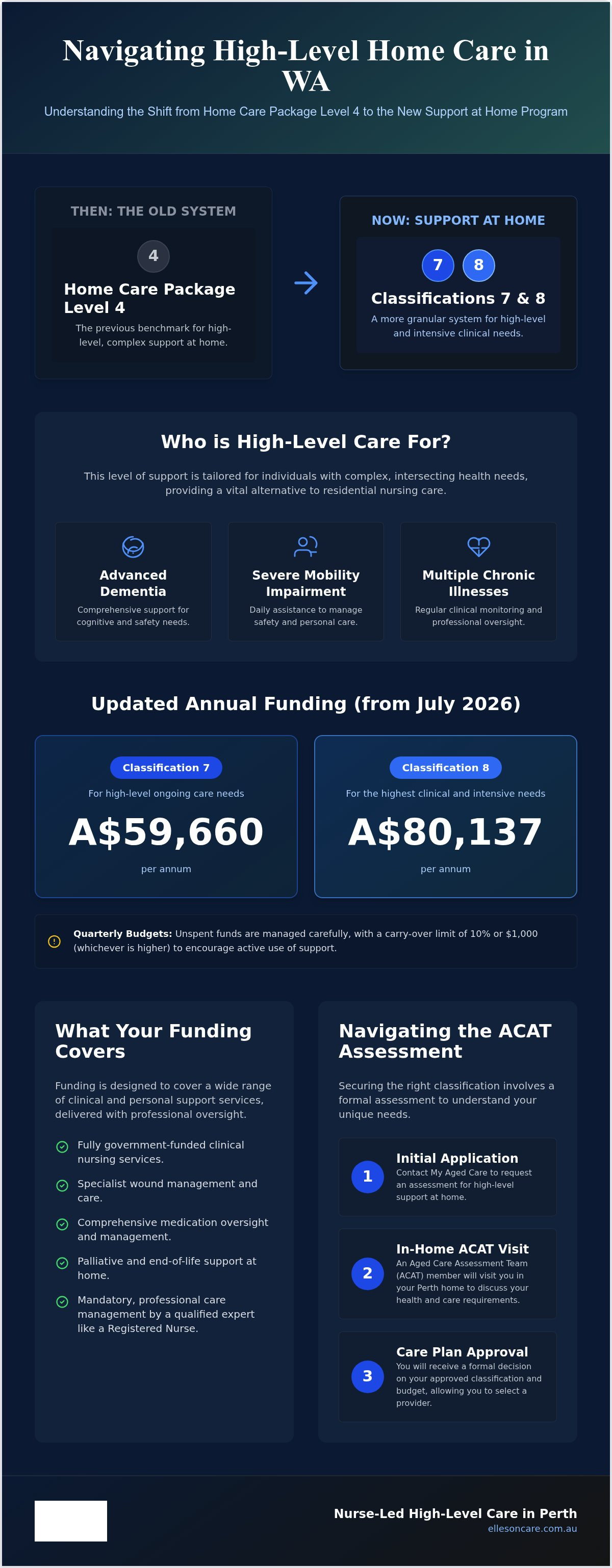
Under the current 2026 regulations, individuals who previously qualified for a home care package level 4 are now assessed under Classifications 7 and 8 of the Support at Home program. Classification 7 generally covers high-level ongoing care, while Classification 8 is reserved for those with the highest clinical needs. The new system distinguishes between short-term restorative pathways, intended for recovery after an injury, and the ongoing high-level support required for permanent health conditions. Because these classifications involve significant funding and complex medical needs, professional care management is mandatory. This ensures that a qualified professional, such as a Registered Nurse, coordinates your services to prevent hospitalisations and ensure your care plan remains responsive to your changing health status.
Funding Classifications 7 and 8: The Budget for High-Level Care
For families who previously sought a home care package level 4, the 2026 financial landscape offers a more tailored approach to funding. As of July 2026, the annual government allocation for Classification 7 stands at $59,660.00, while Classification 8 provides $80,137.12 for those with the most intensive needs. The transition moved away from daily accruals to a quarterly budget model. This change ensures that high-level support remains consistent, allowing you to plan for regular nursing visits and daily personal care without worrying about fluctuating daily rates. It's a structure designed to provide stability and confidence for seniors living at home in Perth.
Managing these significant funds requires a clear understanding of the carry-over rules. To ensure that support is actively utilised for your well-being, the government limits the amount of unspent funds that can move from one quarter to the next. Generally, you can carry over up to 10% of your quarterly allocation or $1,000, whichever is higher. Any surplus beyond this cap is returned to the government pool. This makes proactive care planning essential, as it ensures your budget is working effectively to improve your quality of life. You can review the specific guidelines on the official Australian Government portal for aged care services to see how these rules apply to your situation.
Classification 7 vs. Classification 8: Which One is Right?
The distinction between these two classifications often comes down to the level of clinical risk and the frequency of required interventions. Classification 8 is typically reserved for individuals with advanced clinical needs or 24/7 safety concerns, such as those requiring frequent overnight monitoring or complex medical technology. Each July, these budgets undergo indexation to reflect the current cost of living and healthcare delivery in Western Australia. If a sudden health crisis occurs, "Special Payments" may be accessible to provide additional temporary funding, ensuring your care remains uninterrupted during difficult times.
Care Management: The Value of Clinical Oversight
With high-level funding, a 10% care management allocation is included to provide professional coordination. When you're managing a budget of up to $80,000, a nurse-led approach becomes a vital safety net. This fee covers the expertise of a coordinator who organises complex schedules involving multiple therapists, equipment providers, and clinical staff. Regular RN-led reviews ensure that your care plan evolves alongside your health needs, maintaining clinical safety at every stage. For families in Perth, expert care coordination provides the reassurance that a professional advocate is always looking out for your loved one's best interests.
Clinical Support and Services: What Your Level 4 Funding Covers
The transition of a home care package level 4 into the high-level classifications of 2026 ensures that the most vulnerable seniors receive a robust framework of clinical support. Under the Home Care Packages Program, this funding is designed to provide a multidisciplinary team that works in unison to maintain your health. It moves beyond basic domestic help, prioritising intensive personal care such as assistance with showering, dressing, and hygiene. These daily tasks are handled with a focus on dignity, ensuring you feel respected while receiving the physical support necessary to start your day safely.
Your budget also facilitates essential allied health services delivered directly to your door in Perth. This includes regular visits from physiotherapists to maintain mobility, occupational therapists to assess home safety, and podiatrists to manage foot health. For many, a significant portion of the budget is allocated to assistive technology. This might involve funding for high-quality mobility aids or vital home modifications, such as the installation of ramps or bathroom rails. These practical adjustments are crucial for preventing falls and ensuring your Perth home remains a safe sanctuary as your needs evolve.
Specialised Nursing Services for Complex Needs
Managing intricate health conditions requires professional nursing services led by experienced Registered Nurses. For those living with chronic wounds, catheter requirements, or respiratory issues, having a clinician oversee your care is a vital safety measure. This level of support often includes hospital-grade interventions, such as ventilator management or oxygen therapy, delivered in the comfort of your own lounge room. When families face the challenges of palliative care, RNs provide a compassionate, steady presence. They manage pain and complex symptoms with clinical precision, ensuring end-of-life support prioritises the individual's comfort and personal wishes.
Domestic Assistance and Social Connection
High-level care often necessitates a constant presence to ensure safety and peace of mind. Your funding can be structured to provide 24/7 or overnight care, offering a protective shield during the hours when risks are highest. This support extends to the logistical challenges of living with complex needs in Western Australia. Dedicated staff can provide transport to specialist appointments at major Perth medical centres, such as Fiona Stanley Hospital or Sir Charles Gairdner Hospital, ensuring you never miss a critical review. Additionally, nutritional support is prioritised through meal preparation that caters to specific dietary requirements, helping you maintain the strength and well-being needed to remain independent at home.
Navigating the My Aged Care Assessment for Level 4 in Perth
To secure the high-level funding previously known as a home care package level 4, an assessment by the Aged Care Assessment Team (ACAT) is an essential first step. In Perth, these assessments are conducted by health professionals who evaluate your physical, psychological, and social needs within your own environment. It is a critical gatekeeping process because it determines whether you meet the clinical criteria for Classification 7 or 8 under the Support at Home program. Preparing for this face-to-face meeting allows you to present a clear, honest picture of your daily challenges and the specific clinical support required to maintain your safety and dignity.
Documenting complex clinical needs is vital if you are seeking a Classification 8 outcome. You should gather recent specialist reports, current medication lists, and evidence of any recent hospitalisations or health setbacks. Articulating how a chronic condition affects your independence helps the assessor understand why high-level funding is necessary rather than lower-tier support. In Western Australia, wait times for these assessments can fluctuate. Understanding these local timelines helps you plan for the months ahead without feeling left in a state of uncertainty. If you need immediate support while navigating the system, professional care advocacy in Perth can help you prepare your documentation and understand the process.
What to Expect from a Perth ACAT Assessment
During the visit, the assessor looks for specific clinical indicators that suggest a need for high-level intervention. They observe mobility to evaluate fall risks and may ask about skin integrity, which is particularly important for seniors with limited movement. It's often helpful to have a family advocate or a current nurse present during the assessment. They can provide a professional perspective on why clinical nursing oversight is more appropriate than basic domestic assistance. Focusing the conversation on medical stability and risk management ensures the assessor sees the full scope of your clinical requirements.
Managing the Transition and Interim Care
While waiting for high-level funding to be approved and assigned, you can often access entry-level support through the Commonwealth Home Support Programme (CHSP). This serves as a temporary measure for services like transport or light domestic help. If your health declines rapidly during this waiting period, you can request an urgent reassessment to fast-track your application. Many families choose to engage in-home aged care in Perth as a private bridge. This ensures that expert care begins immediately while the government funding process concludes, providing a seamless transition to long-term support.
Partnering with Elleson Care for High-Level Support
Elleson Care stands as a dedicated partner for families navigating the complexities of high-level support in Western Australia. As a Perth-owned and operated provider, our team is led by Registered Nurses with over 22 years of experience in clinical and aged care settings. We understand that transitioning from a home care package level 4 to the new Support at Home classifications requires more than just logistical coordination; it requires a compassionate, expert hand to ensure safety and comfort. Our approach is fundamentally family-centred, recognising that when a senior requires intensive care, their loved ones also need a reliable source of stability and professional guidance.
By focusing on dignity-first care plans, we ensure that clinical requirements never overshadow your personal autonomy. We operate as advocates for WA families, using our deep knowledge of the local healthcare system to bridge the gap between medical necessity and home-based comfort. Whether you're managing complex wound care or require palliative support, our team provides a steady, protective presence. We focus on evidence-based practices that allow you to remain in your own home with confidence, knowing that your care is managed by professionals who truly value your quality of life.
Why Clinical Leadership Matters for Level 4
Clinical leadership is the foundation of safe, high-level care at home. With an RN-led team, we can identify subtle health changes early, which is often the key to preventing unnecessary hospital admissions. This proactive oversight is critical when managing a home care package level 4 equivalent budget, where the clinical stakes are significantly higher. We provide professional medication management and act as clinical advocates during consultations with your GP or specialists. This expertise ensures that your care plan is meticulously followed and adjusted as your health evolves, giving you the reassurance that a highly experienced professional is overseeing every aspect of your well-being.
Starting Your Journey with Elleson Care
We're here to help Perth families navigate the transition into the Support at Home program with transparency and ease. Our team coordinates your entire clinical circle, including specialist nurses, allied health therapists, and dedicated support workers. This integrated approach ensures that every person entering your home is aligned with your specific goals and health requirements. Your first step is booking a clinical consultation where we assess your needs and discuss how to maximise your funding. It's an opportunity for us to listen to your story and begin building a care relationship based on integrity, discipline, and fundamental kindness.
Empowering Your Choice for High-Level Care at Home
The evolution from a traditional home care package level 4 into the modern Support at Home classifications offers a more tailored approach to maintaining your independence. You now have the opportunity to access significant funding that prioritises your clinical safety while respecting your personal dignity. By focusing on professional oversight and a clear understanding of the 2026 regulations, you can ensure your home remains a place of comfort rather than a transition point to residential care.
Elleson Care is a WA owned and operated provider led by Registered Nurses with over 22 years of experience. We specialise in complex clinical and palliative care, providing a steady, reliable presence for families throughout Perth. We invite you to book a clinical consultation with our Perth nursing team to explore how we can support your unique health journey. Choosing to stay at home is a powerful decision, and we are here to provide the expert, compassionate partnership you need to make it a reality. You deserve a future defined by safety, stability, and the comfort of your own surroundings.
Frequently Asked Questions
What is the main difference between Level 3 and Level 4 home care in 2026?
The primary difference lies in the intensity of clinical oversight and the volume of support hours provided. While Level 3 (now Classifications 5 and 6) addresses intermediate needs, a home care package level 4 (Classifications 7 and 8) is designed for those with complex, daily clinical requirements. This high-level funding prioritises professional nursing and intensive personal care, providing the necessary resources to manage chronic conditions that would otherwise require residential aged care.
How much total funding do Classifications 7 and 8 provide annually?
As of July 2026, the annual government funding for Classification 7 is $59,660.00, while Classification 8 provides $80,137.12. These amounts are indexed twice yearly to stay in line with healthcare costs in Western Australia. The budget is managed through a quarterly model, ensuring Perth seniors have a consistent and reliable stream of funding to cover their essential nursing, allied health, and personal care services throughout the year.
Can I use Level 4 funding for 24/7 nursing care at home?
While Classification 8 provides the highest tier of government support, it is generally not sufficient to cover one on one nursing care 24 hours a day. It is intended to provide intensive daily visits and regular clinical monitoring. Families requiring around the clock supervision often use their budget for high frequency nursing and overnight respite, sometimes supplementing the package with private contributions to ensure total safety during every hour of the day.
What happens to my Level 4 package during the Support at Home transition?
If you were already receiving a Level 4 package before the 2025 transition, you were moved into the Support at Home program under "no worse off" protections. This ensures your funding levels and service hours remain stable. For new applicants in 2026, the process involves a direct assessment for Classification 7 or 8. The new system is designed to be more flexible, allowing for a more precise match between your clinical needs and your budget.
How long is the wait for a high-level care package in Western Australia?
Wait times in Perth can vary based on the urgency of your clinical situation. Generally, the process from your initial ACAT assessment to receiving your funding classification can take several months. Those with high priority needs, such as individuals requiring palliative support or those at immediate risk of hospitalisation, are often fast tracked. It's common to use entry level CHSP services as an interim measure while waiting for your full high level allocation.
Can Level 4 funding be used for major home modifications like ramps or lifts?
Yes, your high-level funding can be allocated toward significant home modifications that support your safety and mobility. This includes the installation of permanent ramps, stair lifts, or specialised bathroom modifications. These projects require an assessment and recommendation from an occupational therapist to ensure the changes are clinically necessary. These modifications are vital for Perth seniors who wish to navigate their homes independently while managing complex physical health challenges.
Is a Basic Daily Fee required for Support at Home Classifications 7 and 8?
The old basic daily fee has been replaced by a system of service based contributions. Under the 2026 regulations, all clinical care, such as nursing and allied health, is fully funded by the government with no contribution from the senior. From October 2026, personal care services also became fully government funded. You may only be asked to contribute toward non clinical services, such as domestic help or meal preparation, depending on your financial circumstances.
How do I switch my high-level package to Elleson Care?
Switching to Elleson Care is a seamless process that begins with a clinical consultation to review your current care plan. You will need to contact My Aged Care to obtain your referral code and notify your current provider of your intention to move. Our Perth based team handles the coordination of the transfer, ensuring your nursing services and personal care continue without interruption. We focus on a smooth transition that prioritises your clinical safety and personal dignity.


