

What if the right support starts with the participant’s goals, rather than a preset list of services? Choosing in-home disability support Perth residents can access is a personal decision. It’s understandable to want clarity about what help may be available, how NDIS funding could apply and whether a provider will listen to the person receiving support.
Support at home can include assistance with personal care, household tasks or community access. Some participants may also need clinical support, so discuss individual needs and goals rather than assuming every provider offers the same services. A suitable arrangement should respect the participant’s preferences and involve them in decisions about how support is delivered.
This guide covers everyday and clinical supports to ask about, how to compare providers in Perth and what to discuss before services begin. It also includes practical questions to clarify provider communication and NDIS plan arrangements. Elleson Care is a West Australian-owned, nurse-led provider. Its team can discuss how its NDIS and clinical support services may align with a participant’s needs.
Key Takeaways
- In-home disability support Perth can include help at home or in the community, depending on the participant’s needs, goals and provider capabilities.
- Start with the participant’s priorities and preferred routines, then discuss how support could encourage choice and everyday participation.
- Compare more than service lists: ask about communication, staff capability, continuity and how feedback is handled.
- Before services begin, identify priorities, review plan information and confirm relevant funding and service arrangements with a plan manager or the NDIA.
- Ask how Elleson Care’s personal care, domestic assistance, community access and clinical nursing may fit the participant’s needs.
What In-Home Disability Support in Perth Includes
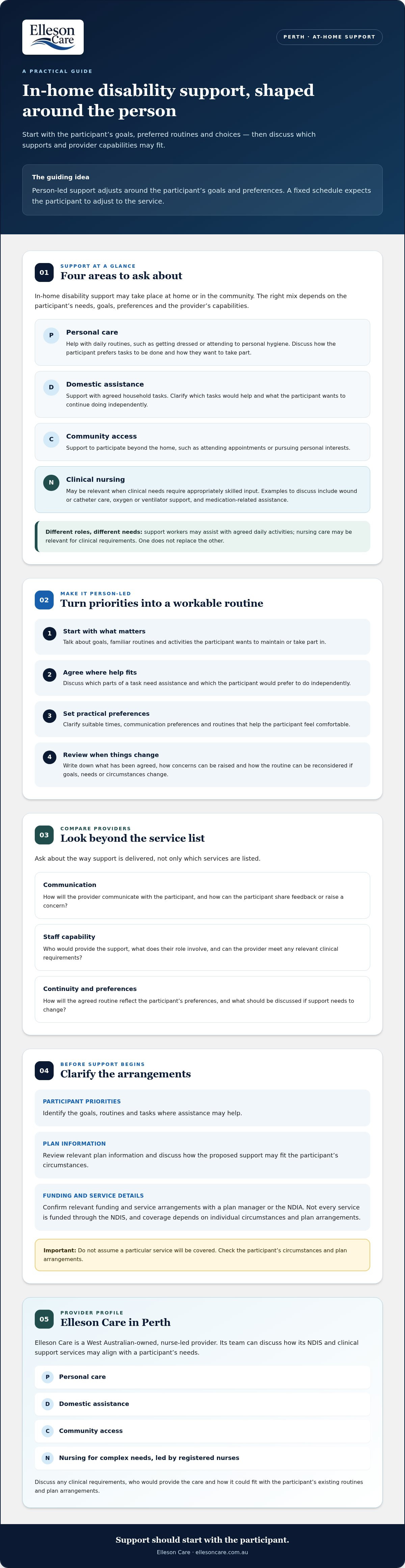
In-home disability support is assistance provided in a person’s home or community, shaped around their needs, goals and preferences. Depending on the person’s circumstances and the provider’s capabilities, it may include personal care, household tasks, community access or clinical nursing. The right mix varies, and not every service is funded through the NDIS.
For people using NDIS funding, the National Disability Insurance Scheme (NDIS) is one part of working out how support may be arranged. Whether a particular service is included or funded depends on individual circumstances and plan arrangements. Check with a plan manager or the NDIA rather than assuming a service will be covered.
Which everyday supports may be delivered at home?
Personal care can include assistance with daily routines, such as getting dressed or attending to personal hygiene. A respectful approach starts by asking how the participant prefers tasks to be done, supporting their choices and giving them the opportunity to take part as much as they wish.
Domestic assistance is a separate type of support and may cover agreed household tasks. Community access supports participation beyond the home, such as attending appointments or pursuing personal interests. The useful mix depends on what matters to the participant. One person may want help maintaining a familiar routine at home, while another may prioritise getting to activities in their community.
Start by discussing the participant’s routines, preferences and goals, rather than choosing from a fixed service list. For example, identify the particular tasks where assistance would help and what the participant wants to continue doing independently. This gives you a clearer basis for discussing how support could encourage everyday choice and participation.
When might in-home support include nursing care?
Disability support and clinical nursing are different kinds of assistance. A support worker may help with agreed daily activities, while nursing care may be relevant when a participant has clinical needs requiring appropriately skilled input. One does not replace the other. The right arrangement depends on the person’s assessed needs and care requirements.
For example, a participant may need nursing support for wound or catheter care, or for more complex needs involving oxygen or ventilator support. Medication-related assistance may also need to be discussed in light of the participant’s requirements and the provider’s capabilities. These examples won’t apply to everyone.
Before support begins, explain any clinical requirements and ask who would provide the care, what their role involves and how it could fit with the participant’s existing routines. Elleson Care offers personal care, domestic assistance, community access and nursing for complex needs, with registered nurses leading its team. Discuss these services in relation to the participant’s needs, goals and plan arrangements, particularly if nursing input may sit alongside everyday disability support.
How NDIS home support can reflect a participant’s goals
Useful support starts with the participant’s priorities, not assumptions about what they should need. A goal might be managing more of a morning routine, keeping up with household tasks or getting to a regular community activity. Discuss what assistance could help the person work towards that outcome while respecting their choices and abilities.
Person-led support adjusts around the participant’s goals and preferences; a fixed schedule expects the participant to adjust to the service. That difference can affect how support is planned, delivered and reviewed.
Turning personal goals into a practical support routine
Talk through each task together. Which parts does the participant want help with, and which would they prefer to do independently? For example, someone may want assistance to prepare for an outing but prefer to choose their own clothes and pack their belongings. Agreeing on these details can support independence while keeping useful assistance in place.
Discuss practical preferences too, including suitable times, how workers should communicate and routines that help the participant feel comfortable. Write down what has been agreed and decide how the participant can raise concerns or request a change. Review the routine if their goals, needs or circumstances change, rather than assuming it will remain suitable.
Matching support type to the person’s needs
Different supports serve different purposes. Personal care assists with daily routines; domestic assistance helps with agreed household tasks; community access supports participation beyond the home. Clinical nursing may be relevant when a person has health-related care needs requiring appropriately capable practitioners. The right combination depends on the individual, and clinical requirements should be discussed with the provider before support begins.
A diagnosis alone doesn’t confirm eligibility for a particular NDIS-funded support. Funding depends on individual circumstances and current plan arrangements, so check the participant’s plan and seek guidance from their plan manager or the NDIA. Confirm proposed supports against current official NDIS information before making arrangements.
Respect, choice and participation are also worth discussing when you’re assessing how a service works in practice. The Australian Government’s National Standards for Disability Services provide a reference point for conversations about service quality and outcomes. Ask how a provider will listen to the participant, record their preferences and respond to feedback.
For people considering in-home disability support Perth, a practical first step is to list the outcomes that matter most and the tasks where assistance may help. You can then learn about Elleson Care’s NDIS support and discuss whether its services may suit the participant’s goals and needs.
Comparing In-Home Disability Support Providers in Perth
A service list is only a starting point. Compare providers by considering how their support would work in the participant’s everyday life: whether it matches their needs, how staff communicate and whether the person feels respected and involved. Use the questions below to compare specific answers, not just general assurances.
| What to compare | Questions to ask |
|---|---|
| Service fit | Can you provide the supports being considered, and how would they align with the participant’s goals and plan arrangements? |
| Communication | How will workers learn the participant’s communication preferences, routines and boundaries? How can the participant share feedback? |
| Staff capability | What experience and skills do workers have that relate to the person’s specific support needs, including any clinical requirements? |
| Continuity | How are workers matched with the participant, and what happens if the usual worker changes? |
| Plan arrangements | How does the provider work with the participant’s plan-management arrangements, and what should be confirmed with a plan manager or the NDIA? |
Questions to ask a Perth disability support provider
Ask the provider to describe how the proposed support would work day to day. Who will brief workers about the participant’s preferences? How will changes to routines or support needs be shared with the team? If the participant is uncomfortable or wants to change an arrangement, how can they raise it?
Look for answers that are clear and specific to the participant, rather than relying on broad assurances. The participant should have a meaningful role in decisions about day-to-day support, including the chance to explain what is and isn’t working.
How to assess safety, experience and service fit
Match staff experience to the participant’s actual requirements. If support includes clinical tasks, ask which practitioners would provide them and how their capabilities relate to those needs. A provider’s general experience alone may not show whether the team is suited to a particular situation.
Where provider registration is relevant to the participant’s plan or the support being considered, verify the provider’s status directly. The NDIS Quality and Safeguards Commission provides information about registered providers, participant safeguards and complaints. Ask the provider about its status and check official information where relevant.
Fit is personal too. Consider whether the participant feels comfortable speaking openly, is treated with respect and has control over decisions. When comparing in-home disability support Perth options, ask each provider the same questions, then discuss the answers with the participant. Consider how clearly each team explains worker matching, communication and its response to feedback.
Preparing for In-Home Disability Support in Perth
A little preparation can make the first provider conversation more focused and help the participant stay involved. Work through the decisions in order: clarify priorities, review relevant plan information, shortlist providers, ask practical questions and agree on next steps before support begins.
What information to have ready for an initial discussion
A short written summary can help explain what the participant wants support with and what matters to them in daily life. Note preferred routines, communication needs and tasks they want to do independently. You don’t need to have every detail resolved before making an enquiry.
- Priorities: Note the support needs and goals the participant wants to discuss.
- Plan arrangements: Summarise how the plan is managed and ask what information the provider needs. Confirm whether a proposed service aligns with current funding and plan arrangements with the plan manager or the NDIA.
- Practical questions: Ask about worker matching, relevant clinical capabilities, communication and how feedback or changes are handled.
- Location and availability: Confirm directly whether the provider covers the participant’s Perth area and can deliver the required support. Don’t assume suburb coverage or availability.
For clinical needs, describe the requirements clearly and ask who would be involved in providing the support. If you’re considering nursing input, clarify how it could fit alongside the participant’s everyday support and existing routines.
What to agree before support begins
Before services start, make sure the participant and provider have the same understanding of what has been agreed. Clarify the type of support, proposed schedule, communication method and each person’s responsibilities. Ask how the participant’s preferences will be shared with workers and how the arrangement can be reviewed if needs or circumstances change.
Discuss consent and privacy, including what information may be shared, with whom and for what purpose. Agree on how the participant can raise a concern, give feedback or request a change. If family members are involved, clarify the participant’s preferences about their role in conversations and decisions.
If a carer also needs support, discuss the participant’s and carer’s priorities when planning the arrangement. For an initial conversation about in-home disability support Perth, prepare the participant’s questions, then confirm service fit, funding arrangements and local availability directly. To discuss Elleson Care’s NDIS support or clinical care at home, contact Elleson Care about support options.
How Elleson Care supports people at home in Perth
Elleson Care is a West Australian-owned provider offering NDIS support and clinical care at home. Its services can be discussed in relation to the participant’s circumstances, preferences and goals. The conversation can focus on what support may suit the person, rather than assuming every participant needs the same combination of services.
Everyday assistance may include personal care, domestic assistance and community access. Where clinical needs are part of a person’s circumstances, nursing support may also be relevant. Registered nurses lead the team, which has more than 22 years of experience. This nursing leadership is worth discussing when a participant may need clinical care alongside daily-living assistance.
A coordinated approach to everyday and clinical needs
Daily-living support and nursing have different purposes, but both may be relevant for one participant. For example, someone may want assistance with personal care or household tasks while also requiring clinical support such as wound management, catheter care or palliative support. The appropriate services depend on the person’s needs and the provider’s capabilities.
Elleson Care’s family-centred approach supports a collaborative conversation about the participant’s routines, goals and support requirements. The participant’s preferences should remain central, including how they want support delivered and who they want involved in discussions. Confirm service suitability, clinical requirements and current Perth-area coverage directly with the team, as needs and availability can vary.
Discuss your support needs with the Elleson Care team
A first discussion can start with a few practical details: what the participant wants to work towards, which routines matter to them, what support they’re considering and whether there are clinical requirements to discuss. Ask how the proposed services relate to the participant’s circumstances, what provider arrangements apply and whether support is available in their part of Perth.
NDIS funding and service arrangements depend on individual circumstances and the participant’s plan. Confirm funding questions with a plan manager or the NDIA, and discuss service details with the provider before making arrangements. This helps clarify what is being considered and what needs to be checked next.
If you’re exploring in-home disability support Perth, you can Discuss in-home support with Elleson Care. Share the participant’s goals and preferences, and ask the team about relevant NDIS support, clinical care and current Perth coverage. You don’t need to have every detail settled before starting the conversation.
Take the next step towards support that fits
The right support begins with the participant’s priorities. Consider which everyday tasks they’d like help with, what they prefer to manage independently and whether clinical care may also be needed. Then compare providers by service fit, staff capability, communication and how they respond to participant feedback.
Before support starts, confirm the proposed services, current Perth-area coverage and relevant funding arrangements with the provider, plan manager or NDIA. NDIS funding depends on individual circumstances and plan arrangements, so check rather than assume.
Elleson Care is West Australian owned and operated, providing NDIS support and clinical care at home. Its registered-nurse-led team has over 22 years of experience. If you’re considering in-home disability support Perth, a conversation can help clarify whether its services may suit the participant’s needs and goals.
Discuss your support needs with Elleson Care. Start by sharing what matters to the participant, then ask about relevant support options in Perth.
Frequently Asked Questions
What does in-home disability support include in Perth?
In-home disability support in Perth can include assistance at a person’s home or in the community, depending on their needs, goals and provider capabilities. Examples include personal care, help with household tasks and community access. Clinical nursing may also be relevant when a participant has clinical needs requiring appropriately capable practitioners. Discuss what is suitable and available rather than assuming every provider offers the same services.
Can NDIS funding pay for support at home?
NDIS funding may pay for support at home if the support is included in the participant’s plan and meets the relevant funding rules. Funding isn’t automatic for every service or participant. Review the plan and ask the plan manager or the NDIA whether the proposed support and provider arrangements are appropriate. Check current official NDIS guidance before committing, particularly if the support involves clinical care or you’re unsure how the plan is managed.
How do I choose an in-home disability support provider in Perth?
Compare how each provider’s services, staff capability and communication approach fit the participant’s needs and preferences. Ask how workers are matched, how they learn the participant’s routines, and how feedback or changes are handled. If clinical support is needed, ask about relevant practitioner experience. Confirm Perth-area coverage directly, then consider whether the participant feels listened to, respected and involved in decisions about day-to-day support.
Do I need a registered NDIS provider for in-home support?
Whether a registered provider is needed depends on the participant’s plan-management arrangements and the type of support. Some arrangements or support categories may require a registered provider, while others may allow more choice. Confirm the requirements for the specific support with the NDIA or plan manager, and verify a provider’s registration through official NDIS sources where relevant. Don’t assume a provider’s status or that a particular support can be claimed.
Can disability support include personal care and household tasks?
Yes, personal care and domestic assistance may be available as disability support, depending on the person’s needs, plan and provider’s services. Personal care can involve help with daily routines, while domestic assistance relates to agreed household tasks. Discuss which tasks the participant wants help with and which they prefer to manage independently. Confirm whether the proposed supports align with the participant’s plan before arranging services.
Can a nurse provide clinical support at home for an NDIS participant?
A nurse may provide clinical support at home when it’s appropriate to the participant’s needs and the provider has practitioners capable of delivering it. Examples can include wound management, catheter care or palliative support. Nursing is distinct from everyday disability support, and not every participant will need it. Discuss clinical requirements with the provider and confirm whether the service fits the participant’s circumstances and current NDIS plan arrangements.
What should I ask before starting in-home disability support?
Ask which supports the provider can deliver, how workers are matched and briefed, and how the participant’s communication preferences will be respected. Clarify the proposed schedule, responsibilities, privacy arrangements and how to raise a concern or request a change. If clinical care is involved, ask about practitioner capability and coordination. Also confirm local availability and discuss funding or plan questions with the plan manager or the NDIA before support begins.


