

Last Tuesday, a daughter in Subiaco sat at her kitchen table, staring at a screen full of government acronyms while worrying if her father's wait for support would ever end. It's a common scene across Perth as families try to understand how my aged care actually works in 2026. You likely feel that same weight of responsibility, balanced against the fear that a single wrong step might lead toward a residential facility rather than the in-home comfort your loved one deserves.
We understand that the transition to the new Support at Home program and the Single Assessment System can feel more like a barrier than a gateway. This guide offers a clear, empathetic roadmap to help you navigate the registration process and manage assessment timelines with confidence. You'll learn how to secure high-quality clinical care that prioritises dignity, ensuring your family remains supported by local experts who truly understand the Western Australian healthcare landscape.
Key Takeaways
- Navigate the my aged care registration process with a five-step roadmap designed to simplify government jargon and secure a personalised client record.
- Identify the specific clinical and domestic requirements needed to prepare for the new Single Assessment System with confidence and clarity.
- Understand how the 2026 Support at Home program offers flexible quarterly funding for those wishing to remain independent in Western Australia.
- Learn why a nurse-led, local Perth provider can offer more specialised clinical outcomes than larger, "big-box" organisations.
- Gain clarity on the role of the Department of Health and Aged Care in regulating subsidised services to ensure your loved one receives high-quality support.
What is My Aged Care and How Does it Work?
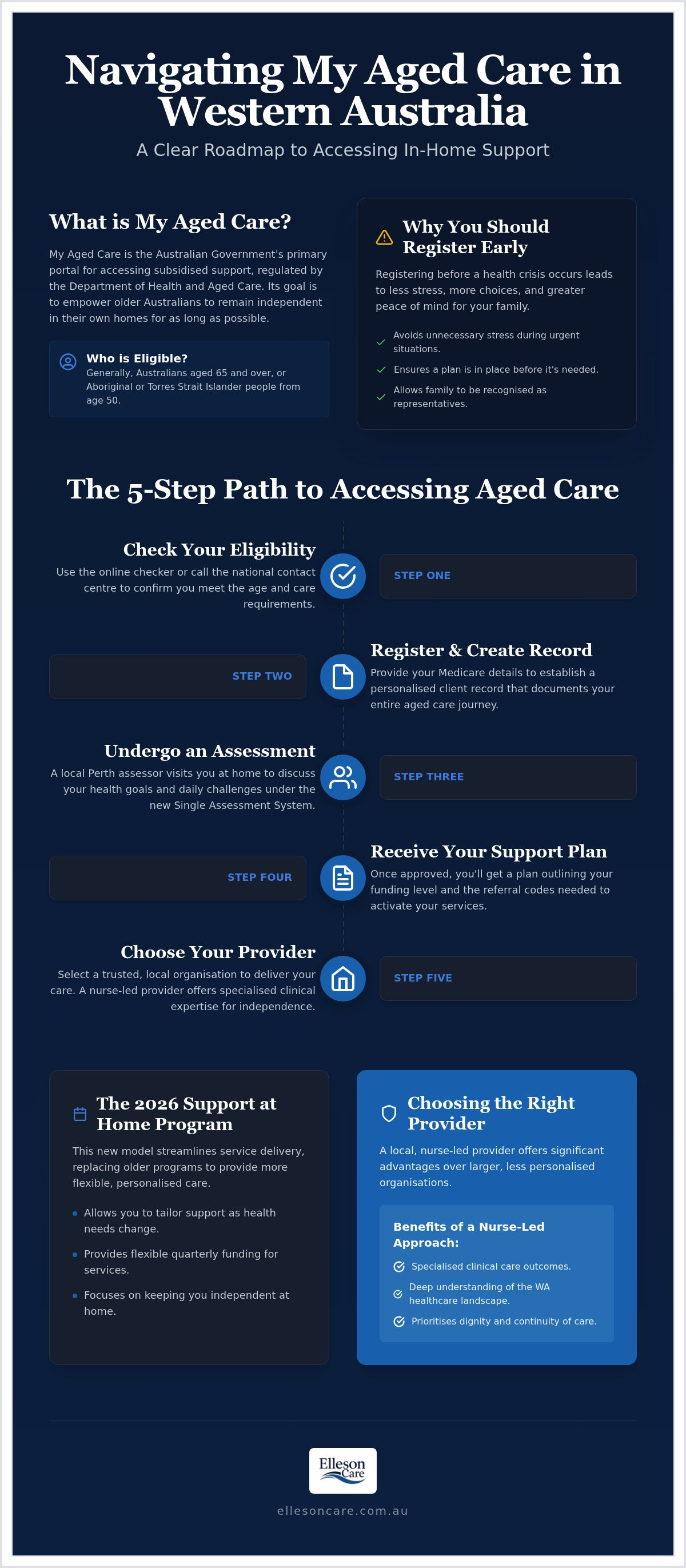
At its core, my aged care serves as the primary Australian Government portal designed to help seniors access subsidised support. It isn't just a website; it's a comprehensive system regulated by the Department of Health and Aged Care to ensure that every older Australian receives a high standard of service. The system's fundamental purpose is to empower you or your loved one to remain independent in your own home for as long as possible, providing a steady alternative to premature moves into residential care.
Eligibility for these services is generally based on age and functional need. Typically, Australians aged 65 and over are eligible to apply, while Aboriginal or Torres Strait Islander people can access the system from age 50. Understanding the broader context of aged care in Australia helps families see that this portal is part of a larger commitment to dignity and choice in later life. By centralising assessments and service referrals, the government aims to create a transparent path toward personalised well-being.
The Gateway to Support at Home
For many years, the system connected individuals to the Commonwealth Home Support Programme (CHSP) for basic assistance. However, the landscape has evolved significantly. In 2026, the transition to the new Support at Home program has streamlined how clinical and domestic services are delivered. This new model focuses on flexibility, allowing you to tailor your support as your health needs change over time.
When you first engage with the system, a personalised client record is created. This "aged care record" acts as a living document of your health journey, storing assessment results, support plans, and service history. It ensures that every health professional or nurse-led provider you work with in Perth has a clear understanding of your specific requirements, providing a sense of stability and continuity in your care.
Why You Need to Register Early
One of the most compassionate things you can do for yourself or your family is to register before a health crisis occurs. Waiting until an urgent need arises often leads to unnecessary stress and restricted choices. By setting up a profile early, you establish a foundation that allows for a methodical and thorough approach to your future needs. It gives your family the peace of mind that a plan is already in place, should your circumstances shift suddenly.
Early registration also simplifies the process for your representatives. When your details are already in the system, family members can be formally recognised as carers or advocates, making it much easier for them to support you during assessments. My Aged Care is the essential first step for any Perth senior seeking home assistance.
The 5 Steps to Accessing Aged Care in Perth
Securing support shouldn't feel like an uphill battle. By following a structured path, you can move from initial curiosity to receiving professional care with minimal stress. The process is designed to be methodical, ensuring that your specific clinical and domestic needs are matched with the right level of government funding. To begin this journey, you must engage with the official My Aged Care portal, which acts as the central hub for all subsidised services in Western Australia.
- Step 1: Check your eligibility. Use the online checker or call the national contact centre to see if you meet the age and care requirements.
- Step 2: Register and create your record. This involves providing your Medicare details and establishing a personalised client record that stays with you for life.
- Step 3: Undergo a face-to-face assessment. A local Perth assessor will visit you at home to discuss your health goals and daily challenges.
- Step 4: Receive your support plan. Once approved, you'll receive a plan outlining your funding level and the referral codes needed to activate services.
- Step 5: Choose your provider. Select a trusted organisation to deliver your care. Many families find that a nurse-led approach provides the clinical expertise necessary for staying independent.
Registration and the 1800 Number
When you're ready to register, have your Medicare card and basic medical history close at hand. Calling 1800 200 422 is often the most reassuring way to start, as you can speak directly with a representative who understands the system's nuances. If you're calling on behalf of a parent, it's vital to nominate yourself as a representative or advocate during this initial conversation. This simple step allows you to manage their my aged care profile and speak with assessors or providers on their behalf without legal hurdles later on.
From Assessment to Action
As of July 2026, the new Single Assessment System has replaced the older RAS and ACAT models, creating a more unified experience for Perth residents. While wait times for an assessment can vary based on the urgency of your situation, being prepared can speed up the process. We recommend keeping a "daily diary" for a week before your appointment. Documenting specific moments where you struggle with wound management, mobility, or domestic tasks ensures the assessor sees the full picture of your needs. If you're feeling overwhelmed by the paperwork, our team at Elleson Care can offer guidance on what to expect during this pivotal meeting.
Preparing for Your My Aged Care Assessment
The assessment is a pivotal moment in your my aged care journey. It's the point where your lived experience meets government funding criteria. To ensure you receive the appropriate level of support, you'll need more than just your Medicare card. Start by compiling a thorough medical history and an up-to-date list of all medications. This preparation allows the assessor to understand the clinical complexity of your situation rather than just seeing a snapshot of your day.
Identifying specific areas where you struggle is equally important. Whether it's difficulty with wound management or a need for domestic assistance, being precise helps the assessor categorise your needs correctly. We strongly recommend having a trusted family member or a professional nurse advocate present. Their role isn't just to provide emotional support; they can ensure that every health concern is articulated clearly and that your long-term goal of staying in your Perth home remains the central focus.
The Role of Local Perth Assessment Teams
Perth-based assessors are trained to evaluate how your home environment impacts your safety and independence. They'll look for potential hazards, such as steep steps or inaccessible bathrooms, that might hinder your ability to live alone. It's vital to be honest about your "worst days". If you usually struggle to get out of bed or manage your hygiene but happen to feel energetic during the assessment, you must describe your typical difficulties. If your care needs change after this meeting, you can request a reassessment to reflect your new circumstances.
Describing Your Clinical Needs
Clearly communicating your requirements for nursing services is essential for securing higher-tier funding. If you require specialised support like professional wound care or catheter management, highlight these clinical tasks specifically. These are often the services that make the difference between staying at home and needing to relocate. Having a nurse-led advocate during this phase ensures that the assessor understands the technical nature of your care, bridging the gap between your daily experience and the clinical standards required for subsidised support.
Understanding the 2026 Support at Home Program
The 2026 Support at Home program represents the most significant reform to the Australian aged care system in decades. It replaces the previous Home Care Packages (HCP) and Short-Term Restorative Care (STRC) models with a more responsive, integrated framework. For Perth families, this shift means moving away from a "one-size-fits-all" annual budget toward a flexible, quarterly funding model. This new structure ensures that clinical and domestic support is available when you need it most, rather than being tied to rigid, long-term allocations.
If you currently hold a Home Care Package, you've likely already transitioned into this new system. The government has applied a "no worse off" principle to protect those who were in the system before the changes, ensuring your contribution rates didn't increase during the changeover on 1 November 2025. This reform aims to significantly reduce waiting times across Western Australia, allowing seniors to access my aged care services shortly after their assessment is finalised. By streamlining the path from approval to service delivery, the system helps prevent the health declines that often occur while waiting for support.
Key Benefits of the New System
One of the primary advantages of this reform is the increased transparency regarding how your funding is utilised. You now receive clearer statements that detail exactly how your budget is spent on care versus administration. Access to assistive technology and home modifications has also been fast-tracked. Instead of waiting months for equipment approvals, the new system allows for quicker interventions to keep your home safe. Additionally, from 1 October 2026, personal care services are fully funded by the government, meaning you'll have no out-of-pocket costs for these essential tasks.
Managing Your Individualised Budget
With eight distinct funding levels ranging from $11,795 to $78,106 annually, the program allows for precise clinical nursing oversight. This granularity is vital if your health needs fluctuate. If you experience a temporary setback, the system now allows you to "top up" services to provide extra support during recovery. Because the model prioritises clinical outcomes, choosing a provider with strong nursing governance is more important than ever. A nurse-led team can help you navigate these budget adjustments, ensuring your clinical requirements are always met with high standards of care. If you're ready to see how these changes benefit your family, contact our Perth clinical team to discuss your personalised support plan.
Choosing the Right Provider in Perth
Selecting a provider is the final and most personal stage of the my aged care journey. While large national "big-box" organisations offer scale, they often lack the intimate clinical oversight required for complex health needs. In contrast, local agencies prioritising clinical leadership ensure that your support isn't just a schedule of tasks, but a managed health outcome. Truly effective in-home aged care in Perth requires a personalised touch that only a team deeply embedded in the Western Australian community can provide.
When you're interviewing potential partners, it's vital to look beyond the marketing brochures. Ask specific questions about their clinical governance and the experience of their frontline staff. Do they employ registered nurses to oversee care plans? How do they manage sudden fluctuations in health? Choosing a West Australian owned and operated agency ensures that your support is managed by professionals who understand the local hospital systems and share your community values. This local expertise provides a sense of stability and trust that is often missing in larger, fragmented organisations.
The Elleson Care Difference
Elleson Care stands apart as a nurse-led provider. Our team is guided by registered nurses with over 22 years of experience, ensuring a higher standard of clinical safety for every client we serve. We don't just tick boxes on a service list; we embrace a holistic family approach in every care plan. This means we consider the well-being of the entire family unit, providing a steady, reliable presence that respects your individual autonomy. Our deep roots in Western Australia mean we're not just a service provider; we're your neighbours, committed to the highest ethical standards of care.
Taking the Next Step with Confidence
If you're currently receiving support but feel that your care isn't meeting your clinical or personal needs, you have the right to switch providers. The process is straightforward and won't interrupt your funding. We encourage you to book a private consultation to discuss your my aged care referral codes and explore how a more clinical, nurse-led approach can improve your daily life. Our role is to act as your advocate, ensuring the system works for you rather than against you. Contact Elleson Care today to help simplify your journey and secure the high-quality in-home support you deserve.
Empowering Your Independence at Home
The journey through the my aged care system is a path toward maintaining dignity and independence within your own community. By understanding the registration steps and preparing thoroughly for your assessment, you've already taken the most important actions toward securing your future well-being. The 2026 Support at Home reforms ensure that you now have more control over your clinical and domestic support than ever before, with increased transparency and funding flexibility.
Choosing a partner who understands the Perth healthcare landscape is essential for long-term success. As a West Australian owned and operated provider, we offer nurse-led clinical expertise with registered nurses who bring over 22 years of experience to every home. We're here to ensure that your care plan is managed with both technical precision and human warmth, prioritising your safety and personal goals above all else.
Let Elleson Care guide your family through the My Aged Care journey and help you navigate these changes with confidence. You don't have to face these complex decisions alone. We're ready to support you in creating a safe, comfortable environment where you can thrive in the place you love most.
Frequently Asked Questions
Is My Aged Care free to use for all Australians?
Registration and the assessment process are completely free for all eligible Australians. However, once you begin receiving services, you may be asked to contribute toward the cost if your financial circumstances allow. The government subsidises the majority of the care, but a basic daily fee or a means-tested care fee may apply. We recommend completing a formal income assessment to understand your specific contribution requirements before starting your care journey.
How long does the My Aged Care assessment take in Perth?
Assessment timelines in Perth vary depending on the urgency of your situation and current regional demand. Generally, you can expect a face-to-face meeting within two to six weeks of your initial registration. If your health needs are critical, the process can be fast-tracked. After the assessment, it may take several more weeks to receive your formal support plan and the referral codes required to begin services with your chosen provider.
Can I choose my own provider once I am approved for a package?
You have the complete right to choose any approved provider that meets your clinical and lifestyle needs. This choice and control is a fundamental pillar of the Australian aged care system. You aren't locked into a specific organisation and can switch providers at any time if your current support doesn't meet your expectations. Selecting a local, nurse-led team ensures your care is managed by experts who understand the unique Western Australian healthcare landscape.
What is the difference between a Home Care Package and CHSP?
The Commonwealth Home Support Programme (CHSP) provides entry-level, subsidised support for basic tasks like cleaning or transport. In contrast, Home Care Packages, which transitioned to the Support at Home program in late 2025, are designed for individuals with more complex or ongoing clinical needs. Support at Home offers higher funding levels and greater flexibility, allowing for professional nursing oversight and specialised clinical care that isn't typically available through the basic CHSP model.
What happens if my My Aged Care application is rejected?
If your application is unsuccessful, you'll receive a letter explaining the decision based on the current assessment criteria. You have the right to request a review of the decision if you believe your circumstances weren't fully understood. Alternatively, you can reapply later if your health needs change or your functional independence declines. We often suggest keeping a detailed diary of your daily challenges to provide clearer evidence during any future reassessment process.
How do I find my My Aged Care referral code?
Your referral codes are unique identifiers found within your my aged care client record. You can access these codes by logging into the online portal via myGov or by calling the national contact centre on 1800 200 422. These codes are essential for your chosen provider to activate your services. If you're working with a family representative, they can also access these details on your behalf to help streamline the commencement of your care.
Can I use My Aged Care for respite care in Perth?
Yes, you can access subsidised respite care in Perth through the my aged care system. Respite is designed to provide primary carers with a necessary break while ensuring the individual continues to receive high-quality support. This can be delivered in your own home or through community centres. Including respite in your support plan is an excellent way to maintain a holistic family approach while supporting the well-being of everyone involved.
Do I need a doctor’s referral to register with My Aged Care?
You don't need a formal referral from a doctor to register with the system. Any individual, family member, or friend can initiate the process online or over the phone. While a referral isn't mandatory, having your GP's medical summary available during the assessment is highly beneficial. This clinical documentation helps the assessor understand your health history and ensures that your support plan accurately reflects the level of professional nursing care you may require.


