

What does the NDIS Code of Conduct look like when a worker is helping with personal care, supporting a household task or planning a community outing? The NDIS code of conduct for workers puts respect, safety and integrity into everyday interactions, not just policy documents. Applying it can feel less straightforward when a participant’s choices, privacy or wellbeing raise questions.
Clear guidance matters, especially when a participant may be at risk or raises a concern. Good support makes the Code visible through everyday choices: listening, communicating clearly and treating each person with dignity. Workers also need to know when to pause, seek guidance and follow the right reporting steps.
This practical guide explains the Code’s core expectations in plain English and how they apply to common support situations. It covers ways to uphold choice, privacy and safety, what to do when something concerns you, and how these principles inform person-centred NDIS support.
Key Takeaways
- The NDIS code of conduct for workers sets expectations for safe, respectful and ethical support, including protecting participants’ rights and acting with integrity.
- Apply the Code in everyday tasks by seeking consent, respecting preferences and protecting personal information during care and community access.
- Respecting a participant’s choices also means responding appropriately to foreseeable risks and following agreed support procedures.
- If a conduct or safety concern arises, distinguish between immediate safety steps, internal notification, complaints and reportable incident obligations.
- Clear procedures, supervision, ongoing learning and accessible feedback pathways help make the Code part of consistent, accountable support.
What is the NDIS Code of Conduct for workers?
Featured snippet definition: The NDIS Code of Conduct is a set of conduct requirements established under the National Disability Insurance Scheme (Code of Conduct) Rules 2018. The NDIS Quality and Safeguards Commission explains that it sets expectations for how NDIS providers and workers deliver supports and services to people with disability.
In plain English, the NDIS code of conduct for workers guides how support is provided, not just how workers respond to serious misconduct. It matters because participants should be treated with dignity and receive safe, respectful support, while workers need clear expectations to guide professional decisions. The Code operates within the broader National Disability Insurance Scheme, but the Commission’s guidance and the Code’s Rules set out the relevant conduct requirements.
Who must follow the NDIS Code of Conduct?
The Code applies to NDIS providers and workers, whether or not a provider is registered with the NDIS Commission. Registration status does not remove a worker’s responsibility to follow the Code when delivering NDIS supports. Its expectations apply across settings, including personal care at home, domestic assistance and support to take part in community activities in Perth.
The Code is distinct from a provider’s policies, which set procedures for its own workforce, and from worker training, which helps build knowledge and skills. The NDIS Practice Standards are a separate framework used in the Commission’s quality and safeguarding arrangements for registered providers. These measures can support consistent practice, but they do not replace the Code’s conduct requirements.
What conduct principles should workers understand?
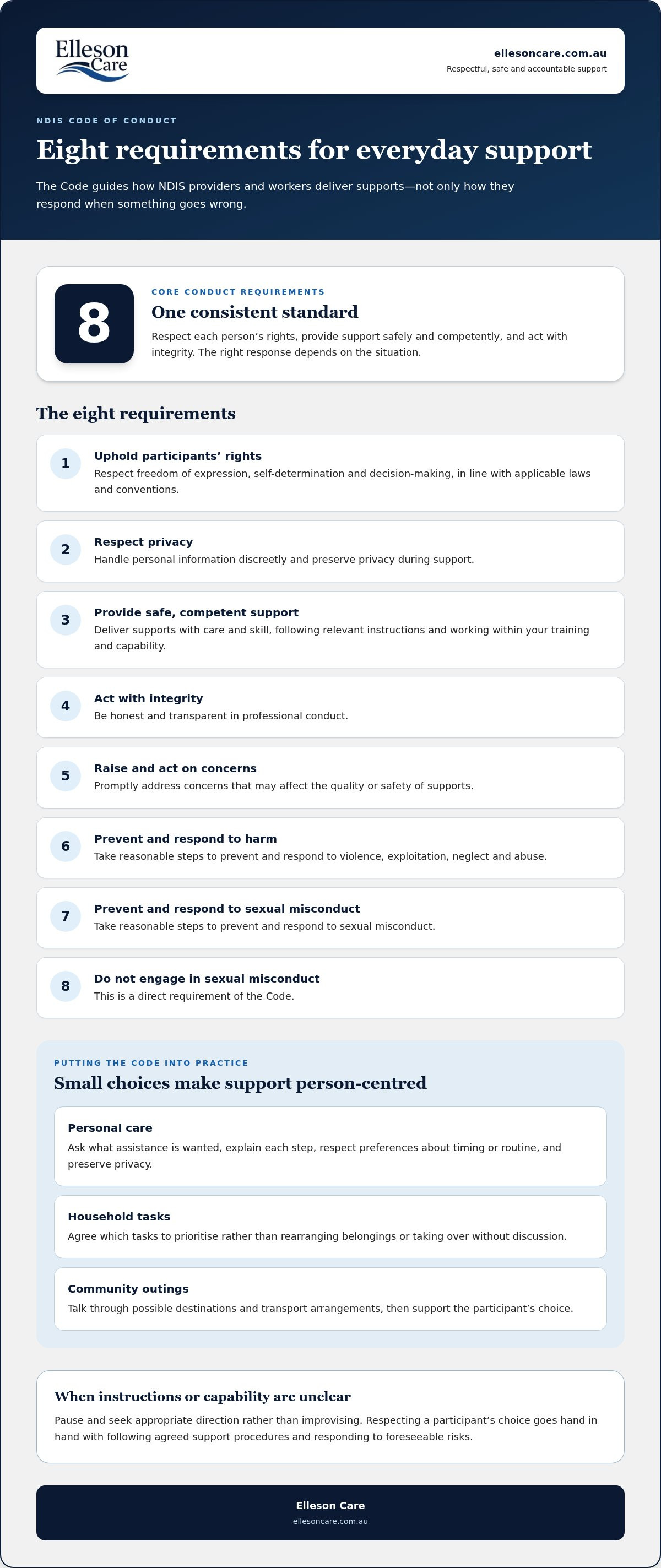
The NDIS Commission’s Code sets out eight requirements. In summary, workers and providers must:
- Respect each participant’s rights to freedom of expression, self-determination and decision-making, in line with applicable laws and conventions.
- Respect participants’ privacy.
- Provide supports safely and competently, with care and skill.
- Act with integrity, honesty and transparency.
- Promptly raise and act on concerns that may affect the quality or safety of supports.
- Take reasonable steps to prevent and respond to violence, exploitation, neglect and abuse.
- Take reasonable steps to prevent and respond to sexual misconduct.
- Not engage in sexual misconduct.
These expectations apply consistently, but the appropriate response depends on the situation. Respecting privacy during personal care, for example, calls for discretion, while a concern about possible harm requires appropriate action. The Code is not a checklist to use only after something goes wrong. It informs everyday professional conduct and support decisions.
How does the NDIS Code of Conduct apply during everyday support?
The Code is reflected in small, repeated decisions: asking before assisting, explaining what will happen and giving the participant time to respond. The NDIS Commission’s NDIS Code of Conduct sets the standards. Workers apply them in ways that respect each person’s rights while providing safe, competent support.
How can workers respect choice, dignity and privacy?
Choice is meaningful when options are clear and the participant has room to decide. During personal care, a worker can ask what assistance is wanted and respect preferences about timing or routine. For domestic assistance, they can agree which tasks to prioritise rather than rearranging belongings or taking over without discussion. On a community outing in Perth, they can talk through possible destinations and transport arrangements, then support the participant’s choice.
Respecting a decision does not mean rushing or assuming consent. Explain the task in an accessible way, check understanding and ask before touching a person or their possessions. If someone declines, listen and follow relevant support instructions rather than pressuring them. For shared principles of dignity and independence across support settings, see this in-home aged care guide.
Privacy also depends on how information is handled. Discuss personal matters discreetly, share information only through appropriate channels and avoid leaving records or messages where others can see them. During personal care, explain each step and preserve the participant’s privacy as much as possible.
What does safe and competent support look like?
Safe support means following relevant support plans, instructions and workplace procedures while staying alert to what is happening in the moment. Workers should only perform tasks they are trained and competent to do. If a request falls outside their capability or instructions are unclear, they should pause and seek appropriate direction rather than improvise. The NDIS code of conduct for workers calls for both respect for choice and care in how support is delivered.
For example: “I’ll support your preferred routine, and we’ll follow the agreed steps for using your mobility aid.”
Clear communication helps participants understand what support is available and what will happen next. Person-centred NDIS support services can put these principles into practice through personal care, domestic assistance and community participation, with attention to each participant’s preferences and agreed support arrangements.
NDIS Code of Conduct: common misunderstandings workers should avoid
The NDIS Code of Conduct is not reserved for investigations or serious incidents. It guides ordinary professional judgement, from how a worker communicates a change to whether they pause and clarify an instruction. The Guidance for NDIS Workers offers practical examples of how conduct expectations apply in support situations. The NDIS code of conduct for workers supports consistent, respectful practice. It does not mean that every difficult interaction is a breach.
| Misunderstanding | Careful correction |
|---|---|
| “The Code only matters after something serious happens.” | It also guides routine conduct, including clear communication, seeking consent and respecting a participant’s preferences. |
| “Person-centred support means doing anything a participant asks.” | Workers should take requests seriously while considering agreed support arrangements, safety and the limits of their role. |
| “We’re friendly, so professional boundaries are less important.” | Warmth can build trust, but it does not replace privacy, appropriate boundaries or accountability. |
| “A disagreement automatically means someone has breached the Code.” | Disagreement alone does not establish a breach. The circumstances and conduct matter. |
Does the Code apply only when a worker does something wrong?
No. Its preventive role is to help workers make considered choices before a concern escalates. For example, explaining a change in plans and listening to a participant’s response can support trust and informed decision-making. A worker who checks a preference instead of assuming it is applying the Code in everyday practice. If a participant disagrees with a decision, listen and try to understand the difference. Disagreement by itself is not proof of misconduct.
Does person-centred support mean doing whatever a participant requests?
Respecting autonomy does not mean ignoring foreseeable safety concerns or agreed procedures. A worker can acknowledge what the participant wants, explain any relevant support-plan or safety consideration, and discuss options without being dismissive. If a request falls outside the worker’s role or competence, they should avoid improvising and seek appropriate guidance through workplace channels.
Being approachable matters, but the relationship remains professional. Workers should protect personal information, maintain appropriate boundaries and be accountable for their actions, even when a support relationship feels familiar. If a situation is uncertain, check current NDIS Commission guidance and follow relevant workplace procedures rather than making assumptions or reaching an absolute conclusion.
What should an NDIS worker do about a conduct or safety concern?
If a participant may be at risk, act promptly to protect their immediate safety, then report the concern through the appropriate channels. Stay calm and follow relevant emergency and workplace procedures. A worker’s role is to respond, listen and pass on accurate information, not to investigate allegations or decide whether a breach has occurred.
What if a participant may be at immediate risk?
Prioritise safety. If someone is in immediate danger or needs urgent emergency assistance, call 000, then follow workplace procedures and notify the appropriate supervisor as soon as it is safe to do so. Urgent action does not replace internal reporting. Listen to the participant without pressing for details, and do not promise a particular outcome or confidentiality you cannot guarantee.
How should a worker raise and record a concern?
Use the provider’s reporting and complaints procedures, and raise urgent concerns without delay. Record what you observed or were told, relevant times, who was present and what actions you took. Keep the account factual, distinguish direct observations from information shared by others, and handle records in line with privacy and workplace procedures. Do not conduct your own interviews or try to resolve a serious allegation alone.
- Make the situation safer. Address immediate risks within your role and use emergency procedures where needed.
- Listen respectfully. Give the participant space to explain, without leading questions or judgement.
- Write a factual record. Note relevant details and actions as soon as practicable, following workplace processes.
- Escalate through the right channel. Notify the appropriate supervisor or provider contact, and follow any further instructions.
These pathways are related but distinct. An internal notification informs the provider so it can respond under its procedures. A participant, worker or other person can also make a complaint to the NDIS Quality and Safeguards Commission, including anonymously, by calling 1800 035 544 or lodging it online. A complaint is not the same as a reportable incident.
For registered providers, reportable incidents include specified serious events such as a participant’s death, serious injury, abuse or neglect, sexual misconduct, or unauthorised use of a restrictive practice. The provider must notify the Commission within 24 hours for these serious incidents, with a final report due within five business days. Workers should promptly pass on relevant information. The provider is responsible for meeting its notification obligations.
Clear, person-centred communication is also central to clinical support. Read this Perth nursing services guide for more on personalised clinical care at home. To learn about Elleson Care’s NDIS support, visit the service page.
How can providers and workers make the Code part of good support?
The Code is easier to apply consistently when workers know what is expected, where to find guidance and who to approach when a situation is unclear. Clear procedures and regular supervision can turn conduct principles into practical decisions. They also give workers an opportunity to reflect on what is working well and where they need support.
What helps workers uphold the Code consistently?
Induction should clarify a worker’s role, relevant workplace procedures and the steps for raising concerns. Workers also need to understand the participant’s support plan and any instructions relevant to the tasks they perform. The NDIS Worker Orientation Module, Quality, Safety and You, can support learning about quality and safeguards. Ongoing discussion and supervision help workers consider how the NDIS code of conduct for workers applies when circumstances change or instructions are unclear.
Providers can reinforce accountability by making feedback and complaints pathways understandable and accessible to participants. Workers should listen respectfully, explain how feedback can be shared and follow the provider’s process for passing it on. Feedback can reveal where communication or support practices need attention. Complaints should be handled respectfully, with appropriate privacy and clear communication about next steps, without promising an outcome before the matter is considered.
What does person-centred NDIS support look like in Perth?
In everyday support, person-centred practice means keeping the participant’s goals and preferences in view while providing support safely and respectfully. In personal care, that may mean communicating before each task and respecting a person’s preferred routine. With domestic assistance, it can involve agreeing together which household tasks matter most. For community participation, it means supporting the person’s chosen activities and communicating clearly about arrangements.
Continuity and respectful communication can help workers understand what matters to each participant and provide support with dignity. Elleson Care is a West Australian owned and operated provider of NDIS support services in Perth, including personal care, domestic assistance and community participation. Its team is led by registered nurses with over 22 years of experience. This experience is relevant context for its supports, not a guarantee of compliance. The Code remains a standard workers and providers must apply in practice.
For a closer look at support options, Explore Elleson Care’s NDIS support services.
Put respectful, safe support into practice
The NDIS code of conduct for workers guides everyday decisions as well as responses to concerns. Seeking consent, respecting privacy and supporting participant choice help make the Code real in each interaction. When a safety or conduct concern arises, act promptly, record facts and follow the appropriate reporting pathway rather than trying to investigate it alone.
Consistent support also relies on clear communication, understanding role boundaries and listening to participant feedback. These practices help protect dignity and build trust over time.
Elleson Care is a West Australian owned and operated provider offering NDIS support in Perth, including personal care, domestic assistance and community participation. Its team is led by registered nurses with over 22 years of experience. To learn more, explore Elleson Care’s NDIS support services.
With clear expectations and a person-centred approach, workers can help create support that feels respectful, safe and shaped around each participant.
Frequently Asked Questions
Does the NDIS Code of Conduct apply to all support workers?
Yes, the Code applies to NDIS providers and workers in connection with NDIS supports and services, including those delivered by unregistered providers. The NDIS code of conduct for workers is not limited to staff employed by registered organisations. A worker’s specific responsibilities depend on their role, the support being delivered, relevant participant arrangements and workplace procedures. For example, a worker providing in-home support should follow relevant instructions while respecting the participant’s rights and preferences.
What are the main principles of the NDIS Code of Conduct?
The Code requires providers and workers to respect participants’ rights, privacy, self-determination and decision-making; provide supports safely and competently, with care and skill; and act with integrity, honesty and transparency. It also requires workers and providers to raise and act on concerns, take reasonable steps to prevent and respond to violence, exploitation, neglect and abuse, and take reasonable steps to prevent and respond to sexual misconduct. These principles guide routine support, not only incident responses.
Can an NDIS worker refuse a participant’s request?
There is no blanket yes or no. Workers should listen, explain their response respectfully and consider the participant’s preferences alongside relevant support arrangements, safety and their role. If a request falls outside the worker’s competence or responsibilities, they should not improvise or dismiss the participant. They can explain the concern, discuss suitable options and seek guidance through workplace procedures. The circumstances matter, so workers should avoid treating every request or disagreement the same way.
What should an NDIS worker do if they witness abuse or neglect?
Prioritise the participant’s immediate safety, follow emergency procedures and call 000 if there is immediate danger or an urgent need for emergency assistance. Listen calmly, record factual observations and actions, and promptly notify the appropriate workplace contact. Do not investigate the allegation yourself or promise a particular outcome. Internal notification is separate from a reportable incident notification. Registered providers must notify the NDIS Commission within 24 hours for specified serious incidents, including abuse or neglect.
Is the NDIS Code of Conduct different from the NDIS Practice Standards?
Yes. The Code sets conduct expectations for NDIS providers and workers delivering supports and services. The NDIS Practice Standards describe quality and safeguards requirements for registered providers and are used in the Commission’s provider quality framework. They are related, but they are not interchangeable. A worker’s day-to-day conduct responsibilities under the Code should not be confused with provider-level obligations under the Practice Standards. Workers should follow the procedures and instructions relevant to their role and the support they deliver.
What happens if an NDIS worker breaches the Code of Conduct?
A concern may be handled through the provider’s processes and, depending on the circumstances, may also be considered through NDIS Commission regulatory pathways. The response or outcome is not automatic. It depends on the conduct, available evidence and applicable processes. A worker who becomes aware of a possible breach should raise it through the appropriate channel and keep any record factual. Participants and others can also complain to the Commission about a potential Code breach.
How can an NDIS worker make sure their support respects a participant’s rights?
Listen to the participant, seek consent, explain support clearly and offer choices that reflect their preferences and goals. Protect privacy, follow relevant support plans and workplace procedures, and avoid taking over tasks the participant wants to do themselves. If safety or role boundaries are unclear, pause and seek appropriate guidance. In Perth, these practices matter across settings, from personal care at home to domestic assistance and community participation.


