

What if the key to providing the best possible support for your loved one isn't working harder, but actually allowing yourself the space to breathe? Caring for a family member with complex needs is a deeply rewarding journey, yet the reality of caregiver burnout is something many Perth families face in silence. You want the best for them, but the constant pressure can leave you feeling depleted and uncertain about where to turn for help.
It's completely natural to feel anxious about leaving your loved one's health in someone else's hands, especially when clinical needs are involved. This article will show you how to navigate ndis respite care funding to secure the high-quality, nurse-led support your family deserves. You'll learn how to recharge your own batteries while ensuring your loved one remains safe, comfortable, and professionally cared for by experts who understand the nuances of specialised healthcare.
We'll break down the 2026 funding rules for Short Term Accommodation, clarify the transition from STA to STR terminology, and provide a clear path to finding local clinical expertise that offers genuine peace of mind.
Key Takeaways
- Understand the transition from Short Term Accommodation (STA) to Short Term Respite (STR) and how this funding specifically supports your family's informal care network.
- Learn how to access the standard 28-day annual allocation of ndis respite care to manage your well-being without compromising on support quality.
- Discover the practical differences between accommodation-based stays and in-home support to find the most comfortable environment for your loved one's needs.
- Follow a step-by-step guide to preparing for an NDIS plan review by documenting the clinical necessity of a temporary break for both the carer and participant.
- Gain peace of mind by choosing a nurse-led provider in Perth that prioritises safety and clinical excellence for participants with complex health requirements.
What is NDIS Respite Care? Understanding Short Term Respite (STR) in 2026
The way families access support through the National Disability Insurance Scheme (NDIS) is changing to better acknowledge the effort required for long-term caregiving. While many families in Perth still use the term ndis respite care, the NDIA has refined its language to focus on the clinical and emotional outcomes of the support. This shift ensures that the funding is recognised not just as a service for the participant, but as a vital investment in the stability of the entire household.
Proactive ndis respite care is a clinical necessity for sustainable support, not a luxury or a simple "holiday." It's specifically designed to support your informal support network, which includes the dedicated family members and friends who provide daily assistance. By choosing to organise respite before you reach a point of total exhaustion, you can effectively prevent caregiver burnout and avoid the stress of crisis situations. Ultimately, this support is about sustaining the caring relationship, allowing you to return to your role with renewed energy and focus.
The Shift from STA to Short Term Respite
The transition from Short Term Accommodation (STA) to Short Term Respite (STR) was introduced to reflect the true purpose of the funding. Previously, the term "accommodation" often led to confusion, suggesting the focus was merely on the building or location. The updated STR terminology emphasises the "respite" element, which is the professional intervention that allows carers to rest. When you attend your next planning meeting, using the term STR helps planners understand that you're seeking a structured break to maintain your health and the quality of care you provide at home.
Short Term Respite is a support that provides a temporary break for both the participant and their primary carer.
Who Can Access NDIS Respite Funding?
Securing funding for respite depends on meeting specific "reasonable and necessary" criteria. Generally, this support is available to participants who live with informal carers or those who require high-intensity clinical support that can't be maintained 24/7 by a single person. To access these funds, you'll need to demonstrate how a temporary change in support helps you achieve your long-term goals. At Elleson Care, we find that our 22 years of clinical experience is a significant asset for families. Because we're nurse-led, we can help you document the clinical necessity of respite, ensuring the safety and dignity of your loved one are prioritised throughout the process.
Funding and Eligibility: How Much Respite Can You Access?
Funding for ndis respite care is primarily located within your "Core Supports" budget, specifically under the "Assistance with Daily Life" category. The NDIA typically allocates up to 28 days of Short Term Respite per year to ensure families have regular intervals of rest. This funding is all-inclusive and generally covers the following essential components:
- 24-hour support from qualified care professionals.
- Safe and comfortable accommodation away from home.
- Nutritious meals and snacks tailored to dietary requirements.
- Negotiated social and community activities to promote engagement.
This comprehensive level of support allows the primary carer to fully disengage from their daily responsibilities, knowing their loved one is in a secure environment. This perspective is echoed by Carers Australia on respite, which highlights that these breaks are essential for the long-term well-being of the entire family unit. Keep in mind that individual stays are generally limited to 14 days at a time to maintain the focus on temporary relief rather than long-term housing.
The 28-Day Rule and Exceptional Circumstances
While 28 days is the standard annual framework, families often find creative ways to utilise this time, such as scheduling one weekend a month or several shorter mid-week breaks. However, there are instances where 28 days may not be sufficient. In cases of high clinical need, such as when a participant requires specialised ventilator or wound care, you can request additional funding. For 2026, there are specific rate caps for Western Australia [verify] that change based on the staff-to-participant ratio and whether the support falls on a weekend or public holiday. Requesting an extension requires clear clinical documentation to justify why the standard allocation doesn't meet the safety requirements of the participant.
What Respite Funding Does Not Cover
Distinguishing between a therapeutic break and other support types is necessary to ensure your funding is used correctly. STR funding cannot be applied to permanent housing or long-term residential care arrangements. Similarly, the NDIS does not cover purely social "holidays" or luxury tourism activities that lack a clear link to your disability-related goals. Every stay must align with the broader objectives in your plan, such as building independence or maintaining your current living situation. If you're unsure how your current plan covers these needs, our team at Elleson Care can help you understand the specific categories available to you.
Types of Respite: Finding the Right Fit for Your Family
Every family has unique dynamics and care requirements. Finding the right type of ndis respite care is about balancing the participant's comfort with the carer's need for a complete break. In Western Australia, families can choose between structured facility stays or personalised support within their own residence. This flexibility ensures that respite care perth remains a highly adaptable service that respects individual preferences and clinical needs.
Integrating nurse-led clinical support into these choices ensures that safety is never compromised. Whether the goal is social engagement or maintaining a complex medical routine, the delivery model should be tailored to the individual's specific goals. This approach prioritises dignity and safety, allowing everyone involved to feel secure during the period of transition.
Short Term Accommodation (STA) Centres
Choosing a dedicated centre often provides the change of scenery that can significantly boost a participant's mental well-being. These environments are specifically designed for accessibility and safety, often facilitating peer interaction through shared activities. When evaluating a centre, it's vital to look for clinical staffing levels and a welcoming atmosphere rather than just a clinical layout. Centres that offer more than just a bed, such as those with planned community outings, allow participants to build independence and social skills in a supportive, controlled setting.
In-Home Respite and Clinical Support
For many, the comfort and familiarity of their own home are essential for maintaining emotional stability. In-home respite is particularly beneficial for participants with sensory sensitivities or intellectual disabilities who rely on a strict daily routine. By utilising professional nursing services, families can ensure that complex health requirements, such as ventilator support or wound management, are handled with clinical precision. This model allows the primary carer to step away while the participant remains in a known environment, reducing the anxiety often associated with transitions.
At Elleson Care, our registered nurses oversee all support workers, providing an additional layer of expertise that general providers often lack. This oversight ensures that whether the respite occurs in a centre, at home, or out in the community, the standard of care remains exceptionally high. We focus on a holistic, family-centred approach that preserves the participant's autonomy while giving the family the space they need to recharge.
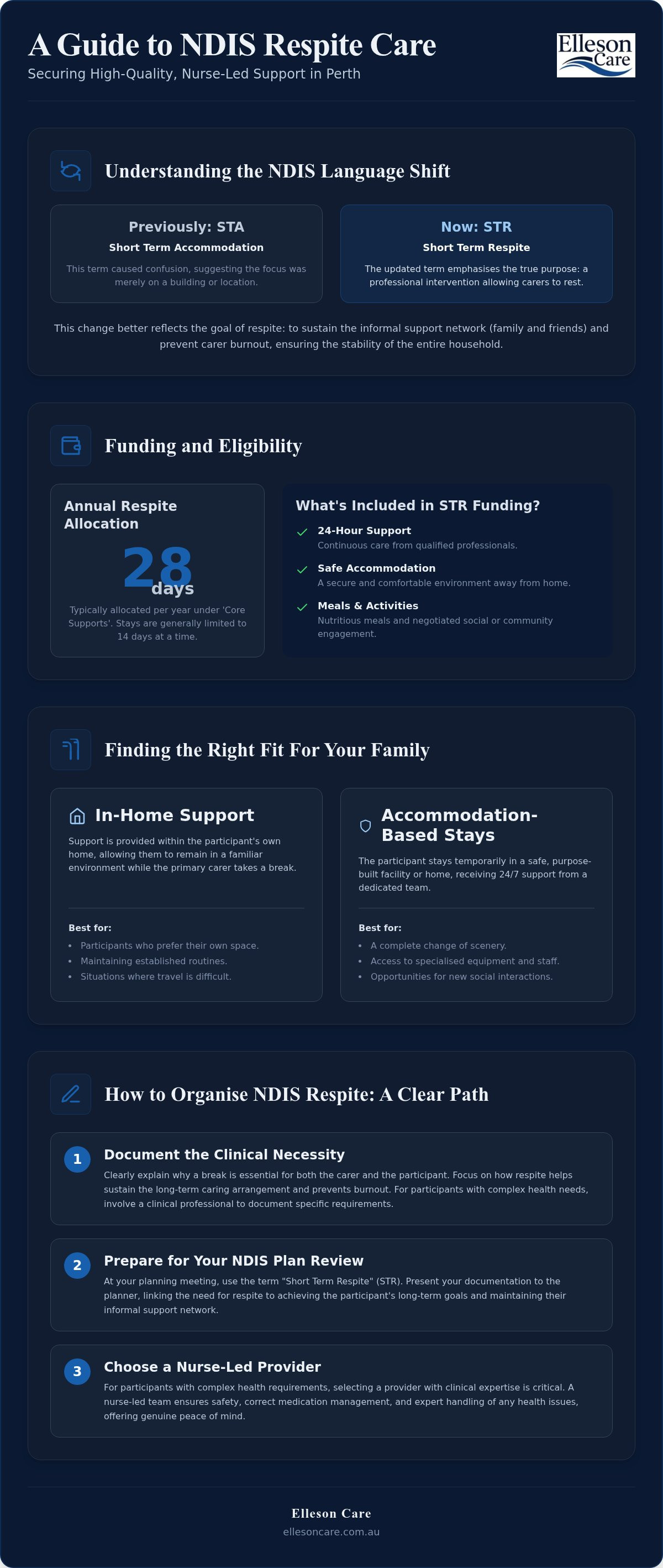
How to Organise NDIS Respite in Perth: A Step-by-Step Guide
Organising ndis respite care doesn't have to be a source of stress. By following a structured approach, you can transition from feeling overwhelmed to having a clear support plan that prioritises your family's health. This process ensures that every detail, from complex medication management to personal social preferences, is documented and respected by your chosen provider.
- Step 1: Review your current NDIS plan for "Short Term Respite" or "STA" funding. This is usually located under your Core Supports budget.
- Step 2: Collect evidence of carer burnout or the documented need for a temporary break. Clinical letters or a diary of care requirements can be helpful.
- Step 3: Consult with a registered ndis provider like Elleson Care to discuss their clinical expertise and availability.
- Step 4: Create a detailed respite plan. This document should integrate clinical requirements, such as wound care or ventilator support, with the participant's personal goals.
- Step 5: Confirm the booking and prepare for the transition. Sharing routine details with the care team helps maintain a sense of stability for your loved one.
Preparing for Your NDIS Plan Review
Articulating the need for respite to your NDIS planner or Local Area Coordinator (LAC) requires a focus on sustainability. You must clearly explain how a break allows you to continue your role as a primary carer effectively. Carer impact statements are a vital tool in this process, as they provide a formal record of the physical and emotional toll of 24-hour care. You should document how respite will help maintain your informal support network by preventing long-term exhaustion and supporting the participant's independence.
Choosing a Local Perth Provider
Selecting a provider with deep roots in the Perth healthcare system offers significant advantages, especially for families managing complex clinical needs. Local knowledge ensures that your provider can coordinate effectively with other West Australian health services if required. When interviewing potential partners, ask direct questions about their staff training and nurse-led oversight. A provider that is West Australian owned and operated often brings a more personalised, community-focused perspective to their care. It's important to verify that registered nurses are directly involved in supervising the support workers who will be caring for your loved one.
If you're ready to secure professional, clinical support for your next break, you can connect with our Perth-based clinical team to discuss a personalised respite plan.
Why Nurse-Led Respite Matters: The Elleson Care Difference
Choosing a provider for ndis respite care involves more than just finding an available vacancy. It requires a partner who understands that clinical safety is the foundation of a truly restful break. At Elleson Care, our approach is built on over 22 years of specialised nursing experience, ensuring that every participant receives high-tier professional support. We operate as Compassionate Experts, where clinical authority is balanced with human warmth to create an environment that feels both secure and welcoming for Perth families.
Our registered nurses don't just work in the background; they actively oversee the care provided by our support workers during every stay. This nurse-led model is particularly vital for participants with complex needs who require specialised interventions like wound management, catheter care, or ventilator support. By having clinical leadership at the core of our service, we provide a level of safety and reliability that general support providers often lack. This oversight ensures that evidence-based practices are followed, maintaining the highest standards of personal dignity and clinical excellence.
Clinical Peace of Mind for Families
Families often carry a significant emotional burden when considering a break, particularly when their loved one has complex health requirements. Knowing that a Registered Nurse is supervising the care team significantly reduces the anxiety of leaving a loved one's health in someone else's hands. We adopt a holistic family approach, recognising that the well-being of the participant is inextricably linked to the stability and health of their entire home environment. As a West Australian owned and operated healthcare provider, we're deeply committed to our local community, offering a steady and reliable presence that families can depend on for long-term stability.
Tailored Respite Plans in Perth
No two families share the same journey, which is why we develop a personalised care plan for every respite stay we facilitate. These plans are designed to maintain the participant's dignity and autonomy, ensuring their personal goals are met while their primary carer takes the necessary time to recharge their own batteries. Whether the stay involves community engagement or intensive in-home support, we focus on creating a seamless transition that respects the individual's routine and comfort. We believe that professional care should never feel clinical or detached, but rather like a supportive extension of the family unit.
Contact Elleson Care today to discuss your NDIS respite needs in Perth.
Securing Sustainable Support for Your Family's Future
Accessing ndis respite care is an essential step in maintaining the health and longevity of your family's informal support network. By understanding the transition to Short Term Respite and the specific 2026 funding rules, you can move forward with the confidence that your loved one's needs are fully recognised. Whether you choose in-home support or a dedicated centre, the priority remains the same: ensuring a safe, dignified experience that allows you to return to your caring role with renewed energy.
As a West Australian owned and operated provider with over 22 years of experience, we're dedicated to providing high-standard clinical and NDIS support. Our registered nurses oversee every aspect of care, offering specialised expertise in wound management and ventilator support to give you genuine peace of mind. You don't have to navigate this journey alone. You're invited to book a consultation with our nurse-led team in Perth to discuss how we can tailor a respite plan to your family's specific needs. We're here to provide the steady, compassionate expertise you need to thrive.
Frequently Asked Questions
What is the difference between STA and NDIS respite care?
These terms describe the same essential support under the NDIS framework. Short Term Accommodation (STA) was the original terminology, but it is now frequently referred to as Short Term Respite (STR) to better reflect its purpose. Both provide funding for a temporary stay away from your usual home, covering the costs of 24-hour care, accommodation, and meals. This shift in language emphasises the importance of giving the primary carer a meaningful break.
Can I use my NDIS funding for a respite stay in Perth?
You can certainly use your NDIS funding for ndis respite care in Perth if it is included in your Core Supports budget. This funding is designed to be flexible, allowing you to choose a local provider that aligns with your clinical requirements and social goals. Using a Perth-based service ensures you remain close to your existing healthcare network while receiving professional support that helps you maintain your independence and well-being.
How many days of respite care does the NDIS usually fund?
The NDIS typically provides funding for up to 28 days of Short Term Respite per year for eligible participants. You can use this allocation flexibly to suit your family’s needs, such as scheduling one weekend away every month or taking a longer block of up to 14 days. It is vital to document how these breaks support your informal care network during your plan review to ensure this funding continues to meet your needs.
Do I need a registered nurse for my NDIS respite care?
A registered nurse is necessary if you have complex health needs that require professional clinical management during your stay. This includes specialised requirements such as ventilator support, complex wound care, or catheter management. While general support workers assist with daily living, nurse-led oversight provides a higher safety standard. This ensures that high-intensity medical needs are handled with precision, offering peace of mind for families managing complex disability requirements.
Can respite care be provided in my own home?
Respite care can be delivered in your own home through professional in-home support services. This is often an ideal solution for participants who find transitions to new environments stressful or who rely on a very specific home routine. Our clinical team provides personalised care and domestic assistance in your familiar surroundings, allowing your primary carer to recharge while you remain comfortable and secure in the environment you know best.
What happens if I need more than 28 days of respite care in a year?
If your circumstances require more than the standard 28-day allocation, you will need to demonstrate that the additional support is reasonable and necessary. This process involves providing evidence of high clinical needs or a significant change in your home situation, such as a carer's illness. Clinical documentation from registered nurses can be used to justify why an extension is required to maintain your safety and the stability of your informal support network.
How do I get respite care added to my NDIS plan during a review?
To secure ndis respite care during a plan review, you should provide a carer impact statement that explains the necessity of a temporary break. You must articulate how this support will help sustain your caring relationship and prevent burnout. Including clinical evidence of your specific care needs from a professional provider helps your LAC or planner understand the level of support required to keep you safe and well-cared for during these periods.
Is Elleson Care a registered NDIS provider in Western Australia?
Elleson Care is a fully registered NDIS provider based in Perth, specialising in nurse-led clinical and disability support. We are West Australian owned and operated, with a leadership team of registered nurses who bring over 22 years of experience to our community. Our registration ensures that we adhere to the highest safety and quality standards, allowing us to deliver complex clinical care and personal support tailored to the unique goals of every participant we serve.


