

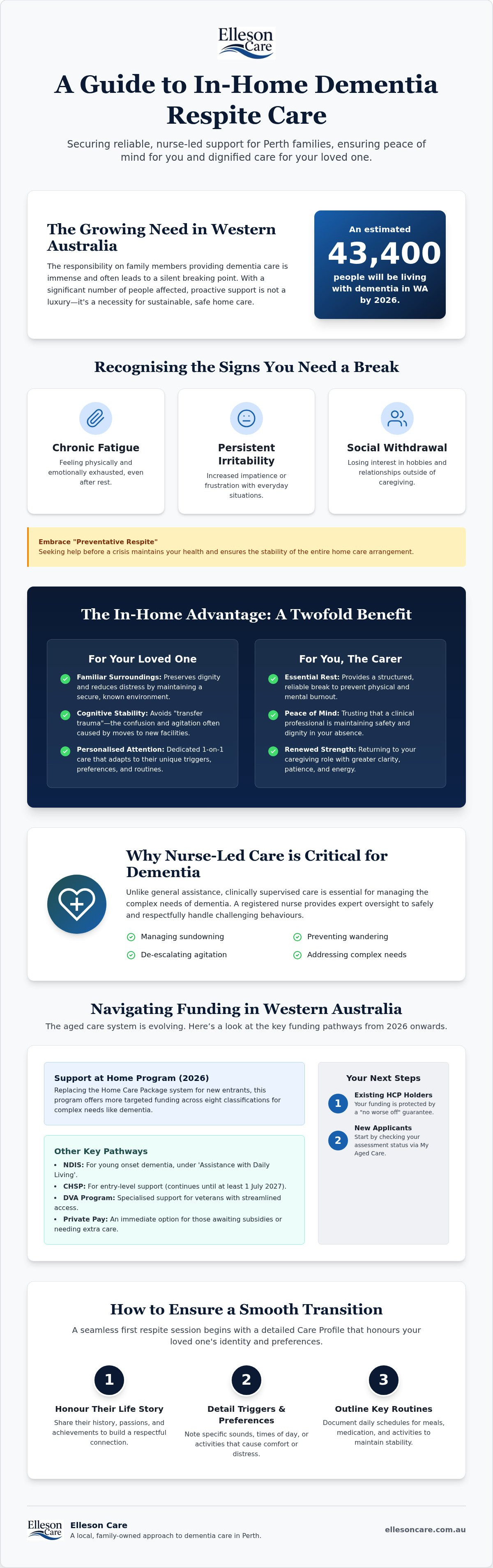
With an estimated 43,400 people living with dementia in Western Australia in 2026, the weight of responsibility on family members often reaches a silent breaking point long before professional help is sought. You likely feel that providing this care yourself is the only way to guarantee your loved one's dignity, yet the resulting burnout and social isolation make it vital to find reliable in-home respite for dementia caregivers Perth. It's natural to feel anxious about leaving their safety in someone else's hands, especially with the recent complexities of the Support at Home program transitions.
This guide will help you discover how to secure high-quality, nurse-led care that prioritises both clinical safety and your own well-being. You'll learn how to navigate the 2026 funding landscape to find a reliable break that offers true peace of mind. We'll explore how professional supervision provides a respectful transition into support, allowing you to return to your caregiving role with renewed strength and clarity.
Key Takeaways
- Understand how professional in-home support preserves your loved one's dignity in familiar surroundings while providing you with a necessary break.
- Navigate the 2026 Support at Home program updates to effectively secure funding for in-home respite for dementia caregivers Perth.
- Identify the critical safety benefits of nurse-led care when managing complex behaviours such as sundowning, wandering, or agitation.
- Learn how to facilitate a smooth transition into professional support by developing a detailed Care Profile that honours your loved one's unique life story.
- Discover the value of a local, family-owned approach that prioritises clinical expertise and emotional stability for West Australian families.
The Essential Role of In-Home Respite for Perth Dementia Carers
Respite care within the home involves professional support delivered in the familiar, safe environment where your loved one feels most secure. Unlike general aged care, which might focus on basic domestic tasks, specialised in-home respite for dementia caregivers Perth addresses the unique cognitive and emotional challenges of neurodegenerative conditions. It provides a structured break that allows you to step away while a trained professional maintains the safety and dignity of the person in your care.
With over 43,400 people living with dementia in Western Australia, the pressure on family carers is immense. Without regular support, the physical and mental health toll can be profound, often leading to a total collapse of the home care arrangement. Professional intervention doesn't just provide a temporary rest; it creates a sustainable environment that can significantly extend the time a senior remains living at home safely.
Recognising the Signs You Need a Break
Chronic fatigue, persistent irritability, and a sense of social withdrawal are often the first indicators that the demands of caregiving have exceeded your current capacity. Many families wait for a crisis before seeking help, yet the most effective approach is "preventative respite" that maintains your health before it fails. Caregiver burnout is a clinical risk factor that jeopardises the health and safety of both the carer and the client.
Benefits of the In-Home Model for Dementia Patients
For individuals with cognitive impairment, staying in a familiar environment is a clinical priority. Moving a person with dementia to an unfamiliar residential facility, even temporarily, can trigger "transfer trauma," which often manifests as increased confusion or physical aggression. In-home care avoids this distress by maintaining established routines that are critical for cognitive stability. This model also provides dedicated 1-on-1 attention from a professional who understands your loved one's specific triggers and preferences, a level of personalised care that is rarely achievable in a group facility setting. By introducing in-home respite for dementia caregivers Perth, families can ensure their loved ones receive expert supervision without the disorientation of a new environment.
Navigating Funding and Respite Options in Western Australia
Securing sustainable in-home respite for dementia caregivers Perth requires a clear understanding of the evolving Australian healthcare landscape. Since the significant reforms on 1 November 2025, the aged care system has undergone a major transition. The previous four-level Home Care Package (HCP) system has been replaced for new entrants by the Support at Home program. This modernised model aims to provide more targeted funding across eight distinct classifications, ensuring that those with complex clinical needs, such as advanced dementia, receive the specific resources they require to stay safe at home.
The 2026 Support at Home Transition
The Support at Home program offers greater flexibility for dementia-specific clinical care compared to older systems. If you were already receiving a Home Care Package before the transition, the Australian Government's "no worse off" guarantee ensures your existing funding levels are maintained. For those starting their journey in 2026, checking your current assessment status via My Aged Care is the essential first step. To understand how these changes impact your specific situation, you can read The Support at Home Program in 2026: A Complete Guide for WA Families.
For West Australians with young onset dementia, funding is often accessed through the NDIS under the "Assistance with Daily Living" category. This allows for personalised support that focuses on maintaining independence and social engagement. Meanwhile, the Commonwealth Home Support Programme (CHSP) remains a vital resource for entry-level needs and will continue to operate until at least 1 July 2027. This provides a necessary bridge for families who require basic assistance while awaiting a more comprehensive Support at Home assessment.
Private Pay and DVA Options
Veterans in Perth can often access specialised support through the DVA Community Nursing Program. This provides a streamlined path to clinical care without the standard aged care wait times, prioritising those who have served. However, if you're currently in a waiting period for government subsidies or do not meet specific eligibility thresholds, private-pay respite is a viable option for immediate assistance. Many families choose to combine private funding with their existing packages to increase the frequency of nurse-led visits during particularly challenging periods.
Building a comprehensive care plan often involves layering these different streams to suit your family's unique requirements. If you're feeling overwhelmed by the transition, speaking with a professional clinical care team can help clarify which options best support your loved one's dignity and your own need for rest.
Choosing a Provider: Why Nurse-Led Care Matters for Dementia
Selecting a provider for in-home respite for dementia caregivers Perth is a decision that extends far beyond finding someone to sit in a room. It involves choosing a partner who understands the intricate relationship between cognitive decline and physical health. While a companion provides social interaction, a clinically trained dementia support worker identifies subtle changes in a client's baseline that a layperson might overlook. This level of professional insight is essential for maintaining a stable environment at home.
This distinction becomes vital when managing complex behaviours such as aggression, wandering, or sundowning. Professional techniques, such as redirection and environmental modification, allow for a calm resolution to distressing episodes without resorting to restrictive practices. Elleson Care’s leadership, backed by over 22 years of Registered Nursing experience, ensures that every care plan is built on a foundation of clinical safety and ethical standards. This high-tier oversight means that medication management is precise and that any changes in physical condition are addressed immediately.
Clinical Expertise vs. Domestic Assistance
Deciding when to transition from basic domestic help to clinical support is a pivotal moment for many Perth families. Clinical observation involves monitoring for early indicators of health decline, such as dehydration or the onset of infections, which often present as increased confusion in people with dementia. Having a nurse-led team means your loved one isn't just being watched; they're being assessed. Clinical oversight reduces hospital readmissions for Perth seniors by identifying and managing minor health issues before they escalate into emergencies.
Specialised Dementia Training and Empathy
True expertise in dementia care combines technical knowledge with profound empathy. Professional carers utilise person-centred approaches to de-escalate anxiety, focusing on the individual's remaining strengths rather than their deficits. This method respects the person's history and personality, ensuring they feel safe and understood during your absence. It’s about more than just safety; it's about preserving the individual’s quality of life through meaningful engagement.
Consistency in staffing is another essential component of high-quality respite. Building trust with a person living with dementia takes time and patience, which is why we prioritise matching clients with regular carers. For a deeper look at how specialised support can be integrated into your home, see our Comprehensive Guide to Nursing Services in Perth. This holistic approach ensures that the transition to professional support feels like a natural extension of your own care, providing you with a reliable break while your loved one remains in expert hands.
How to Organise and Prepare for Your First Respite Session
Moving from the decision to seek help to the actual implementation of care requires a structured approach to ensure the safety and comfort of your loved one. Successful in-home respite for dementia caregivers Perth depends on a transparent partnership between the family and the clinical provider. This process begins with an initial consultation designed to match a specific carer’s personality and skill set to the unique needs and temperament of the client.
The Initial Assessment in your Perth Home
When a Registered Nurse visits your Perth home for the initial assessment, they conduct a thorough review of the client's current health status and the physical environment. This isn't a mere administrative task; it is a clinical safety audit. We look for subtle environmental triggers, such as lighting that might worsen sundowning or floor rugs that pose a trip risk. This is also your opportunity to discuss complex needs like ventilator management or specialised wound care, ensuring that the professional matched to your family has the exact clinical competencies required for high-tier support.
Practical Tips for a Smooth Handover
A successful transition relies on clear communication and the sharing of personal knowledge that only a family member possesses. We recommend creating a "Life Story" or "Care Profile" that details your loved one’s history, career, and hobbies. This document serves as a bridge, allowing the respite worker to engage in meaningful conversation and activities that resonate with the client’s past. When a carer understands that a client was once a keen gardener or a teacher, they can tailor their interactions to honour that identity, which significantly reduces anxiety during the handover.
- Prepare a "cheat sheet" of likes, dislikes, and specific calming techniques that work for your loved one.
- Start with short "trial" sessions of two to three hours to help the client and the carer build familiarity.
- Ensure the carer has easy access to necessary medical supplies, mobility aids, and a list of emergency contacts.
Managing the emotional transition is a significant step for many family members in the Perth community. It is common to feel that no one can provide care quite like you do, but professional support is a way to supplement your efforts, not replace them. Setting specific objectives for each session, whether it is clinical monitoring or simply a supervised walk in a local park, provides a sense of purpose for the visit. You deserve a reliable break to recharge your own health and maintain your social connections. To take the first step toward a sustainable care arrangement, book a clinical consultation with our experienced nursing team.
Elleson Care: Personalised Dementia Support in Perth
Elleson Care operates as a West Australian owned and operated provider, which ensures a level of local accountability that large national franchises often struggle to replicate. Our leadership is defined by Registered Nurses with over 22 years of clinical experience, bringing a high standard of professional excellence to every home we enter. We believe that in-home respite for dementia caregivers Perth should be more than a service; it's a partnership built on trust, integrity, and a deep respect for the individual's autonomy.
The Elleson Care "Family Approach" is the cornerstone of our practice. We treat your loved one with the same dignity and professional care we would expect for our own family members. This holistic view of healthcare ensures that we aren't just managing symptoms or providing supervision, but are actively supporting the person's emotional and social well-being through every interaction.
A Local Team You Can Trust
With a 22-year history of nursing leadership in WA, we understand the specific needs of the Perth community. Choosing a smaller, personalised team over a large corporation means you won't be dealing with a rotating cast of strangers. Instead, we prioritise consistency, allowing your loved one to build a meaningful relationship with a regular carer. This stability is vital for those living with cognitive impairment. For more information on how to integrate this support into your life, see our Respite Care in Perth: A Family Guide to Professional Support.
Taking the Next Step
We invite you to reach out for a confidential, no-obligation chat about your current situation. We understand that the administrative side of care can be overwhelming, so we offer practical assistance in navigating My Aged Care and NDIS documentation. Our team can help you understand your assessment outcomes and ensure you're accessing the full range of support available to you.
You don't have to manage this journey alone; we're here to provide a steady, reliable presence. By choosing a nurse-led approach, you gain the confidence that your loved one's safety is managed by experts. This allows you to focus on your own health and the quality of the time you spend together, knowing that the clinical complexities of in-home respite for dementia caregivers Perth are in capable hands.
Securing Sustainable Support for Your Family
Choosing the right support system is a profound commitment to your loved one’s dignity and your own long-term health. Navigating the 2026 Support at Home program allows you to access specialised funding that prioritises clinical safety within the comfort of a familiar environment. By opting for nurse-led care, you ensure that complex behaviours and health changes are managed with professional expertise rather than just basic supervision.
Securing reliable in-home respite for dementia caregivers Perth doesn’t have to be a journey you take alone. Elleson Care is a family-owned West Australian business led by Registered Nurses with over 22 years of experience. We specialise in complex dementia support, providing a steady, professional presence that honours your family’s unique needs and daily routines.
Taking the first step toward professional support is often the most difficult, but it’s also the most rewarding for your family’s collective well-being. We invite you to Book a Clinical Consultation with Elleson Care Today to discuss a personalised care plan. You’ve carried this responsibility with immense strength; now, let us help you maintain that balance with the expert support you deserve.
Frequently Asked Questions
Is in-home respite for dementia covered by a Home Care Package?
Yes, in-home respite for dementia caregivers Perth is a core component of government-funded support. Under the Support at Home programme, which replaced the previous package system in late 2025, funding is allocated based on eight classification levels. This ensures that those with complex dementia needs receive appropriate clinical and social support. You can use your allocated funds to schedule regular sessions that provide you with a necessary break while your loved one remains safe.
Can I get emergency in-home respite in Perth if I get sick?
While Elleson Care provides planned clinical support, we are not an emergency medical response service. If you require urgent assistance because you've become suddenly unwell, the Carer Gateway is the primary contact for emergency respite in Western Australia. Once your immediate situation is stabilised, we can work with you to establish a regular, reliable care schedule that prevents future crises and ensures your loved one’s ongoing safety and dignity.
How do I know if my loved one is eligible for NDIS respite support?
NDIS support is generally available to individuals under the age of 65 who have a permanent and significant disability, including young onset dementia. Eligibility is determined through a formal assessment that looks at how the condition impacts daily tasks. If your loved one is eligible, respite is often funded under the "Assistance with Daily Life" category. Our team can help you understand the NDIS documentation required to secure these essential services in Perth.
What happens if the person with dementia refuses to let the carer in?
Resistance to care is a common symptom of dementia, often rooted in confusion or anxiety. We address this through a methodical, person-centred approach that prioritises building trust. By starting with shorter sessions and ensuring consistency in the staff assigned to your home, we help the individual feel more comfortable with a new presence. Our nurse-led team uses specialised de-escalation techniques to manage these delicate transitions with the utmost respect for your loved one’s autonomy.
Are your respite workers trained specifically in dementia care?
Yes, our support workers receive specialised training that is overseen by Registered Nurses with over 22 years of experience. This clinical leadership ensures that every team member understands how to manage the unique cognitive and physical challenges associated with dementia. We focus on evidence-based practices, such as environmental modification and redirection, to provide a higher standard of safety. This expertise allows us to handle complex behaviours that general aged care providers might find challenging.
Can in-home respite include clinical nursing tasks like wound care?
Yes, because we are a nurse-led provider, we can include specialised clinical tasks during a respite session. Our Registered Nurses manage complex requirements such as wound management, catheter care, and ventilator support. This clinical oversight is a significant benefit of in-home respite for dementia caregivers Perth, as it allows for professional health monitoring in a familiar setting. This holistic approach ensures that both the medical and social needs of your loved one are met simultaneously.
How long are the typical respite sessions you provide in Perth?
We provide flexible session lengths that are tailored to your family's specific requirements and funding levels. Typical sessions might range from a two-hour social engagement visit to longer blocks of clinical supervision. During our initial in-home consultation, we discuss your routine to determine a schedule that offers you a meaningful break. Whether you need a morning to attend appointments or a longer period to rest, we organise support that fits your lifestyle.
Do I need a My Aged Care assessment before contacting Elleson Care?
You don't need to wait for a formal assessment to reach out to us for a confidential discussion. While government-subsidised care through My Aged Care or the NDIS requires an assessment, we can assist you in navigating that process from the start. We also offer private-pay options for families who require immediate support while their funding is being processed. This ensures your loved one receives high-quality care without the stress of administrative delays.


