

Could a personal alarm provide all the reassurance an older person needs overnight? It can help summon assistance, but it doesn’t replace planned support when someone needs help moving, managing confusion or following a night-time routine. For families considering overnight care for elderly Perth residents, the right option depends on what happens during the night and what helps the person feel safe and comfortable.
It’s understandable to be unsure whether occasional check-ins are enough or hands-on support is needed. Falls, medication routines and disrupted sleep can affect both an older person and the family members supporting them, especially when carers are already tired.
This guide compares personal alarms, sleepover support and active overnight care, and explains how to weigh the options as part of an individual plan. It also covers practical points to discuss when arranging aged care support in Perth, including personal preferences, night-time needs and how clinical expertise can inform care at home. The aim is to help families make a considered choice that respects dignity while addressing safety.
Key Takeaways
- Match overnight support to the help needed, whether that means reassurance, personal care, mobility assistance or clinical support.
- Compare sleepover care, active overnight care and personal alarms by considering who is present, whether they’re awake and how often assistance may be needed.
- Use a practical checklist to weigh mobility, cognition, night-time routines, privacy and the older person’s preferences when planning overnight care for elderly Perth residents.
- Prepare for care-planning discussions by recording night-time needs and considering how My Aged Care assessment and Support at Home funding may apply.
- Learn how person-centred aged care and registered-nurse-led clinical experience can help shape a thoughtful in-home support plan.
What does overnight care for older people in Perth involve?
Overnight care is planned support at home during evening, night-time or early-morning hours. It may involve a reassuring check-in, help with personal care, assistance getting safely to or from bed, or support with an identified clinical need. Families considering overnight care for elderly Perth residents can use the Australian aged care system as broad context, but the right support depends on the individual and their circumstances.
Start planning with what happens during the night, rather than with a standard roster. Consider how often help is needed, whether the person can move safely, and what they prefer around bedtime and waking. The home layout matters too: stairs, bathroom access, lighting and the distance between the bedroom and toilet can affect what support is practical. Discuss relevant health needs with treating health professionals so care arrangements reflect current advice.
Which night-time changes may signal a need for more support?
Look for patterns rather than focusing on one difficult night. Repeated trouble with toileting, bed-to-chair transfers, settling or managing the morning routine may suggest that extra assistance would help. Falls concerns, increased night-time confusion or changes after a hospital stay can also be reasons to review the current plan. These changes don’t automatically mean someone needs continuous support. Talk with the older person and, where appropriate, their treating health professionals about what has changed and what would make nights more manageable.
How can overnight support protect choice and independence?
Support should fit around the person’s routines, privacy and preferences. They may want help with a particular task, a familiar approach to bedtime, or time to do what they can independently. Agreeing how and when assistance is offered can make it feel respectful rather than intrusive. The plan can also account for cultural preferences, communication needs and changes in condition over time.
Person-centred overnight care provides the help a person needs while respecting how they want to live at home. That means listening to the older person, involving family where appropriate and adjusting support as needs change, rather than taking over tasks unnecessarily.
Planned care is different from an emergency response. If an urgent or life-threatening medical concern arises, call 000. Overnight care can form part of a broader in-home support plan, but it should not be relied on as an emergency medical response.
Sleepover, active overnight care or a personal alarm: what is the difference?
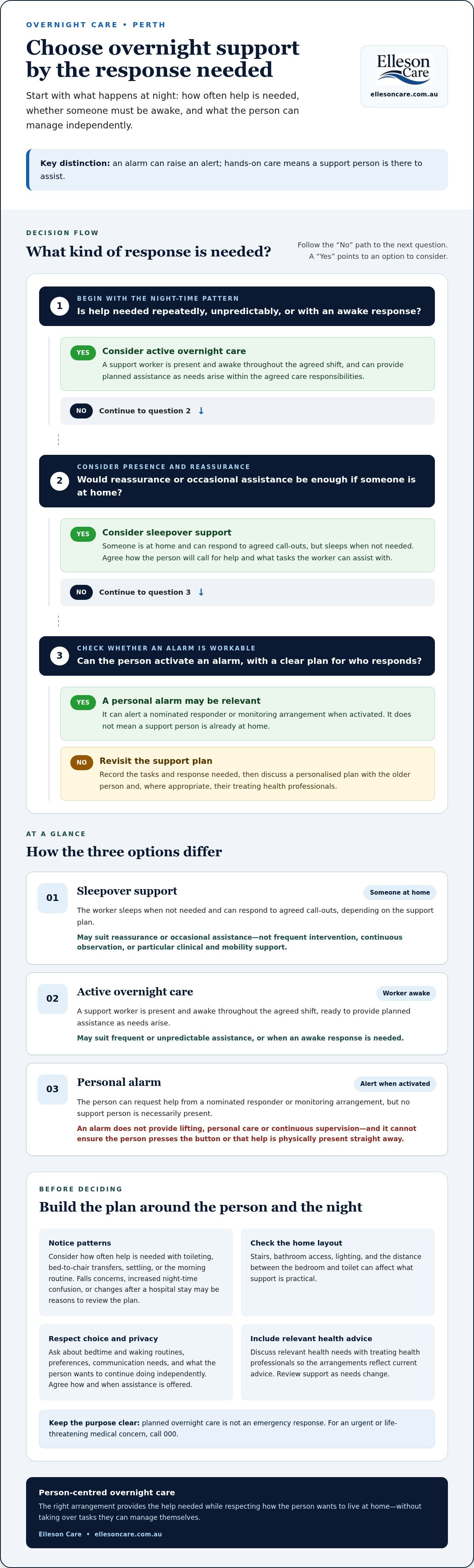
These options provide different levels of support. In a sleepover arrangement, someone is at the home and can be called on for agreed assistance. With active overnight care, a worker stays awake. A personal alarm lets someone request help, but it does not mean a support person is already beside them. The Australian Government’s overview of arranging and funding aged care provides broader context on in-home support. The comparison below focuses on what each option can offer during the night.
| Option | Is someone present and awake? | What help may be available? | May suit when |
|---|---|---|---|
| Sleepover support | Someone is at home, but sleeps when not needed. | Can respond to agreed call-outs, depending on the support plan. | Reassurance or occasional assistance may be needed, rather than continuous attention. |
| Active overnight care | A support worker is present and awake throughout the agreed shift. | Can provide planned assistance as needs arise, within the agreed care responsibilities. | Help is frequent, unpredictable or requires an awake response. |
| Personal alarm | No support person is necessarily present at home. | Can alert a nominated responder or monitoring arrangement when activated. | The person can use the alarm and there is a clear plan for who responds. |
When might sleepover support suit an older person?
Sleepover support may suit someone who feels more settled knowing help is nearby or occasionally needs assistance during the night. Before choosing it, agree what happens if they wake, how they’ll call for help and what tasks the worker can assist with. It may not suit someone who needs frequent intervention, continuous observation or particular clinical and mobility support.
When may active overnight support or an alarm be relevant?
Active support may be more appropriate when assistance is needed repeatedly or the person needs an awake response rather than waiting for someone to wake. An alarm can help someone who is able to activate it, provided there’s a clear response arrangement. It can’t ensure someone presses the button or that help is physically present straight away.
An alarm can raise an alert; hands-on care means a person is there to assist. An alarm does not provide lifting, personal care or continuous supervision. For families considering overnight care for elderly Perth residents, the key question is how often help is needed and whether a device or an in-home care plan can meet that need. A personalised aged care plan can take individual routines and clinical considerations into account. Learn about Elleson Care’s in-home aged care.
How to compare overnight care options for an older person in Perth
Begin with the support the person actually needs at night, then consider which arrangement fits their preferences and the family’s capacity. This makes it easier to compare overnight care for elderly Perth residents without assuming that the most intensive option is always necessary. A practical discussion should cover:
- Frequency: When is help needed, what tasks are involved and how often do they occur?
- Mobility: Can the person move safely in bed, stand or reach the bathroom? Note any mobility aids and assistance they use.
- Cognition and communication: Is the person sometimes confused or disoriented overnight? How do they prefer support to be offered?
- Clinical needs: Record relevant health instructions and changes, and discuss clinical requirements with treating health professionals.
- Daily life: Consider preferred bedtime and morning routines, privacy, familiar approaches to care and the older person’s priorities.
- Carer capacity: Include how disrupted sleep is affecting family carers and whether the current arrangement feels sustainable.
What care details should families map before deciding?
If practical, keep a brief record of night-time assistance over several days. Note when support is needed, the task involved and whether the person needed prompting, reassurance or hands-on help. Include mobility aids, communication preferences, usual routines and relevant clinical instructions. Invite the older person to describe what would help them feel comfortable at home. Their perspective can guide the plan and help preserve choice.
| Night-time pattern | Points to consider |
|---|---|
| Occasional help to get to the bathroom | How often does it happen, and can the person safely call for assistance? |
| Repeated transfers or reassurance | Would support need to be awake and available at several points overnight? |
| Changes after a hospital stay | What guidance has the treating team provided, and should the support plan be reviewed as recovery progresses? |
| Family carer regularly losing sleep | Could a planned support arrangement provide rest while respecting the older person’s routines? |
How should families weigh safety, dignity and continuity?
Consider identified risks alongside the person’s independence. A concern about falls, for example, can prompt a discussion about mobility and the home environment without automatically meaning constant supervision is needed. Clear communication and handovers help ensure support follows agreed routines and responds to changes in need. Familiar approaches can also make assistance feel less disruptive.
If family carers need a break, My Aged Care provides information about overnight respite care. For more on support at home and maintaining independence, read this guide to in-home aged care in Perth.
How to arrange overnight support in Perth, including funding questions
A clear process can make decisions about overnight care for elderly Perth residents easier to manage. Start with the person’s night-time needs, then explore suitable support and any relevant funding. Eligibility and programme coverage depend on individual circumstances, assessment and current rules, so don’t assume a particular type of overnight help will be funded.
- Document what happens overnight. Record the usual routine, when help is needed, the tasks involved and how often they occur. Note changes such as a recent hospital discharge, along with the older person’s preferences.
- Discuss the care needs. Include the older person and, where appropriate, family carers and treating health professionals. Clarify whether needs involve personal care, mobility assistance, reassurance or clinical support. If nursing input is relevant, read about nursing services in Perth.
- Review assessment and funding pathways. For Australian Government-funded aged care, contact My Aged Care to discuss an assessment. An assessment helps identify support needs; it does not mean every requested service or overnight arrangement will automatically be funded.
- Plan the support. Use the assessment information, preferences and available funding details to shape a practical arrangement. Agree on support tasks, routines and how changes in need will be communicated.
What information helps start a care-planning conversation?
Bring a concise record of night-time routines and assistance, existing assessment information and relevant care instructions. Include the person’s mobility aids, communication preferences and what they find reassuring or intrusive. If needs have changed, note when and how. These details help keep planning grounded in daily life rather than relying on a general description of care needs.
Which funding pathways may be worth understanding in 2026?
As of 2026, Support at Home is the Australian Government programme that replaced Home Care Packages and the Short-Term Restorative Care Programme. Access involves an aged care needs assessment arranged through My Aged Care, by website or phone. The assessment considers a person’s needs, while eligibility, approved services and funding depend on current programme rules and the individual outcome. The Commonwealth Home Support Programme remains separate; its merger with Support at Home is not expected before 1 July 2027, according to current guidance.
For an overview of programme details and changes, see the Support at Home Program in 2026. If the person has disability-related support needs, NDIS funding may be relevant only if they meet NDIS access requirements and the support aligns with their plan. Veterans may also explore DVA pathways, subject to their circumstances and applicable eligibility. Elleson Care’s person-centred aged care and clinical nursing can inform a personalised plan. Learn about in-home aged care support.
How Elleson Care can inform a personalised in-home care plan
Planning overnight care for elderly Perth residents is one part of understanding the person’s wider support needs at home. Elleson Care provides person-centred aged care and clinical nursing, with support shaped around individual circumstances, preferences and dignity. Considering night-time concerns alongside daily living needs can help families identify what assistance may be useful, rather than assuming one arrangement suits everyone.
How can nurse-led experience support thoughtful care planning?
Elleson Care’s registered-nurse-led team brings over 22 years of experience to in-home aged care and clinical support. Considering daily living needs alongside relevant clinical needs can help families build a clearer picture of the support required. For example, personal care or domestic assistance may sit alongside clinical services such as wound management or post-hospital care, depending on the person’s circumstances. This experience can inform planning, while appropriate support remains specific to each person.
A broader care plan can also help families see how different forms of assistance fit together. Someone returning home after hospital may need support with everyday tasks as well as clinical care. Another person may value help with personal care while maintaining familiar routines and doing as much as possible independently. A considered plan responds to the person rather than adding support without a clear purpose.
What can families expect from a person-centred conversation?
A useful conversation begins by listening to the older person. Their priorities may include privacy, a familiar bedtime routine, how assistance is offered or which activities they want to manage themselves. Families can share what they have noticed, including changes in support needs, while keeping the person’s wishes central. This provides a practical foundation for discussing aged care and clinical support at home.
Needs can change over time. A plan can be revisited as health, mobility, routines or family-carer capacity changes, so support continues to reflect the person’s circumstances. Discussing both immediate concerns and longer-term priorities can help families consider how personal care, domestic assistance and clinical nursing may fit together.
Elleson Care is West Australian-owned and provides personalised aged care and clinical nursing in clients’ homes. Explore Elleson Care’s in-home support as part of planning around the person’s priorities, routines and care needs.
Choose night-time support that fits the person
The right overnight support starts with understanding what happens during the night, how often assistance is needed and what helps the older person feel comfortable at home. A personal alarm can alert someone to a need for help, while sleepover or active support involves a person being present. These options serve different purposes, so consider the level of assistance, the person’s preferences and the family’s capacity when planning.
Funding may depend on an individual assessment and current programme rules. Recording night-time needs and discussing them as part of a broader care plan can help families take a considered next step.
Elleson Care is a West Australian-owned provider of personalised aged care and clinical nursing at home. Its registered-nurse-led team brings over 22 years of experience to care planning that considers individual needs and dignity. Explore personalised in-home care with Elleson Care and take a calm, informed step towards support that feels right for your family.
Frequently Asked Questions
Can a personal alarm replace overnight care for an older person?
No. A personal alarm may help someone call for assistance if they can activate it and there’s a clear response arrangement. It doesn’t provide hands-on help with transfers, toileting or medication routines, or offer ongoing supervision. If support is needed repeatedly overnight, consider whether planned in-home care may be more appropriate, alongside other safety measures. An alarm can form part of a plan, but it doesn’t meet every night-time care need.
What is the difference between sleepover care and active overnight care?
Sleepover care generally means a support person is present overnight and may respond to agreed needs, while active overnight care involves a worker who stays awake to provide support throughout the night. The most suitable arrangement depends on how often assistance is needed and what tasks are involved. Consider the person’s routines, mobility and any clinical needs, and agree in advance what assistance is expected if they wake.
How do I know if an older person in Perth needs overnight care?
Consider whether the person regularly needs help overnight, feels unsafe alone, or has changes in mobility, cognition or personal care needs. Also consider whether family carers can sustain the current routine and get enough rest. If you’re considering overnight care for elderly Perth residents, begin by listening to the older person and recording what happens at night. Discuss recurring concerns and relevant changes with their care professionals.
Can overnight care be provided at home in Perth?
Yes, aged care and clinical support can be provided in a person’s home, with the plan shaped around their needs, preferences and home environment. Discuss tasks and timing as part of individual care planning, including any mobility assistance or clinical requirements. Elleson Care provides personalised aged care and clinical support at home. Consider how this support fits with the person’s routines and broader care needs.
Can aged care funding help pay for overnight support in Australia?
It may, depending on the person’s assessment, eligibility, approved services and current programme rules. Support at Home began on 1 November 2025, replacing Home Care Packages and the Short-Term Restorative Care Programme. An aged care needs assessment can be arranged through My Aged Care to consider support needs, but funding for a particular overnight arrangement shouldn’t be assumed. Refer to current My Aged Care guidance and consider it alongside the person’s assessed needs.
What should families consider when choosing night-time support for an older person?
Match the level of support to the person’s needs. Consider how often assistance is required, whether a worker needs to stay awake, and the person’s mobility, routines and preferences. Also discuss privacy, communication, continuity and relevant clinical instructions. A personal alarm may complement a care plan if the person can activate it and a response arrangement is in place. An alarm alerts someone, while in-home support can provide direct assistance.


