

If you are currently sitting at the kitchen table wondering if the only way to keep your parent safe is a transition into residential care, you aren't alone. For many families in Western Australia, the decision to remain at home often feels like a choice between emotional comfort and financial stability. Understanding the cost of 24/7 in-home care Perth is no longer just about looking at a single hourly rate; it's about navigating a new era of government subsidies and clinical requirements that came into effect with the 2025 and 2026 reforms.
We understand that the shift to the Support at Home programme and the complexities of NDIS funding can feel overwhelming, especially when you're worried about the quality of support provided during those quiet midnight hours. This guide will help you decode the 2026 funding landscape, from the eight new classification levels to the critical difference between active overnight shifts and sleepover allowances. You'll gain a clear perspective on how to supplement government contributions with private fees, ensuring your family can access high-standard, local care that preserves your loved one's independence without compromising their safety.
Key Takeaways
- Understand how a tailored blend of clinical expertise and domestic assistance supports the choice to remain at home with dignity and safety.
- Gain clarity on the cost of 24/7 in-home care Perth by understanding the significant price difference between active night shifts and passive sleepover arrangements.
- Learn to maximise available government subsidies by navigating the 2026 Support at Home funding levels and NDIS High Intensity pathways.
- Identify the importance of Registered Nurse oversight and clinical consumables in preventing unexpected gaps in your care budget.
- Evaluate the long-term financial and lifestyle implications of 24/7 home care compared to the complex fee structures of residential aged care.
Navigating 24/7 In-Home Care Costs in Perth (2026 Update)
Choosing 24/7 support is a profound commitment to a loved one's independence. It is more than just having someone present in the house; it is a coordinated mosaic of personal care, domestic assistance, and clinical oversight. For many in Western Australia, the decision to remain at home is driven by a desire for dignity and the comfort of familiar surroundings. While the financial investment is significant, the emotional and physical benefits of staying in one's own community often outweigh the alternative of moving into a residential facility. The current structure of Aged care in Australia has undergone substantial changes, making it essential for families to understand how these reforms influence the cost of 24/7 in-home care Perth today.
Determining if around-the-clock care is financially viable for your family involves looking beyond simple hourly rates. The 2026 regulatory landscape focuses on transparency, ensuring that every dollar spent contributes directly to a higher standard of well-being. By integrating government subsidies with private contributions, many Perth families find they can maintain a safe, nurse-led environment at home that rivals or exceeds the level of support found in traditional institutional settings.
The Support at Home Program Transition
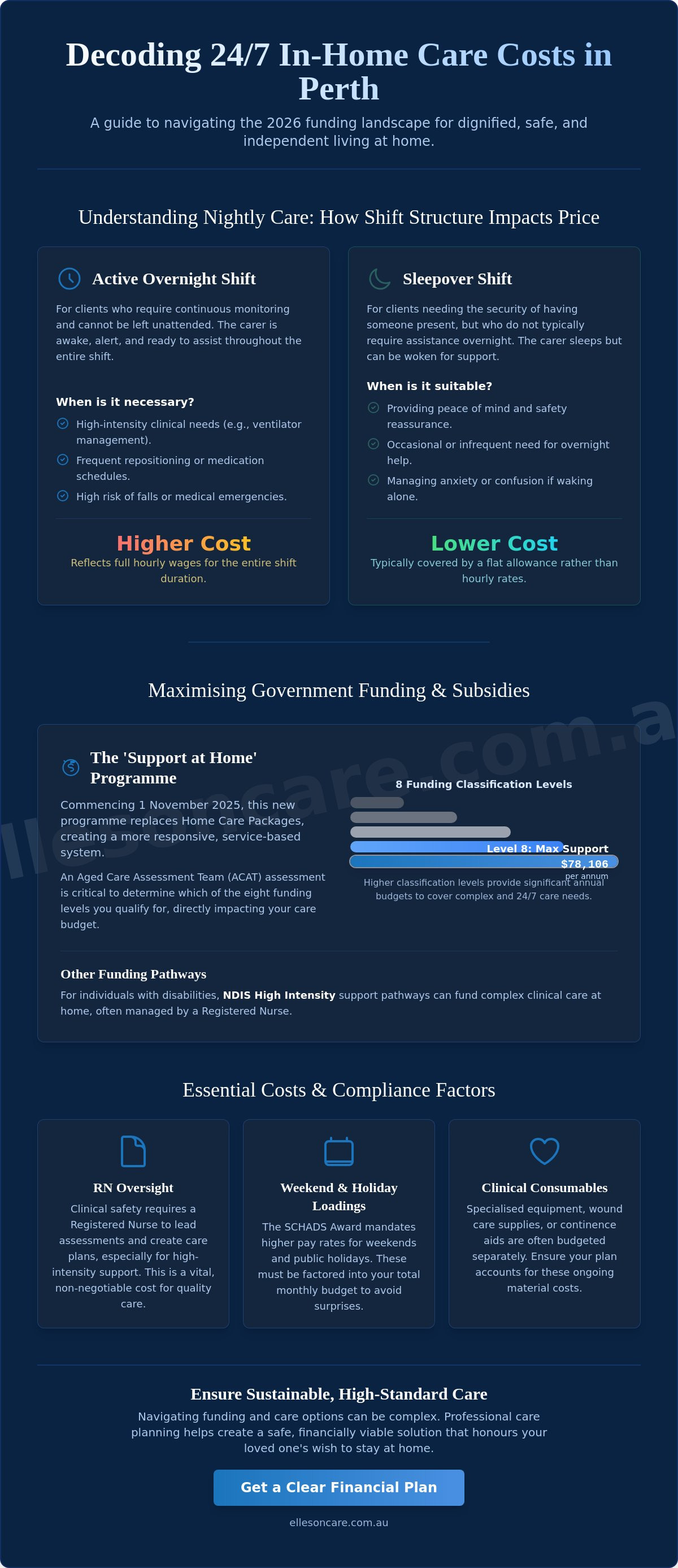
On 1 November 2025, the Australian government replaced Home Care Packages with the Support at Home program. This shift was designed to create a more responsive system with eight distinct funding classifications. For those requiring 24/7 support, the role of the Aged Care Assessment Team (ACAT) in Perth is now more critical than ever. They determine which of the eight levels a person qualifies for, with Classification 8 providing the highest annual budget of $78,106. This new system aims for service-based costing, giving you a clearer view of exactly what your funding covers and where private gaps might exist.
Why 24/7 Care is a Clinical Decision, Not Just a Financial One
Safety is the cornerstone of any long-term care arrangement. Deciding on the intensity of support isn't just a matter of budget; it's a clinical necessity. Nurse-led assessments are vital to identify whether a client requires standard personal care or high-intensity clinical support, such as ventilator management or complex wound care. These requirements dictate the qualifications of the staff entering your home. We believe in the Elleson Care holistic family approach, which prioritises clinical expertise to ensure that the cost of 24/7 in-home care Perth reflects a sustainable, safe, and deeply respectful partnership between the provider and the family.
Active Night vs. Sleepover Shifts: How Shift Structure Impacts Price
Families often assume that around-the-clock support carries a flat daily rate. In reality, the cost of 24/7 in-home care Perth is calculated by assembling specific shift blocks that match the individual's needs throughout a 24-hour cycle. This structure is heavily influenced by the Social, Community, Home Care and Disability Services (SCHADS) Award, which sets the legal standards for how workers are compensated in Western Australia. Because different times of the day carry different financial obligations, your fortnightly bill will fluctuate based on the ratio of active support to passive presence, as well as the inclusion of weekend and public holiday loadings.
When planning for long-term stability, it is essential to look at the total monthly commitment rather than just the base hourly rate. Saturday and Sunday shifts attract higher loadings under the SCHADS Award, and public holidays can significantly increase costs for that specific period. Information found on My Aged Care can help you understand the basics of how these shifts are funded, but a local provider can offer a more detailed breakdown of how these loadings apply to your specific situation in Perth. Balancing these variables requires careful professional care planning to ensure the arrangement remains sustainable for the long term.
When is an Active Night Shift Necessary?
An active night shift is required when a client cannot be left unattended for more than a short period. This is often a clinical necessity for those with frequent medication needs, a high falls risk, or conditions requiring complex monitoring. If the care involves specialised tasks, such as managing clinical equipment, a Registered Nurse (RN) may be required rather than a support worker, which influences the overall budget. It is important to note that the cost of 24/7 in-home care Perth for active support often exceeds the maximum annual funding provided by the Support at Home program, particularly for Classification 8 recipients, necessitating a clear plan for private top-up fees.
The Sleepover Model: A Cost-Effective Alternative
For individuals who are generally stable overnight but require a "just in case" presence, the sleepover model offers a more affordable pathway. Under this arrangement, a caregiver stays at the home for a continuous shift, typically eight hours, and is provided with a private room and bed. The SCHADS Award allows for a flat sleepover allowance, currently $51.09, provided the worker is not disturbed. If the caregiver is required to assist the client during the night, they are paid at their hourly rate for the time worked. This hybrid approach allows families to maintain safety and peace of mind while managing the overall financial commitment of around-the-clock support.
Funding Pathways for 24/7 Support in Western Australia
Securing the right financial support is often the most significant hurdle for families seeking around-the-clock care. While the cost of 24/7 in-home care Perth is substantial, several government pathways exist to help alleviate the pressure. Most West Australians will access support through either the National Disability Insurance Scheme (NDIS) or the Support at Home programme. Additionally, the Department of Veterans' Affairs (DVA) provides specific nursing and personal care contributions for Perth veterans, which can be integrated into a broader care plan. Understanding how to layer these funding sources is essential for creating a sustainable long-term solution.
A recent National Seniors Australia report highlighted how rising prices in the sector can undermine confidence in the system. This makes it even more vital for families to work with providers who offer transparent, service-based costing. By identifying every available subsidy, you can ensure that your loved one receives the high-intensity support they require without the constant fear of a funding shortfall.
NDIS and 24/7 Care: The Goal-Based Approach
For individuals under 65 living with a disability, the NDIS provides a pathway for 24/7 support through "High Intensity Daily Personal Activities." To secure this level of funding, the support must be deemed "reasonable and necessary" to help the participant achieve their lifestyle goals. Clinical evidence is paramount here. Integrating professional nursing services into the plan can provide the technical justification needed during NDIS plan reviews, especially when care needs escalate due to a change in health status.
Bridging the Gap with Private Home Care
Even with the highest government subsidies, such as Classification 8 in the Support at Home programme, there is often a gap between the total funding and the actual cost of 24/7 in-home care Perth. Many families choose to self-fund additional hours to ensure continuity of care or to maintain a specific level of clinical oversight that government caps may not fully cover. This private top-up approach allows for greater flexibility in choosing staff and scheduling. It is also worth investigating if these private contributions have implications for the Commonwealth Seniors Health Card or other care-related concessions, as every financial detail helps in maintaining a steady, reliable care environment.
Hidden Costs and Compliance: What Perth Families Often Overlook
When calculating the cost of 24/7 in-home care Perth, it is easy to focus solely on the face value of hourly rates. However, a sustainable care arrangement involves several layers of support that often remain invisible until the first invoice arrives. True around-the-clock care requires robust clinical governance, meticulous roster coordination, and the provision of specialised equipment. These elements are not merely administrative overheads; they are the safeguards that ensure a loved one remains safe, comfortable, and out of the hospital system. Families should also consider the practical costs of community participation, such as travel expenses and petrol levies, which allow a client to maintain their social connections within the Perth metropolitan area.
The administrative burden of managing a 24/7 roster is significant. Coordination fees cover the essential work of ensuring that every shift is filled by a qualified professional, even during unexpected staff illness or public holidays. Additionally, the physical environment often requires modifications or consumables that fall outside standard care hours. This might include everything from high-grade wound dressings to the hire of specialised pressure-relieving beds. Factoring these variables into your initial budget prevents financial strain and ensures that the focus remains entirely on the recipient's quality of life.
The Importance of Clinical Governance
Stability in care is as much about clinical oversight as it is about physical presence. Choosing a provider based solely on the lowest cost of 24/7 in-home care Perth can be a risky strategy if it lacks Registered Nurse (RN) led governance. At Elleson Care, we prioritise clinical safety by managing complex needs such as pressure injury management and medication titration under strict professional supervision. This level of oversight provides the necessary insurance and peace of mind that a support worker alone cannot offer. High standards of clinical governance are a global benchmark; for instance, NeeryVille Care provides specialised support for dementia and other complex conditions, illustrating the importance of regulated, professional oversight in home settings. Regular nursing assessments act as an early warning system, identifying health changes before they escalate into an emergency department visit.
Staffing Stability and the "Perth Premium"
The Western Australian labour market presents unique challenges for the care sector. Attracting and retaining high-calibre staff in Perth requires a commitment to fair wages and professional development, often referred to as the "Perth Premium." While this may influence the base rate, the value of staffing stability cannot be overstated. Consistent caregivers develop a deep understanding of a client's routines and subtle health cues, which significantly reduces long-term costs associated with health complications. If you are not yet ready to commit to a permanent arrangement, utilising respite care Perth serves as an excellent way to trial staff compatibility and shift structures before establishing a full 24/7 schedule. To understand how these factors apply to your family's unique situation, we invite you to contact us for a clinical consultation.
Is 24/7 In-Home Care Right for You? A Decision Framework
Deciding between residential care and around-the-clock support at home is one of the most significant choices a family will ever face. It requires a delicate balance of financial planning, clinical necessity, and emotional readiness. While the cost of 24/7 in-home care Perth is a primary consideration, the decision often hinges on whether the home environment can be adapted to meet high-intensity needs. A successful arrangement depends on more than just funding; it requires a home that is safe for both the client and the staff, alongside a family that feels supported rather than overwhelmed by the logistics of complex care coordination.
Before committing to a path, it is helpful to perform a "Family Capacity" check. Managing a 24/7 roster involves significant oversight, from ensuring shift coverage to managing clinical supplies. Families must decide if they have the time and expertise to lead this coordination or if they require a professional provider to take the lead. Engaging a partner who understands the local Perth landscape ensures that the clinical, legal, and emotional aspects of the care plan are handled with professional discipline, allowing the family to focus on their relationship with their loved one.
Home Care vs. Residential Care: The Financial Reality
The financial structure of residential aged care often involves a Refundable Accommodation Deposit (RAD) or a Daily Accommodation Payment (DAP). These fees can be substantial and sometimes necessitate the sale of the family home. In contrast, choosing to remain at home allows the property to be preserved as a family asset. While the cost of 24/7 in-home care Perth involves daily service fees, the "Return on Investment" is measured in the quality of life gained by staying in a familiar neighbourhood. Being able to remain close to local Perth parks, friends, and community centres provides an emotional stability that is difficult to replicate in an institutional setting.
The Elleson Care Difference: Nurse-Led 24/7 Support
We are a proudly West Australian owned and operated provider, deeply committed to the well-being of our local community. Our approach is defined by person-centred care that prioritises the individual's dignity and autonomy at every stage. With over 22 years of nursing experience, our team brings a level of clinical authority that significantly lowers the risks associated with high-intensity 24/7 support. We understand that every family's financial situation is unique, and we are dedicated to providing clear, honest guidance through the complexities of the 2026 funding reforms. If you are ready to explore how around-the-clock support can work for your family, we invite you to contact us for a transparent, no-obligation discussion regarding your care needs and a professional clinical assessment.
Securing a Safe and Sustainable Future at Home
Maintaining independence within your own four walls is a deeply personal goal that requires both a clinical strategy and a clear financial roadmap. By understanding how shift structures and clinical requirements impact the cost of 24/7 in-home care Perth, you can build a sustainable model that balances safety with your family's long-term budget. Whether you are navigating the latest Support at Home reforms or looking to maximise high-intensity NDIS funding, the key lies in transparent planning and professional oversight.
As a West Australian owned and operated provider led by Registered Nurses with over 22 years of experience, we specialise in complex clinical and NDIS support. We are here to help you bridge the gap between government subsidies and the high-standard care your loved one deserves. We invite you to Request a Personalised 24/7 Care Cost Assessment to gain clarity on your specific needs. With the right partner by your side, staying at home isn't just a possibility; it's a pathway to continued dignity and peace of mind for your entire family.
Frequently Asked Questions
Is 24/7 in-home care cheaper than a nursing home in Perth?
In-home care is often more financially advantageous when you consider the preservation of the family home as an asset. While residential care usually requires a Refundable Accommodation Deposit (RAD) that can reach $500,000 or more, staying at home avoids this massive capital outlay. The daily service fees for 24/7 care may be higher than nursing home daily contributions, but the ability to keep your property and remain in a familiar neighbourhood offers a different kind of long-term value.
Does the NDIS cover the full cost of 24/7 support?
The NDIS can cover the entire cost of 24/7 support if it is deemed "reasonable and necessary" to meet your specific goals. This typically requires a "High Intensity Daily Personal Activities" budget within your plan. You will need to provide strong clinical evidence and assessments from healthcare professionals to justify why around-the-clock support is essential for your safety and independence, especially during a plan review or when health needs change.
What is the difference between a sleepover and an active night shift?
An active night shift requires the caregiver to stay awake and alert throughout the entire night to provide continuous monitoring or clinical assistance. In contrast, a sleepover shift allows the staff member to sleep in a private room, provided they are not required to assist the client for more than one hour. Choosing a sleepover model when clinically safe can significantly reduce the cost of 24/7 in-home care Perth compared to paying for active awake hours.
Can I use my Support at Home funding for 24/7 care?
Yes, you can direct your Support at Home classification budget towards the cost of 24/7 in-home care Perth. However, it is important to note that even the highest classification (Level 8) provides an annual budget of $78,106, which rarely covers the full expense of 24/7 support. Most families use their government funding as a foundational contribution and then supplement the remaining balance with private top-up fees to ensure complete coverage.
Do I need to provide a bedroom for 24/7 care staff?
A private bedroom and bed are only required if your care plan includes sleepover shifts. Under the SCHADS Award, staff must have access to adequate sleeping facilities to qualify for sleepover rates. If your care is strictly "active" where the staff member remains awake all night, a bedroom is not necessary. However, you should still provide a comfortable, quiet area where the caregiver can take their designated breaks during their shift.
How does the 2026 Support at Home program change 24/7 care costs?
The 2026 programme replaced Home Care Packages with a more transparent, eight-level funding structure that began on 1 November 2025. This change abolished the basic daily fee and moved toward service-based pricing, making it easier for families to see exactly how their subsidy is being spent. While the reforms don't necessarily lower the base hourly rates of providers, they offer much greater clarity when you are trying to calculate your total out-of-pocket expenses.
Can Elleson Care provide registered nurses for 24/7 clinical needs?
Yes, we specialise in providing Registered Nurses (RNs) for clients who require 24/7 clinical oversight. This is particularly important for individuals with complex needs such as ventilator support, tracheostomy management, or advanced wound care. Our nurse-led model ensures that every aspect of your care is supervised by professionals with over 22 years of experience, providing a level of safety and clinical integrity that standard support workers cannot offer alone.
What happens to the cost of care on public holidays in WA?
The cost of care increases significantly on public holidays due to mandatory loadings set by the SCHADS Award. In Western Australia, you should expect to pay higher hourly rates on days such as WA Day, ANZAC Day, and Good Friday. These loadings are a legal requirement for all providers, so it's essential to factor these specific dates into your annual care budget to avoid any financial surprises during holiday periods.


