

What if the safest place for your parents to receive clinical-grade medical care wasn't a hospital or a nursing home, but the very lounge room where they've lived for decades? Many Perth families feel the weight of this question as they watch their loved ones grow older. You likely worry about a sudden fall or feel completely drained by the effort of coordinating care while managing your own life. With the recent shift to the 2026 Support at Home programme, understanding how to keep elderly parents at home in Perth has become more complex, yet more achievable than ever before.
We understand that you want your parents to age with dignity without compromising their medical safety or your own well-being. This guide provides the clarity you need to secure the practical steps and government funding required for this transition. You'll discover how the eight new funding classifications work, why clinical support is now fully government-funded, and how professional aged care services can provide the peace of mind your family deserves. We'll outline a structured path to ensure your parents stay social, safe, and supported in the community they love.
Key Takeaways
- Understand how the 2026 Support at Home programme provides structured funding classifications to simplify access to clinical care and daily independence.
- Discover the practical steps and professional resources regarding how to keep elderly parents at home in Perth while maintaining their safety and dignity.
- Learn why complex medical requirements can be safely managed in a domestic setting through the oversight of Registered Nurses and professional clinical support.
- Identify the importance of Occupational Therapy assessments and environmental modifications, such as cooling strategies for Perth heatwaves, to prevent home injuries.
- Recognise the benefits of a nurse-led, family-owned Western Australian partner in providing a stable and empathetic care journey for your loved ones.
Understanding the Choice to Age at Home in Western Australia
In Western Australia, the concept of "ageing in place" has undergone a significant transformation. As of 2026, it no longer refers simply to receiving assistance with household chores or basic gardening. Instead, it represents a sophisticated, clinical-grade model of care that allows seniors to remain in their own residences while receiving high-level medical and personal support. Research consistently shows that most adults would prefer to age in place, and for those living in our beautiful city, this preference is deeply tied to the local lifestyle. Whether it is a morning walk along the Swan River or staying close to the familiar breezes of the Perth coast, the environment plays a vital role in a senior's well-being. Knowing how to keep elderly parents at home in Perth requires a shift in perspective; it is about seeing the home as a viable, safe alternative to a clinical facility.
A common concern for many families is the threshold of safety. You might ask yourself when the medical needs of a parent become too complex for a domestic setting. In the past, a diagnosis requiring regular clinical monitoring often meant a move to residential care. However, modern home care now integrates Clinical Support and Aged Care Services that bring the expertise of the hospital into the home. This evolution ensures that safety is managed through professional oversight rather than relocation. It's a relief for families to learn that complex conditions don't always necessitate a move away from the people and places they love.
The Emotional and Social Benefits of Home-Based Care
Staying at home allows seniors to maintain their established rhythms and social identities. When a person remains in their own neighbourhood, they keep their connections to local Perth social clubs and community centres. This continuity is essential for preserving dignity. Moving to a facility often triggers "relocation stress syndrome"; this is a period of intense confusion and anxiety that can lead to physical decline. By opting for person-centred care at home, we prioritise the individual's history and sense of self, ensuring they remain a visible, active member of their community.
Why Perth Families are Choosing Home Care in 2026
The current trend among West Australian families is a move toward "reablement." This approach focuses on helping seniors regain or maintain their functional skills rather than simply performing tasks for them. It is a proactive way to manage how to keep elderly parents at home in Perth by fostering independence. Families today seek a balance where they can remain emotionally involved in their parents' lives without the overwhelming burden of being the primary care coordinator. With the availability of specialised nursing services and clinical support, even complex health journeys can be navigated within the comfort of a family home, providing a sense of stability that benefits every generation.
Navigating the Support at Home Program and Funding in 2026
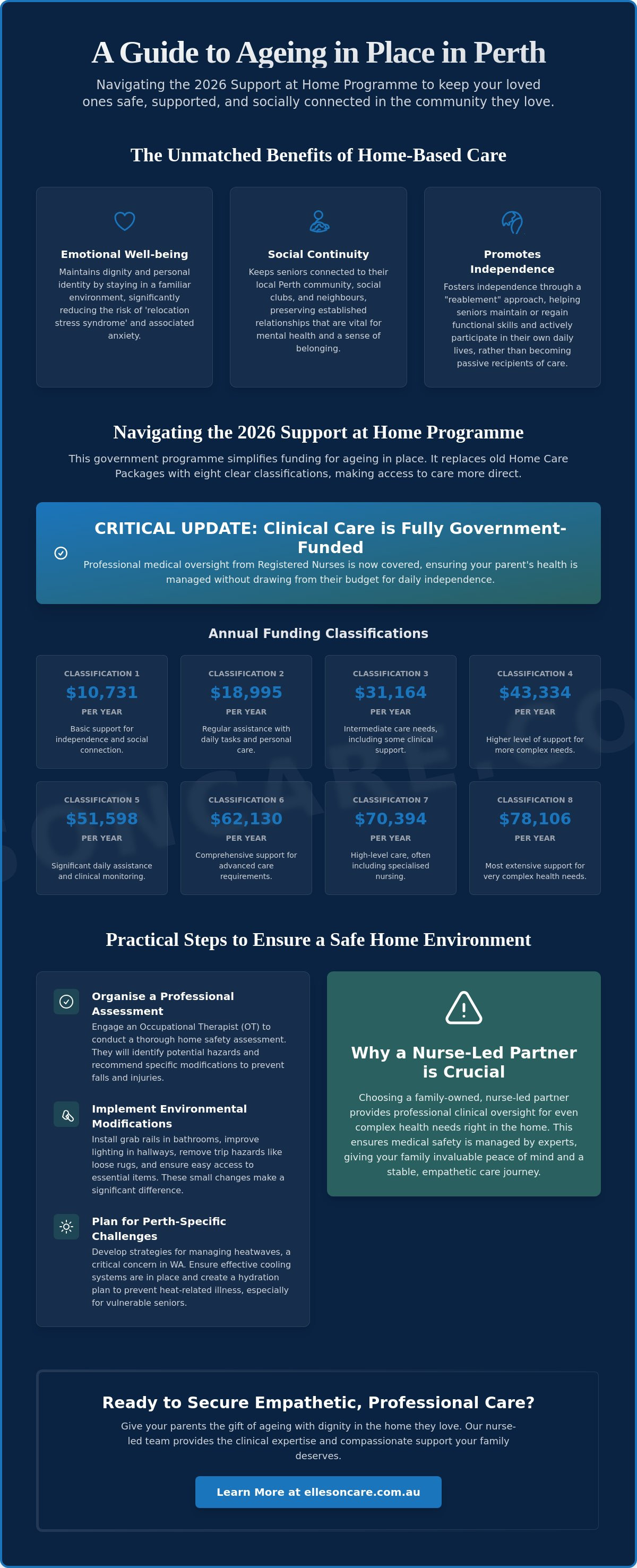
The Support at Home programme is the primary Australian Government subsidy for ageing in place. Following its full rollout in 2026, this system has replaced the old Home Care Packages to create a more direct pathway for families considering how to keep elderly parents at home in Perth. The new model organises funding into eight distinct classifications, ranging from $10,731 to $78,106 per year. A significant benefit of this 2026 structure is that clinical care is now fully government-funded. This ensures your parents can receive professional medical oversight without depleting their personal budget for daily independence and domestic assistance.
For those who were already receiving support before the 2025 transition, "No Worse Off" protections ensure you won't pay higher contributions than under the previous system. This stability is vital for long-term planning and provides a sense of security for families. To begin the process, Perth residents must engage with My Aged Care for an Aged Care Assessment Team (ACAT) evaluation. This assessment determines which of the eight funding levels best matches your parent’s needs, often coordinating with Perth metropolitan Older Adult Health Hubs to ensure a comprehensive view of their clinical and social requirements.
Steps to Secure Funding for Your Parents
- Step 1: Registration. Contact My Aged Care to register your parents. You will need their Medicare card and a basic summary of their health history ready for the initial phone screening.
- Step 2: The ACAT Assessment. A professional will visit the home to discuss daily challenges and goals. It is helpful to have a list of current medications and any recent specialist reports available to provide a clear picture of their needs.
- Step 3: Individualised Budget. Once approved, you will receive an individualised budget. This allows you to allocate funds toward essential Aged Care Services that support both clinical safety and domestic comfort.
Managing Costs and Contributions
The 2026 programme introduces greater transparency with government-set price caps on all services. While clinical care is fully funded, contributions for "Everyday Living" services are determined by a means test through Services Australia. It is important to note that care management fees are now capped at 10% of the quarterly budget, ensuring more of the funding goes directly toward active support. By prioritising high-impact clinical services and safety modifications, you can ensure your parents remain safe while making the most of the available subsidy. This structured approach provides a clear roadmap for families determining how to keep elderly parents at home in Perth without the financial confusion of previous years.
Clinical Safety: Managing Complex Health Needs Without a Nursing Home
A common misconception among families is that a high level of medical complexity automatically necessitates a move to a residential facility. However, the modern "Hospital in the Home" model has fundamentally changed the landscape of private care. By utilising professional Clinical Support, it is now entirely possible to manage sophisticated health requirements in a domestic setting. This approach ensures that the home remains a place of healing rather than just a place of residence. When exploring how to keep elderly parents at home in Perth, the focus must shift from simple assistance to clinical oversight. Providers like Elleson Care champion a "Nurse-Led" model, where Registered Nurses supervise every aspect of the care plan to ensure medical safety is never compromised.
This clinical rigour is essential for families who feel overwhelmed by the technical demands of chronic disease management. Navigating the Support at Home Program allows you to access the necessary funding for these high-level services, ensuring that professional expertise is a standard part of your parent's daily life. It provides a sense of stability that is often missing when families try to manage medical crises on their own.
High-Acuity Care: From Wound Management to Ventilator Support
Modern home-based care can now accommodate needs that were previously restricted to hospital wards. This includes managing chronic conditions such as diabetes through regular blood glucose monitoring or supporting respiratory health with ventilator care. Professional in-home nursing is also vital for specialised wound management and catheter care, which are critical for preventing infection and hospital readmission. Additionally, palliative care at home allows individuals to experience their final months with profound dignity, surrounded by familiar sights and sounds while receiving expert pain management and emotional support.
The Safety Net: Emergency Planning and Monitoring
Ensuring safety involves more than just reactive care; it requires a proactive "safety net" built on technology and professional vigilance. A robust safety strategy often includes:
- Smart Monitoring: Implementing personal alarm systems and smart home sensors that can detect falls or unusual patterns of movement.
- Clinical Escalation Plans: Developing a 24/7 plan that outlines exactly what happens if a parent's condition changes, providing families with a clear roadmap during stressful moments.
- Regular Nursing Assessments: Utilising scheduled reviews by Registered Nurses to identify subtle health declines before they escalate into an emergency.
This structured oversight is the key to understanding how to keep elderly parents at home in Perth safely. It transforms the home into a controlled, secure environment where medical needs are met with the same precision found in a clinical facility, but with the warmth only a home can provide.
Practical Steps to Organise the Home and Local Perth Support
While clinical oversight provides the medical foundation for safety, the physical layout of a house often determines the daily success of ageing in place. When families ask how to keep elderly parents at home in Perth, the first practical step involves a professional Occupational Therapy (OT) assessment. These specialists identify subtle hazards that often go unnoticed, such as loose rugs, poor lighting in hallways, or high-threshold doorways. In Western Australia, we must also consider our unique climate. Perth heatwaves pose a significant risk to seniors, making it essential to ensure that cooling systems are reliable and that the home remains a temperate sanctuary during the peak of summer.
Creating a sustainable environment also means looking after the people providing the support. Coordinating care is a marathon, not a sprint. We encourage families to utilise respite care options within the Perth metropolitan area to maintain their own well-being. Taking a planned break ensures that family caregivers can recharge, which ultimately prevents burnout and preserves the quality of the relationship between the parent and the child. It's about building a "Care Circle" where the responsibility is shared among family, GPs, and professional providers.
Home Modifications for Safer Independence
Modifying a home doesn't always require a full renovation. Simple changes, such as installing high-visibility tape on stairs or adding grab rails in bathrooms, can significantly reduce the risk of falls. For more complex needs, major modifications like ramps or accessible kitchen designs may be necessary. Many Perth homes built in previous decades feature narrow corridors or sunken lounge rooms that require thoughtful adjustment. Fortunately, funding from the Support at Home program can often be directed toward these vital environmental changes, ensuring your parent's residence evolves alongside their needs.
Building Your Local Support Network
Success in home-based care relies heavily on a robust local network. We recommend finding a Perth-based GP who specialises in geriatric health and understands the complexities of 2026 care models. Establishing relationships with local pharmacies that offer delivery services in suburbs like Joondalup or Fremantle adds an extra layer of convenience. Choosing a WA-owned provider is equally important; they understand the local health landscape and can navigate West Australian healthcare pathways with ease. This local expertise is a cornerstone of how to keep elderly parents at home in Perth successfully. If you're ready to begin this transition, exploring our Clinical Support and Aged Care Services can help you build the professional foundation your family needs.
Choosing a Nurse-Led Partner for Your Family’s Journey
Selecting a care provider is one of the most significant decisions a family will make. While many agencies offer basic domestic assistance, a nurse-led approach provides a level of clinical security that standard models cannot match. When determining how to keep elderly parents at home in Perth, it's vital to choose a partner who views care through a medical lens while maintaining a warm, human connection. Local roots matter. As a West Australian owned and operated family business, we understand the local community and the specific healthcare pathways available to families in our suburbs. This local expertise ensures that care is not just a service, but a stable relationship built on trust and professional integrity.
The transition from "thinking about care" to "starting care" often feels like the most difficult step. Many families worry about the disruption to their parents' routines or the complexity of managing new support workers. By choosing a partner that integrates clinical nursing with daily domestic assistance, you ensure a holistic approach. This means your parents receive the medical oversight they need for safety alongside the practical help they require for comfort. It is this balance of clinical authority and human warmth that allows seniors to thrive in their own homes for as long as possible.
The Elleson Care Difference: Clinical Expertise with a Family Touch
Our leadership team brings over 22 years of nursing experience to every care plan we develop. This deep clinical foundation allows us to oversee complex needs with a level of precision that domestic-focused agencies simply cannot provide. We're committed to culturally sensitive and person-centred care, ensuring that every Perth family feels their unique identity is respected. Our holistic family approach is specifically designed to reduce the coordination stress for adult children. We handle the technicalities of Clinical Support and Aged Care Services so you can focus on being a daughter or a son again.
Your Next Steps to Peace of Mind
Moving forward requires a clear plan tailored to your family's circumstances. We suggest booking a consultation to discuss your parents' specific clinical and social requirements in detail. We also assist families in navigating the My Aged Care system, providing a steady hand through the assessment and funding process to ensure you receive the correct classification. For deeper reading on maintaining safety and dignity, you can explore our In-Home Aged Care in Perth: A Nurse-Led Guide. Taking this first step is the most effective way to secure a future where your parents can age safely in the place they love. It is the definitive answer to how to keep elderly parents at home in Perth with confidence.
Securing a Safe Future in the Home They Love
The full implementation of the 2026 Support at Home programme has provided a clearer, more structured path for West Australian families. You now have the resources to ensure that clinical safety and personal dignity coexist in a domestic setting. By focusing on professional nursing oversight and proactive home modifications, the challenge of how to keep elderly parents at home in Perth becomes a manageable journey rather than an overwhelming burden. This transition is about more than just assistance; it's about providing a foundation of medical security within a familiar environment.
As a 100% West Australian owned and operated family business, we're dedicated to providing the stability your family needs. Our leadership team brings over 22 years of Registered Nursing experience to every care plan, specialising in complex clinical care and DVA services. We invite you to Book a Clinical Consultation with our Perth Nursing Team to discuss your parents' unique requirements and social goals. With the right professional support, your loved ones can continue to enjoy the comfort of their own home with absolute peace of mind. You don't have to navigate this path alone.
Frequently Asked Questions
How do I start the process of keeping my parents at home in Perth?
The process begins by contacting My Aged Care to register your parents for an assessment by the Aged Care Assessment Team (ACAT). This is the essential first step for any family determining how to keep elderly parents at home in Perth with government assistance. The assessment identifies their specific clinical and domestic needs, which then determines their funding classification under the 2026 Support at Home programme.
Can the Support at Home program pay for a nurse to visit every day?
Yes, the programme can fund daily nursing visits if the ACAT assessment identifies a clinical necessity for such frequent oversight. Under the 2026 regulations, clinical care is fully funded by the Australian Government. This means these essential medical services do not draw from the budget allocated for everyday living or independence supports, ensuring that high-level health needs are met without compromising other home services.
What happens if my parents' health suddenly declines while they are at home?
If a parent's health declines, you should request a priority reassessment through My Aged Care to move to a higher funding classification. It is also vital to have a professional clinical escalation plan in place with your provider. While we do not provide emergency medical response, our Registered Nurses can conduct urgent reviews to adjust care plans and coordinate with your GP to manage health changes before they become a crisis.
Is home care cheaper than a residential nursing home in Western Australia?
Home care is often a more financially sustainable solution in Perth, especially since the 2026 reforms made clinical care fully government-funded. While residential care involves significant accommodation deposits and daily fees, staying at home allows families to utilise their individualised budget for specific support. You only pay for the services required, and many clinical costs that previously required private contributions are now covered by the Commonwealth.
How do we handle my parents' resistance to having "strangers" in their home?
Resistance is a natural response to a perceived loss of privacy, so we recommend a gradual introduction of services. Starting with a familiar Registered Nurse for a clinical review can build trust more effectively than starting with domestic tasks. Our person-centred approach ensures that the same small team of professionals visits, allowing your parents to build meaningful relationships and feel a sense of stability in their own home.
Can I use NDIS funding and Aged Care funding at the same time for my parents?
Generally, individuals cannot receive NDIS and Aged Care funding simultaneously. If your parent is already an NDIS participant before they turn 65, they can choose to remain with the NDIS or transition to the Support at Home programme. However, those over 65 who are not already on the NDIS must access support through the aged care system. We can help you navigate which pathway provides the best Clinical Support for their situation.
What local Perth resources are available for emergency respite care?
Emergency respite in Perth can be accessed through the Commonwealth Respite and Carelink Centres or by contacting My Aged Care directly for urgent support. Several local providers offer short-term restorative care pathways that provide intensive support over 16 weeks to help regain independence. This is a vital resource for families needing immediate assistance while they organise long-term plans for how to keep elderly parents at home in Perth.
How does the 2026 Support at Home program differ from the old Home Care Packages?
The 2026 Support at Home programme replaced the old four-level system with eight specific funding classifications. The most significant change is that clinical care is now fully government-funded and distinct from the "Everyday Living" budget. This ensures that medical needs are always prioritised and that funding is managed through a transparent, quarterly budget model rather than the previous annual accrual system, providing greater clarity for Perth families.


