

What if the key to staying in your own home wasn't just about finding someone to help with the chores, but about building a partnership that restores your sense of agency? Many seniors and NDIS participants in Perth feel a deep sense of trepidation when they first look for personal assistance. It's difficult to move past the fear of losing your privacy or being treated like a number by a rotating door of strangers. You want to remain in the community you love, but the process of securing reliable support often feels overwhelming.
We understand that you value your independence above all else. This guide provides a comprehensive roadmap to identifying, funding, and managing high-quality support that honours your choices. We will walk you through the practical steps of finding trustworthy staff who see the person behind the care plan. You'll learn how to manage the 2026 updates to the Support at Home program and NDIS pricing, ensuring you have the confidence to build a care arrangement that feels like a genuine partnership rather than a chore.
Key Takeaways
- Learn to distinguish between basic domestic tasks and the active, person-centred support that defines high-quality personal assistance.
- Discover how to perform a comprehensive audit of your daily routine to identify "friction points" where professional support can most effectively restore your independence.
- Gain clarity on navigating the NDIS and My Aged Care funding streams to secure the resources necessary for a sustainable, long-term care plan.
- Understand the importance of selecting a nurse-led, Perth-based provider to ensure your support is managed with clinical authority and a deep respect for your personal dignity.
What is Personal Assistance in the Context of In-Home Care?
Personal assistance is more than just a service; it's a dedicated partnership designed to facilitate daily living while preserving your autonomy. For seniors and NDIS participants in Perth, this support goes beyond the basics of maintaining a household. It involves a person-centred approach where every action is tailored to your specific preferences and lifestyle goals. Understanding What is In-Home Care helps clarify that while many services exist, personal assistance is uniquely focused on the individual's daily living and self-determination. Unlike domestic assistance, which focuses primarily on tasks like mopping floors or dusting shelves, personal assistance is an active form of support. It's about empowering you to lead the life you choose in the comfort of your own home.
Choosing a provider with a clinical foundation is essential for long-term safety. While gig-economy platforms might offer quick solutions, they often lack the professional oversight required for complex care. A nurse-led service ensures that your support is built on evidence-based practices and a thorough understanding of your health needs. This professional standard provides a level of reliability and security that is fundamental when inviting someone into your private life. In our Perth communities, this high standard of care plays a vital role in preventing social isolation and ensuring that every individual feels valued and respected.
The Difference Between a Personal Assistant and a Support Worker
In the context of the NDIS, the terms personal assistant and support worker are frequently used interchangeably, yet they often carry different nuances. A personal assistant typically focuses on the individual's specific choices and daily autonomy, acting as an extension of the client's own will. This role is deeply goal-orientated, focusing on what you want to achieve each day. Because this relationship is so personal, matching personalities is a critical step. A successful partnership relies on mutual respect and a shared understanding of your lifestyle, ensuring that the care provided feels natural and supportive rather than intrusive.
Core Duties: What Can You Actually Ask For?
You might wonder what specific tasks fall under this umbrella. Personal assistance is versatile and adapts to your needs. Common duties include:
- Assistance with meal preparation and nutrition.
- Support with grocery shopping and personal banking.
- Accompanying you to community events or social gatherings.
- Help with Active Daily Living (ADLs) such as grooming or dressing.
Community access is a vital component of this service. Whether it's a trip to the local library or attending a club meeting, these activities are essential for mental wellbeing. The goal is to provide the necessary support for these tasks without taking away your control, ensuring you remain the primary decision-maker in your own life.
How to Audit Your Daily Needs: A Step-by-Step Guide
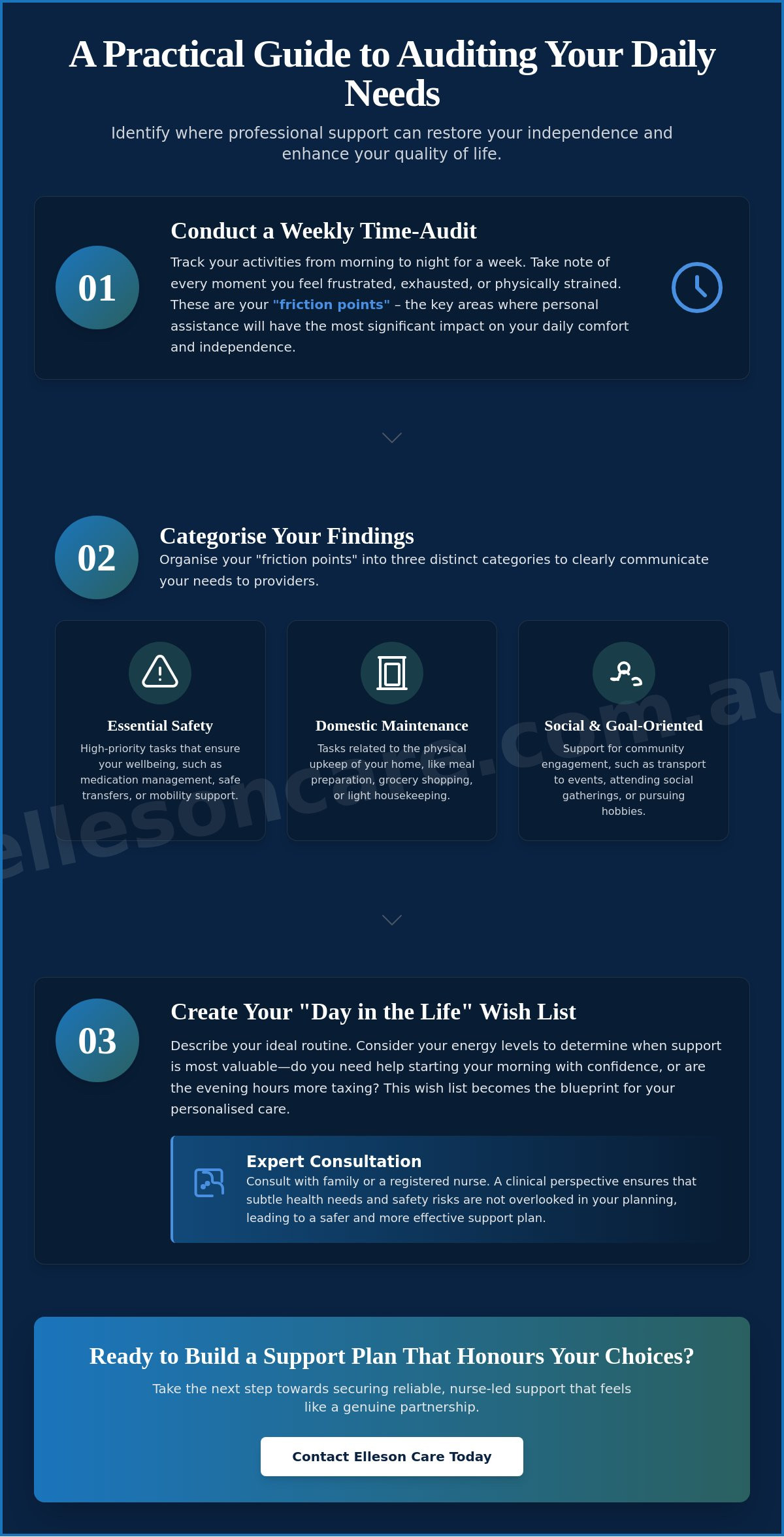
Identifying where you require support begins with careful observation of your current lifestyle. Rather than guessing your requirements, conduct a weekly time-audit to track your activities from morning until night. Note down every moment you feel frustrated, exhausted, or physically strained. These are your "friction points." By documenting these specific instances, you can clearly see where personal assistance will have the most significant impact on your quality of life and daily comfort.
Once you have gathered this data, group your findings into three distinct categories. "Essential safety" includes high-priority tasks such as medication management, transfers, or mobility support. "Domestic maintenance" covers the physical upkeep of your living space. Finally, "social and goal-oriented" tasks focus on your engagement with the Perth community. Understanding these categories helps you communicate your needs effectively to providers and aligns your request with the framework of the NDIS in Western Australia.
Consider your energy levels throughout the day to determine when support is most valuable. Some individuals need help to start their morning with confidence, while others find the evening hours more taxing. Write a "day in the life" wish list that describes your ideal routine and the specific ways you would like to be supported. It is often helpful to consult with family or a registered nurse during this process. A clinical perspective ensures that subtle health needs or safety risks are not overlooked in your personal planning.
Identifying Physical vs. Cognitive Support Needs
Support requirements are rarely identical for every individual. You might need physical assistance with tasks like heavy lifting, which demand specific safety protocols and equipment. Alternatively, your needs might be cognitive, such as help with memory, scheduling appointments, or navigating social cues. For individuals living with dementia or intellectual disabilities, personal assistance provides a steadying influence that adapts to changing daily requirements. Professional oversight is vital here, as complex physical needs often require clinical expertise to manage safely and effectively.
Setting Your Goals for Independence
True independence is about more than just completing a list of household chores. It is about the freedom to pursue what brings you joy and fulfillment. Perhaps your goal is to visit a favourite Perth location like Kings Park or return to a hobby you have recently set aside. When you frame your needs as specific goals, you create a stronger case for funding and support. Aligning your personal aspirations with NDIS outcomes ensures that your plan reflects your desire for a meaningful, active life. If you are ready to begin this process, you can speak with our clinical team to refine your personal audit.
Funding Your Support: NDIS vs. My Aged Care in Western Australia
Securing the right funding is the foundation of a sustainable care arrangement. In Western Australia, most individuals navigate their support through either the NDIS or My Aged Care. It's a complex system, but understanding the pathways ensures you receive the full entitlement you deserve. Under the NDIS, personal assistance is typically funded through the "Core Supports" budget, specifically under the "Assistance with Daily Life" category. This allocation provides the flexibility to use your funds for the specific daily tasks and community goals you identified during your needs audit.
For seniors, the landscape has seen significant improvements with the introduction of the Support at Home Program. This initiative simplifies how Perth families access daily help, moving away from fragmented services toward a more cohesive model of care. If you require a moderate level of support to remain independent, a Home Care Package Level 3 often serves as an ideal intermediate solution. Additionally, the Department of Veterans’ Affairs (DVA) offers specific personal care pathways for veterans, ensuring those who served have access to high-quality, clinical-led support in their own homes.
Navigating the NDIS Price Guide for Personal Assistance
The NDIS Price Guide can feel intimidating at first glance. Standard rates apply to most personal assistance tasks, such as help with dressing, meal preparation, or social outings. High-intensity rates are reserved for more complex health needs that require specialised training or nurse-led oversight. While gig-economy options might seem cheaper, they often lack the insurance, rigorous screening, and clinical governance provided by a registered provider. Choosing a registered partner ensures your support is safe, claimable, and managed with professional integrity.
Aged Care Assessments: Getting the Right Level of Help
Accessing aged care funding in Perth begins with an assessment by the Aged Care Assessment Team (ACAT) or the Regional Assessment Service (RAS). These interviews are your opportunity to advocate for your needs. Be honest about your "friction points" and the times you feel unsafe or overwhelmed. It's vital to highlight your need for social support and community engagement, not just clinical nursing. Clearly explaining how assistance with daily tasks will preserve your dignity ensures that your final care plan reflects the true level of support required to live well.
How to Choose the Right Personal Assistance Provider in Perth
Selecting a provider is a significant decision that impacts your daily comfort and safety. In Western Australia, prioritising locally owned providers often leads to better outcomes because they possess an intimate understanding of the Perth healthcare landscape. A local team knows the specific community resources, local medical centres, and transport nuances that national franchises might overlook. When evaluating options, ensure the organisation is nurse-led. This clinical foundation ensures that your personal assistance is managed with a holistic view of your wellbeing, rather than just a focus on task completion.
Staff consistency is another vital factor to investigate. You should feel confident that the same assistant will visit you regularly, allowing for the development of a genuine bond. This stability prevents you from having to repeat your preferences to a new person every week. A truly person-centred provider will listen to your unique choices rather than simply following a rigid checklist. They should treat your care plan as a living document that evolves alongside your needs and aspirations, ensuring you always feel heard and respected.
The "Compassionate Expert" Test: Questions to Ask
To find a provider that balances professional skill with human warmth, ask specific questions during your initial consultation. You might consider the following:
- How do you train your staff in empathy and maintaining the dignity of your clients?
- What specific protocols are in place if my regular assistant is unwell or on leave?
- Can you coordinate seamlessly with my GP or other in-home aged care services?
A reliable provider will have clear, transparent answers to these questions. This level of clinical integration is essential for maintaining a high standard of health oversight and ensuring your safety at home.
Checking Reviews and Local Reputation
In the Perth community, word-of-mouth recommendations often hold more weight than generic advertisements. Look for providers who have a strong local reputation for managing complex needs, as this typically indicates a higher level of staff training and clinical governance. A provider that prioritises a "family approach" to care will treat you as an individual with a unique story, not just a number on a spreadsheet. This level of investment ensures that your personal assistance feels supportive and respectful. If you're looking for a partner who values your autonomy and safety, you can contact our Perth team today to discuss your specific requirements.
Why Elleson Care is Perth’s Choice for Personalised Support
Elleson Care stands as a steady, reliable presence for families throughout Western Australia. Our leadership team brings more than 22 years of registered nursing experience to the forefront of every care plan we develop. This deep clinical background allows us to offer a "holistic family approach" that views every client as a unique individual with a rich history, rather than just a number in a database. By integrating clinical nursing, NDIS support, and aged care services into a single, cohesive offering, we remove the administrative stress of managing multiple providers. This commitment to local service excellence ensures that Perth families receive the highest tier of professional care without losing the human touch that only a family-owned business can provide.
As a West Australian owned and operated provider, we possess an intimate understanding of the local healthcare landscape. We understand the transition pathways between major Perth hospitals and home-based support, ensuring that your care remains consistent and safe. Our team is deeply invested in the quality of life of our community members, acting as both technically proficient experts and compassionate advocates for your autonomy. Whether you are navigating the later stages of an aged care journey or seeking specific disability support, our integrated model provides the stability and clinical authority required for long-term success.
Nurse-Led Excellence in Daily Assistance
In the context of personal assistance, clinical oversight is a vital safeguard that protects your health and wellbeing. Our registered nurses monitor every aspect of your support, ensuring that subtle health changes are identified early. This proactive approach is essential for preventing unnecessary hospitalisations and managing complex conditions with safety and precision. There is a profound sense of peace that comes from knowing your daily assistant is backed by professional medical expertise. We combine clinical precision with the warmth of a family-owned Perth business to deliver unmatched personal assistance.
Getting Started: Your First Step to a More Managed Life
Taking the first step toward a more managed life is a simple and respectful process. We invite you to book an initial consultation where we can discuss your specific NDIS or Aged Care plan in a calm, supportive environment. This is a no-obligation opportunity for you to ask questions and explore how a partnership with us can restore your confidence. Our team is here to listen to your goals and provide the steady, disciplined support you need to live well at home. Enquire today to see how our personal assistance services can support your independence.
Empowering Your Independence at Home
Organising support is a journey toward reclaiming your time and personal dignity. By conducting a thorough audit of your daily routine and navigating the specific funding pathways available in Western Australia, you can move from a place of uncertainty to one of stability. Choosing a nurse-led provider ensures that your personal assistance is grounded in clinical safety. This professional oversight is essential for managing complex health requirements while maintaining the lifestyle you choose.
As a proudly West Australian owned and operated provider, Elleson Care brings over 22 years of Registered Nursing experience to every home we serve. We are specialists in complex NDIS and Aged Care clinical support, treating every individual with the warmth and respect they deserve. If you're ready to build a care plan that feels like a genuine partnership, we invite you to Book a Consultation with our Perth Nurse-Led Care Team. You don't have to navigate these changes alone; we're here to provide the steady, compassionate expertise you need to live well.
Frequently Asked Questions
Is personal assistance the same as a cleaner?
No, personal assistance is distinct from domestic cleaning services. While a cleaner focuses on the maintenance of your physical environment, an assistant provides active support with your daily living tasks and personal care. This might include help with grooming, meal preparation, or attending social appointments. For those who manage premium residential or holiday properties, hotel-standard maintenance services such as neatly.ae illustrate the level of care required to keep a home in pristine condition. The goal of personal assistance, however, is to facilitate your independence rather than simply maintaining the home.
Can I use my NDIS funding for personal assistance in Perth?
Yes, you can use NDIS funding for these services if your plan includes "Assistance with Daily Life" within your Core Supports budget. This funding is designed to help you complete daily tasks that you might otherwise find challenging. We recommend reviewing your current plan or speaking with your Support Coordinator to ensure your goals align with this type of service in the Perth region.
How much does personal assistance cost per hour in Western Australia?
Hourly rates for personal assistance in Western Australia are typically determined by the National Disability Insurance Scheme (NDIS) Price Guide or the My Aged Care schedule of fees. These rates are indexed annually by the government to reflect changes in the cost of living and the minimum wage. To ensure you have the most current information, it's best to consult the official government pricing documents or speak directly with a registered provider.
Do I need a medical referral to hire a personal assistant for my elderly parent?
You don't require a medical referral from a GP to engage an assistant privately. However, if you wish to access government subsidies through a Home Care Package or the NDIS, you will need to undergo a formal assessment. For seniors, this is conducted by the Aged Care Assessment Team (ACAT) or the Regional Assessment Service (RAS) to determine the necessary level of support.
Can a personal assistant help me with my medication?
Assistance with medication is possible, provided the support worker has received the appropriate training and is working under clinical supervision. In a nurse-led environment, medication prompts or administration are managed with high levels of oversight to ensure safety and compliance with health standards. This is a critical area where professional expertise ensures your health remains a top priority in a home setting.
What happens if I don’t get along with the person sent to help me?
You are always entitled to request a change if the person supporting you isn't the right fit. A successful care relationship relies on mutual respect and shared values; it's not just about task completion. Reputable providers prioritise "person-centred" matching to ensure you feel comfortable and safe in your own home. If the rapport isn't there, you can speak with your care manager to find a more suitable assistant.
Is personal assistance available on weekends and public holidays in Perth?
Yes, support is generally available throughout the week, including weekends and public holidays, to ensure your routine remains consistent. Most providers in Perth operate 365 days a year to meet the needs of their clients. It's important to remember that government funding schedules usually apply higher hourly rates for services delivered outside of standard weekday business hours.
How do I know if I qualify for a Home Care Package to cover these services?
Eligibility for a Home Care Package is determined by My Aged Care based on your age and your need for support to stay living at home. You can start this process by booking an assessment online or over the phone. During the interview, an assessor will discuss your daily challenges and health needs to see if you qualify for one of the four levels of support available.


