

Filling shifts on a roster is not the same as managing life-sustaining clinical risk. For families coordinating NDIS complex nursing care Perth wide, the real challenge isn't simply securing a support worker to cover hours. It's ensuring the professional standing by your bed possesses the advanced clinical governance required to manage a ventilator, flush an enteral line safely, or avert a sudden hospital admission.
If you've felt the quiet exhaustion of liaising between WA Health discharge coordinators, deciphering the High Intensity Support Skills Framework, and wondering whether your home care team is truly qualified, you're not alone. You deserve complete confidence in your clinical safety. This 2026 clinical guide details how to access, fund, and coordinate specialised in-home NDIS complex nursing care across metropolitan Perth while protecting your family's daily routine.
Ahead, we unpack NDIS funding allocations, clinical compliance standards, and the nurse-led steps needed to establish safe, hospital-grade care right at home.
Key Takeaways
- Understand the specific eligibility criteria that separate standard daily support from specialised, disability-related clinical interventions.
- Discover the exact assessment pathway required to secure funding for NDIS complex nursing care Perth wide within your plan.
- Learn how direct Registered Nurse oversight safely manages high-intensity clinical needs, from tracheostomy care to enteral feeding, in your own home.
- Identify the governance standards you must demand from providers, including direct AHPRA registration and verifiable risk-management protocols.
- Gain practical strategies for coordinating seamless hospital-to-home transitions across metropolitan Perth that safeguard both clinical stability and family routines.
What is NDIS complex nursing care and who qualifies in Western Australia?
Specialised clinical healthcare delivered at home transforms long-term disability support into safe, dignified independent living. Administered under the National Disability Insurance Scheme (NDIS), complex nursing care bridges the gap between acute hospital treatment and routine personal care. In Western Australia, qualification relies on demonstrating that your clinical needs stem directly from a permanent functional impairment. To secure approval, supports must satisfy the National Disability Insurance Agency (NDIA) reasonable and necessary criteria, proving that ongoing skilled nursing mitigates acute medical risks while actively supporting your day-to-day autonomy.
Clinical criteria under the NDIS High Intensity Support Skills Framework
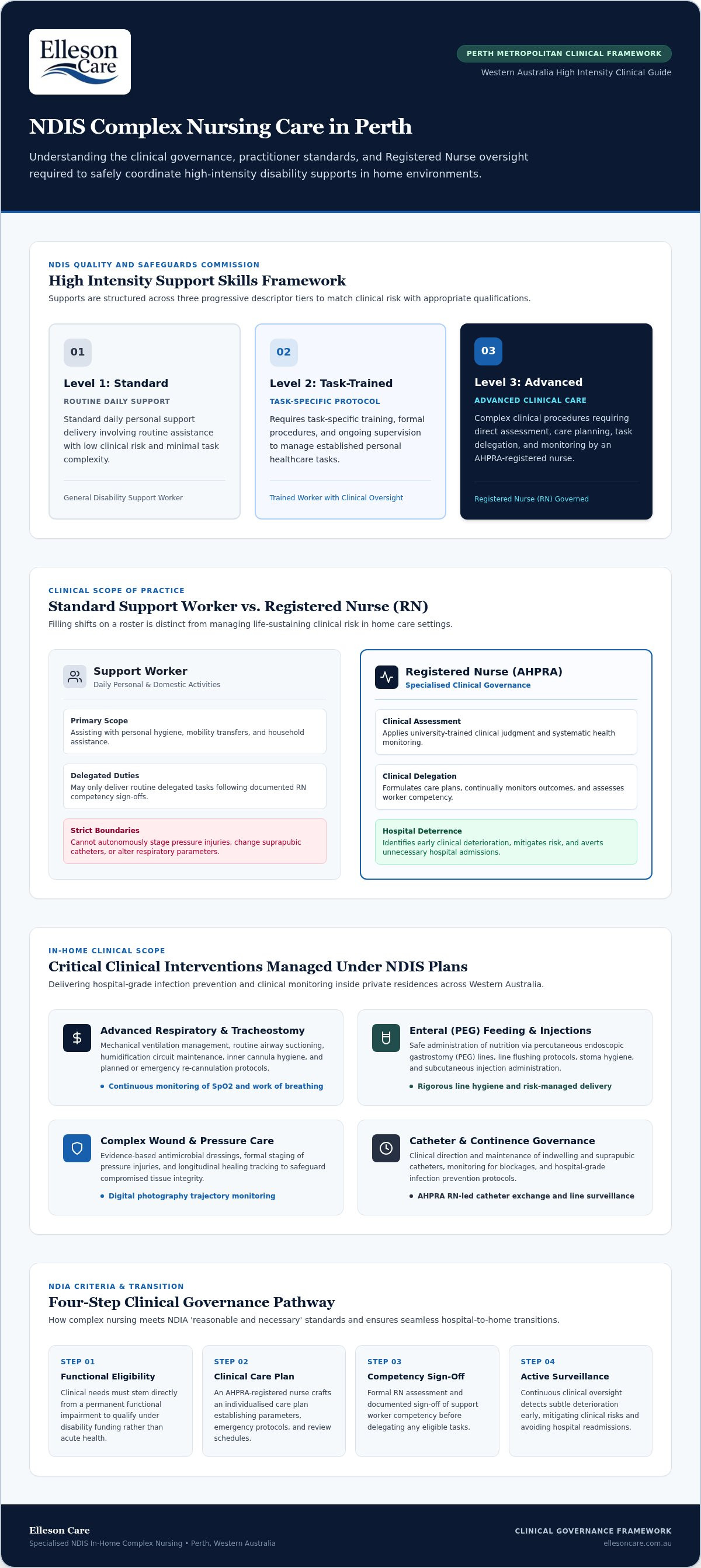
Under current NDIS quality standards, high-intensity support refers to specialised assistance with daily personal activities where clinical risks demand defined practitioner training, direct oversight, and rigorous compliance. The NDIS Quality and Safeguards Commission categorises these complex supports across three progressive skill descriptor levels: Level 1 covers standard support delivery, Level 2 demands specific task-based training, and Level 3 governs advanced clinical procedures.
Indicators requiring advanced intervention include mechanical ventilation, tracheostomy management, complex wound care, subcutaneous injections, and enteral (PEG) feeding. Registered nurse assessment and clinical governance are legally mandated whenever a participant's health relies on these procedures. An AHPRA-registered nurse must develop the individualised care plan, continually monitor clinical outcomes, and formally assess support worker competency before delegating any eligible tasks.
Essential differences between support worker tasks and registered nursing
Standard disability support focuses on daily living activities such as personal hygiene, mobility transfers, and household assistance. In contrast, complex nursing interventions require university-trained clinical judgment, systematic health monitoring, and immediate risk mitigation. Support workers cannot autonomously change suprapubic catheters, stage pressure injuries, or alter respiratory parameters without formal RN delegation and documented competency sign-offs.
Coordinating professional NDIS complex nursing care Perth wide ensures that highly technical healthcare remains firmly grounded in clinical safety. Having a dedicated Registered Nurse oversee your support team prevents preventable clinical deterioration, identifies subtle issues before they escalate, and eliminates unnecessary hospital admissions so you can remain safely at home.
Critical clinical supports managed under Perth NDIS nursing plans
Managing complex health needs in a home environment demands continuous clinical vigilance and structured clinical oversight. Community-based disability nursing unites diverse clinical specialities, ranging from respiratory management to continence care, under a single person-centred framework. Bespoke care plans are updated systematically as your health stability shifts, ensuring hospital-grade infection prevention protocols operate smoothly inside your private residence. This disciplined support integrates naturally with comprehensive nursing services, giving participants dependable clinical safety without disrupting cherished family routines.
Advanced respiratory support, tracheostomy, and invasive ventilation
Participants requiring mechanical ventilation or artificial airways need prompt, highly trained intervention. Registered Nurses oversee routine airway suctioning, humidification circuit maintenance, inner cannula hygiene, and planned or emergency re-cannulation protocols. Continuous clinical monitoring of oxygen saturation and work of breathing allows clinicians to detect early signs of respiratory compromise long before acute distress occurs, maintaining stability across day and night hours.
Complex wound management, pressure injury prevention, and catheter care
Impaired mobility carries substantial skin integrity and urinary health risks. Comprehensive nursing plans incorporate formal pressure injury staging, evidence-based antimicrobial dressings, and digital photography tracking to monitor healing trajectories over time. Nurses also direct indwelling and suprapubic catheter maintenance, scheduled bladder washouts, and rapid-response protocols for autonomic dysreflexia. By aligning care with established professional standards for nurses, clinicians implement specialised repositioning regimens and pressure-relieving equipment tailored to individual biomechanical needs.
Enteral nutrition and complex subcutaneous medication management
Enteral feeding requires precise technique to prevent aspiration, blockages, and site infections. Clinical nurses manage Percutaneous Endoscopic Gastrostomy (PEG) and PEJ feeds, formula delivery, line flushes, and stoma skin hygiene. They also administer complex continuous infusions, subcutaneous injections, and targeted blood glucose monitoring for participants living with diabetes alongside functional impairments.
When coordinating NDIS complex nursing care Perth wide, having consistent clinical leadership protects against dangerous complications. If you are evaluating how nurse-led clinical governance can support your household, you can connect with our Perth nursing team to discuss your specific care requirements.
How to secure NDIS funding for complex clinical nursing in Perth
Securing appropriate funding for specialised clinical support requires a clear, evidence-based approach. The NDIA funds disability-related health supports, but approval hinges on proving that these needs result directly from your permanent functional impairment rather than general medical care. To build an indisputable case for plan inclusion, follow this four-step pathway:
- Step 1: Obtain specialist medical reports. Secure detailed documentation from your treating general practitioners, neurologists, or WA Health hospital specialists confirming your diagnosis and clinical stability requirements.
- Step 2: Commission an independent nursing assessment. Engage an AHPRA-registered nurse to complete a formal Continence, Respiratory, or Comprehensive Clinical Care Assessment outlining direct care tasks.
- Step 3: Quantify hospitalisation prevention. Clearly articulate how dedicated nursing hours directly avert secondary complications, pressure injuries, sepsis, and emergency department presentations.
- Step 4: Lodge a formal review. Submit your evidence through an NDIS plan reassessment request or formal internal review under section 100 of the National Disability Insurance Scheme Act.
Securing clinical evidence from Western Australian health specialists
Gathering comprehensive evidence from local allied health professionals and WA Health hospital discharge teams is critical during hospital-to-home transitions. Planners frequently question the boundary between state healthcare responsibilities and NDIS supports. Your documentation must state that while WA public hospitals manage acute clinical episodes, ongoing in-home nursing maintains baseline stability. Recommendations must explicitly outline individual clinical tasks, required practitioner skill levels, and justified weekly hours to prevent generic funding rejections.
Navigating NDIS Core versus Capacity Building funding categories
Most funded nursing interventions sit within the Core budget under "Assistance with Daily Life" (Disability-Related Health Supports). This covers direct registered nurse hours for routine clinical interventions. Meanwhile, Capacity Building funding supports "Improved Daily Living", financing nurse-led education to upskill families or train support workers in delegated procedures.
Confusion often arises when NDIA planners mistake disability-related health needs for mainstream health system duties. Establishing robust evidence for NDIS complex nursing care Perth wide ensures your funding reflects actual clinical risk, securing reliable care for your household.
Key criteria for evaluating specialised NDIS nursing providers in Perth
Entrusting clinical interventions to an external team demands strict scrutiny of organizational safety. Rather than selecting an agency that merely schedules shifts, participants must examine a provider's clinical governance framework, transparent incident reporting systems, and clinical risk mitigation protocols. Legitimate clinical providers ensure that every nurse on their roster is registered directly with the Australian Health Practitioner Regulation Agency (AHPRA). They also maintain clear escalation pathways and support families with planned breaks through specialised respite care in Perth, protecting family carers from chronic burnout without disrupting technical care routines.
Registered nurse oversight versus generic disability labour hire
Genuine clinical accountability in disability support exists only when care plans are authored, supervised, and continually reviewed by experienced Registered Nurses rather than non-clinical administrative staff. Generic labour brokers frequently send casual workers with generalised certificates into high-acuity environments. In contrast, clinical providers conduct face-to-face competency validations before allowing any support worker to assist with delegated clinical tasks. High staff turnover, fluctuating carer faces, and unverified credentials are major warning signs of compromised safety.
Local Perth responsiveness, communication, and family-centred values
Working with a locally owned provider ensures immediate familiarity with Perth metropolitan healthcare networks, from Fiona Stanley Hospital in the south to Sir Charles Gairdner Hospital in the north. Local clinical teams adapt smoothly to established household routines, actively listening to family insights rather than imposing rigid, institutional schedules. Comprehensive providers also understand multi-generational living, seamlessly coordinating clinical interventions while assisting ageing parents or relatives with dignified in-home aged care under the same trusted banner.
When you require dependable NDIS complex nursing care Perth wide, prioritize an organisation built on authentic clinical authority and personal dignity. To secure dedicated clinical support tailored precisely to your household, contact Elleson Care today to arrange an in-home clinical consultation.
Partnering with Elleson Care for person-centred clinical nursing in Perth
Choosing a clinical provider is an intimate decision that directly affects your safety, independence, and household peace of mind. As a dedicated, West Australian owned and operated provider based in Perth, Elleson Care delivers high-level clinical support directly to your home. We reject the transactional labour-hire model, choosing instead to build care around your individual routines, cultural background, and personal goals. Our collaborative onboarding process begins with listening, ensuring your family feels heard, valued, and clinically secure from day one.
Clinical excellence grounded in over 22 years of nursing expertise
Under the clinical leadership of Registered Nurses with more than 22 years of healthcare experience, our organisation maintains the highest standards of practice. Our team possesses specialised capabilities covering invasive ventilation, tracheostomy management, complex wound care staging, enteral feeding, and community-based palliative support. Technical skill alone isn't enough; clinical excellence must be paired with genuine empathy and respectful bedside manners. By prioritising staff continuity, we ensure familiar, qualified nurses support you consistently, fostering deep trust and predictable routines.
Coordinated hospital-to-home transitions across Perth metropolitan health networks
Moving from an acute ward back into your private residence can feel overwhelming without structured coordination. Our clinical leaders collaborate directly with discharge teams across Perth metropolitan hospitals, including Fiona Stanley Hospital, Royal Perth Hospital, and Sir Charles Gairdner Hospital. We work proactively to ensure essential consumables, clinical equipment, and physician-approved nursing care plans are operational well before you walk through your front door.
This coordinated transition bridges the gap between inpatient treatment and sustainable independent living. If you are preparing for discharge or seeking reliable NDIS complex nursing care Perth wide, our Registered Nurses are here to help. Reach out to Elleson Care to discuss your clinical needs and take the next step toward safe, compassionate home care.
Taking the Next Step Towards Safe Clinical Independence at Home
Securing high-intensity disability support shouldn't mean sacrificing the comfort, dignity, or privacy of your home environment. By establishing comprehensive clinical assessments, understanding your funding pathways, and insisting on direct Registered Nurse oversight, you protect your household against preventable complications and unnecessary hospital readmissions.
As a proudly West Australian owned and operated healthcare provider serving metropolitan Perth, Elleson Care bridges the gap between acute clinical expertise and compassionate home support. Backed by over 22 years of registered nursing leadership, our clinicians manage complex clinical interventions with quiet precision, including ventilator support, tracheostomy care, complex wound staging, and catheter maintenance. You don't have to manage this journey alone.
When you're ready to establish dependable NDIS complex nursing care Perth wide, we're here to help you navigate every detail. Speak with our experienced clinical nursing team at Elleson Care today to build a safe, sustainable care routine designed entirely around your life.
Frequently Asked Questions
Can NDIS funding pay for Registered Nurses to provide daily care at home?
Yes, NDIS funding covers direct Registered Nurse hours when clinical interventions directly relate to your disability and meet reasonable and necessary criteria. Funded under the Core Supports budget as Disability-Related Health Supports, this allocation provides skilled nursing for tasks like ventilator checks, complex wound dressings, and catheter maintenance. It ensures clinically unstable participants receive essential healthcare without needing extended hospital stays.
How does the NDIA differentiate complex nursing care from standard personal care?
The NDIA separates standard assistance from complex care using the High Intensity Support Skills Framework. Standard personal care involves non-clinical assistance with mobility, showering, and domestic duties. In contrast, complex nursing care covers higher-risk clinical procedures, such as managing tracheostomies, stomas, or enteral feeding lines. These activities require formal clinical assessment, ongoing Registered Nurse governance, and specialised competency sign-offs before any task can be safely delegated.
What clinical qualifications must an NDIS complex care nurse hold in Western Australia?
In Western Australia, complex care nurses must maintain active registration with the Australian Health Practitioner Regulation Agency (AHPRA). Registered Nurses hold university degrees and must comply with Nursing and Midwifery Board of Australia standards. When coordinating NDIS complex nursing care Perth wide, clinicians also undergo NDIS Worker Screening checks, specific high-intensity clinical competency verifications, and regular professional development in areas like invasive ventilation and complex wound staging.
What happens if a participant requires urgent changes to their clinical care plan?
When a participant's health status shifts, an AHPRA-registered nurse immediately assesses the emerging risks and updates the clinical care plan. If the adjustment requires additional nursing hours or different consumables, the provider collaborates with the participant's support coordinator or Local Area Coordinator. They lodge an urgent change of circumstances review with the NDIA, providing updated medical reports from treating specialists to secure the required funding adjustments.
Can family members be trained by nurses to perform high-intensity clinical tasks?
Yes, Registered Nurses can deliver structured clinical training directly to family members and informal carers. Funded through the Capacity Building budget under Improved Daily Living, this education covers technical procedures such as enteral feeding tube flushes, basic airway suctioning, and catheter hygiene. This nurse-led training builds family confidence, protects participant dignity, and ensures household routines remain clinically safe and sustainable.
Is NDIS complex nursing care available across all suburbs in the Perth metropolitan area?
Specialised community nursing services are widely accessible across metropolitan Perth, spanning northern coastal corridors down to the southern suburbs. Providers like Elleson Care deliver home-based clinical support across the Perth region, coordinating directly with local GPs and community clinics. When selecting a provider for NDIS complex nursing care Perth, confirm their clinical nursing teams actively travel to your specific local government area to ensure continuity.
How do hospital discharge teams in Perth coordinate with community nursing providers?
Hospital discharge coordinators at facilities like Fiona Stanley Hospital or Royal Perth Hospital liaise directly with community nursing providers before discharge occurs. The community Registered Nurse reviews inpatient handover notes, attends discharge planning conferences, and verifies that specialised home equipment, oxygen concentrators, or feeding pumps are installed. This proactive communication guarantees a smooth transition from hospital wards to the home environment without clinical disruptions.


