

A warm smile and a willingness to help with daily chores are no longer enough to define quality in-home care. Welcoming a new carer into your private home is deeply personal, and it's entirely natural to feel anxious about unvetted strangers, high agency turnover, or helpers who cannot spot subtle changes in your health. When your dignity, comfort, and physical safety are at stake, understanding what makes a good support worker helps you look beyond basic domestic assistance to find truly capable care.
You deserve absolute confidence that the person beside you possesses both the emotional intelligence to honour your independence and the clinical training to manage unexpected emergencies. In this guide, you'll discover the essential personal traits, accredited qualifications, and rigorous safety standards that define exceptional aged care and disability support professionals. We provide the practical criteria you need to interview, assess, and select a reliable carer who upholds your rights and delivers consistent, nurse-led peace of mind.
Key Takeaways
- Understanding what makes a good support worker starts with viewing them as an empowering partner who actively protects your personal dignity and promotes long-term independence.
- Exceptional carers combine high emotional intelligence with keen observational skills to detect subtle cognitive and physical health changes before they escalate.
- Crucial compliance checks, such as verified NDIS Worker Screening Clearances and recognised Certificate III qualifications, distinguish professional care practitioners from casual domestic helpers.
- A structured five-step interview process using real-world scenarios helps you evaluate a candidate's critical thinking, communication style, and reliability with confidence.
- Registered nurse governance transforms day-to-day assistance into proactive health management through clear clinical escalation pathways and regular competency assessments.
Core Qualities: What Makes a Good Support Worker in 2026?
A good support worker is an empathetic, skilled professional who champions a client's autonomy and dignity, enabling them to live safely and independently within their own home and community.
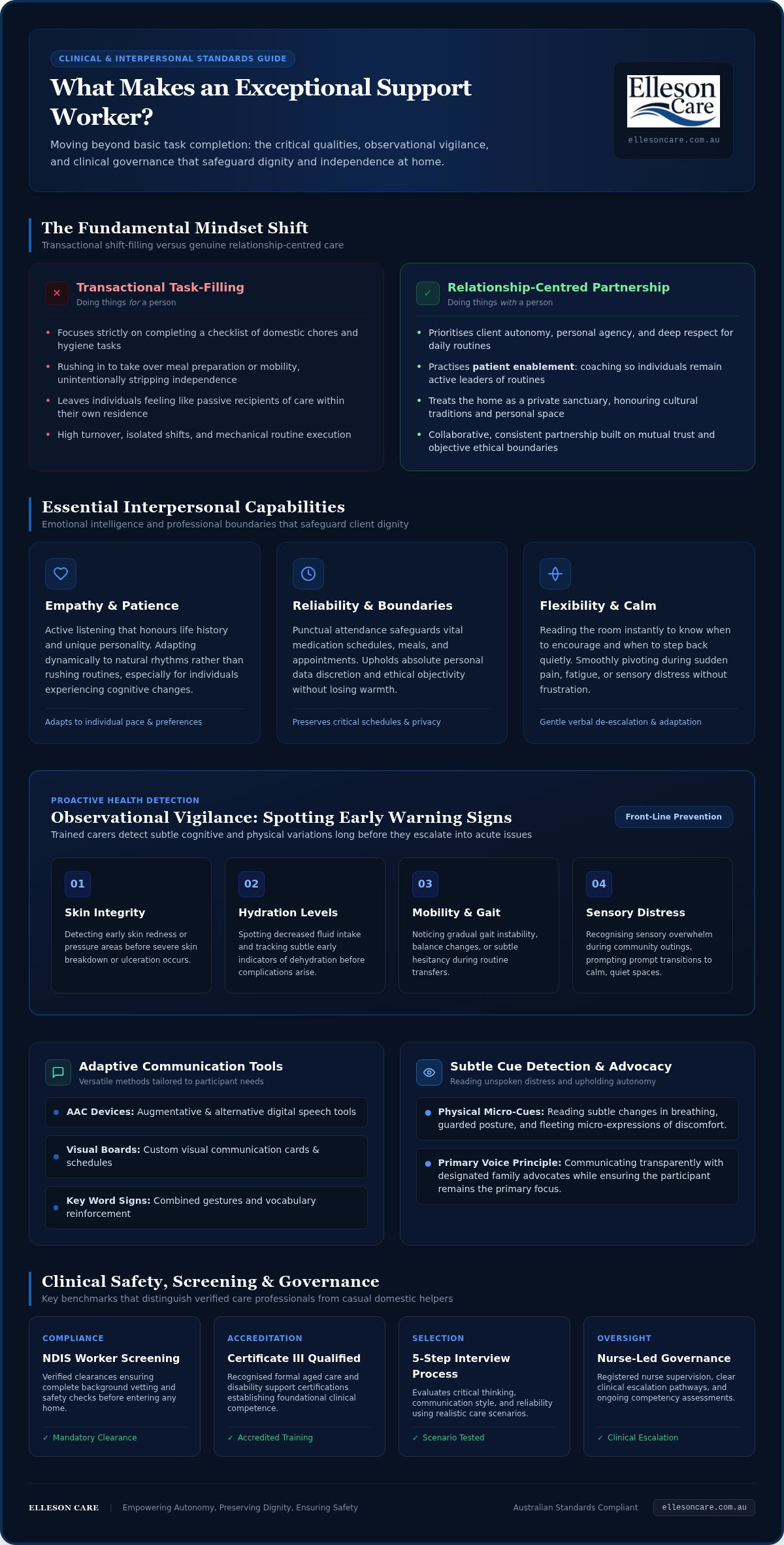
Completing a checklist of household chores or personal hygiene tasks does not define excellence in care. When evaluating what makes a good support worker, task execution is merely the baseline. Genuine support requires an empowering mindset that prioritises doing things with a person rather than simply doing things for them. Transactional shift-filling treats support work as a series of isolated domestic duties, often leaving individuals feeling like passive recipients of care in their own residences. In contrast, relationship-centred support fosters a consistent, collaborative partnership built on mutual trust, personal agency, and deep respect for the individual's routines.
Empathy, Patience, and Unconditional Positive Regard
Exceptional support begins with active listening that honours every person's life history, unique personality, and daily preferences. Patience is vital, particularly when supporting individuals experiencing memory loss, cognitive changes, or communication barriers. Rather than rushing through routines, an observant carer adapts to the client's natural rhythm. They respect the home as a private sanctuary, honouring cultural traditions, personal space, and lifestyle choices without judgment.
Reliability, Punctuality, and Professional Boundaries
Reliability forms the cornerstone of emotional and physical safety. Arriving on time preserves critical medication schedules, meal routines, and appointments, protecting clients from unnecessary distress or vulnerability. True professionals understand how to maintain clear ethical and emotional boundaries while delivering compassionate care. They safeguard personal data with absolute discretion, act with integrity, and nurture warm, respectful relationships that never compromise client dignity or professional objectivity.
Essential Interpersonal and Practical Skills Beyond Basic Care
High emotional quotient (EQ) separates ordinary helpers from exceptional carers. While technical capabilities matter, an emotionally attuned support worker reads the room instantly, recognising when to offer encouragement and when to step back quietly. A core element of what makes a good support worker is the commitment to preserve participant autonomy. Rushing in to take over meal preparation or mobility tasks might save time, but it inadvertently strips away independence. Skilled carers practice patient enablement, coaching and assisting so participants remain active leaders in their own routines.
True professionalism requires observational vigilance and everyday flexibility. If sudden fatigue or pain disrupts the day's schedule, a skilled worker pivots smoothly without showing frustration. Finding dedicated, locally matched professionals through person-centred disability support services ensures you receive this adaptable, dignified care tailored directly to your personal lifestyle.
Adaptive Communication and Active Listening
Care needs vary greatly, requiring versatile communication tools. Competent carers work comfortably with augmentative and alternative communication (AAC) devices, visual communication boards, and key word signs. They pay close attention to subtle cues, such as changes in breathing, guarded posture, or fleeting micro-expressions that signal unspoken discomfort. When speaking with designated family advocates, they communicate transparently while ensuring the participant remains the primary voice in every conversation.
Proactive Problem Solving and Observational Vigilance
Vigilant support workers function as essential front-line observers, spotting early warning signs long before they turn into acute medical issues. They routinely identify subtle physical and cognitive changes, including:
- Early skin redness or pressure areas before skin breakdown occurs
- Decreased fluid intake or subtle signs of dehydration
- Gradual gait instability or hesitancy during routine transfers
- Sensory overwhelm during community outings, prompting calm transitions to quieter spaces
When confusion or distress arises, skilled workers apply gentle verbal de-escalation, validating emotions and creating a safe, grounding environment.
Qualifications, Screening, and Clinical Safety: What Sets Experts Apart
Rigorous screening and formal qualifications transform good intentions into dependable, safe care. Many providers treat support work as casual domestic assistance, but true caregiving requires verified technical capability. Understanding what makes a good support worker means looking closely at the statutory clearances, accredited training, and ongoing clinical governance backing every shift.
The table below highlights the distinct differences between an independent helper and a clinically supervised professional:
| Quality Dimension | Basic Domestic Helper | Clinically Supervised Professional |
|---|---|---|
| Screening and Vetting | Basic police check only | Active NDIS Worker Screening Clearance and verified references |
| Formal Qualifications | Unaccredited or informal experience | CHC33021 Certificate III or IV in Individual Support with supervised practical placement |
| Clinical Oversight | None; works in isolation | Direct supervision and clinical delegation by AHPRA-registered nurses |
| High-Intensity Competency | Unverified self-direction | Nurse-assessed sign-offs for enteral feeding, catheter care, and complex medication |
Professional support workers operating under formal governance connect directly with comprehensive nursing services. This clinical bridge ensures changes in physical well-being are reviewed swiftly by registered healthcare professionals.
Mandatory Screening and Statutory Certifications
Legitimate safety starts with verified credentials. Under Australian requirements, professional support workers must hold a current NDIS Worker Screening Check, linking them to a national database that continuously tracks clearance status across its five-year validity cycle. Candidates require a National Police Clearance, an active Working with Children Check where applicable, and current HLTAID011 Provide First Aid and CPR certificates tailored to home and community settings.
Clinical Competency and Continuous Skill Development
Accredited coursework such as the CHC33021 Certificate III in Individual Support provides fundamental knowledge through at least 120 hours of supervised practical placement. However, ongoing competency assessments ensure day-to-day safety in private residences. Professional workers participate in regular clinical training that covers:
- Ergonomic manual handling techniques using ceiling hoists, slide sheets, and standing lifters to protect client dignity and physical safety
- Strict infection prevention and control protocols aligned with national healthcare standards
- Specialised clinical competencies under registered nurse delegation, including dysphagia meal modifications, subcutaneous injections, and seizure management
These structured checks define what makes a good support worker, giving families confidence that complex health routines remain in capable, accountable hands.
How to Interview and Choose the Right Support Worker for Your Needs
Selecting the right carer requires a structured approach that looks beyond a friendly personality. Shared hobbies build quick rapport, but clinical safety, reliability, and emotional maturity determine long-term success. Families managing aged care funding under the Support at Home program can follow a simple five-step framework: define specific daily support goals, verify mandatory statutory clearances, conduct scenario-based interviews, run an initial trial shift, and gather direct feedback from the participant. This systematic process clarifies what makes a good support worker for your unique household.
Essential Scenario-Based Interview Questions to Ask
Hypothetical scenarios reveal how a candidate applies critical thinking under pressure. Consider asking targeted questions such as:
- "If a participant feels overwhelmed and refuses their usual morning routine, how do you adapt without causing distress?"
- "What specific steps would you take if you noticed sudden confusion, slurred speech, or a minor skin tear?"
- "How have you supported participants with similar mobility, neurological, or communication needs in the past?"
Listen for answers that prioritise client consent, calm de-escalation, and timely escalation to clinical supervisors.
Structuring an Initial Trial Shift and Assessing Fit
A paid trial shift provides clear insight into everyday working chemistry. Before the shift begins, outline daily expectations, domestic boundaries, and communication preferences clearly. During the visit, observe whether the carer listens actively and moves through your home with quiet respect for personal space. After the shift concludes, speak privately with the care recipient to gather their honest, unpressured feedback regarding comfort, dignity, and personal connection.
Balancing Independent Platforms Against Managed Care Providers
Digital booking platforms give families direct hiring control, but they also transfer significant administrative burdens, including tax management, screening verification, and finding last-minute replacements when a worker falls ill. Conversely, a managed provider delivers reliable continuity of care, professional insurance, and established clinical governance. This reliable structure proves invaluable during planned transitions, such as coordinating short-term respite care services for family carers. To ensure your loved one receives consistent, qualified support across Perth, connect with our dedicated local team today.
The Nurse-Led Difference: Why Clinical Governance Elevates Support Work
Support work reaches its highest potential when backed by experienced clinical leadership. While warm interpersonal skills establish trust, having direct access to registered nursing oversight turns daily visits into an effective wellness monitoring network. A support worker does not operate in isolation. Backed by clinical governance, they serve as observant eyes and ears in the home, trained to recognise emerging health issues before they escalate into acute medical crises. This clinical foundation transforms what makes a good support worker from a simple list of personal qualities into a reliable standard of care.
Professional nursing governance forms the backbone of safe, sustainable in-home aged care and disability support. Rather than waiting for a noticeable decline to trigger an emergency response, nurse-led oversight introduces proactive clinical reviews that maintain client independence, safeguard dignity, and prevent unnecessary hospital admissions.
Proactive Health Escalation and Peace of Mind
Clear escalation pathways protect vulnerable clients in their home environments. When an observant carer notes early changes, such as reduced fluid intake, persistent skin redness, unexpected medication side effects, or subtle shifts in balance, they escalate their observations directly to a Registered Nurse. This clinical team immediately reviews the care plan, liaises with general practitioners, and adjusts daily support routines promptly. Having this direct clinical link prevents avoidable emergency hospital visits and provides profound peace of mind to families.
A Holistic, Family-Centred Approach in Perth
Clinical governance also enriches the entire family experience. Experienced nurse leaders design comprehensive care plans that align with household dynamics, cultural values, and personal routines. Rather than leaving workers to interpret care tasks on their own, our clinicians deliver continuous mentoring, regular debriefings, and formal competency sign-offs directly to the care team. This ongoing support ensures that every support professional visiting your home brings both technical proficiency and genuine empathy.
With more than 22 years of clinical leadership, Elleson Care delivers this nurse-led reassurance across the Perth metropolitan area. As a 100% Western Australian owned and operated provider, our local team matches individuals with dedicated, consistent support professionals who understand the community. By combining frontline warmth with rigorous nursing governance, we ensure that what makes a good support worker translates into safe, empowering care every single day.
Securing Confident, Dignified Support at Home
Finding the right care partner shouldn't feel like a difficult choice between genuine companionship and clinical safety. Ultimately, what makes a good support worker is the ability to protect your personal autonomy while maintaining vigilant, high-level standards across every visit. When rigorous screening, continuous observational skill, and sincere empathy come together, your home remains the safe, comforting sanctuary it is meant to be.
Elleson Care brings more than 22 years of healthcare leadership to in-home care across Perth. As a proudly Western Australian owned provider, we back every carer with continuous clinical governance and direct mentoring from experienced Registered Nurses. You don't have to navigate these decisions alone. Connect with our nurse-led care team today to meet dedicated, locally matched support professionals who will honour your routines, safeguard your health, and support your long-term independence with warmth and dignity.
Frequently Asked Questions
What qualifications should a disability or aged care support worker hold in Australia?
The benchmark vocational qualification in Australia is the CHC33021 Certificate III in Individual Support, specialising in Ageing or Disability. This accredited course requires at least 120 hours of supervised practical placement. In addition to formal certification, a capable worker must maintain current HLTAID011 Provide First Aid and CPR certificates, alongside ongoing training in safe manual handling and infection control.
What is the difference between a support worker and a registered nurse?
A support worker assists with personal care, daily household activities, and community participation. In contrast, a Registered Nurse holds university qualifications, AHPRA registration, and clinical expertise to manage complex medical needs like wound dressing, catheter changes, and palliative support. Understanding what makes a good support worker includes recognising this partnership, as great carers operate under direct nurse oversight to maintain clinical safety at home.
Can a support worker administer prescription medication during a home visit?
Yes, support workers can assist with medication, provided they have completed accredited training in assisting with medication and hold current competency verification. They can prompt, open blister packs, or observe clients taking prescribed oral tablets according to a pharmacy-prepared Webster-pak and GP care plan. However, complex clinical administration, such as insulin injections or peg medication, requires delegation and direct assessment by a Registered Nurse.
How do I know if a support worker is the right personality match for my family?
The right personality match shows clearly through active listening, shared values, and an intuitive respect for your household routines. During an initial trial shift, observe whether your family member feels relaxed, heard, and supported rather than rushed. Discovering what makes a good support worker for your household often comes down to emotional compatibility, ensuring the care relationship feels like a genuine partnership rather than an intrusion.
What checks and clearances are legally required for support workers in Western Australia?
In Western Australia, professional support workers must hold a cleared NDIS Worker Screening Check or a current National Police Certificate. If supporting minors, a valid Working with Children Check (WWCC) is mandatory. Providers must also verify valid Australian working rights, current CPR and First Aid certifications, and comprehensive vehicle insurance if the worker provides community transport across Perth.
What happens if our regular support worker is unwell or on annual leave?
When using a managed care provider, planned leave or unexpected illness is covered by a rostered replacement worker who is already briefed on your individual care plan. At Elleson Care, our local Perth team ensures backup carers possess the exact competencies required for your routines. This structured handover protects your continuity of care, eliminating the stress of scrambling for last-minute replacements on independent booking apps.
Can our support worker assist with transport and community social outings?
Yes, support workers can provide transport to medical appointments, shopping centres, social clubs, and community events across the Perth metropolitan area. Workers who transport clients must hold a valid Western Australian driver's licence, a roadworthy vehicle with comprehensive insurance, and appropriate restraint training if transferring mobility equipment. This assistance is designed to build social confidence and keep you connected to your local community.


