

What if the most vital support your family needs right now isn't another daytime appointment, but eight hours of restorative rest? When you're managing complex health dependencies through the night, every evening brings a familiar tension. Accessing dedicated NDIS overnight care at home Perth families can rely on should bring genuine relief, yet sorting through shift structures and clinical requirements often feels overwhelming.
You already know that chronic sleep deprivation isn't sustainable for any household. Waking at every sound, managing repositioning schedules, and worrying whether support staff can handle an unexpected health event takes an exhausting physical toll. You deserve to sleep without constant anxiety, knowing your loved one is safe and treated with dignity.
Discover how NDIS overnight care works in Perth, from funding sleepover shifts to clinical nurse-led support. This guide examines the essential differences between active and sleepover models, clarifies how to allocate your NDIS Core budget, and shows how local clinical governance protects your family's well-being.
Key Takeaways
- Understand the vital differences between inactive sleepover shifts and active waking nights to determine the right level of support.
- Learn how to navigate Core funding under Assistance with Daily Life to establish reliable NDIS overnight care at home Perth families can depend on.
- Identify when nocturnal health needs require registered nurse clinical governance rather than standard domestic care.
- Follow practical guidance to prepare your household for night support while preserving personal privacy and individual dignity.
- Discover how dedicated overnight assistance relieves carer exhaustion, giving family members true restorative rest and lasting peace of mind.
Understanding NDIS Overnight Care at Home in Perth: Sleepover vs Active Night
NDIS overnight care at home provides essential physical, personal, and clinical support during the continuous hours between dusk and dawn to ensure participant safety and sustain informal family caregiving. Funded through the National Disability Insurance Scheme (NDIS), these nocturnal supports fall into two distinct models: inactive sleepovers and active waking nights. Choosing the correct structure is vital for personal safety, clinical efficacy, and compliant plan budget allocation.
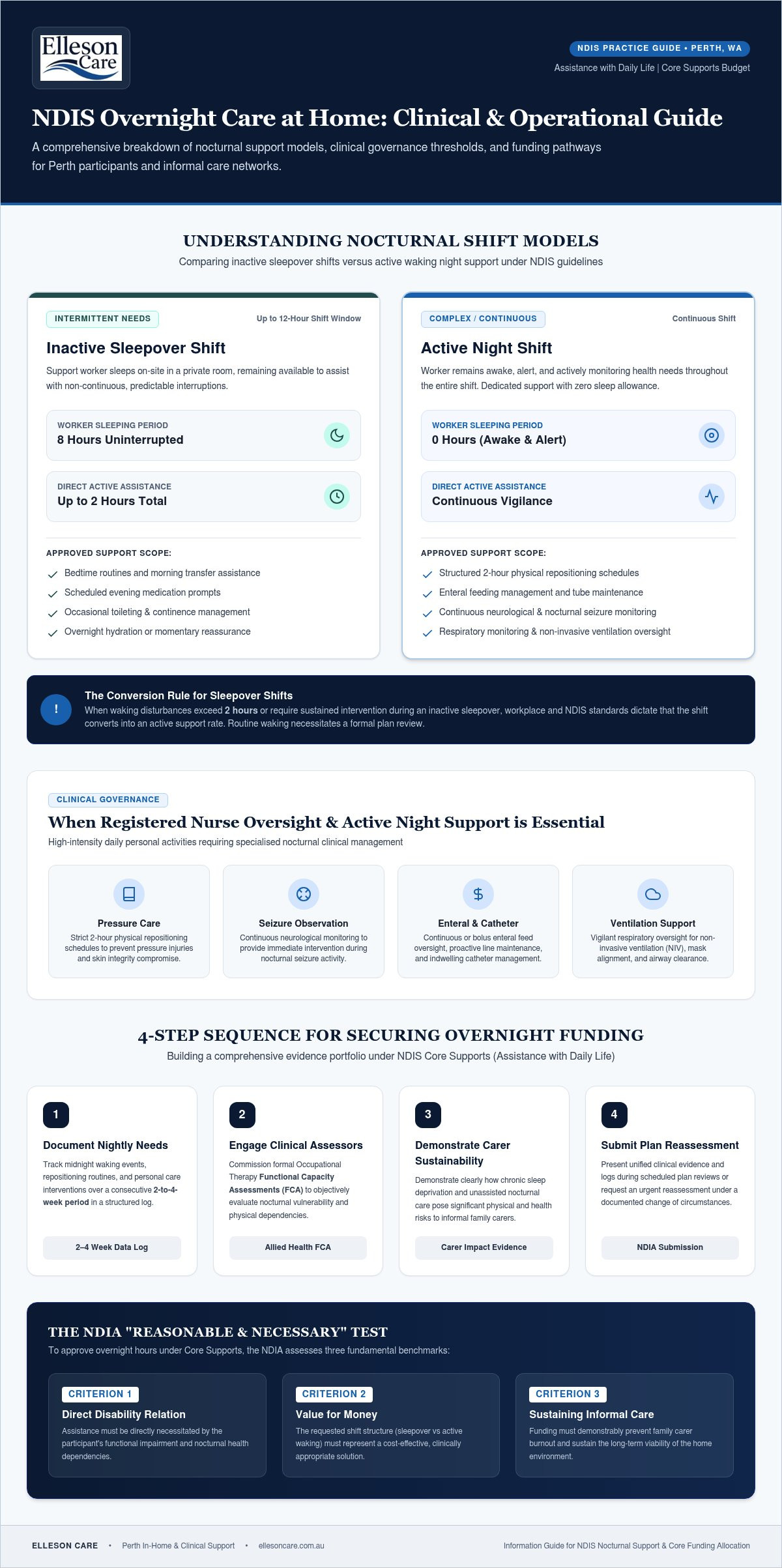
Many families exploring NDIS overnight care at home Perth services struggle to identify which category fits their domestic routine. Inactive sleepover support involves a support worker sleeping on-site in a private room, available to assist with intermittent, non-continuous interruptions. Active night shifts, by contrast, demand that the worker remains awake, alert, and actively monitoring health needs throughout the entire shift. The boundary between these models depends directly on the frequency, intensity, and predictability of night-time interventions.
Inactive Sleepover Shifts: When Occasional Assistance is Needed
A standard sleepover shift spans a continuous window of up to twelve hours, incorporating an uninterrupted eight-hour sleeping period alongside up to two hours of direct, active assistance. This model suits participants who generally rest well but need occasional help with:
- Bedtime routines, medication prompts, and morning transfers
- Occasional assistance with toileting or continence management
- Overnight hydration or reassurance during momentary distress
When waking disturbances exceed two hours or require sustained intervention, workplace standards dictate that the shift converts into an active support rate. If night waking becomes routine, a formal review is necessary to adjust your support arrangements accordingly.
Active Night Shifts: Continuous Nocturnal Care and Complex Support
Active night shifts involve dedicated, continuous waking support where the worker does not sleep at any point during the shift. This level of care is essential for individuals with complex physical or clinical dependencies who cannot be safely left unmonitored for extended periods.
Typical requirements during an active night include structured two-hour physical repositioning schedules to prevent pressure injuries, proactive catheter maintenance, and enteral feeding management. It is also critical for participants requiring continuous neurological observation for nocturnal seizure activity or respiratory monitoring for non-invasive ventilation systems. Continuous vigilance ensures immediate, skilled intervention before a minor irregularity escalates into an emergency.
Navigating NDIS Funding for Overnight Support in WA
Securing overnight support requires clear alignment with the National Disability Insurance Agency (NDIA) criteria. In-home night support falls under the Core Supports budget, specifically within the Assistance with Daily Life category. To approve these hours, the NDIA applies the "reasonable and necessary" test, evaluating whether nocturnal assistance directly relates to the participant's disability, represents value for money, and sustains family caregiving arrangements effectively.
Building a successful funding request follows a structured four-step sequence:
- Document nightly needs: Track midnight waking events, repositioning routines, and personal care interventions over a consecutive two-to-four-week period.
- Engage clinical assessors: Commission formal functional capacity assessments that evaluate nocturnal vulnerability and physical dependencies.
- Demonstrate carer sustainability: Show clearly how unassisted night support creates health risks for family members, threatening the stability of the home environment.
- Submit through plan reassessment: Present unified clinical evidence during your scheduled plan review or request a reassessment under change of circumstances.
Partnering with experienced local teams simplifies this process. When planning your budget allocation for NDIS overnight care at home Perth families often benefit from early guidance on coordinating multidisciplinary documentation.
Evidence Required: Partnering with Allied Health and Local Medical Teams
Thorough documentation forms the backbone of any overnight funding approval. An Occupational Therapy Functional Capacity Assessment (FCA) is crucial, as it objectively identifies physical transfers, pressure care risks, and nocturnal toileting dependencies. Complementing this with detailed sleep diaries provides undeniable, real-time proof of waking frequencies. Additionally, specialist letters from Perth metropolitan hospitals or your general practitioner must outline health risks associated with unmonitored nights, reinforcing clinical necessity under established professional standards for nurses and allied practitioners.
Preventing Family Carer Burnout: The Formal Case for Night Respite
Chronic sleep fragmentation represents an immediate hazard to family sustainability. Primary carers who manage continuous night tasks experience profound mental exhaustion, heightened cardiovascular strain, and severe fatigue. The NDIA explicitly recognises that informal supports cannot deliver unassisted care around the clock indefinitely.
Introducing scheduled nocturnal shifts preserves physical health and protects family relationships. Rather than uprooting a loved one into unfamiliar facilities, in-home night support delivers effective, familiar relief. For families considering broader relief options, exploring our comprehensive guide on respite care in Perth reveals how planned nocturnal coverage maintains domestic stability long term.
Clinical Nocturnal Care: When Registered Nurse Oversight is Essential
Basic domestic overnight support assists with mobility and settling routines, but clinical nocturnal care operates under an entirely different scope of practice. High-intensity interventions involve invasive therapies, delicate medical machinery, and volatile health conditions where an undetected issue can turn critical within minutes. During midnight hours, when community-based medical services operate at lower capacities, having direct registered nurse oversight provides an essential clinical safety net.
Nurse-led governance ensures every protocol aligns with rigorous health standards. This clinical umbrella includes the safe administration of complex subcutaneous medications, precise titration of nocturnal pain relief, and rapid triage when vitals fluctuate unexpectedly. A registered nurse coordinates structured escalation pathways, meaning emergencies are identified early and managed methodically rather than through reactive guesswork. Families seeking reliable nursing services in Perth often rely on this level of professional oversight to maintain intensive care routines safely within their domestic environment.
Managing Complex Airway, Enteral Feeding, and Respiratory Dependencies
Specialised clinical care requires active, highly skilled monitoring throughout the night. For individuals relying on continuous non-invasive ventilation or tracheostomies, trained nocturnal staff must clear secretions via suctioning, monitor oxygen saturation, and respond immediately to ventilator disconnect alarms. Enteral feeding regimens via PEG or PEJ tubes also demand vigilant management to prevent tube dislodgement and manage aspiration risks. In conditions involving complex neurological profiles, nurses implement strict seizure management protocols, administering emergency intra-nasal or buccal anti-epileptic medications without hesitation.
Post-Hospital Discharges Across Perth Metropolitan Health Services
Returning home from major tertiary centres like Royal Perth Hospital, Fiona Stanley Hospital, or Sir Charles Gairdner Hospital requires precise clinical continuity. Patients discharging with newly established tracheostomies, complex surgical wounds, or temporary drainage systems face significant risks during their initial nights at home. Poorly coordinated discharges frequently result in premature emergency department readmissions.
Tailored post-operative monitoring bridges this precarious gap. Delivering dedicated NDIS overnight care at home Perth participants require after acute hospitalisation ensures surgical sites remain stable, drains are measured accurately, and pain is managed safely. By establishing nurse-directed clinical monitoring from the first evening home, participants can focus on their recovery with complete clinical reassurance.
Setting Up Your Perth Home for Safe, Dignified Overnight Care
Inviting professional support workers into your private residence overnight marks a significant transition. Balancing rigorous clinical safety with the comfort of your household requires thoughtful preparation. A well-organised environment protects your loved one's dignity while equipping support workers to deliver vigilant care throughout the late hours.
Preparing your household follows a clear sequence:
- Clear clear access routes: Ensure hallways between bedrooms, bathrooms, and utility areas are free of trip hazards, fitted with subtle night-lights to maintain safety without disturbing rest.
- Establish documentation hubs: Set aside a dedicated space for Medication Administration Records (MAR), clinical care plans, and emergency contact lists.
- Equip clinical stations: Arrange hygiene supplies, PPE, spare linen, and disposables within easy reach of the bedside.
- Document emergency protocols: Outline unambiguous escalation steps, defining precisely when to wake family members versus calling emergency medical services.
Caregiver consistency underpins successful home support. Familiar faces reduce nocturnal disorientation and build deep mutual trust. If you are preparing to implement NDIS overnight care at home Perth families can rely on, reach out to our registered nurse team to organise an in-home safety assessment.
Accommodating Support Staff: Sleepover Facilities and Workspaces
Sleepover shifts require specific physical amenities to meet workplace safety standards. Providers must supply a private, quiet bedroom equipped with a comfortable bed, clean linen, and adequate climate control. Establishing clear domestic boundaries protects family privacy, delineating communal household areas from dedicated care zones. For active waking night shifts, workers require a well-lit desk area outside the client's sleeping room to review clinical charts and update digital logs without interrupting sleep.
Local Carer Matching Across Northern and Southern Perth Suburbs
Delivering exceptional nocturnal support relies on thoughtful personnel matching. In-home care demands alignment in communication styles, personal temperament, and cultural values. Whether you reside in Joondalup, Fremantle, Armadale, or coastal Scarborough, local rostering ensures workers arrive reliably on time regardless of severe weather or transport delays.
This community-centred philosophy ensures your loved one receives consistent, respectful care tailored to their individual lifestyle. These person-centred principles reflect the high standards detailed in our guide to in-home aged care in Perth, ensuring every nocturnal shift honours the participant's independence and comfort.
Why Choose Elleson Care for NDIS Overnight Support in Perth?
Elleson Care stands apart as a dedicated, 100% West Australian owned and locally operated healthcare provider. Unlike digital platforms that simply connect participants with unmonitored independent contractors, we take complete clinical and operational responsibility for every hour of support delivered. When arranging NDIS overnight care at home Perth families deserve direct access to established healthcare leadership rather than interstate call centres. Our family-first philosophy ensures that individual dignity, clinical safety, and genuine human warmth guide every evening shift.
We prioritise caregiver continuity above all else. Welcoming consistent, familiar workers into your home builds profound mutual trust and reduces nighttime agitation for participants with cognitive or physical vulnerabilities. By focusing on lasting relationships rather than transient staffing, we create a secure, predictable environment where everyone in the household can rest easily.
The Reassurance of 22+ Years of Registered Nurse Leadership
Direct clinical governance transforms the quality and safety of nocturnal home support. Led by registered nurses with over 22 years of clinical healthcare experience, Elleson Care applies rigorous clinical oversight across all domestic support plans. Our leadership team directly supervises, mentors, and upskills support workers in high-intensity daily personal activities, complex hygiene, pressure injury prevention, and respiratory management.
When unexpected health fluctuations arise at 2:00 am, workers don't have to guess how to respond. They follow clear, nurse-directed escalation protocols tailored specifically to your loved one's health profile. This rigorous oversight establishes a dependable communication bridge between families, support coordinators, general practitioners, and hospital discharge teams across Perth.
Initiating Your Tailored Overnight Support Plan in Perth
Beginning your night support journey is structured, respectful, and unhurried. We start with a comprehensive in-home clinical assessment where an experienced registered nurse visits your home to evaluate nocturnal care requirements, domestic layouts, and personal routines.
Together, we co-design a sustainable schedule that balances inactive sleepovers with active waking shifts, ensuring your NDIS Core budget delivers maximum value and safety. Reach out to Elleson Care today to establish compassionate, reliable overnight support that safeguards your family's health and restores peaceful nights at home.
Restoring Peace of Mind and Restful Nights at Home
Sustaining long-term care at home shouldn't come at the cost of your physical health or nocturnal peace of mind. Establishing reliable NDIS overnight care at home Perth families trust bridges the vital gap between daytime independence and vulnerable midnight hours. Whether your family requires an inactive sleepover shift for occasional reassurance or active waking assistance for complex repositioning, structured night support restores restorative sleep to the entire household.
Elleson Care brings clinical excellence directly into your living environment. Proudly 100% West Australian owned and locally operated, our service is led by Registered Nurses with over 22 years of healthcare expertise. From complex clinical support and ventilator management to compassionate palliative care, we safeguard every night with clinical discipline and profound personal respect. Connect with our compassionate nursing team at Elleson Care to arrange your personalised in-home consultation and reclaim peaceful, supported nights.
Frequently Asked Questions
What is the main difference between an active night and a sleepover shift under the NDIS?
The primary difference lies in whether the support worker is awake or permitted to sleep during the shift. In an inactive sleepover shift, the worker sleeps in a dedicated private room and assists only with occasional disturbances up to two hours. In contrast, an active night requires the professional to remain awake continuously to deliver scheduled interventions like repositioning, clinical monitoring, or complex personal care.
Will my NDIS plan automatically cover overnight support at home?
No, overnight support is not included automatically in standard plans and requires formal justification under the reasonable and necessary criteria. The National Disability Insurance Agency requires clinical evidence, such as an Occupational Therapy Functional Capacity Assessment and sleep logs, establishing why nocturnal assistance is essential. Securing the NDIS overnight care at home Perth families need depends on demonstrating that unassisted nights create genuine risks to participant safety or family sustainability.
Can family members sleep through the night while an overnight carer is present?
Yes, allowing primary family carers to achieve uninterrupted, restorative sleep is one of the chief objectives of overnight support. When professional staff take over nocturnal responsibilities, family members no longer need to sleep lightly or respond to alarms. You establish agreed escalation protocols beforehand, meaning staff only wake you in predetermined family circumstances, leaving you completely off-duty for the night.
What happens if a sleepover support worker has to wake up multiple times?
If a sleepover worker is disturbed for more than two hours of cumulative active support, workplace regulations require the shift to convert into an active hourly rate. Occasional disruptions are expected, but frequent or sustained waking compromises worker safety and participant care. When multiple disruptions become a regular pattern rather than an anomaly, your provider will recommend transitioning your care plan to a funded active waking night structure.
Do support workers need special qualifications to manage overnight clinical care?
Yes, complex overnight health tasks require specialised clinical competencies overseen by registered nurses. While standard domestic sleepovers require Certificate III or IV qualifications, managing invasive equipment such as ventilators, tracheostomies, or enteral feeding pumps requires specific high-intensity training. At Elleson Care, registered nurses with extensive healthcare experience directly train, supervise, and mentor support staff to ensure nocturnal clinical procedures strictly comply with Australian healthcare safety standards.
Is overnight disability care available across all Perth metropolitan suburbs?
Yes, professional overnight disability support is accessible right across the greater Perth metropolitan area. Quality providers coordinate local staffing rosters spanning the northern corridor through Joondalup, eastern communities, southern suburbs down to Mandurah, and coastal precincts. Delivering dependable NDIS overnight care at home Perth wide requires strong regional scheduling so your regular carers live nearby and arrive reliably, regardless of peak traffic or unpredictable weather.
How quickly can overnight in-home care be arranged following hospital discharge in Perth?
Overnight care can often be coordinated within a few days once hospital clinical discharge summaries and funding allocations are established. Smooth transitions from tertiary facilities like Royal Perth, Fiona Stanley, or Sir Charles Gairdner rely on early communication with hospital social workers and ward teams. Elleson Care conducts prompt in-home clinical assessments and tailors nocturnal rosters efficiently, preventing unnecessary discharge delays or risks of early readmission.


