

The difference between standard daily assistance and high intensity support isn't just a matter of hours; it's the difference between simple help and complex clinical risk management. For many families in Western Australia, the transition from hospital to home brings a heavy weight of responsibility and the constant worry that medical complications might arise without professional oversight. You deserve to feel secure knowing that your ndis high intensity support perth is grounded in clinical expertise rather than just basic task completion.
We understand that making sense of the 2026 NDIS Practice Standards and the latest pricing schedules can feel overwhelming when you're already managing a complex health condition. This guide offers the expert clinical guidance you need to manage complex care with clarity and peace of mind. We'll break down the updated 2026 competency requirements, explain how to identify staff with the necessary clinical skills, and show you how Registered Nurse oversight creates a safer, more stable environment for your family.
Key Takeaways
- Learn the critical differences between standard daily assistance and High Intensity Daily Personal Activities (HIDPA) to ensure your care plan accurately reflects your clinical needs.
- Understand the three specific levels of ndis high intensity support perth and the mandatory worker competency standards required for safe, professional delivery.
- Discover why Registered Nurse oversight is the essential benchmark for managing complex health risks and creating robust care plans in a home setting.
- Gain a clear roadmap for navigating the transition from Perth hospitals back to your local community with the right clinical support in place.
- Explore how a holistic, nurse-led approach prioritises personal dignity and provides much-needed stability for both participants and their families.
What is NDIS High Intensity Support and HIDPA?
Understanding the specific requirements of the National Disability Insurance Scheme (NDIS) is essential for families who require more than just general assistance at home. High Intensity Daily Personal Activities, often referred to as HIDPA, represent a specialised tier of support designed for participants with complex health needs. It isn't simply about providing more hours of care; it's about managing high-risk clinical situations that require a sophisticated level of skill and oversight to ensure safety and dignity.
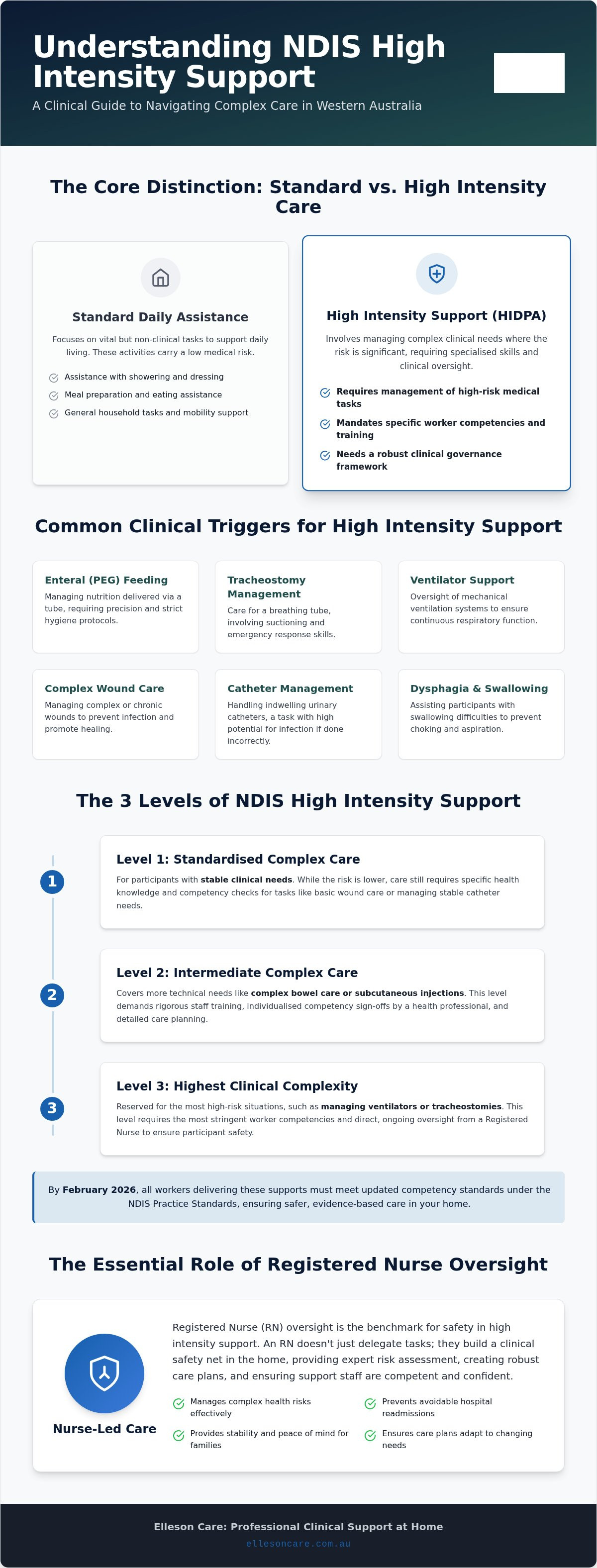
The NDIS Quality and Safeguards Commission mandates stricter standards for these services because the risks associated with incorrect care are significant. Common clinical triggers that move a participant into the high intensity category include dysphagia (swallowing difficulties), the need for respiratory support like ventilators, or complex wound care. These aren't just tasks; they're medical requirements that demand a provider with a robust clinical governance framework.
Identifying Complex Health Care Needs
Care needs transition from standard to high intensity when a participant's health depends on the precise management of clinical procedures. Specific examples include Enteral (PEG) feeding, tracheostomy management, and indwelling catheter care. If a support worker is required to manage these interventions, the support is classified as HIDPA. Under the strengthened 2026 NDIS Practice Standards, providers must now show clear evidence of worker competency for each specific clinical task. This ensures that the person entering your home has the exact skills needed to manage your unique health profile safely.
High Intensity vs. Standard Personal Care
The primary distinction between these two categories lies in the level of training and the necessity of clinical risk assessment. Standard personal care usually involves assistance with showering, dressing, or meal preparation. While these tasks are vital, they don't carry the same medical risk as complex clinical care. For ndis high intensity support perth, the support worker must meet the rigorous requirements of the 2026 High Intensity Support Skills Descriptors.
Your NDIS plan reflects these requirements through specific funding line items that acknowledge the higher cost of employing skilled staff. Because these supports involve higher clinical stakes, they often require professional nursing intervention to oversee the care plan. This oversight ensures that any changes in a participant's condition are identified early, preventing hospital readmissions and maintaining a stable environment at home. Choosing a provider that understands this distinction is the first step toward securing a safe and sustainable care arrangement.
The Three Levels of NDIS High Intensity Support
The NDIS categorises high intensity support into three distinct levels based on the technical complexity of the clinical intervention required. These levels aren't arbitrary. They align strictly with the 2026 High Intensity Support Skills Descriptors to ensure every support worker possesses the specific competencies for the participant’s care profile. Understanding these levels is a vital part of Navigating the NDIS in Western Australia, as it directly influences the funding levels and the type of staff qualifications required in your plan.
By February 2026, all workers delivering these supports must meet updated competency standards. This regulatory shift ensures that the care delivered in your home is evidence-based and safe. The distinction between levels depends on the stability of the participant's condition and the medical risk associated with the specific task being performed. The higher the level, the more rigorous the requirements for clinical oversight and worker training.
Level 1 and 2: Standardised Complex Care
Level 1 involves managing stable clinical needs where the risk is lower but still requires specific health knowledge. Level 2 steps up to intermediate needs, such as bowel care, urinary catheter management, and basic wound care. While these are common supports, they still require a high degree of precision. For ndis high intensity support perth at these levels, the focus is on rigorous staff shadowing and formal competency sign-offs by a qualified health professional.
It isn't enough for a worker to have general disability experience. They must be trained specifically for your unique health profile and equipment. This individualised training ensures that the person providing support in your home is fully equipped to handle the nuances of your daily routine while adhering to the strengthened NDIS Practice Standards. It provides a layer of stability that allows participants to focus on their goals rather than their medical maintenance.
Level 3: Advanced Clinical Requirements
Level 3 represents the highest tier of clinical risk and technical complexity. This level includes managing ventilators, oxygen support, and tracheostomy care. Because these interventions carry life-sustaining implications, Level 3 support often necessitates professional nursing services to maintain clinical safety and personal dignity. Other supports in this category include complex injection administration and severe dysphagia management.
The clinical stakes at Level 3 are exceptionally high. The oversight of a Registered Nurse is vital here, as they don't just perform the task; they monitor for subtle physiological changes that a support worker might overlook. This proactive monitoring is the key to preventing hospital readmissions and managing health crises before they escalate. If you are unsure which level your current plan covers or how to secure the right staff, reaching out to Elleson Care can provide the expert clarity you need to move forward with confidence.
The Importance of Nurse-Led Oversight in Perth
High intensity support is more than a list of daily chores; it is a serious clinical responsibility. While many providers focus solely on scheduling, true ndis high intensity support perth requires a foundation of clinical governance. A Registered Nurse (RN) brings a level of diagnostic insight and risk assessment that general support staff simply cannot provide. This leadership is the gold standard because it ensures that every aspect of a participant's care is guided by medical evidence and professional ethics.
RNs act as the vital link between hospital specialists and the home environment. They translate complex medical instructions into practical, safe daily routines that support workers follow with confidence. With over 22 years of experience, our nursing leadership understands how to manage clinical emergencies with a calm, disciplined approach. This expertise provides families with a sense of stability. They know their loved one's health is being monitored by a professional who knows how to spot the earliest signs of distress.
Clinical Governance and Safety
Effective clinical oversight significantly reduces the risk of avoidable hospital readmissions in Western Australia. By conducting regular clinical audits and staff competency reviews, an RN ensures that the high standards expected by the NDIS Commission are consistently met. This isn't just about ticking boxes; it's about the meticulous management of medication and clinical procedures. Our oversight ensures that medication administration adheres to strict Australian healthcare standards, prioritising safety and accuracy in every interaction.
Empowering Support Workers through Training
At Elleson Care, we believe a support worker is only as effective as the training they receive. Our nurses personally train staff on the specific clinical needs of each participant, moving beyond generic modules to focus on real-world application. This approach ensures that complex procedures, such as ventilator support or wound management, are handled with technical precision and deep respect for the individual's dignity. We foster a culture of clinical excellence where staff feel supported and participants feel safe. This collaborative environment ensures that ndis high intensity support perth is delivered with a human touch that never compromises on professional standards.
Navigating the NDIS Pathway in Western Australia
Transitioning from a clinical setting to the comfort of home is a significant milestone for any participant. In Western Australia, this journey often begins with a discharge from major facilities such as Fiona Stanley Hospital or Royal Perth Hospital (RPH). A successful transition requires a seamless handover between hospital teams and community providers to ensure safety from day one. Your Support Coordinator is an essential ally during this phase. They help advocate for the specific funding required for ndis high intensity support perth, ensuring your plan reflects the technical complexity of your clinical needs.
The landscape of disability and aged care is currently undergoing significant reform. Staying informed about the Support at Home Program transitions is vital for families who want to maintain long-term care stability. These updates highlight a move toward more rigorous clinical oversight, ensuring that participants with complex needs receive the high standard of care they deserve within their local community.
Securing the Right Funding in Your Plan
Preparing for an NDIS planning meeting requires a methodical approach to medical evidence. You must provide the NDIA with clear clinical justification to secure HIDPA funding. This usually involves detailed reports from your GP or specialists that outline the specific risks associated with your condition. Allied Health assessments are equally important; they provide the technical data needed to justify the hours and skill levels required for your daily support.
It's also important to manage consumables and equipment funding alongside your support hours. High intensity care often requires specialized items like enteral feeding sets, tracheostomy supplies, or catheter kits. Ensuring these are appropriately funded in your plan prevents financial stress and ensures your care team has the necessary tools to maintain your health and dignity. Accurate reporting is the best way to ensure your plan remains sustainable and responsive to your needs.
Choosing a Local Perth Provider
Selecting a West Australian owned and operated provider offers meaningful benefits for participants. Local providers understand the specific nuances of the WA Health system and can coordinate more effectively with your Perth-based specialists. This local expertise translates into a more responsive service, especially when clinical needs change or emergencies arise. Proximity allows for more frequent face-to-face clinical reviews and a stronger relationship between the provider and your family.
When you evaluate potential providers, ask direct questions about their clinical governance and emergency protocols. You should feel confident that there is always a Registered Nurse available to guide the support workers and review your care plan. A provider that prioritises clinical integrity will always be transparent about their staff training and competency standards. If you are preparing for a hospital discharge or need to review your current clinical supports, contact Elleson Care to discuss a tailored nursing solution for your home.
Elleson Care: Professional Clinical Support at Home
We understand that managing complex health needs at home is an emotional journey as much as a clinical one. For many families seeking ndis high intensity support perth, the constant weight of responsibility can lead to significant stress and isolation. At Elleson Care, our commitment to person-centred, nurse-led support is designed to alleviate this pressure. By providing a steady, reliable presence in your home, we allow you to return to your role as a family member rather than a full-time carer. Our 22 years of nursing experience ensures that every clinical decision is made with technical precision and deep empathy for your family's situation.
Our 'Holistic Family Approach' recognises that the well-being of a participant is intrinsically linked to the health and stability of their loved ones. We don't just provide medical interventions; we provide a foundation of safety that allows families to breathe again. Whether you require long-term ventilator support or occasional respite care in Perth, our team is there to ensure that your home remains a place of comfort and personal dignity.
Comprehensive Clinical Services
The scope of our clinical support is broad and highly specialised to meet the diverse needs of our community. We provide expert wound management, palliative care, and dedicated post-hospital support to ensure a safe recovery and long-term health maintenance at home. Our Registered Nurses coordinate closely with allied health professionals to integrate therapeutic goals into your daily routine. This comprehensive view includes balancing medical requirements with domestic assistance to ensure your household continues to function smoothly and efficiently.
We believe that the relationship between a participant and their support team is fundamental to successful health outcomes. Because of this, we take great care in tailoring a care team that matches your personality as well as your clinical requirements. This approach ensures a sense of continuity and trust, which is vital for long-term ndis high intensity support perth. You aren't just receiving a service; you're partnering with a team that is fundamentally kind and emotionally invested in your quality of life.
Start Your Care Journey with Confidence
Beginning a new care arrangement is a significant step, and we aim to make the process as transparent and reassuring as possible. Your journey starts with a comprehensive initial assessment conducted by one of our Registered Nurses. During this time, we'll discuss your clinical needs, personal goals, and any specific concerns your family may have. We'll then organise a meet-and-greet with your dedicated support team to ensure everyone feels comfortable and informed before care begins.
Our methodical approach ensures that every detail is captured in a robust care plan that evolves alongside your needs. We invite you to Contact Elleson Care today to discuss your high intensity support needs and discover how our clinical expertise can provide the peace of mind your family deserves.
Securing Your Clinical Future at Home
Managing complex health needs shouldn't mean sacrificing your quality of life or the comfort of your home. By understanding the three levels of high intensity support and the latest 2026 practice standards, you can ensure your NDIS plan provides the clinical safety you require. Professional nursing oversight remains the most reliable way to bridge the gap between hospital-level medical advice and stable daily living. It provides a foundation of security that allows you and your family to focus on personal goals rather than just medical maintenance.
As a local West Australian family-owned business, we're dedicated to providing specialised ventilator and complex clinical care. Our team is led by Registered Nurses with over 22 years of clinical experience, ensuring that your ndis high intensity support perth is delivered with both technical precision and human warmth. We're here to help you navigate these transitions with the steady, expert guidance you deserve. You don't have to manage the complexities of HIDPA alone.
We invite you to book a clinical consultation with our Registered Nurses to discuss how we can support your independence. We look forward to providing the stability and professional care your family needs to move forward with confidence.
Frequently Asked Questions
What qualifies as NDIS high intensity support in 2026?
High intensity support is defined by the technical complexity and medical risk of the tasks required. In 2026, this includes specific clinical interventions such as ventilator management, tracheostomy care, and complex wound management. These supports are governed by the 2026 High Intensity Support Skills Descriptors. If a participant requires a support worker with specialised health training to maintain their safety and well-being, their needs likely fall into this high-intensity category.
Do I need a Registered Nurse to provide my high intensity support?
Direct delivery can often be performed by trained support workers, but Registered Nurse oversight is essential for safety. The NDIS mandates that a qualified health professional assesses worker competency and develops the complex care plan. At Elleson Care, our RNs provide this vital leadership. They bridge the gap between medical advice and daily assistance, ensuring that every clinical procedure is performed to the highest Australian healthcare standards.
How do I get high intensity daily personal activities (HIDPA) in my NDIS plan?
Securing HIDPA funding requires documented medical evidence that justifies the need for specialised worker skills. You'll need comprehensive reports from your GP or specialists, alongside Allied Health assessments that detail the risks associated with your condition. These documents help the NDIA understand why standard personal care is insufficient. Working with an experienced Support Coordinator ensures your plan accurately reflects the clinical complexity of your high intensity daily needs.
Can high intensity support be provided in my own home in Perth?
Yes, ndis high intensity support perth is specifically designed to help participants remain in their own homes rather than in clinical facilities. By providing professional nursing oversight and highly trained staff, we create a safe environment for complex care in a domestic setting. This approach prioritises your personal dignity and autonomy while ensuring that life-sustaining medical requirements, such as respiratory or enteral support, are managed with technical precision.
What is the difference between Level 2 and Level 3 high intensity support?
The primary difference lies in the level of clinical risk and technical skill involved. Level 2 support covers intermediate needs, such as urinary catheter management or stable bowel care. Level 3 is the highest tier, involving complex clinical risks like tracheostomy management or ventilator support. While Level 2 focuses on specialised training, Level 3 often requires more frequent Registered Nurse intervention to monitor for subtle physiological changes and prevent health crises.
How does Elleson Care ensure the safety of participants with complex needs?
Safety is maintained through a robust clinical governance framework led by Registered Nurses with over 22 years of experience. We conduct regular clinical audits and formal competency reviews for every member of our team. This ensures that support workers aren't just generally trained, but are specifically signed off for your unique health profile. This methodical approach reduces the risk of medical complications and provides families with much-needed stability.
Is high intensity support available for both aged care and NDIS participants?
Yes, clinical support is available across both sectors. Elleson Care specialises in delivering high-standard nursing care for both NDIS participants and those receiving aged care services. Whether you are navigating the NDIS or the Support at Home Program, our nurse-led approach ensures that complex health needs are managed with the same level of professional integrity. This holistic service allows individuals of all ages to maintain their independence and dignity at home.
What training do Elleson Care support workers receive for complex clinical tasks?
Our support workers undergo a rigorous training process that is personally overseen by our Registered Nurses. This training isn't just generic; it's tailored to the specific clinical needs and equipment of the participant they are supporting. This includes hands-on shadowing and formal competency assessments. By ensuring our staff are experts in your unique care requirements, we build a culture of safety and excellence that directly improves health outcomes for our participants.


