
What if the biggest risk to your loved one's safety isn't their disability - it's settling for a support provider who isn't clinically equipped to manage it? For families exploring NDIS in-home support in Perth, that question sits at the heart of every decision. You want independence and comfort for the person you care about, but not at the cost of qualified, attentive clinical oversight.
That concern is completely understandable. The NDIS system can feel overwhelming, with funding categories that aren't always straightforward and a real fear that shared or in-home settings might mean compromised care, particularly for those with complex or high-intensity clinical needs.
This guide is here to change that. It will walk you through how NDIS in-home support works in Perth, what to look for in a qualified provider, how funding categories apply to your situation, and how the right support can genuinely build toward greater independence, not just maintain the status quo. Whether you're just beginning your NDIS journey or reassessing your current arrangements, you'll find clear, practical guidance to help you make confident, informed decisions for your family.
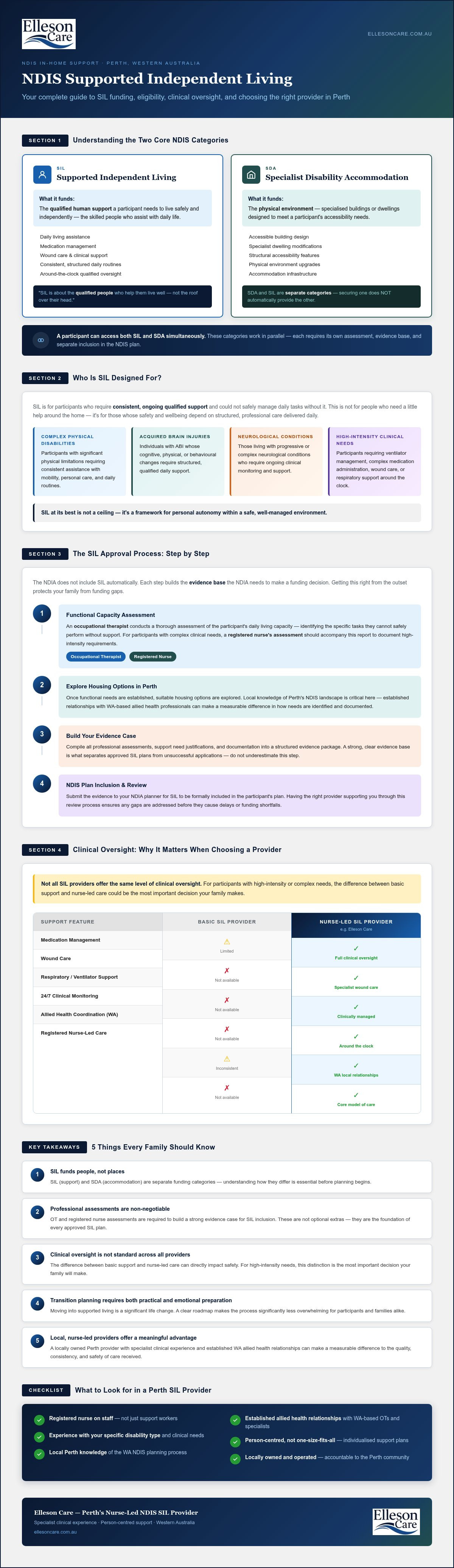
Key Takeaways
- Supported Independent Living (SIL) is a specific NDIS funding category for daily living support - understanding how it differs from housing funding (SDA) is essential before you begin planning.
- Navigating NDIS in-home support in Perth requires professional assessments from occupational therapists and registered nurses to build a strong case for SIL inclusion in your loved one's plan.
- Not all SIL providers offer the same level of clinical oversight - learning the difference between basic support and nurse-led care could be the most important decision you make for your family member's safety.
- Transitioning into supported living involves both practical steps and emotional preparation, and having a clear roadmap makes the process significantly less overwhelming for participants and families alike.
- Choosing a locally owned, nurse-led provider with specialist clinical experience can make a meaningful difference in the quality, consistency, and safety of the support your loved one receives.
Understanding Supported Independent Living (SIL) in Western Australia
Supported Independent Living is one of the most significant funding categories within the NDIS, yet it's also one of the most frequently misunderstood. At its core, SIL is the funding that pays for the human support a participant needs to live as independently as possible - the skilled hands and trained minds that make daily life manageable, safe, and dignified. It is not about the roof over someone's head. It's about the qualified people who help them live well beneath it.
For families exploring NDIS in-home support in Perth, understanding exactly what SIL covers - and what it doesn't - is the foundation of every good planning conversation.
SIL vs. SDA: What is the Difference?
The distinction between SIL and SDA (Specialist Disability Accommodation) is one that catches many families off guard, and conflating the two can lead to significant gaps in planning. Think of it this way: SDA funds the physical environment, the specialised building or dwelling designed to meet a participant's accessibility needs. SIL funds the support delivered within that environment.
A participant might live in SDA-funded accommodation and receive SIL-funded support simultaneously. These two categories work in parallel, not in place of each other. Securing one does not automatically provide the other, and each requires its own assessment, evidence base, and inclusion in the participant's NDIS plan. Understanding this distinction early prevents costly delays and ensures that both the living environment and the standard of daily support are properly funded from the outset.
Who is SIL for? Identifying the Right Fit
SIL is generally designed for participants who require consistent, ongoing support with daily tasks and who couldn't safely manage those tasks without it. In practice, this often means individuals with complex physical disabilities, acquired brain injuries, neurological conditions, or high-intensity clinical needs such as ventilator management or complex medication administration.
The typical SIL participant in Perth isn't simply someone who needs a little help around the home. They're someone whose safety, wellbeing, and quality of life depend on structured, qualified support delivered consistently throughout the day. At its best, SIL isn't a ceiling on what someone can achieve - it's a framework for personal autonomy within a safe, well-managed environment.
Choosing a provider who genuinely understands the Western Australian healthcare landscape matters here. Local knowledge, established relationships with WA-based allied health professionals, and familiarity with how Perth's NDIS planning processes operate can make a measurable difference in how effectively a participant's needs are identified, documented, and funded. That local expertise is not a minor detail; for high-needs participants, it can directly shape the quality of care they receive.
Navigating SIL Eligibility and NDIS Funding Requirements
Securing SIL funding in your loved one's NDIS plan is rarely straightforward, but understanding the process removes a great deal of the uncertainty. The NDIA doesn't include SIL automatically. It requires a structured, evidence-based case that demonstrates why consistent, qualified support is necessary for the participant to live safely and with dignity. Getting this right from the outset protects your family from funding gaps and avoids the frustration of plan reviews that could have been avoided.
The SIL Assessment Process
The pathway to SIL approval follows a clear sequence, and each step builds the evidentiary foundation the NDIA needs to make a funding decision.
- Step 1: Functional Capacity Assessment. An occupational therapist conducts a thorough assessment of the participant's daily living capacity, identifying the specific tasks they cannot safely perform without support. For participants with complex clinical needs, a registered nurse's assessment should accompany this report to document any high-intensity requirements such as medication management, wound care, or respiratory support. This combined evidence base is what demonstrates the need for consistent, potentially around-the-clock support.
- Step 2: Exploring housing options in Perth. Once functional needs are established, the participant and their support network identify appropriate housing that aligns with their goals, accessibility requirements, and preferred location. This step is distinct from SIL itself; it informs the care environment in which SIL will be delivered, and it shapes the intensity and structure of the support model proposed.
- Step 3: Submitting a Roster of Care (RoC). The prospective SIL provider prepares a detailed Roster of Care, which outlines the specific hours, staffing ratios, and types of support required each day. The NDIA reviews this document carefully before approving SIL funding. An inaccurate or under-evidenced RoC is one of the most common reasons SIL applications are delayed or declined.
Maximising Your NDIS Plan for Independent Living
A well-structured NDIS plan does more than cover basic daily tasks. For participants with clinical complexity, it needs to explicitly account for nursing oversight, specialist support worker training, and any high-intensity care protocols. When clinical needs aren't clearly articulated in the SIL quote, they often go unfunded, leaving families to bridge the gap themselves.
Evidence-based reports from registered nurses carry significant weight in this process. A nursing assessment that clearly links a participant's clinical profile to specific support requirements gives planners and the NDIA the clinical language they need to justify appropriate funding. This is one area where a nurse-led provider offers a distinct advantage over generalist services, particularly when navigating NDIS in-home support in Perth for participants with high or complex needs.
For families transitioning from other care arrangements, the planning considerations can differ considerably. Our guide on in-home aged care in Perth explores how clinical oversight supports independence across different funding pathways, and it's a useful reference point for those moving between care types.
A Support Coordinator plays an essential role throughout this process. They help gather the right reports, liaise with the NDIA on the participant's behalf, and ensure the final plan reflects the full scope of clinical and daily living needs. Choosing a Support Coordinator who understands the Western Australian service landscape, and who has experience with high-intensity SIL cases specifically, can meaningfully influence the outcome of a plan review or initial planning meeting.
If you're unsure whether your current plan adequately reflects your loved one's clinical needs, speaking with a nurse-led provider early in the process can help clarify what evidence is still needed. Exploring clinical support options with Elleson Care is a practical starting point for families who want that conversation grounded in genuine specialist experience.
Comparing Perth SIL Providers: Why Clinical Oversight Matters
Not all SIL providers are built the same. That distinction sounds straightforward, but its implications are significant, particularly for participants whose daily safety depends on more than a friendly face and a willingness to help. Choosing a provider without genuine clinical infrastructure isn't just a quality concern; for participants with complex health needs, it can represent a genuine risk to their wellbeing.
The most common gap in NDIS in-home support Perth families encounter isn't a lack of kindness in support workers. It's the absence of clinical governance sitting above them. When something changes, a wound that isn't healing, a medication interaction, a subtle shift in a participant's respiratory pattern, who notices? Who acts? The answer to that question separates basic support from genuinely safe care.
Basic support services typically offer trained disability support workers who assist with daily living tasks. That's appropriate for participants with lower-complexity needs. But for those managing ventilator dependency, complex medication regimens, post-hospital recovery, or progressive neurological conditions, that level of oversight isn't sufficient. Clinical decisions require clinical expertise, and that expertise needs to be embedded in the provider's model, not called in after something goes wrong.
The Value of Registered Nurse Leadership
A nurse-led provider operates from a fundamentally different clinical baseline. Registered nurses bring the capacity to assess, interpret, and respond to health changes in ways that support workers, however well-trained, are not qualified to manage. This matters enormously for wound management, medication administration, respiratory support, and the kind of early clinical intervention that prevents hospitalisations. Elleson Care is led by registered nurses with more than 22 years of specialist experience, and that leadership shapes every layer of care delivery, from how support workers are trained to how clinical risk is monitored day to day.
When a provider's leadership team understands complex health conditions from a clinical standpoint, that knowledge flows through to better documentation, more accurate Rosters of Care, and support workers who are trained to recognise and escalate concerns appropriately. The long-term health outcomes for participants in nurse-led environments reflect this difference in a meaningful way.
Checklist for Evaluating SIL Providers in Perth
When comparing providers, families should look beyond glossy brochures and service lists. Use this checklist to ask the right questions:
- NDIS registration and audit history: Confirm the provider holds current NDIS registration and ask when their most recent quality audit was conducted. Registered providers are subject to NDIS Quality and Safeguards Commission oversight; unregistered providers are not.
- Ratio of support workers to clinical supervisors: Ask directly how clinical oversight is structured. Is there a registered nurse involved in care planning and review? How frequently are clinical checks conducted?
- Experience with specialist needs: A provider experienced in palliative care, post-hospital transitions, or high-intensity clinical support will have established protocols that a generalist service simply won't. Ask for specifics, not generalities.
- Staff training in medication management and emergency response: Find out what training support workers receive beyond their Certificate III or IV. Medication competency, manual handling, and emergency response protocols should be standard, not optional extras.
- Local knowledge and relationships: A West Australian-owned provider with established connections to Perth's allied health network is better placed to coordinate care across disciplines quickly and effectively.
The right provider doesn't just deliver support. They protect your loved one's clinical safety while actively supporting their independence. That combination is what families searching for quality NDIS in-home support in Perth should hold as their benchmark.
Planning the Transition to Supported Independent Living
Moving into supported independent living is one of the most significant transitions a person with disability and their family will ever navigate. It's not simply a change of address. It's a restructuring of daily life, relationships, and identity, and it deserves the same careful planning that any major clinical or life decision receives. For families exploring NDIS in-home support Perth options, having a clear roadmap for this transition can mean the difference between a settled, confident start and a period of unnecessary disruption and distress.
The emotional dimension of this process is real and shouldn't be minimised. Participants may feel a mix of excitement and apprehension about living more independently. Families, particularly those who have been primary carers for years, often experience their own complex feelings, including grief, relief, guilt, and hope, sometimes all at once. Acknowledging these emotions openly, and working with a provider who creates space for them, is part of what makes a transition genuinely successful rather than merely logistically complete.
From Hospital to Home: A Clinical Transition
For participants moving directly from a hospital or rehabilitation setting, the clinical stakes are higher and the planning window is often compressed. A well-managed hospital-to-SIL transition requires more than booking a moving truck. It requires close coordination between the hospital discharge team, the incoming SIL provider, and any allied health professionals involved in the participant's ongoing care.
Before move-in day, the home environment must be fully prepared. This includes confirming that all necessary equipment, such as hospital-grade beds, hoists, or respiratory support devices, is installed, tested, and ready for use. Home modifications need to be completed and signed off. Medication protocols must be documented and handed over clearly. Our guide to nursing services in Perth outlines how clinical continuity is maintained across care settings, which is particularly relevant during these high-risk transition periods. A smooth, well-coordinated transition directly reduces the risk of hospital readmission by ensuring clinical needs are met from the moment a participant arrives home, rather than after a preventable health event.
Where shared SIL arrangements are involved, housemate matching is a detail that deserves serious attention. Compatibility isn't just about personality; it includes sleep schedules, support needs, communication styles, and shared goals for daily life. A thoughtful matching process protects the wellbeing of everyone in the home and builds the foundation for a genuinely supportive living environment.
Building Social Connections in Your New Community
Independence without connection isn't truly independence. Quality SIL providers in Perth actively support participants to engage with their local community, whether that's attending local events, accessing community centres, joining interest groups, or simply building familiarity with their neighbourhood. Social and community participation isn't an optional extra; it's a protective factor against isolation and a meaningful contributor to long-term wellbeing.
Maintaining strong family involvement remains equally important after the move. Regular family visits, shared mealtimes, and open communication with the care team preserve the person-centred, family approach to care that good providers actively encourage. Families who stay engaged tend to notice changes in their loved one's wellbeing earlier, and that kind of informed, ongoing connection strengthens the entire care arrangement.
If you're preparing for this transition and want guidance grounded in genuine clinical experience, speak with Elleson Care's nurse-led team about building a transition plan that's safe, structured, and centred on your loved one's goals.
Elleson Care: A Person-Centred Approach to SIL in Perth
Elleson Care was founded on a straightforward conviction: that people with complex disabilities deserve the same clinical rigour in their home as they would expect in any specialist health setting. As a West Australian owned and operated provider, we bring more than two decades of specialist nursing experience to every care arrangement we build. That depth of clinical knowledge isn't incidental to what we do. It's the foundation of it.
Our leadership team comprises registered nurses with over 22 years of experience in high-intensity clinical support, including ventilator management, complex wound care, and the kind of specialist medication oversight that participants with serious health conditions genuinely require. This expertise shapes how we assess, plan, and deliver NDIS in-home support in Perth, from the initial consultation through to the day-to-day rhythm of a participant's life at home.
What distinguishes our approach is the integration of clinical excellence with a holistic, family-centred philosophy. Every participant we support is treated as a whole person with individual goals, preferences, and relationships that matter. We don't design care plans around administrative convenience. We design them around the person.
Why Perth Families Trust Our Nurse-Led Team
Families who choose Elleson Care consistently describe the same experience: relief. Not because we promise the impossible, but because we provide something genuinely rare in the disability sector, which is consistent, qualified clinical oversight that doesn't switch off when the paperwork is done. Our registered nurses are involved in care planning, clinical review, and the ongoing monitoring of every participant's health status. When something changes, there's a clinician who notices and responds.
We also understand that supporting a person with disability means supporting the entire family unit. Caring responsibilities take a real toll, and sustainable care arrangements account for that. Our approach to respite care in Perth is designed to give families meaningful, planned relief without compromising the continuity or clinical quality of their loved one's support. A well-supported family is a more effective advocate, and that benefits everyone.
Start Your Journey to Independent Living Today
Beginning a conversation with Elleson Care is straightforward. We offer personalised SIL consultations where our clinical team takes the time to understand a participant's health profile, daily living goals, and family circumstances before making any recommendations. From there, we work carefully to match each participant with support workers whose skills, experience, and interpersonal qualities align with that individual's needs and personality.
If you're still building your understanding of available funding pathways, our colleagues at The Support at Home Program in 2026: A Complete Guide for WA Families provides useful broader context for navigating care funding in Western Australia.
When you're ready to take the next step, contact Elleson Care to speak with our nurse-led team about what genuinely safe, clinically grounded NDIS in-home support in Perth looks like in practice. Your loved one deserves that standard of care. We're here to deliver it.
Your Loved One Deserves Genuinely Safe, Independent Living
Navigating NDIS in-home support in Perth is rarely simple, but the path becomes clearer when you know what to look for. Understanding the distinction between SIL and SDA, building a strong evidence base for funding, and choosing a provider with genuine clinical oversight aren't just administrative steps; they're the decisions that directly shape your loved one's safety and quality of life.
Two things matter most when choosing a SIL provider: clinical qualifications and local knowledge. A nurse-led provider who understands Perth's NDIS landscape brings both, and that combination makes a measurable difference in the consistency and safety of daily care.
Elleson Care is West Australian owned and operated, led by registered nurses with over 22 years of specialist experience. We're here to help families move forward with confidence, not uncertainty.
When you're ready to take that next step, speak with a registered nurse about your SIL needs today. The right support is available, and your family doesn't have to figure it out alone.
Frequently Asked Questions About NDIS In-Home Support in Perth
What is the difference between SIL and SDA in Perth?
SIL (Supported Independent Living) funds the human support a participant receives each day, such as personal care, medication assistance, and daily living tasks. SDA (Specialist Disability Accommodation) funds the physical dwelling itself, specifically designed for participants with extreme functional impairment or very high support needs. The two categories are separate and require individual assessments and approval. Living in SDA-funded housing doesn't automatically include SIL funding, and vice versa.
How do I know if I am eligible for NDIS SIL funding?
Eligibility for SIL is determined through functional capacity assessments, typically conducted by an occupational therapist and, where clinically appropriate, a registered nurse. The NDIA looks for evidence that a participant requires consistent, ongoing support with daily tasks that they cannot safely manage independently. Participants with complex physical disabilities, acquired brain injuries, or high-intensity clinical needs are commonly considered, though each case is assessed individually based on documented evidence.
Can I choose my own support workers in a SIL house?
Participants have the right to be involved in decisions about who supports them, and a quality provider will take your preferences seriously during the matching process. In practice, providers manage rostering across the household, so you may not select every individual shift worker. What you can reasonably expect is input into the type of person supporting you, including communication style, skills, and experience, and a provider who genuinely listens to that feedback and acts on it.
Does Elleson Care provide SIL for participants with complex nursing needs?
Yes. Elleson Care specialises in high-intensity NDIS support, including SIL arrangements for participants with complex clinical needs such as ventilator management, complex wound care, and specialist medication administration. As a nurse-led provider with over 22 years of specialist experience, our registered nurses are directly involved in care planning and clinical oversight. This makes us well-suited to support participants whose needs go beyond what a generalist disability service can safely manage.
Will I have to share a house with other people in SIL?
Not necessarily. SIL can be delivered in shared living arrangements, where two or more participants live together with support, or in individual settings depending on a participant's needs, goals, and what the NDIA funds. Shared arrangements are common because they allow support costs to be distributed across housemates, but individual SIL is available for participants whose clinical or personal circumstances make shared living unsuitable. Your support coordinator can help identify which model best fits your situation.
What happens if my clinical needs change while I am in SIL?
A good SIL provider monitors participants' health continuously and responds to changes in clinical need before they escalate. In a nurse-led environment, registered nurses are positioned to identify shifts in a participant's condition and adjust care protocols accordingly. If needs change significantly, the Roster of Care may need to be updated and resubmitted to the NDIA for review. Your provider should initiate this process promptly rather than waiting until a plan review is scheduled.
How long does the NDIS take to approve SIL funding?
SIL approval timelines vary depending on the completeness of the evidence submitted and the NDIA's current processing workload. A well-prepared application, including a thorough functional capacity assessment, clinical reports where relevant, and an accurate Roster of Care, generally moves through the process more efficiently than one that requires follow-up. Families should plan for the process to take several weeks to a few months and work closely with their support coordinator to ensure documentation is complete from the outset.
Are there SIL vacancies currently available in Perth?
SIL vacancies in Perth fluctuate depending on household composition, participant needs, and the matching process. Rather than listing vacancies publicly, most providers, including Elleson Care, assess each participant's profile individually to ensure any placement is genuinely compatible. If you're exploring NDIS in-home support in Perth and want to understand what's currently available for your loved one's specific clinical and personal needs, contacting Elleson Care's nurse-led team directly is the most reliable way to get an accurate, up-to-date answer.


