

Imagine the quiet worry that settles in when you notice a parent's steps becoming less steady on the tiled floors of their Perth home. You want to provide support, but the complex maze of NDIS and Aged Care requirements often feels like a barrier rather than a bridge to safety. Many families find that scheduling an occupational therapy assessment at home is the vital first step toward reclaiming peace of mind and ensuring a loved one's comfort.
It's completely natural to feel a sense of hesitation about inviting a professional into your private sanctuary. Most families we support across Western Australia share that same underlying anxiety; they worry that an assessment might lead to a loss of autonomy or a clinical takeover of their living space. We believe your home should remain a place of dignity, not just a series of clinical risks to be managed by strangers.
This guide will demonstrate how a professional home-based assessment provides the essential roadmap for safe, independent living and the necessary funding approvals. You'll learn the practical steps involved in the process, how to navigate specific WA health systems, and how to secure the modifications that allow you to stay in your own home with confidence.
Key Takeaways
- Understand how a home OT assessment focuses on the 'occupations' of daily life to support your long-term independence and dignity.
- Learn the practical steps involved in an occupational therapy assessment at home and how to gather the right information for a successful visit.
- Discover how tailored recommendations for assistive technology and home modifications can reduce safety risks and improve your daily confidence.
- Identify the specific NDIS and Aged Care funding pathways available to help Perth residents cover the costs of essential home improvements.
- Recognise the value of a nurse-led, holistic model that ensures your therapy goals are seamlessly integrated with your broader clinical and domestic needs.
What is an Occupational Therapy Assessment at Home?
An occupational therapy assessment at home is far more than a standard medical checklist. It's a comprehensive, person-centred evaluation designed to understand how you or your loved one interacts with your private living environment. While a GP might focus on a specific diagnosis, an Occupational Therapist (OT) focuses on the "doing" of life. They examine the intricate relationship between your physical abilities, your cognitive health, and the physical layout of your house.
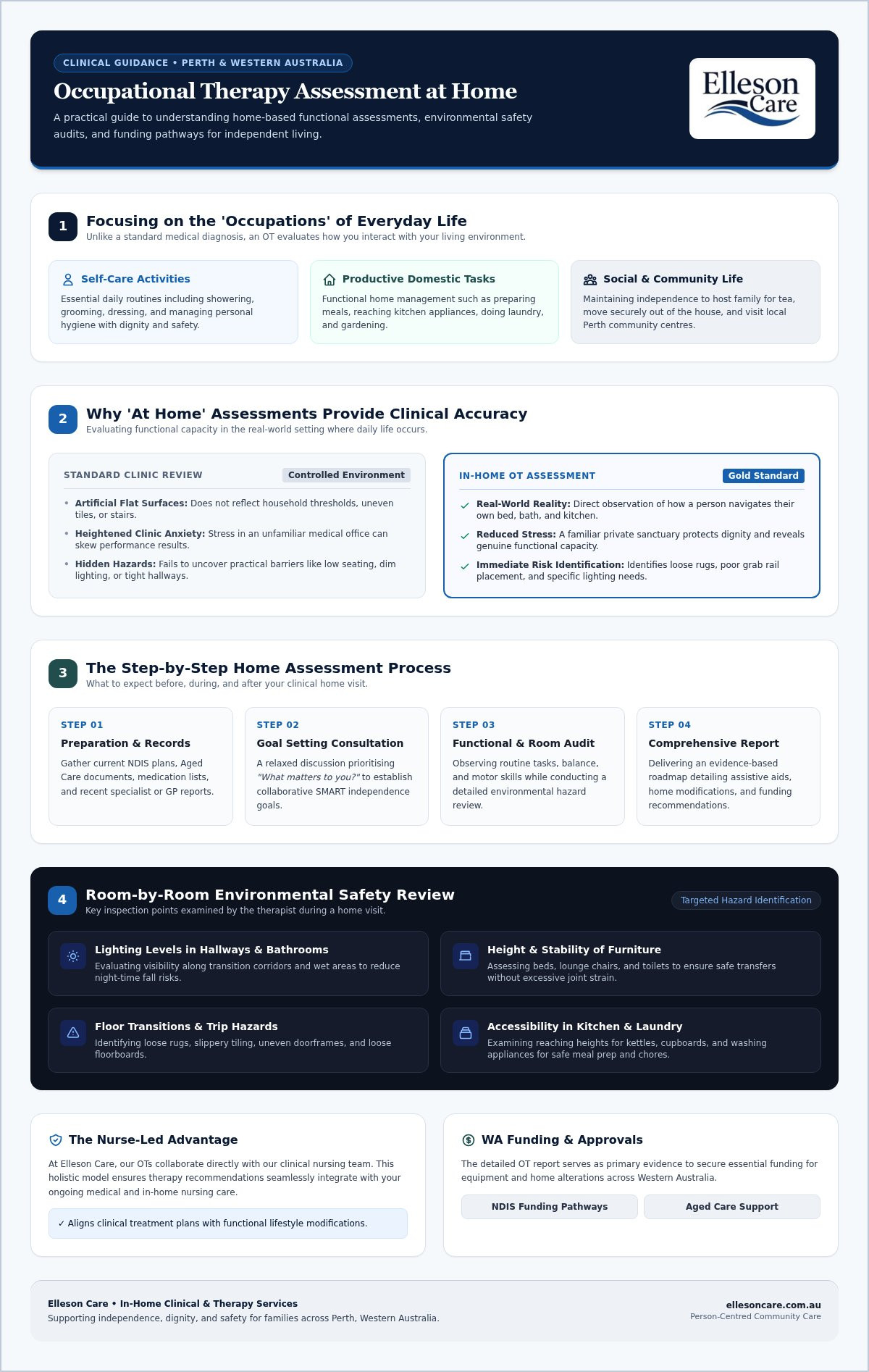
In the clinical world, "occupations" aren't just jobs or careers. They're the essential activities that fill your day and provide a sense of purpose. This includes self-care tasks like showering and dressing, productive tasks like cooking or gardening, and social activities like hosting a friend for tea. An occupational therapy assessment at home identifies exactly where the friction lies in these daily routines. It's a targeted functional capacity review that provides a much clearer picture of your needs than a general health check-up ever could.
The Vital Role of the Occupational Therapist
The therapist acts as a clinical detective, identifying physical, cognitive, and environmental barriers that might be invisible to the untrained eye. They don't just look at what you can't do; they look for ways to make those tasks possible again. At Elleson Care, our nurse-led approach ensures our OTs work closely with our clinical team. This collaboration provides a holistic view of your well-being, ensuring that therapy goals align perfectly with your broader medical and nursing care needs. The result is a practical, actionable support plan tailored to your life in Perth.
Why 'At Home' Assessments are More Effective
Conducting an assessment where life actually happens is the gold standard for clinical accuracy. In a clinic, a person might perform a task perfectly because the environment is controlled, flat, and unfamiliar. At home, we see the real-world reality. We observe how a client navigates their specific hallway, manages the height of their own bed, or reaches for a kettle in their kitchen. This familiar setting significantly reduces "clinic anxiety," which can often skew results in an office. It also allows for the immediate identification of local environmental hazards, such as a loose floorboard or a poorly positioned grab rail, that are unique to your residence.
The Step-by-Step Home Assessment Process
Understanding what happens during a professional visit can significantly reduce the anxiety often associated with clinical reviews. Preparation is the first step toward a successful outcome. Before your therapist arrives, it's helpful to gather your current NDIS plan or Aged Care documents, a list of medications, and any recent reports from your GP or specialists. Having these details ready allows the therapist to focus entirely on your physical needs and personal goals during the occupational therapy assessment at home.
Initial Consultation and Goal Setting
The session begins with a relaxed conversation centred on your daily life. We prioritise the question "What matters to you?" over a simple list of medical symptoms. This person-centred approach ensures that the resulting plan reflects your actual desires for independence. If you're already receiving nursing services, we'll discuss how those clinical supports integrate with your lifestyle. Together, we set SMART goals that might range from safely preparing a meal to improving your confidence when leaving the house to visit a local Perth community centre.
Functional and Environmental Review
Once the initial discussion is complete, the therapist will observe you performing routine tasks. This isn't a test of your ability; it's a way to see where physical or cognitive barriers might be causing frustration. We assess your mobility, balance, and fine motor skills in the context of your own furniture and layout. Simultaneously, we conduct a room-by-room environmental audit. We look at specific details, such as:
- Lighting levels in hallways and bathrooms to prevent falls.
- The height and stability of chairs, beds, and toilets.
- Floor transitions and potential trip hazards like loose rugs.
- The accessibility of frequently used items in the kitchen and laundry.
This thorough review helps us identify whether you would benefit from minor aids or more complex home modifications. Finally, the therapist documents these findings in a comprehensive report. This document serves as the essential evidence required for NDIS plan reviews or My Aged Care funding approvals. If you're unsure where to begin with your application, our team can help you coordinate a professional assessment that meets all regulatory requirements while keeping your comfort at the forefront.
Key Outcomes: From Home Modifications to Assistive Technology
The completion of a professional occupational therapy assessment at home marks the beginning of a practical transformation in your daily environment. It moves beyond identifying challenges to providing tangible solutions that enhance safety and ease of movement. These outcomes typically involve a combination of Assistive Technology (AT), structural home modifications, and personalised lifestyle strategies. By focusing on these areas, we ensure that your living space supports your physical needs rather than creating obstacles.
Assistive Technology can range from low-cost items, such as long-handled reachers and adaptive cutlery, to complex specialised equipment like electric beds or powered wheelchairs. Structural modifications are often more permanent changes to the building itself. This might include installing high-visibility grab rails, building custom ramps for entryway access, or redesigning a bathroom to incorporate a level-access shower. Each recommendation is chosen based on its ability to promote your long-term independence and dignity.
Safety and Falls Prevention Strategies
Addressing high-risk areas is a primary focus of any home review. We pay particular attention to zones where falls are most likely to occur, such as the front steps, the shower, and transitions between different flooring types. For families currently navigating in home aged care perth services, these interventions are vital for maintaining a safe environment. We aim to create a "safety-first" culture that respects the aesthetics of your home. Modern modifications can be designed to blend seamlessly with your decor, ensuring your residence remains a personal sanctuary rather than feeling like a clinical facility.
Equipment Prescription and Trials
We believe that equipment should never be purchased without a thorough trial. Trialling a mobility aid or a specialised chair ensures it fits your physical proportions and functions correctly within your specific room layout. This process is especially important for NDIS participants, as it provides the clinical evidence required to prove that the technology is both reasonable and necessary for your goals. As your health needs evolve, we provide ongoing reviews to ensure your equipment continues to offer the right level of support.
Beyond physical tools, we develop personalised strategies for energy conservation and task simplification. This might involve reorganising kitchen cupboards to reduce reaching or learning new techniques to manage daily fatigue. We also provide essential training for family members and carers on safe handling and equipment use. This collaborative approach ensures that everyone in your support network feels confident and protected while assisting with your daily routines.
Funding and Eligibility for Perth Residents
Accessing financial support for home modifications or assistive technology requires clear clinical evidence. In Western Australia, the path to securing this funding often starts with a professional occupational therapy assessment at home. This document serves as the formal bridge between your daily challenges and the resources provided by government bodies like the NDIS or My Aged Care. Understanding which pathway applies to your situation can significantly reduce the stress of navigating these complex systems.
While the paperwork may seem daunting, these assessments are designed to protect your right to high-quality, safe support. Whether you're a participant in the NDIS, a senior accessing aged care, or a veteran, the clinical report generated by an OT provides the objective data needed to approve your requests. It ensures that every dollar of your funding is spent on interventions that genuinely improve your quality of life and safety.
NDIS Pathways in Western Australia
For NDIS participants, a Functional Capacity Assessment (FCA) is the most powerful tool for justifying your support needs. The resulting OT report provides the National Disability Insurance Agency (NDIA) with the detailed evidence they require to deem a request "reasonable and necessary." By linking the OT's findings directly to your specific NDIS goals, such as increasing community participation or improving self-care, you create a much stronger case for funding. Your Support Coordinator plays a vital role here, helping to ensure the OT's recommendations are correctly integrated into your plan review.
Aged Care and the Support at Home Program
If you're accessing support through the aged care system, your Home Care Package (HCP) funds can be used to cover the costs of a professional OT review. This is particularly relevant as we approach the transition to the support at home program in 2026. Prioritising an occupational therapy assessment at home is often the most effective way to prevent a premature move into residential care. It allows you to use your existing funding to modify your environment so it remains safe and manageable as your needs change.
Perth veterans and their families may also access support through the Department of Veterans' Affairs (DVA). These assessments focus on maintaining independence for those who have served, often covering the full cost of essential equipment and home safety modifications. Additionally, many private health insurance providers offer rebates for allied health services, and Medicare may provide limited support through a Chronic Disease Management plan. If you need help determining your eligibility or starting the process, we encourage you to contact our Perth-based team for professional guidance tailored to your specific circumstances.
Why Choose a Nurse-Led Approach with Elleson Care?
Choosing a provider for an occupational therapy assessment at home is a decision that profoundly impacts the safety and long-term comfort of your family. At Elleson Care, we bring over 22 years of clinical nursing expertise to the coordination of your care. This extensive clinical background allows us to look beyond the immediate physical barriers in a house. We understand how chronic health conditions, medication management, and daily nursing needs intersect with your living environment. Our approach is built on a foundation of ethical standards and a deep respect for your personal dignity.
Our nurse-led team understands the emotional weight of these transitions. We recognize that for many Perth seniors and NDIS participants, the fear of losing independence is a significant concern. We don't view an assessment as a clinical checklist to limit your freedom. Instead, we see it as a collaborative roadmap to help you remain in the home you love. We provide a steady, reliable presence that prioritises your comfort and autonomy at every stage of the process.
Local Perth Expertise and Coordination
As a West Australian owned and operated business, we have deep roots in the Perth community. This local focus means we've spent years identifying the most reliable local suppliers for ramps, rails, and specialised equipment across the metropolitan area. We don't just provide a report; we facilitate the connections needed to bring those recommendations to life. Our family-centred approach reduces stress for everyone involved by streamlining communication between your OT, our nursing team, and your family members. We ensure that your support network is fully informed and confident in the plan we've created together.
A Holistic Pathway to Independence
A standalone clinic might provide a list of modifications, but our nurse-led team offers a truly holistic model that integrates occupational therapy assessment at home with broader clinical and domestic support. This ensures your care plan is seamless and responsive to your evolving needs. We support you through the initial assessment, the implementation of modifications, and the long-term journey beyond. We believe that maintaining your independence shouldn't feel like a clinical takeover of your home. Instead, it should feel like a steady partnership that protects your autonomy while providing the professional security you deserve. If you're ready to take the next step toward a safer home environment, you can contact Elleson Care today to organise your home assessment and discover the difference that nurse-led coordination makes.
Securing Your Independence at Home
Taking the step to organise an occupational therapy assessment at home is a profound commitment to your long-term safety and personal dignity. By identifying specific environmental barriers and securing the necessary funding through NDIS or Aged Care pathways, you create a sustainable environment where you can truly thrive. This process ensures that your residence remains a place of comfort rather than a source of daily physical struggle.
As a Western Australian owned and operated provider, Elleson Care brings a nurse-led clinical team with over 22 years of experience to every family we support. We focus on a holistic model that integrates clinical expertise with genuine human warmth. We invite you to Book a Consultation with our Perth Nursing Team to discuss how we can coordinate the assessments and modifications needed for your peace of mind.
You don't have to navigate these complex health systems alone; we're here to provide the steady, professional guidance you deserve. Your future at home is bright, and with the right support, it can be filled with confidence and security.
Frequently Asked Questions
How long does a home occupational therapy assessment typically take?
A standard occupational therapy assessment at home typically takes between 90 minutes and two hours to complete. This timeframe allows our therapists to conduct a thorough review of your daily routines and physical environment without rushing the process. We prioritise your comfort and ensure there is ample time to discuss your personal goals. If your needs are particularly complex, we may schedule a follow-up visit to ensure every detail is accurately captured.
Do I need a doctor's referral for an OT assessment in Perth?
You generally don't need a formal doctor's referral to access an OT assessment in Perth if you're using NDIS or Home Care Package funding. Private clients can also book directly with our team. However, if you're seeking support through the Department of Veterans' Affairs (DVA), a referral from your GP may be required. We recommend checking your specific funding guidelines or contacting our nurse-led team for clarification on your eligibility.
What should I have ready before the therapist arrives at my home?
Preparing a few key items can help your therapist provide the most accurate recommendations. We suggest having your current NDIS plan or Aged Care details ready, along with a list of your current medications and any recent specialist reports. It's also helpful to think about specific tasks that have become difficult lately, such as using the shower or navigating the garden. This preparation ensures the session focuses on the areas that matter most to you.
Can an OT assessment help me get a wheelchair through the NDIS?
Yes, an occupational therapy assessment at home is the essential first step for securing a wheelchair or other complex assistive technology through the NDIS. The therapist provides the clinical evidence required to prove that the equipment is both "reasonable and necessary" for your independence. They'll assess your physical requirements and home layout to ensure the prescribed wheelchair integrates perfectly with your lifestyle and supports your long-term mobility goals.
Will the OT recommend expensive renovations to my house?
Our therapists always prioritise the most cost-effective and least intrusive solutions first. While major redesigns are sometimes necessary for safety, many challenges can be resolved with minor modifications like grab rails, improved lighting, or simple assistive tools. We focus on your personal preferences and budget, ensuring that any recommendation for a structural change is fully justified by your clinical needs. You remain the final decision-maker regarding any changes made to your home.
Is the cost of the assessment covered by my Home Care Package?
Most Home Care Packages (HCP) allow you to use your allocated funds to cover the cost of professional allied health assessments. This is considered a vital investment in your safety and a key strategy for preventing premature entry into residential care. Because Elleson Care is a nurse-led provider, we can help you coordinate these assessments within your package limits, ensuring you receive the highest standard of professional care without unexpected out-of-pocket expenses.
What happens if I disagree with the findings in the OT report?
We view the assessment as a collaborative partnership, and your perspective is vital to the final outcome. If you feel a finding doesn't accurately reflect your daily reality, we encourage an open discussion with your therapist. Our nurse-led clinical team is experienced in navigating these conversations to ensure the final report is both clinically accurate and respectful of your lived experience. We aim to produce a roadmap that you feel confident and comfortable following.
How often should a home OT assessment be reviewed?
We recommend reviewing your home assessment at least once every twelve months or whenever there is a significant change in your health or mobility. Regular reviews ensure that your equipment and home modifications continue to meet your evolving needs. In Perth, many families find that an annual check-in provides peace of mind, allowing us to identify new safety risks early and adjust your support plan to maintain your independence.


